
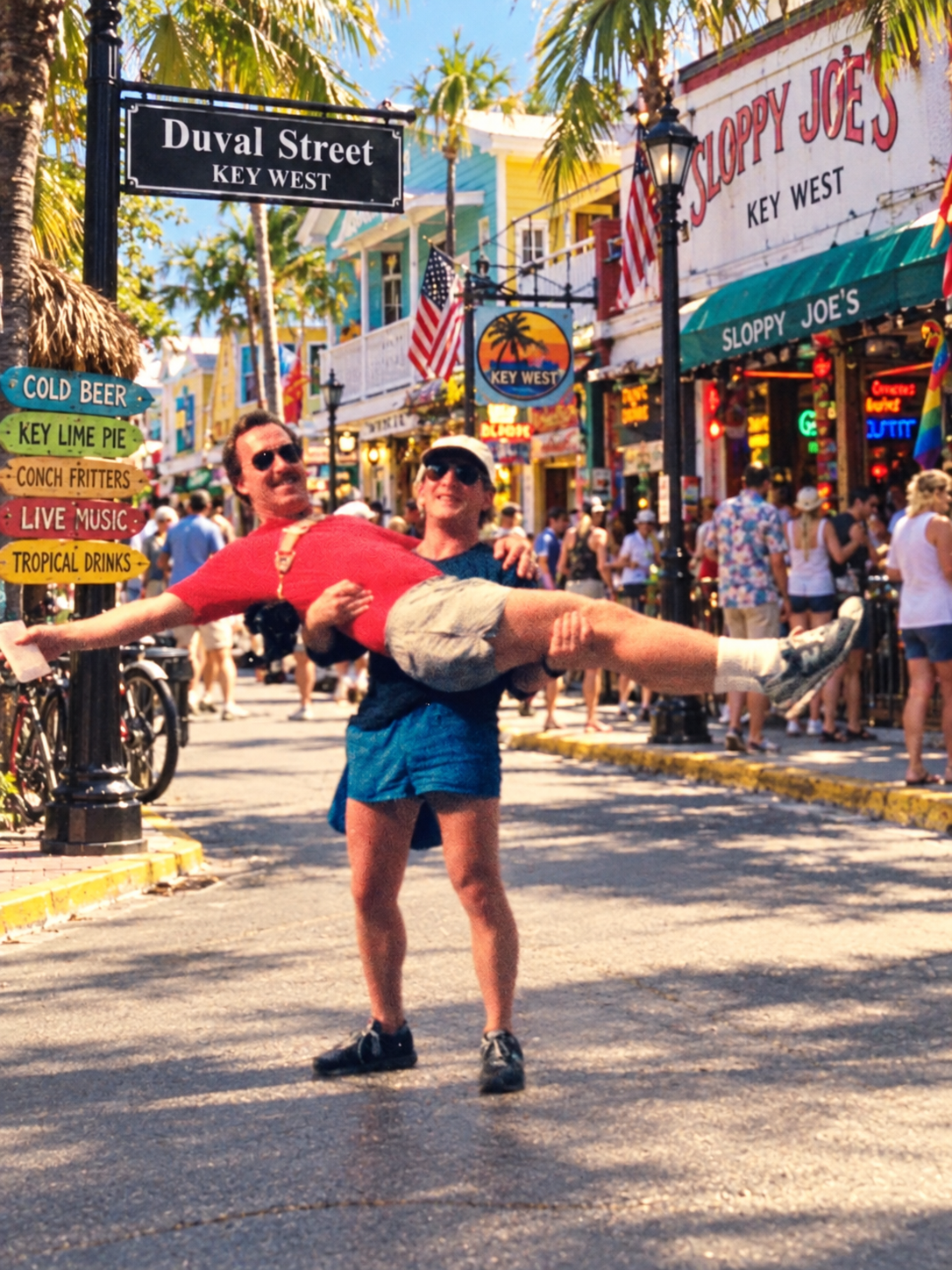
On the night of November 4, 1980, I got very drunk.
I don’t normally drink much. In fact, I can count on the fingers of both hands and the toes of one foot the number of times I’ve been drunk. But that night, I was more spectacularly intoxicated than I had ever been before—or have been since.
There were two major reasons for my inebriation and one minor one.
The minor reason was that I was vacationing in Key West, Florida, with my best friend, Rich. Key West was a Jimmy Buffett-approved party town, a place where sobriety was generally regarded as an eccentric hobby. People came to play, and at our age, playing was practically a full-time profession. Which explains why the evening began with some Afghan weed we’d brought along.
We were ready to go before we were ready to go.
The first major contributor to my intoxication was my inexperience with a particularly treacherous tropical libation: the Hurricane. For anyone unfamiliar with this instrument of neural destruction, here’s what goes into one:
THE HURRICANE | ONE DRINK
• 2 oz light rum
• 2 oz dark rum
• 2 oz passion fruit juice or purée
• 1 oz fresh orange juice
• ½ oz fresh lime juice
• ½ oz grenadine
• ½ oz simple syrup (optional, for extra sweetness)
• Ice
• Orange slice and maraschino cherry, for garnish
HOW TO MAKE IT
1. Fill a cocktail shaker with ice.
2. Add both rums, the fruit juices, grenadine, and optional syrup.
3. Shake vigorously for 10–15 seconds.
4. Strain into a large Hurricane glass filled with crushed ice.
5. Garnish with an orange slice and a maraschino cherry.
Here’s the problem: Hurricanes taste great. Drinking them is easier than virtue on Duval Street after midnight. And they pack a wallop. Four ounces of rum in a single drink will get you where you want to go at warp speed.
Which, if I’m being honest, was exactly where I wanted to go.
No, I hadn’t discovered that my girlfriend was cheating on me. I hadn’t lost my job or failed at some grand personal quest.
Ronald Reagan had just been elected president.
Don’t get me wrong. I knew Jimmy Carter’s presidency had been battered by failure. The economy was mired in stagflation, with inflation averaging roughly 13 percent that year. Americans were being held hostage in Iran, the rescue attempt had ended in disaster, the energy crisis had worn everyone down, and the Soviet invasion of Afghanistan had made an already grim picture worse. Bad news seemed to be working overtime.
Still, Carter had been dealt a lousy hand. And I believed he was a good man who put God and country first.
And how many times in our lives have we voted for an imperfect candidate because we thought the alternative was far worse?
For the record, I didn’t think Reagan was a bad guy. He was amiable, funny, and good-looking in a retro, old-Hollywood sort of way. And he could deliver a speech better than most. He could make a sales pitch sound like a benediction, which is useful when the customer neglects to read the fine print.
But I thought he was selling snake oil. Supply-side economics sounded to me like trickle-down economics with a better marketing department—the same old idea in a freshly pressed suit, designed to convince working-class Americans that cutting taxes for the rich was their patriotic duty. It didn’t take a rocket scientist to be skeptical. Just over a year later, Reagan’s own budget director, David Stockman, described the Kemp–Roth tax proposal as a “Trojan horse” for lowering the top income-tax rate.
What I feared—and what prompted the first two of my four Hurricanes that night—was a country where working people and the poor would be squeezed while the wealthy accumulated more money and more influence over the government. The promise was that prosperity would eventually trickle down. “Eventually” has always been a marvelous word for people who already have theirs.
Not to brag—much—but I was spot on. Consider the numbers. From 1978 to 2025, U.S. productivity increased 86 percent, while typical worker compensation rose just 28 percent and CEO compensation at the 350 largest U.S. companies soared 1,316 percent.
Ah, the American Dream style middle class and poor people need not apply.
Did I know that Reagan’s shining city on a hill would, in my view, give way to an oligarchy in which billionaires spend hundreds of millions of dollars trying to shape elections and policy—and drown out the voices of ordinary Americans? No. But then again, I never dreamed I’d carry a computer in my pocket or live in Rio de Janeiro.
The reason for my other two Hurricanes was Reagan’s embrace of the Religious Right and its so-called family values. I knew enough history to be wary when politicians made religion part of the machinery of government. It rarely ended well for people whose beliefs differed from those of the majority.
Phyllis Schlafly’s campaigns against the Equal Rights Amendment and abortion rights, and her insistence on traditional roles for women, combined with Jerry Falwell’s opposition to gay rights, feminism, and secularism in public life, rubbed me the wrong way. I hear echoes of those ideas today in what I regard as the growing influence of white Christian nationalism. What still gets me is the contradiction: some of the loudest people invoking Christianity in politics seem to treat empathy and kindness as optional electives.
By the end of that epic drunk, I was lying on the hood of our rented red Chrysler LeBaron, smoking a Marlboro and bitching to my ride-or-die, Rich, about the horrors I believed this election would bring upon the country. I’ll never forget his response.
“Paul, it’s going to be a helluva party, but the hangover is going to be a bitch.”
There’s a small possibility he was talking about that particular evening. I prefer to think he was predicting the future.
For me, the election of 1980 was the Republican Party’s original sin. Reagan didn’t invent America’s darker instincts; he gave some of them a winning coalition. The tax-cutting faithful got their supply-side gospel, the Religious Right got a seat at the political table, and the wealthy got a government increasingly willing to confuse their interests with the national interest.
A marriage of convenience, performed in front of the flag, with the bill sent to everyone else.
Forty-six years later, I see the offspring of that bargain in a MAGA-dominated party increasingly comfortable with grift, devoted to protecting wealth, and hostile to queer Americans, immigrants, and religious freedom for anyone outside its preferred pews. The party that promised less government has become remarkably enthusiastic about putting it in bedrooms, classrooms, libraries, and houses of worship. Apparently the problem was never big government. It was who got to use it.
Forty-six years ago, I got drunk because I feared for the future of my country. This Tuesday, November 3, I hope to get drunk again—this time for its salvation. Only now it’ll be caipirinhas, not Hurricanes. Hey, we all have to evolve.
Vote blue.
Also Go Green:
If you’ve enjoyed this little excursion through my memories, politics, and questionable drinking habits, you might enjoy my new novel, The Green Flash. It’s a story about friendship, love, loss, and the people who never quite leave us. Unlike American politics, it features characters you might actually want to spend time with. Available on Amazon in paperback, hardcover, and Kindle. Click here to buy The Green Flash. You’ll be supporting an independent author, which is considerably more rewarding than supporting a billionaire. At least this one says thank you.


