
I’ve said it before.
I am a stranger in a wonderful land. I don’t pretend to know everything about Brazil, its politics, or its election laws. But I’ve been coming here for almost 15 years, and I’m married to a woman who is not only far smarter than I am but also reads everything and talks to some of the smartest people in the country. It’s an arrangement that has done wonders for my education and very little for my ego.
So I’ve learned a few things by listening, observing, and practicing auditory osmosis.
Watching Sunday’s Brazilian election was terrific. We Americans are so accustomed to our own electoral circus that watching another democracy do its job was fascinating, fun, and, frankly, joyful. Then again, my wife’s candidate won, which added considerably to the joy around our house.
Here are a few things Brazil got right—and a few things the United States might consider borrowing before we invent another 400-page plan to study the problem.
First, voters must identify themselves with an official photo ID, and Brazil maintains a national voter registry. That isn’t quite the same as requiring one universal national ID card, but it does mean the system knows who is eligible to vote. We can debate the merits of a national identification system in America—or, for that matter, whether IDs are needed to vote. But what Brazil has done is marry identification to an actual, functioning voting process.
Then there’s electronic voting. Brazilians cast their ballots on electronic machines, and the totals arrive fast. Within a few hours of the polls closing, the country knew who had won. No weeklong television vigil. No counties counting until the next lunar cycle. Which is nice, especially for those of us who like to go to bed early. Don’t hate me because I need my beauty sleep. At my age, it’s more of a capital-improvement project.
Brazil also has the Tribunal Superior Eleitoral, or Superior Electoral Court. Seven judges oversee the national election system and resolve electoral disputes quickly. That’s right, sports fans: a court specifically devoted to elections. Compare that with our system, where electoral litigation can move at the speed of a sloth on a coffee break. Yes, I know. An ironic metaphor.
And Brazil has no Electoral College. To become president, a candidate has to win a majority of valid votes, with a runoff if nobody does so in the first round. Imagine that: the person who gets the most votes—and clears 50 percent—wins. Somewhere in America, a constitutional scholar just dropped his powdered wig.
Here’s another idea worth stealing: Brazil holds national elections on Sundays. Voting is compulsory for most literate adults ages 18 through 70, with exceptions and a way to justify an absence. And public transportation was made available free of charge for voters in this election. We, meanwhile, hold federal elections on a Tuesday—not even a federal holiday—and expect people to fit democracy between a staff meeting, a doctor’s appointment, and picking up the dry cleaning. Then we express deep concern about turnout.
Am I suggesting compulsory voting? I’m on the fence about that. Candidates and parties should motivate people to vote. And we Yankees don’t like to be told we have to do anything. What we do love is an excuse not to vote: too busy, too tired, too much traffic, lousy weather, lousy candidates, and, of course, the ever-popular ‘my vote won’t matter.’ We spend months complaining about government and then treat the chance to change it like an invitation to help somebody move. Maybe there is something to be said for making people pay a price for not exercising their franchise. At least we’d find out how much an excuse is worth.
Of course, even a system that works cannot protect itself entirely from politicians who don’t like the answer.
On Sunday night, Flávio Bolsonaro claimed the election was illegitimate and demanded that it be annulled. His complaint centered on transportation problems, heavy rain, and a two-hour extension for polling places that were still open. Here’s the delicious part: both campaigns had asked for more voting time to address access problems. The judge ruled on Lula’s petition, so Bolsonaro’s feelings got hurt—even though the outcome was the very one he had requested. He got what he wanted and complained anyway. In the Bolsonaro household, apparently even getting your way is grounds for a recount.
Lula won by more than 4.4 million votes. Flávio can seek legal review; that’s what courts are for. But announcing that an election was stolen is not the same thing as proving it. Brazil has already demonstrated that there can be a price for turning an unsupported accusation into a lawsuit. In 2022, after Jair Bolsonaro lost, the Electoral Court fined his Liberal Party nearly 23 million reais for a bad-faith challenge to the voting machines. It turns out that shouting ‘fraud’ is free; trying to pass it off as evidence is expensive when your proof is hot air.
The theme of Flávio’s campaign was ‘Vote for me because I’m just like Dad.’ Turns out he wasn’t lying about that—an unexpected breakthrough in the family’s relationship with the truth. After losing in 2022, Jair Bolsonaro flew to Florida rather than remain for Lula’s inauguration and the peaceful transfer of power. Apparently, in the Bolsonaro family, a concession speech is something you deliver from the departure lounge.
Now Flávio’s whereabouts have become a story of their own. There are reports that he may have crossed into Argentina after his defeat, although authorities have not confirmed that he left Brazil. What is confirmed is that he missed the deadline to surrender his passports, and federal police canceled them. For a family that prides itself on standing and fighting, there does seem to be an unusual interest in frequent-flyer miles. Perhaps ‘stand and fight’ is just what they call priority boarding.
For the record, don’t even think about it, Junior.
Back to the point. Think about what financial consequences for baseless election litigation might do in the United States. Demented Don can file claims, throw around conspiracy theories, and keep the grievance industry humming. But attach a serious price tag to frivolous claims, and the Great Pumpkin might suddenly discover a touching reverence for judicial restraint. He loves a good lie, but he loves his money more. Even Tommy Flanagan, Jon Lovitz’s pathological liar, would have to admire the performance. Yeah, that’s the ticket.
Finally, this election reminded us that experts, polls, and betting markets can all be wrong. When I checked Kalshi, the prediction market had Bolsonaro favored by roughly 85 to 15. That’s not a poll, but it was a remarkably confident forecast for a man who lost. Prediction markets are wonderful at explaining the future—right up until the future happens.
Here at home, people are already talking about a blue tsunami next Tuesday. Lovely. But predictions don’t vote. Markets don’t vote. Pundits, despite the noise, still get only one ballot apiece.
We do.
So don’t sit at home admiring the forecast. Vote. Get your friends to vote. Check on your neighbors. Help someone get to the polls. Democracy is not a spectator sport, and it certainly isn’t a betting market. It’s a responsibility that belongs to the people who bother to show up.
Brazil showed us how to count the votes, accept the arithmetic, and keep the country moving—even when a losing politician would rather argue with the calculator.
Next Tuesday, let’s give America something worth counting.
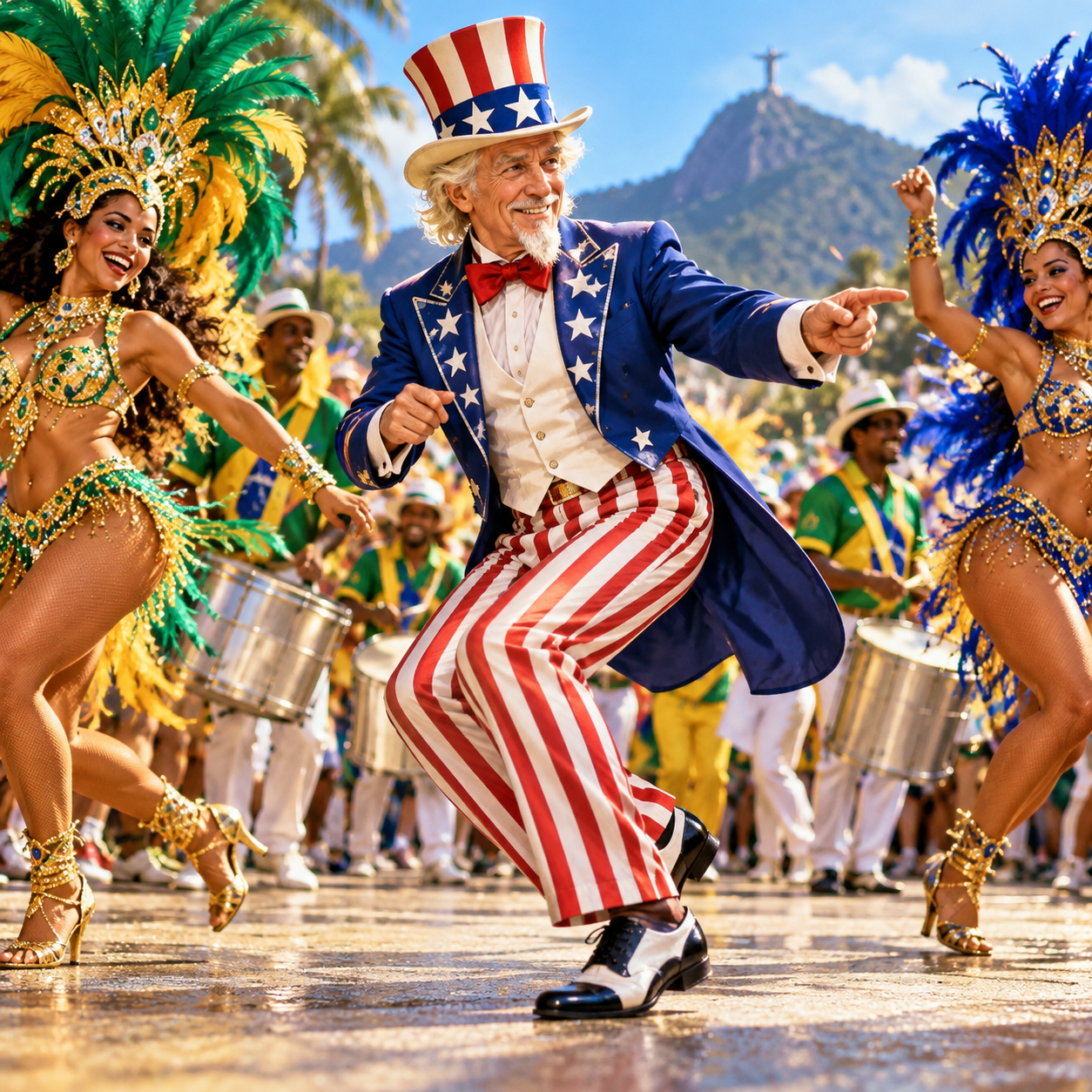
Let’s teach America how to samba again.
One last shameless plug: I also wrote a novel, The Green Flash. It’s about friendship, love, loss, and the people who never quite leave us. Unlike this essay, it contains considerably fewer politicians. If you’ve enjoyed reading me for free, please buy a copy.
Buy The Green Flash on Amazon: https://bit.ly/4i9H8vr


