
The news this week has not been the kind that allows for a good night’s sleep.
Elon Musk and the Great Pumpkin in the White House each denied responsibility for restrictions on the satellite services Ukraine relies on for its national defense. Each pointed at the other while Putin, one imagines, laughed like a Bond villain. All that was missing was the white cat.
Crude oil prices surged as two ships sank and others came under attack near the Strait of Hormuz. Meanwhile, the supposed Ukraine–Russia energy truce appeared to have all the substance of another one of Dementia Don’s hallucinations.
And in an episode that might impress his dictator friends, federal agents searched a sitting congresswoman’s home. California was given 48 hours to respond to a thumb drive supposedly containing the names of ineligible voters. Side note: A similar thumb drive provided to Pennsylvania contained 18,000 names; according to the review, not one was an illegal voter. All in service of a voter-fraud theory that has been disproved so many times it would be funny if it weren’t so pathetically sad.
I was desperate for a reason to laugh. Not because any of this is funny, but humor is my way of deflecting the sting of reality. Unexpectedly, I found it in this week’s political debates. Jon Stewart ought to have a field day on Monday. Meanwhile, some of my literary heroes—Mencken, Twain, Vonnegut, and P. J. O’Rourke—might have enjoyed themselves, too.
“It’s very important that you guys are able to hear from both of us tonight.”
On paper, that sounds like a nine-year-old complaining that his friends won’t stop talking.
The speaker was Dan Schwartz, the Democratic candidate for Maryland’s 1st Congressional District, debating Republican incumbent Andy Harris on October 13.
Harris had been asked about rising diesel prices and the Trump administration’s decision to ease sanctions on Russian diesel. He began explaining that the real culprit was Democratic environmental regulations.
The audience laughed. Not a polite chuckle, either. The sort of laughter that escapes when an explanation collides head-on with common sense.
Harris was not amused. Apparently, laughter required permission. He scolded the audience, invoked his First Amendment rights, and informed a woman that she was rude. Twice.
Schwartz, meanwhile, calmly reminded everyone that they needed to hear both candidates. Harris then assured the moderator that his own supporters weren’t interrupting anybody.
There was something wonderfully theatrical about a congressman invoking the First Amendment while lecturing his constituents for laughing at him.
To be fair, audiences should let candidates finish their answers. But the Constitution guarantees freedom of speech, not freedom from ridicule.
Across the country this past week, candidates for Congress, the Senate, and governorships gathered beneath unforgiving television lights to explain the inexplicable, defend the indefensible, and occasionally stumble into something genuinely funny.
Not necessarily jokes. Something better. Irony.
Consider Alaska.
During Thursday’s Senate debate, Republican incumbent Dan Sullivan noticed that his Democratic opponent, Mary Peltola, was consulting notes while answering questions. This apparently struck him as suspicious.
Sullivan asked whether the candidates had been given the questions in advance. The moderators assured him they had not. Peltola had a two-word explanation: “Just prepared.”
There is something deliciously American about a politician treating preparation as probable cause. In MAGA-world, apparently, you shoot first, gather the facts later, and regard the person who brought notes as a possible criminal mastermind.
Call me peculiar, but implying that your opponent cheated because she came prepared is a strange argument to make in what is, after all, a job interview.
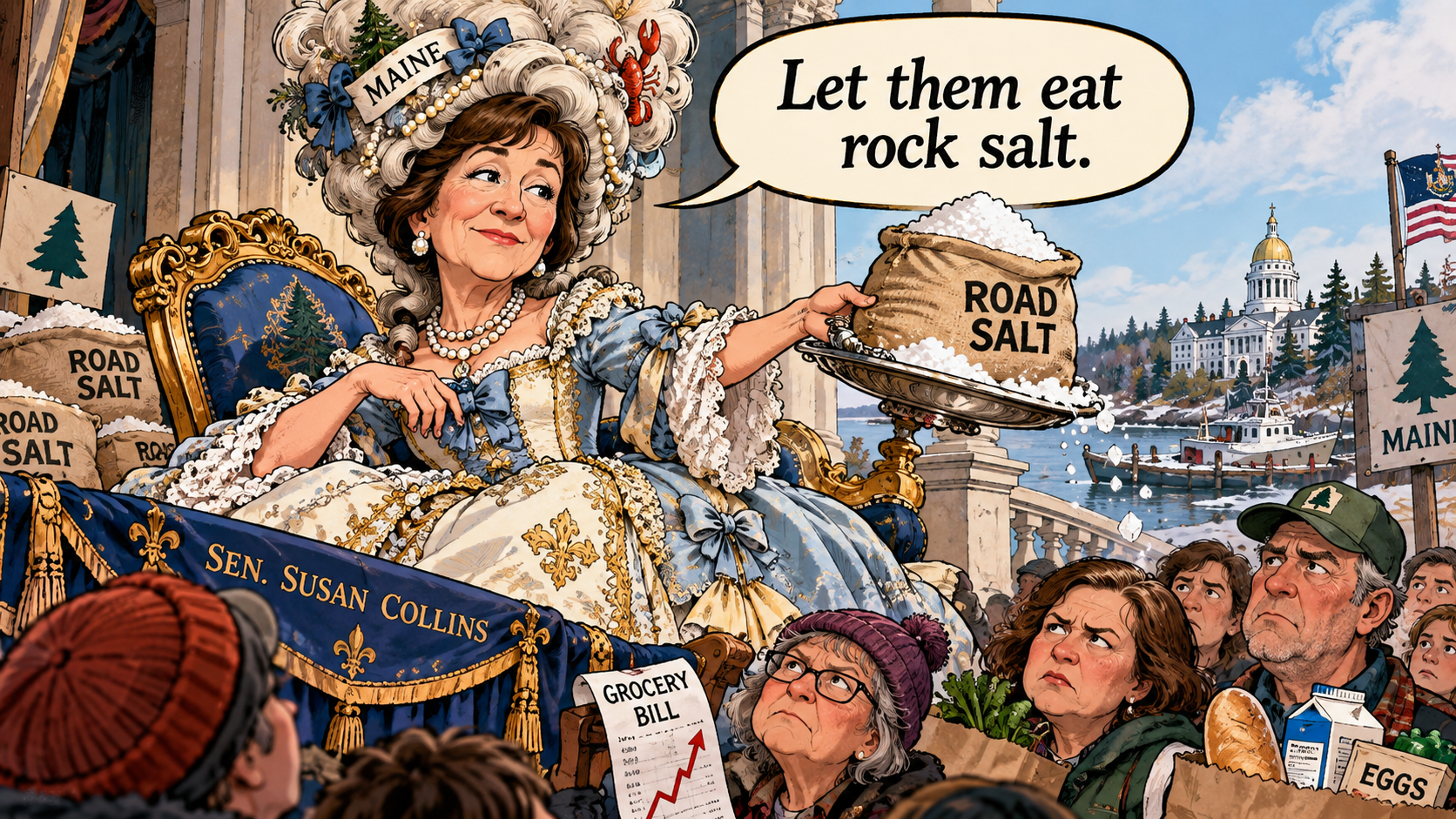
In Maine, Democratic Senate candidate Troy Jackson had debated Republican incumbent Susan Collins over tariffs earlier this month.
Collins highlighted her success in getting Canadian road salt removed from the tariff list. Fair enough. Road salt matters in a Maine winter.
Jackson was unimpressed.
“We can’t eat road salt.”
True. It is useful on an icy road, less so between two slices of bread.
Then there was Massachusetts, where Senator Ed Markey debated Republican John Deaton, who emphasized his independence from party orthodoxy despite running on the Republican ticket.
Markey compared the arrangement to being a “carnivorous vegetarian.”
Somewhere, a MAGA political consultant is charging six figures to explain how that’s perfectly consistent.
Massachusetts, however, was hardly alone in its descent into political vaudeville. In Georgia, a gubernatorial debate managed to proceed without one of the gubernatorial candidates. In Arkansas, one candidate expressed relief at being physically situated between his opponents. And in New York, Governor Kathy Hochul discovered that her opponent had managed to secure the support of at least two Democrats. Democracy, it seems, was having a particularly entertaining week.
Georgia was the most literal. Republican Rick Jackson declined to attend the Atlanta Press Club debate, leaving Democrat Keisha Lance Bottoms beside an empty podium. It was the rare political contest in which one side was represented by office furniture, with no discernible loss of substance.
Then the moderator announced: “Mayor Bottoms, you may now ask a question to your opponent, represented by the empty podium.” She was allowed 30 seconds to ask it and another 30 to rebut the answer she imagined her absent opponent might have given.
I would have liked to hear the podium’s position on health care. Or education. As far as we know, it was the only participant that night to make no claims it couldn’t substantiate.
In Arkansas, Republican Governor Sarah Huckabee Sanders and Libertarian Colt Shelby traded barbs about agriculture. Democrat Fred Love, stationed between them, offered a candid assessment: “I’m glad I’m between these two.” It was like being seated between feuding relatives at Thanksgiving, except nobody could pretend they needed to check on the turkey.
In New York, Republican Bruce Blakeman invoked New York City Mayor Zohran Mamdani. Hochul replied: “Who Donald Trump actually thinks is a great mayor.” So much for guilt by association.
And in Illinois, Republican Darren Bailey discussed the prospect of the Chicago Bears moving to Indiana with Governor J. B. Pritzker. Bailey sounded quite certain the team was leaving. “It’s like you’re wishing for it,” Pritzker interjected. Rooting for a football team to leave your state is a curious strategy when you’re asking to govern it.
In all four states, the humor came from the same place: a politician’s grand story colliding with the inconvenient facts of the moment. Sometimes it was two endorsements. Sometimes an NFL franchise. And sometimes a lectern with a more disciplined communications strategy than the candidate who should have been standing behind it.
None of these remarks will reduce the national debt, lower grocery prices, end a war, improve the quality of congressional legislation, or help me sleep at night.
But a good laugh can expose a contradiction faster than a 40-page policy paper, three charts, and a panel of cable-news hosts shouting over one another.
I suspect Mencken, Twain, and Vonnegut would have enjoyed these exchanges. Nobody appreciated a puffed-up politician being deflated more than those three. They might have laughed all night. Then they’d have remembered that the people onstage are asking us to put them in charge.
We live in an age when politicians employ armies of consultants, pollsters, opposition researchers, and social-media specialists to construct the perfect message.
Yet the memorable moments come when the machinery breaks down and an actual human being says something unexpectedly simple.
Or when an audience begins laughing.
The most revealing political statements aren’t always the ones candidates rehearse for weeks. Sometimes they’re the ones that escape before anyone can stop them.
And sometimes the punchline comes from the audience.
Which brings us back to Maryland, where a congressman was offended that his constituents laughed at him, and his opponent politely asked them to listen.
Somewhere, Mencken is reaching for his notebook. Twain is lighting a cigar. And Vonnegut is shaking his head.
So it goes.


