
I promise you this Substack is not about Vivek Ramuswanky and his despicable campaign ad.
It is not about the vice president of the United States giving that ad his seal of approval, even though it features Amy Acton’s estranged mother attacking her daughter, whose stepfather was indicted by a grand jury for allegedly raping her when she was 12. A mother who chose her pedophile husband over her children.
Nor is it about the Orange in Chief—the adjudicated rapist and protector of the most infamous pedophile—telling Ramaswamy to keep running the ad.
I could have written about the Republicans who spoke out against the vile ad. Nancy Mace, for example. But they have so sullied their brand with their blind support for the Abuser in Chief that I can’t bring myself to do it.
Instead, I want to tell you about another election, one taking place far from the United States but carrying uncomfortable echoes of our own politics, with consequences that will reach well beyond its borders.
Tomorrow, Sunday, October 25, Brazil goes to the polls for a presidential runoff between incumbent Luiz Inácio Lula da Silva and Flávio Bolsonaro, son of former president Jair Bolsonaro. The family name should sound familiar. So, unfortunately, will some of the politics.
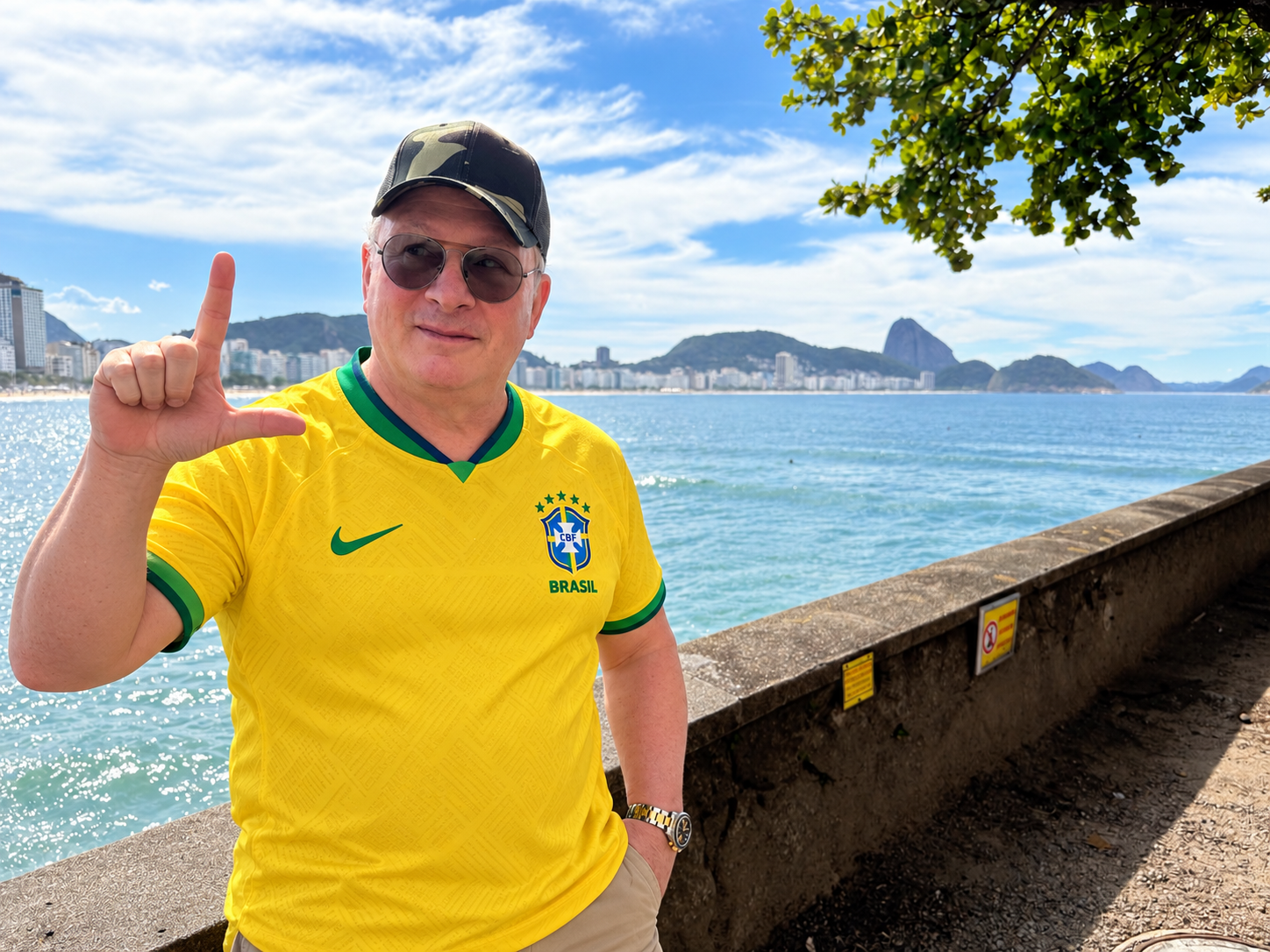
Before we get into it, a disclaimer: I am watching all of this through a gringo’s eyes. I am not an expert in Brazilian politics. That would be my wife, who consumes more news than most AI bots and has the distinct advantage of being smarter than any of them.
Let me begin with how Brazil’s electoral system differs from ours and, dare I say it, how some of those differences make it better.
First, Brazilians vote on Sunday, a day many workers have off. The idea is to give people a chance to cast a ballot without sacrificing a day’s wages. It makes sense. The purpose of democracy, after all, is to give everyone a voice, not merely those who can afford to take Tuesday off.
Also, Brazil does not elect a president who wins less than half the valid vote. If no candidate clears 50%, as happened in the first round this year, the top two face each other in a runoff. It means the winner needs an actual majority rather than benefiting from a fractured field. Better for legitimacy. Better for governance. A surprisingly uncomplicated concept.
Third, Brazil counts votes remarkably quickly using its electronic voting system. In the first round, results emerged within hours of the polls closing. Now, Mike Lindell, before you get your pillow in a twist, the system includes digital signatures, printed polling-place tally reports and multiple layers of auditing. It turns out that speed and safeguards can coexist. Who knew?
Finally, voting is mandatory for most literate Brazilians between 18 and 70. If you miss an election without an accepted justification, the fine can be as little as R$3.51—less than a dollar. Hardly enough to send anyone into bankruptcy. But leave your electoral status unresolved and the bureaucracy can make life uncomfortable: passport applications, certain public jobs and enrollment renewals can all become problems. Brazil has managed to turn civic duty into something more consequential than a slogan on a bumper sticker.
Nearly 80% of registered Brazilians voted in the first round this year, compared with about 64% of eligible Americans in the 2024 presidential election. Those figures use somewhat different voter populations, but the contrast is striking. I can make a reasonable argument for the American approach, in which candidates must motivate people to vote. Still, a democracy in which more people participate seems preferable to one that leaves so many voices unheard. Even when some of those voices insist on voting for people I wouldn’t trust to pick up Rosie’s poop.
Which brings us to the two men on tomorrow’s ballot. This is where the similarities with American politics become less an echo than a tribute band.
Flávio Bolsonaro is the candidate, but his father, Jair, is the brand. Jair was once dubbed the “Trump of the Tropics.” Both men built political identities on grievance, cultural warfare, contempt for inconvenient institutions and the conviction that losing an election is something that happens only when somebody cheats. Jair took that last belief far enough to earn a 27-year prison sentence for plotting a coup after his 2022 defeat. Family values apparently include an unusually expansive definition of peaceful transitions of power.
Flávio presents himself as a more disciplined version of his father. Beside a man who treated the presidency like an argument with civilization, that may be true. But the son has accumulated his own baggage. Prosecutors accused him in the so-called rachadinha affair, involving alleged kickbacks from staff salaries. The case was shelved after courts invalidated key evidence, without a trial resolving the accusations. Not a conviction. It is also not the kind of episode one generally highlights in a campaign biography. More recently, he has faced an investigation into funding for a film about his father that was actually an illegal campaign donation; he denies wrongdoing…of course he does.
Flávio proposes spending cuts, deregulation and renewed privatizations, and draws support from big business and agribusiness. Wealthy investors could be forgiven for feeling especially well represented. But when a politician promises to rescue ordinary people by loosening the rules governing powerful interests, it is worth asking who gets rescued first. My guess is the people with lobbyists, not bus passes.
Then there is Lula. At 80, Luiz Inácio Lula da Silva is not a fresh face, unless you define fresh as somebody who has been in national politics since most of us still owned rotary telephones.
But Lula seems to view the presidency as something larger than a domestic culture war. He wants Brazil to have a larger voice in world affairs: in the United Nations, through BRICS, across the Global South, and in negotiations with powers that have occasionally mistaken Latin America for an annex. He wants Brazil trading with the United States, China and everybody else without having to ask any of them for permission. A country of Brazil’s size and resources should not be treated as a supplier of raw materials with a flag attached.
The Petulant Orange provides perhaps the clearest contrast. When Washington hit Brazilian exports with new tariffs, Lula objected, sat down with Trump at the White House, and kept negotiations going without pretending Brazil was available for purchase. He has said he prefers a deal to a trade war but will retaliate if necessary. In other words, diplomacy without kneepads.
The Bolsonaro boys have chosen a different strategy. Kneepads. Eduardo went to Washington seeking U.S. sanctions against Brazilian judges involved in his father’s prosecution—and claimed credit for tariffs that landed on Brazilian exporters. Flávio later made his own Oval Office visit, Eduardo in tow, where Dad’s legal troubles were among the topics. Perhaps this passes for patriotism in the family: inviting a foreign president to punish your own country until your father gets what he wants.
Lula may not get everything he wants from Trump, but at least he seems to remember whom he’s supposed to represent. The Bolsonaros appear to believe Brazilian sovereignty ends at the Mar-a-Lago coat check.
The Amazon is not a vacant lot awaiting a developer with a bulldozer. Under Lula, deforestation has fallen dramatically, reaching its lowest annual level since satellite records began in 1988. He argues that Brazil’s forests, water and strategic minerals should benefit Brazilians and remain under Brazilian control. His support for oil exploration complicates the environmental halo, as it should. Protecting nature while looking for more petroleum is a contradiction, not a magic trick. Still, there is a difference between wrestling with that contradiction and pretending climate change is a rumor started by people who dislike cattle.
Education may be the clearest measure of his ambition. Lula has backed more full-time schooling, financial support to keep lower-income teenagers enrolled, and an expansion of federal technical and vocational campuses. He signed a new ten-year national education plan this year. He wants Brazil to export ideas, engineering and technology rather than just commodities. Apparently, developing the next generation is also a form of economic development. Someone should notify the consultants.
To me, it is a simple choice. The Bolsonaros, like Trump, want to exploit Brazil for their own political and financial gain. Under them, Brazil would not be for Brazil but for the United States and corporate interests. Lula’s vision is of Brazil as a global leader, where the state works to benefit all its citizens, not just the wealthy and powerful. Where education, not ignorance, is Brazil’s guiding star.
I am a stranger in a wonderful land. I don’t pretend to know everything about Brazilian politics. But I know enough to believe that if Brazil wants a destiny of its own choosing, Lula offers the better path forward. The world has enough Trump imitators. Brazil doesn’t need one with Portuguese subtitles.


