
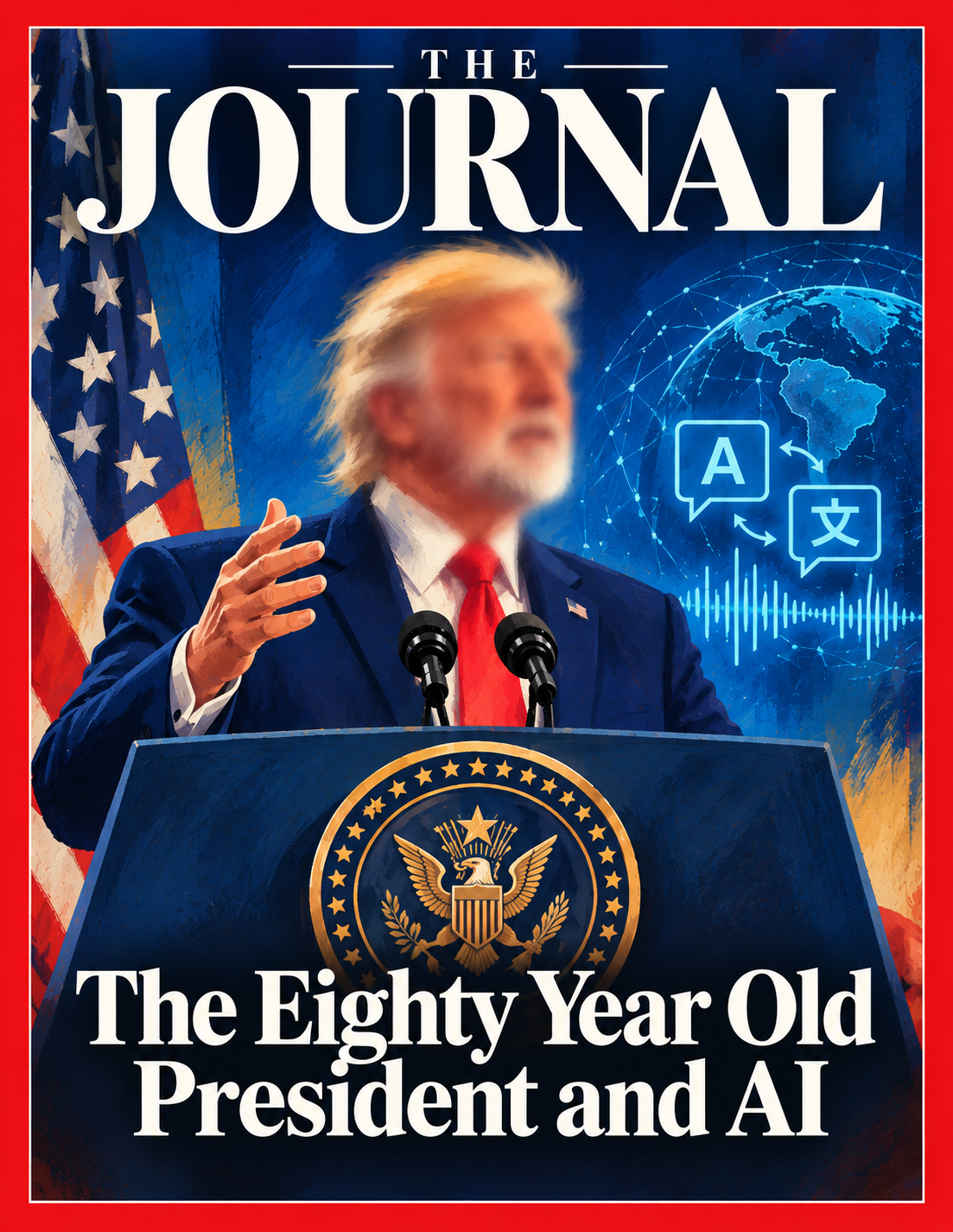
On Thursday night, I sat down to watch an interview with the eighty-year-old President.
It was a simple setting. Inside his official residence, the interviewer, dressed casually, sat in one chair, leaning slightly forward for the camera, while the President, also dressed casually, sat opposite him.
The interviewer was not awed by sitting in the presence of the great man. He asked pointed questions and demanded full answers when he felt the President did not respond fully or dipped too deeply into partisan politics. Remarkably, the President was not offended. He seemed to enjoy the back-and-forth and treated the reporter with respect and, occasionally, deference. He was articulate! He resisted the temptation to insult and demean. Moreover, he did not act his eighty years. He was vibrant and engaged. He spoke in full sentences and provided explanations and the reasons behind his vision for the country. Imagine that: an answer with a subject, a verb, and an actual point.
Moreover, the President seemed to want the interview to go on forever. He was enjoying himself. It seemed the only reason the interviewer ended the conversation was that he had run out of questions.
In the end, it was a tour de force by the President—one that left me impressed and, I admit, a little jealous.
Shocked? You shouldn’t be. Because if you have not figured it out by now, the President being interviewed was not Agent Orange…it was President Luiz Inácio Lula da Silva—Lula of Brazil. Eight months older than Dementia Don, he is a force of nature who looks and acts thirty years younger than his nearly eighty-one years. Something he attributes to daily intense workouts, his sixty-year-old wife, Janja, and a sense of purpose. (Donny, please note: playing golf from a cart while surrounded by sycophants is not a workout; it is a moving cocktail party without the cocktails.)
Lula had a lot to say:
- “Much money in few hands is poverty; little money in many hands is wealth.”
- He said his commitment is to ensure that the bricklayer’s son gets a diploma and every Brazilian table has plentiful food—not to bankers who profit from misery.
- He said money in the people’s hands is investment, not spending, and that those who have money should be taxed.
Let’s be honest. It is hard to argue with any of those statements. But it seems that tax-the-poor, feed-the-rich Donny and a good part of the Republican Party would say just the opposite—and then send out a fundraising email congratulating themselves for it.
He was especially strong on education.
- “The country has no way out if we don’t invest in education.”
- He said Brazil had 140 federal institutes when he took office in 2003, will end this year with 802, and that he wants to reach 1,000.
- He said workers with university degrees rose from 4.8 million in 2003 to 25.5 million, and his goal is 60 to 70 million.
- He said the housekeeper’s daughter will go to university to become a doctor, architect, or engineer, and that people who dislike him for it will keep disliking him.
- On technology, he wants to train thousands of young people for the digital world and said Brazil will owe nothing to anyone in AI.
Wow. A president who brags about providing a good education so people can flourish, as opposed to one who brags about the monuments and buildings he is naming for himself. Talk about refreshing. One is talking about human capital; the other seems to have developed an edifice complex. Especially considering the talk in the United States about downplaying the need for a college education and arguing that the future of employment lies with plumbers and electricians.
Let’s be clear: college is not vocational school. It expands your knowledge base and provides you with critical-thinking skills that allow you to see the world with clear eyes and plot a map for the future.
And sure, AI is going to take a lot of jobs away from the workforce, but the only way to make sure there are future jobs is through education. And a college education that enriches bankers and sends students into permanent debt is not the way to do that. Perhaps, instead of fighting wars that you can’t win and that didn’t need to be fought to begin with, we should fund higher education instead. Less willy waving, more scholarships.
Let me put it another way. If we had funded college education instead of this endless war that has caused inflation and hardship for every American, over 1 million students could have received a college degree—something that would do more to ensure our future than the macho foreign policy of Pistola Pete and Private Bonespur. Apparently, textbooks are less photogenic than missiles.
And if you think that the Mad Tariffers’ policies have helped improve the United States’ standing in Brazil, Lula begs to differ. He said the tariffs cut trade with the U.S. by 9.7%—less money for the U.S. economy—which was more than made up for by increased trade with China by 20%, Indonesia and Germany by 15%, and Vietnam by 14%. In other words: you want to play, FAFO.
When asked about Trump specifically, he said he refused to be bullied just because the U.S. has the largest army in the world. He said Brazil demands to be respected, not demeaned, and if that means looking elsewhere for partners, fine. We love having the United States as a friend. As a bully, not so much. Turns out sovereign nations have caller ID. And nobody picks up a phone to be insulted.
So why am I nattering on about this?
First, it was refreshing to listen to a President of a republic talk more about the future of his country than about how wonderful he is and why he is the greatest thing since mankind first discovered toast.
Second, we in the United States often fall under the delusion that we are the only people in the world and that citizens of other countries will automatically accept what we have to say. As a country, we need to listen more and dictate less. Otherwise, we are going to lose friends and do irreparable damage to our economy and our standing in the world.
Exceptionalism means good listening skills and empathy far more than bullying.
And A.I.
Wow. Bet you didn’t think I was going there.
I listened to this entire interview live using my AirPods 5 in live translation mode, powered by Apple Intelligence. It is an exceptionally good use of AI, especially considering my many years of failed attempts to speak and understand Portuguese. Technology: 1. My language skills: still awaiting a recount.
It confirmed something I already knew: AI is an exceptionally useful tool. In fact, these days I couldn’t do what I do without it. Most of my day, every day, is spent running a couple of small internet start-ups. Without AI for prospecting, modeling, presentations, and creative work, I could not do what I do in the time I need it done—or without a staff that would outstrip my budget before lunch.
And when I write, it helps me—a notoriously bad proofreader—check for misspelled words, punctuation errors, and grammatical no-nos. There is irony in having AI clean up a paragraph warning about AI, but I have learned to live with it.
That said, AI, if allowed to proceed unchecked and unregulated, is a gigantic, potentially world-ending catastrophe. Don’t believe me? Sam Altman of OpenAI, Dario Amodei of Anthropic, Demis Hassabis of Google DeepMind, and Elon Musk have also backed the general call for slowing the race and adding regulation to the industry. When the people building the rocket start asking where the brakes are, perhaps we should pay attention.
I mean, they should know, right? O
But who doesn’t? Yeah, that guy. The one who uses AI to portray himself as Christ, the Pope, or a superhero. Apparently, artificial intelligence can generate almost anything except self-awareness.
Why? I mean, come on. What does Donald Trump love above all other things? Money. I heard a MAGA pundit arguing the other day that we should not regulate AI because it represents 3.1% of GDP. In other words, money—especially money in the hands of the moneyed elite—is far more important than the destruction of humanity. On the bright side, the quarterly numbers should look terrific right up until the apocalypse.
Sigh.
Here is a simple truth. No industry in the history of the world has volunteered to self-regulate. They would giddily poison people’s food, cause cancer, or destroy the environment in order to enrich themselves, regardless of the cost to the world. Corporate conscience tends to arrive shortly after the subpoena.
In other words, the Trump AI accord—a pinky promise committing their companies to stronger internal safety controls, independent audits, monitoring teams, and board-level oversight—is not worth the paper it was never printed on.
Don’t believe me? Trump said—this will blow your mind—“it was morally binding.” That’s right. He invoked morals as the governing law regulating AI. Apparently, we have reached the point where “trust us” from a man who has no moral compass is being marketed as an iron-clad regulatory framework.
God help us. This movie, as currently being directed, does not end well.
31 days.


