
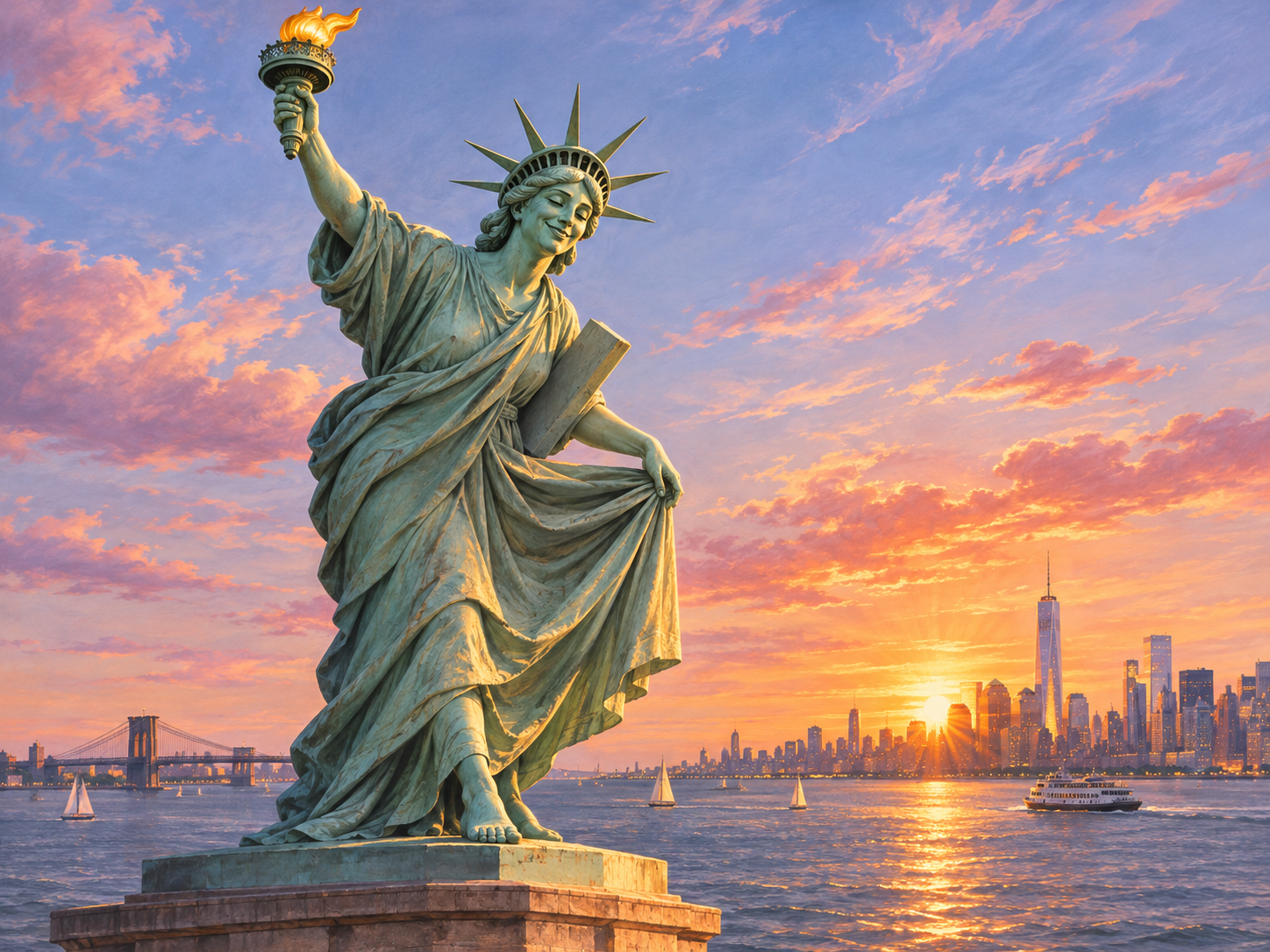
For too long a period, I have written about whathisface in the White House and the orange stain he has left on this country.
It hasn’t exactly been a cheerful undertaking.
There have been mornings when I have sat down at my computer, coffee in hand, determined to write about something uplifting, only to discover that the administration had managed to commit three fresh outrages before breakfast. At some point, you begin to suspect that the national motto has been quietly changed from E Pluribus Unum to Non Possumus Makeus This Shittus Uppus.
Watching the country suffer the slings and arrows of this administration has been painful. Not merely because of the policies, the cruelty, the corruption, or the daily assault on the English language, although God knows there has been plenty of each.
For me, the most painful aspect has been the growing suspicion that we might never recover.
I feared that something fundamental had changed. The America I grew up believing in, albeit an imperfect country with a rather impressive collection of historical sins, had somehow decided that decency, honesty, and basic human dignity were no longer part of the national ethos. (For the record, Musk-rat, empathy was considered a virtue long before Independence.)
And perhaps the damage was permanent. That we would never find a solvent capable of removing the orange stain MAGA has left on our Constitution.
Then came Tuesday.
I have spent the days since trying to identify the feeling that came over me as the returns rolled in.
Relief? You betcha.
Satisfaction? Come on now!
Schadenfreude? Oh yeah. I’d be lying if I said there wasn’t a generous helping of that. I am only human, and apparently not a particularly charitable one.
But there was something else.
Something I hadn’t experienced in quite some time.
Hope.
Not the town in Arkansas, or the disingenuous stuff peddled by politicians who promise to change the world while quietly making side deals with their donors.
The real thing. The kind that sneaks up on you when you have nearly convinced yourself that optimism is a character flaw.
Tuesday gave me hope.
And rather than immediately returning to our regularly scheduled programming of political outrage, I would like to suggest something unusual.
Let’s sit back, relax, and enjoy the moment.
We do not need to spend today speculating about the next Speaker of the House, the Senate majority leader, or the 10,000 ways the Democrats might find to fuck this up.
We can postpone the declaration that MAGA is dead, buried, and awaiting resurrection on some obscure cable channel. Nor do we need to devote another thousand words to the news that Beelzebub has apparently been appointed White House chief of staff.
Let the political undertakers, consultants, television experts, and professional hand-wringers do all that. It is what they are paid for. Besides, most of them are incapable of enjoying a victory without immediately identifying seventeen ways it could become a catastrophe.
We should turn them off.
Because Tuesday was about far more than which political party controls Congress.
It was about what Americans did when given the opportunity to speak for themselves.
And what they said was extraordinary.
Consider the history that was made.
In Georgia, Keisha Lance Bottoms became the first Black woman elected governor in American history.
Think about that for a moment.
In a country that has existed for 250 years, a Black woman had never been elected governor of a state. Not once.
Until Tuesday.
In New Mexico, Deb Haaland became the first Native American woman elected governor. A descendant of the people who inhabited this continent long before Europeans arrived will now lead one of its states.
One could make a fairly convincing argument that this particular milestone was overdue by several centuries.
Texas elected Gina Hinojosa, its first Latina governor. Minnesota elected Peggy Flanagan to the United States Senate, the first Native American woman ever elected to that institution.
Michigan elected Abdul El-Sayed, the nation’s first Muslim senator. New Hampshire elected Chris Pappas, the first openly gay man to win a Senate seat.
These are not merely entries in some future edition of the Almanac of American Politics.
These are doors opening. This is DEI in its natural habitat.
And behind every one of those doors are children who can now look at the people governing this country and recognize someone who looks like them, comes from a family like theirs, or understands something about their lives.
I find that rather wonderful.
There is also something deliciously American about the fact that so many of these breakthroughs occurred in places where conventional political wisdom insisted they couldn’t happen.
Conventional political wisdom, of course, is that peculiar branch of human knowledge in which people are paid enormous sums to explain, with absolute certainty, why yesterday’s predictions were wrong.
Tuesday was not especially kind to the profession.
Nor was it kind to the assumption that Americans had become permanently resigned to whatever Washington decided to inflict upon them.
They showed up.
Young voters, in particular, shifted dramatically. People who had been dismissed as apathetic demonstrated that they were paying attention.
And across the country, voters exercised the one power that remains stubbornly beyond the reach of presidential executive orders.
They voted.
It sounds almost embarrassingly simple.
But democracy is, at its heart, an enormously complicated system built around a remarkably uncomplicated proposition.
The people get to decide.
Not the billionaires. Not the television personalities. Not the fellows in expensive suits who have confused access to power with possession of wisdom.
The people.
And Tuesday, the people reminded Washington that their employment contracts are subject to renewal.
We are Americans, not characters in a Disney movie. There is no musical number at the end in which everyone embraces and the villain is transformed into a harmless woodland creature.
Although I would pay good money to see that particular transformation.
What Tuesday demonstrated was that the American experiment still has a pulse.
For years, we have been told that the country is hopelessly divided, that truth no longer matters, that institutions are powerless, and that the public has surrendered its capacity to distinguish leadership from performance art.
Tuesday suggested that those conclusions may have been premature.
I have lived long enough to understand that political victories are temporary. There will be disappointments. There will be compromises that make us uncomfortable, decisions that make us furious, and politicians who discover that power has a remarkable ability to diminish their acquaintance with principle.
But that is a problem for another day.
Today, I want to think about the poll workers who spent countless hours making sure ballots were properly counted. The candidates who entered races they were told they couldn’t win. The volunteers who knocked on doors, made telephone calls, and endured the peculiar pleasure of discussing politics with strangers.
And the millions of Americans who took time from their jobs, families, and daily obligations to participate in an act of faith.
Because voting really is an act of faith.
Faith that your voice matters. That the country belongs to its citizens. That tomorrow does not have to resemble yesterday.
For much of the past several years, I had begun to wonder whether that faith was misplaced.
Tuesday reminded me why I had it in the first place.
We have not solved our problems. We have not repaired every institution or healed every wound. And there are still plenty of people in Washington who should not be trusted with the combination to a bicycle lock, much less the machinery of government.
But perhaps we have rediscovered something important.
The capacity to surprise ourselves.
The ability to say enough.
And the possibility that the better angels of our nature, having apparently spent the last several years on an extended leave of absence, might be finding their way back to work.
I don’t know what happens next.
For once, I’m content not to know.
For the life of this Substack, I have spent an enormous amount of time writing about what is wrong with America.
Today, I would rather celebrate what is right with it.
Thank you, America.
I needed that.


