
This is a difficult issue for me to write about.
It is deeply personal, and I know that some of my friends—and even some members of my family—will disagree with what I have to say. My inclination has been to keep my opinions and emotions to myself unless I can have a quiet, face-to-face conversation. Preferably one in which nobody feels compelled to shout.
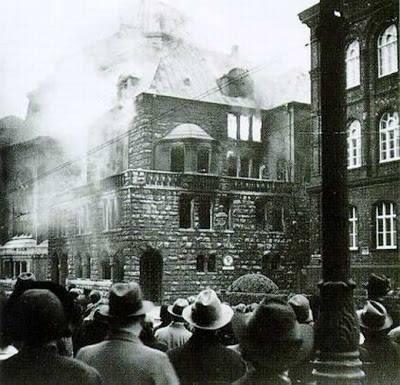
But tomorrow marks the 88th anniversary of Kristallnacht. Every year, I publish my father’s recollection of that terrible night and ask people never to forget what happened or what it represents. This year, I don’t feel I can do that without first addressing what is happening around us.
In Jewish tradition, the number eight can symbolize what comes after completion: renewal, a new beginning, something beyond the familiar cycle. I don’t put much stock in numerology, but on this 88th anniversary, I’m willing to borrow a little of that hope. I’d like to see a new beginning in Israel: a government without Benjamin Netanyahu and one willing to bring Arab parties into its governing coalition.
Which brings me to Netanyahu.
The nicest thing I can say about him is that he speaks excellent English. My list of compliments ends there.
For years, he has maintained power by depending on hard-right and religious parties, exploiting divisions and making the prospect of peace feel perpetually just out of reach. I believe his leadership has been disastrous. His embrace of Donald Trump as a political soulmate doesn’t exactly improve my opinion of him.
Israel’s military response to Hamas after October 7 was understandable. But Netanyahu’s government has too often treated the devastating consequences for Palestinian civilians as something to be managed rather than prevented. More than 74,000 Palestinians have been reported killed in Gaza. That is a human tragedy.
I also believe Netanyahu’s policies have handed antisemites around the world a fresh supply of excuses. That does not make him responsible for their hatred. They own that. But it doesn’t absolve him of responsibility for his decisions, either.
And yet there is another part of this story that too often gets left out.
On October 7, 2023, Hamas-led attackers murdered approximately 1,200 people in Israel and took 251 hostages. Any country subjected to an attack of that magnitude would have responded militarily. Hamas has also operated in and around civilian areas, putting Palestinian civilians at enormous risk. Deliberately using civilians to shield military objectives violates the laws of war.
Pretending Hamas bears no responsibility for what happened after October 7 is deliberate ignorance.
War is ugly, and history offers some awful reminders. In March 1945, American bombers firebombed Tokyo, killing upwards of 50,000 civilians in a single night. The bombings of Hiroshima and Nagasaki killed more than 200,000 civilians. The United States defended its campaign against Japan as necessary to bring the war to an end and save American lives. History can help us understand how governments justify wartime decisions. It does not make every decision just.
I am not offering Israel a blanket defense. Far from it. Palestinian lives matter. Israeli lives matter. The law of war matters. And acknowledging one of those truths should not require pretending the others don’t exist.
Then there are the words we use.
Apartheid is one of them. Using it as a shorthand for Israel’s relationship with Arabs is inflammatory and wrong. Arab citizens of Israel vote, serve in the Knesset, and participate in public life. That doesn’t erase discrimination, inequality, or the grave questions raised by Israel’s treatment of Palestinians in the West Bank. But it is not apartheid.
Genocide is another word that gets thrown into almost every argument about Gaza. It has a specific meaning: acts committed with the intent to destroy, in whole or in part, a national, ethnic, racial, or religious group. I do not believe it should be used casually. I believe doing so belittles what happened in Rwanda, Cambodia, Bosnia, and the Holocaust.
What is happening in Gaza is an epic human tragedy. We should treat it as such. But we should be very careful about the words we choose to describe it.
And we should not forget who Hamas is. Its 1988 charter called for Israel’s destruction and contained openly antisemitic language. Its leaders have repeatedly spoken of eliminating Israel. Whatever arguments people make about the Israeli government, Hamas is not some misunderstood neighborhood association with a public-relations problem.
So why am I writing all this? Because we need to make distinctions, and lately we seem determined not to.
You can condemn Israel’s actions in Gaza or the West Bank without being antisemitic. You can despise Netanyahu without being antisemitic. You can demand Palestinian rights and statehood without being antisemitic. I may disagree with parts of your argument, but I understand why you feel strongly about it.
Hating Jews because they are Jews is different. So is holding Jewish people in Philadelphia, New York, or anywhere else personally responsible for the decisions of the Israeli government.
And the same principle applies to everyone. Hating Muslims, Christians, Hindus, or Jews because of how they worship is wrong. Full stop. It is dangerous, and it is contrary to what we should stand for as human beings and as Americans.
Which brings me to Philadelphia.
A pro-Palestinian cycling group has organized a November 8 boycott ride targeting six Jewish-owned restaurants. The organizers say they are protesting the owners’ support for Israel, not their religion. But the public call to drive these establishments out of the neighborhood is alarming, and the timing—on the eve of Kristallnacht—makes it impossible for me to shrug off.
If you object to something a business owner has actually done, make your case and apply the same standard to everyone. But if the message is that Jewish-owned restaurants don’t belong in your neighborhood, don’t insult our intelligence by calling that justice. Call it what it is: antisemitism.
Tomorrow, I will share my father’s account of the night when Jewish businesses were attacked simply because Jews owned them. I am not suggesting a bicycle boycott is Kristallnacht. It isn’t.
But 88 years later, if you cannot hear the echo, you aren’t listening.


