
Early on the morning of September 12, 2001, I went for a long run along the Greenway on New York’s Upper West Side.
This was not to clear my head after the events of the day before. Well, maybe a little. But its primary purpose was to continue my training for the Chicago Marathon, just three weeks away.
This was my first marathon, and despite the fact that I am built more like a weightlifter (thanks, Fran Farrell) than a runner, I was determined to do well. The year before, my father had been diagnosed with lymphoma, a disease that just a few years earlier might have been fatal, but medical research had created drugs that cured him. I was grateful. So grateful that I had joined Team in Training, a Leukemia and Lymphoma Society program that trained people to run marathons while they raised money from sponsors for the organization.
I had raised $15,000 to honor my dad, and I was determined to do well even though I had never told him I was running the marathon in his honor. He just thought I was going through some crazy midlife crisis. You may ask: Why didn’t I tell him? It was something he had taught me years before called tzedakah, the Jewish practice of giving anonymously so that neither the donor nor the recipient is obligated to the other.
I didn’t need anything further from him. Pop had given me enough. And keeping silent about why I was running the marathon—because of a lesson he had taught me as a child—was the best way I could think of honoring him.
It was a beautiful day. The sun was shining, and the Hudson glittered. If you had somehow slept through the previous day, you would have had no idea how profoundly the world had changed, except perhaps for the fact that there were fewer runners than usual.
But when you got to 57th Street, where the Greenway opens up to the south, you could see smoke rising from the pile. And when you hit Chelsea Piers at 23rd Street, you saw a line of ambulances parked bumper to bumper, stretching to where the path was blocked just below Canal Street. At the time, reality had not set in. We thought there might be a mass of survivors who had been miraculously saved, and the ambulances were a vivid symbol of our hope—and our denial of reality.
The hope those ambulances represented inspired me. I ran home, showered, and walked the few blocks over to the Red Cross offices at 66th and Amsterdam to donate a pint of blood for anyone who might have survived the attack. There I was greeted by a volunteer who told me that if I wanted to donate blood, I should go next door to Martin Luther King Jr. High School, where they were setting up a facility to handle mass donations. She also informed me that it would likely be hours before I could donate. So before joining the queue, I stopped at a magazine store (remember them?) and bought The New York Times, the Daily News, and the New York Post because, back then, our source of information and distraction didn’t have a ringtone.
At MLK, we were given a number and directed to the auditorium to wait until our number was called. I spent the next eight hours reading the ink off those papers. Tragedies teach us who our friends are, and what I remember most about the news that day was the support and solidarity the nations of the world offered us.
For example:
18 fellow NATO members—Belgium, Canada, Czech Republic, Denmark, France, Germany, Greece, Hungary, Iceland, Italy, Luxembourg, Netherlands, Norway, Poland, Portugal, Spain, Turkey and the United Kingdom—agreed that the attacks could constitute an attack on all of them under Article 5.
Russia, China, Japan, India, Pakistan, Israel and Iran were among the countries whose governments quickly condemned the attacks or expressed sympathy and support.
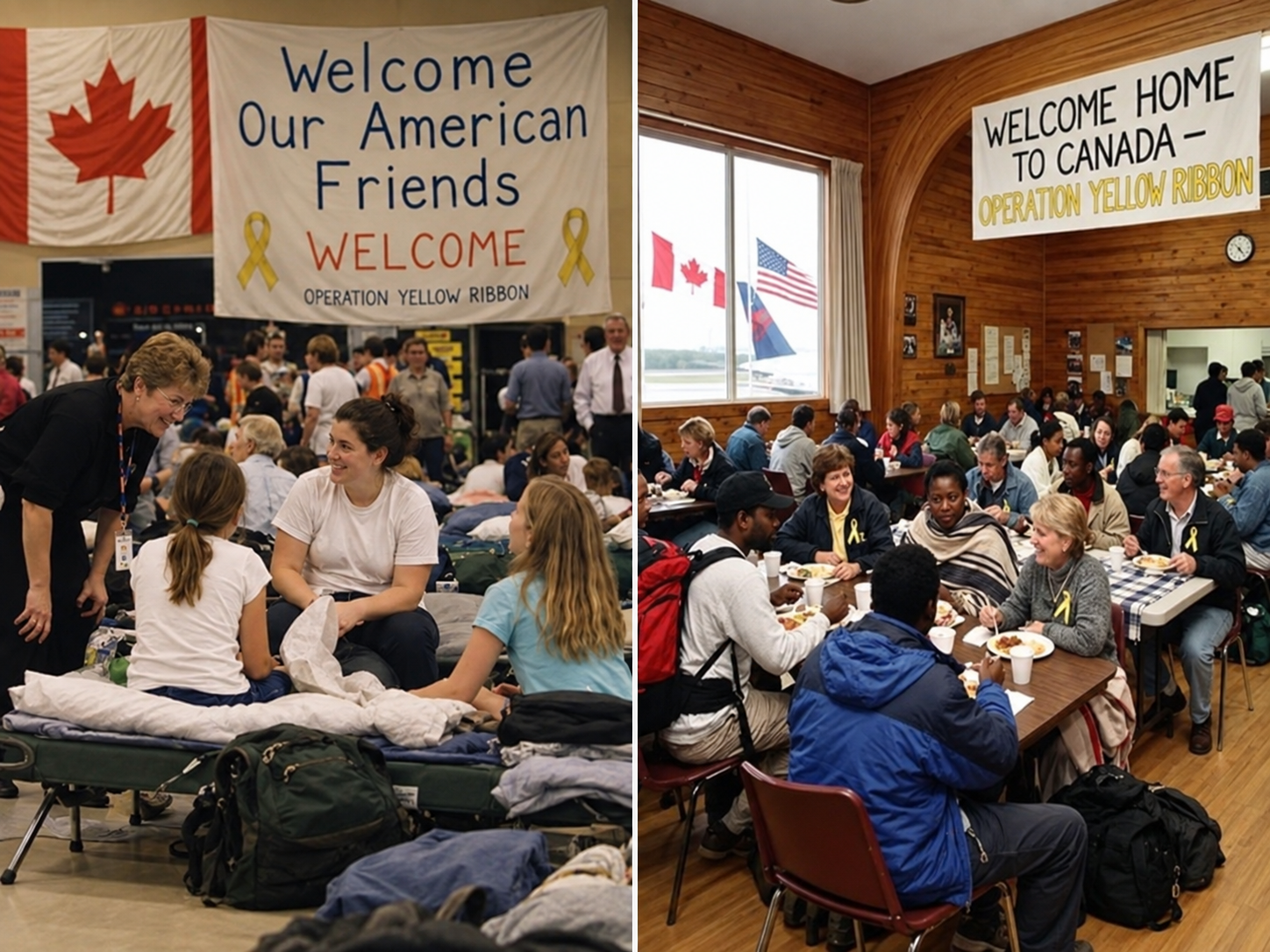
Canada also performed an extraordinary practical service on September 11 by taking diverted U.S.-bound aircraft and caring for tens of thousands of stranded passengers. (Later, they would send 146 relief workers to New York, and Canadian Mohawk and other ironworkers came south to help dismantle the wreckage.)
I haven’t forgotten what it felt like to know the world had our back—that they were with us because they knew we would stand with them. It felt good. It made me feel like we were not alone.
But it does make me wonder: If a terrorist incident of this magnitude happened today, would the world feel the same? I doubt it. The Screaming Meme, whose idea of diplomacy is telling other countries why they should kneel before us, has spent years treating goodwill like the credit card of a company that is about to declare bankruptcy—something to be emptied because it won’t be his problem for long. He has squandered a remarkable share of the goodwill our nation accumulated over 250 years. Diplomacy, after all, is not a protection racket with better stationery.
Think about it.
- Do you think Iran would offer us any support whatsoever, other than perhaps sending a congratulatory fruit basket to the terrorists?
- Would Denmark be able to find warm words of support after Agent Orange demanded Greenland as though it were the last property in a Monopoly game?
- Is Italy likely to feel simpatico toward us after Agent Orange has told deliberate lies about its prime minister? Nothing says friendship quite like publicly inventing things about your friends.
- What do you think Spain would say after Denteless Don threatened to cut off all trade with them? ‘Our thoughts and prayers are with the people who just threatened our economy’ doesn’t exactly roll off the tongue.
- Don’t even get me started with Canada.
After all Agent Orange has said and done, can you imagine the world showing us the same generosity of spirit today that it did in 2001? You can only kick your friends in the shins only so many times before they don’t answer the phone.
But if you don’t believe me—or think I am cherry-picking the data, consider the following facts from Pew Research. Numbers, unlike politicians, have the annoying habit of remembering what happened:
- In 2002, the United States was viewed favorably by a majority in 35 of the 42 countries surveyed—about 83% of the countries polled. America was especially well regarded in much of Europe, Africa, Japan, and the Philippines. Pew described the world as still having a significant “reserve of goodwill” toward the United States.
- By 2026, Pew’s newest survey paints almost the reverse picture. Across 36 countries, the median favorable rating of the United States is just 37%, while 57% view it unfavorably. Pew says positive ratings are now at or near historic lows in countries including Canada, France, Germany, Italy, the Philippines, South Africa, South Korea, and the United Kingdom.
And here is the kicker: The U.S. is no longer the most popular country in the world. China is. That is not merely losing the room. That is setting fire to your house, after defunding the fire department, insulting the firefighters and wondering why your house burned to the ground.
On September 12, 2001, I sat in a high-school auditorium with hundreds of New Yorkers waiting to give blood that, as it turned out, almost no one would need. Outside, smoke rose from lower Manhattan. But I was comforted by the knowledge because around the world, friends—and even countries that were anything but friends—stood beside us.
That reservoir of goodwill was real, precious, and paid for over generations. We did not inherit it so one man could drain it to build generational wealth.
The tragedy is not simply that America is less loved today. It is that when the next terrible day comes, we may finally discover what all that orange swagger cost us: the empty space where our friends used to stand.


