A Rant, Being a Dutch Uncle, and Trump’s War on the Undocumented

Dear Nephew,

Forgive the letter format, but it’s easier for me to type with all ten fingers than just my thumbs.

Before I begin, I want to be transparent about my feelings regarding immigration.

In 1936, my father and his family applied for a green card to immigrate to the United States. My great uncle Max had illegally immigrated to the U.S. in 1914 and became a citizen in 1936. That year, he returned to Austria to visit his family and convinced my grandfather they needed to leave Europe before the next war. At the time, strict immigration quotas imposed by the isolationist Republican Party allowed only 10,000 green cards per year for people born in Poland. Despite being sponsored by a U.S. citizen with financial backing, my father’s family didn’t receive a green card until November 1939—two months after the war in Europe began. They left Austria in December 1939, just before the borders closed. Had they not made it out, they likely would have perished in the concentration camps like millions of others.

Our immigration system was broken then and as a result millions died ( see MS St. Louis – Wikipedia) I can’t and we shouldn’t forget that when I talk about immigration..

But let’s start somewhere else maybe in an area where we agree. The country desperately needs systemic immigration reform. The current system doesn’t meet business needs or offer a fair, efficient process for those seeking legal entry. Both parties have failed to pass meaningful legislation, and we must hold them accountable.

That said, the Biden administration did gain bipartisan support for a border reform package. It would have legally closed the border if crossings rose above a certain threshold, reformed the asylum process, and dedicated significant resources to manage the border. That legislation was killed by Donald Trump and his supporters—not because it was flawed, but so he could campaign on an anti-immigration platform.

You might argue that legislation wasn’t needed—look what Trump has done in just eight weeks in office. The issue is, much of that activity oversteps legal bounds or is outright unlawful. That’s why there are currently 151 lawsuits pending against the government for its actions. I don’t have time to dive into all of them, but here are two that really bother me.

First, Trump signed an executive order to end birthright citizenship. The problem? The 14th Amendment explicitly guarantees it. So why propose something so blatantly unconstitutional? My guess: red meat for a base hungry to demonize immigrants. But you’d have to ask him.

Second, an executive order revoked asylum protections for 530,000 immigrants from Cuba, Haiti, Nicaragua, and Venezuela. These individuals had been granted two-year humanitarian parole under the prior administration, allowing entry with the support of sponsors. What do you think will happen when they’re sent back to their home countries? I doubt they’ll be welcomed with flowers and chocolates. More likely: prison, persecution, and soul-crushing oppression.

It’s unnecessary. It’s vindictive. It’s cruel. It’s fundamentally un-American.

Trump’s immigration approach has also damaged the United States’ standing in the world. This morning, the Brazilian news outlet UOL reported on Homeland Security Secretary Kristi Noem posing with half-naked, shaved-head Venezuelan prisoners in El Salvador. It slammed the current administration and ended with this quote:

“David Frum, a former speechwriter for George W. Bush, posted a warning on social media: ‘Almost every major action Trump has taken is intentionally illegal. Trump is betting that the U.S. democratic system is too broken to stop him. He assumes, to use a phrase, “All we have to do is kick in the door and the whole edifice will crumble.” It’s time for the test.’

The U.S.’s 240-year-old democratic experiment is under threat.”

Combine that with Trump treating tariffs like Halloween candy—trick or treat, everyone gets something—and you get a foreign policy that has extinguished the glow of American exceptionalism. We’re no longer the shining city on a hill; we’re the shadow others are trying to avoid.

There is an economic consequence to all of this—actually, many—but I’m going to focus on one: tourism. The international tourism industry supports 1.7 million U.S. jobs and generates over $225 billion a year in revenue. Yet the way some international visitors have been treated—jailed for weeks without cause—has chilled that industry:

Trump’s main argument for his immigration crackdown—economic strain—falls apart in other ways. He claims undocumented immigrants bring crime and are a drain on public resources like education, law enforcement, and healthcare. In North Carolina, where there are an estimated 500,000 undocumented immigrants, some figures suggest a net cost of $2.45 billion, accounting for taxes paid versus services received.

Yes, that’s a significant burden—but it ignores the broader economic contribution of those workers. They spend most of their income locally, driving demand in:

  • Groceries
  • Housing
  • Transportation
  • Retail and services

Using a conservative multiplier (1.5 to 1.8 is typical for low-wage spending), their broader economic impact is:

$7.54 billion × 1.6 = ~$12.06 billion in total economic activity.

This doesn’t include industries like agriculture, hospitality, food service, and construction—already facing labor shortages. Removing these workers would mean higher prices, reduced hours, or outright closures.

Here’s my point: the economic case for mass deportation crumbles. These workers contribute far more than they cost.

Which raises another question: why hasn’t the Trump administration targeted the companies hiring undocumented workers?

It’s like the war on drugs. The DEA realized that arresting users doesn’t work, so they started targeting the cartels. Similarly, if businesses weren’t hiring undocumented workers, fewer people would risk crossing the border.

If immigration were truly a priority, the administration would be cracking down on employers—not scapegoating vulnerable individuals.

Speaking of crime, another argument made by Fox News and the administration is that the undocumented bring crime. That claim is entirely specious. According to the American Immigration Council and other reliable sources, crime rates actually drop in communities with undocumented immigrants. U.S.-born citizens are:

  • Twice as likely to commit violent crimes
  • 2.5 times more likely to be arrested for drug crimes
  • Four times more likely to commit property crimes

Sources:

So if the Trump administration’s rationale—crime and economics—is unfounded, why persist with these policies? For a definitive answer, you’d have to ask him. But I have a theory: scapegoating.

Scapegoating is the act of blaming individuals or groups for problems they didn’t cause—often for political gain. History is littered with examples. It’s a tactic used to avoid hard work and policy-making and instead rally a base through fear.

Which brings me back to the beginning. Yes, we have a border problem. Yes, our borders must be secure for safety and national well-being. But that doesn’t come from building a wall that people can climb over. It doesn’t come from vilifying a group of people who came here—yes, without documentation—but to work for employers who knowingly hire them.

Solving this problem requires research and hard conversations. It means listening to diverse perspectives and forging bipartisan, lasting solutions.

That’s the hard work Trump has avoided—because his goal isn’t to solve the problem. His goal is to use it for political power. And to do that, he needs a scapegoat, not a solution.

But that is just what I think.

NBL

Posted in Uncategorized | Tagged , | Leave a comment

Posted in Uncategorized | Leave a comment

Cherry Blossoms, The Garden State, and Presidential Role Models

People often get the wrong idea about New Jersey.

The image they conjure when the state’s name is mentioned is that of the New Jersey Turnpike between the George Washington Bridge and the Outerbridge Crossing, which offers stunning views of oil refineries, ports, warehouses, and the opposite of scenic beauty. The more sophisticated may picture Asbury Park—or the high jinks of Jersey Shore.

They rarely think about why it’s called the Garden State. Yet New Jersey ranks fourth in floriculture sales and seventh in horticulture, generating over $1.5 billion in sales last year. Nationally, the state ranks:

  • 5th in blueberries
  • 4th in cranberries
  • 3rd in eggplant
  • Top ten in tomatoes, squash, cucumbers, and sweet corn

But only those of us who’ve been given the secret handshake know that New Jersey is home to one of the largest Cherry Blossom Festivals in the United States. Newark’s Branch Brook Park has over 5,300 cherry trees across 18 varieties, far surpassing D.C.’s Tidal Basin, which has a mere 3,800 trees. It’s beyond gorgeous. The sheer number of trees and their pink and white blossoms are splendiferous—a full-throated, clarion call that spring has arrived.

I saw on the news the other day that this year’s festival will be held April 5–13. But instead of making me plan a trip to the park with Rosie so she could smell the flowers and roll in their petals, it made me think of the story we all learned in childhood.

I first heard it in Mrs. Ruprecht’s first-grade class, when she read us the tale of George Washington chopping down the cherry tree. According to the story, young George had been gifted a hatchet. Wanting to test its mettle, he chopped down his father’s prized cherry tree. When confronted, George famously said, “I cannot tell a lie. I chopped down the tree.”

Ironically, the story is a lie. It never happened. It was created by Mason Locke Weems, Washington’s first biographer and a preacher, to present our nation’s first president as a moral role model—especially for children. But it served its purpose. It implanted the idea, over a dozen generations, that our leaders should be truthful, forthright, and decent. That those who sit in the office once held by Washington, Adams, and Lincoln must possess a high moral code and be among our most decent citizens.

Remembering this made me wonder: What moral code is Donald J. Trump teaching Gen Z and Gen Alpha?

Is it that, unlike George Washington, it’s perfectly okay to lie? After all, Trump told over 35,000 falsehoods during his first term (for those keeping score, that’s about 21 a day). His record-setting prevarication continues into his second term, with Executive Order 14149, which prohibits the use of taxpayer dollars for fact-checking, the elimination of Inspectors General who investigate fraud, waste, and abuse, and dozens of lies told during his State of the Union speech.

I’m pretty sure most of us had a teddy bear growing up. He was probably your best friend and confidant during those rough pre-K years. The bear was named after the 26th president, Theodore Roosevelt. Apparently, he had been hunting—unsuccessfully—when his guides cornered and tied up a black bear for him to shoot. He refused. It went against his sense of fairness and sportsmanship. That small act of kindness sparked a toy that would comfort millions of children for generations.

What will Donald Trump’s legacy be? His lack of empathy toward the hundreds of thousands of refugees who came to this country seeking asylum—only to be sent back to face abuse, prison, or death—paints a dark picture. Perhaps Mattel will introduce a line of Incarcerated Ethnic Ken and Barbie dolls, complete with orange coveralls and manacles, prodded by a G.I. Joe ICE Edition. Think of the comfort that will bring children—while being supervised by their Haitian nannies. Oh, wait. Well, you know what I mean.

In school, we were taught that Harry Truman had a sign on his desk that read: “The buck stops here.” The sign, made in a prison workshop and sent to him by the warden, delighted the president. He felt it perfectly summarized the office. Regardless of who made the decisions in his administration, he was ultimately responsible—whether it was taking credit for the formation of NATO and the Marshall Plan, or owning the more questionable decisions that fueled early “Red Scares” or led to the dropping of nuclear bombs on Nagasaki and Hiroshima.

As Truman said in his farewell address:
“The President—whoever he is—has to decide. He can’t pass the buck to anybody. No one else can do the deciding for him. That’s his job.”

The lesson we took from Harry was this: Be humble about the good decisions, and own the outcomes of the bad ones.

Sadly, the current occupant of the White House is teaching children the opposite. The sign on his desk might as well read:
“Every decision correct—unless they were screwed up by the people I hired, in which case they are to blame.”
Of course, that would be too big a sign.

Perhaps he could replace it with two large buttons:

  • One for the “good” decisions, which randomly say things like:
    “I am a very stable genius!”
    “Nobody has been more successful than me!”
    “Only I could have fixed this.”
  • And another for the failures, programmed to offer excuses like:
    “That is fake news.”
    “The deep state is out to get me.”
    “Joe Biden and Barack Obama created this mess.”

The stories we learned in school about our presidents were meant not just to inform, but to inspire.

George Washington taught us about honesty.
Theodore Roosevelt taught us about kindness and fair play.
Harry Truman taught us about responsibility.

So it begs the question:
What is Donald Trump teaching future generations—and what kind of stain will that leave on our national character?

Posted in Trump Opposition | Tagged , , , , , , , , , , | Leave a comment

The Whataboutism Poll

Posted in Uncategorized | Leave a comment

Anniversaries, Going Brazilian, and Gratitude

Thirteen years ago today, I met Elaine.

I was on an eighteen-day cruise up the coast of Brazil with a transatlantic passage that would make port in Morocco, Portugal, and Italy.

It did not start well. My first dinner partner on the Costa Pacifica was named Diego. He was a recently graduated lawyer from Buenos Aires who spoke two words of English: “American Express.” As I spoke fewer words in Spanish than he did in English, we did not engage in the delightful shipboard banter I had hoped would accompany my cruise.

For the next two nights, I ate by myself at the pizza buffet. It was lonely, pathetic, and I realized that if I did not change my strategy, I would have a miserable three weeks. I went to the Maître D’ and asked to be seated at a new table where someone spoke English. He was not encouraging. There were few English speakers on board, and most were already sitting together. He could put me at a table with Brazilian lawyers who, while he did not know if they spoke English, might. Would that be okay? I said, “Please.”

I dressed carefully that evening and arrived at the dining room as it opened for the 8 p.m. seating. I was seated and welcomed by three empty chairs. Oh well, I thought, it is early. Five minutes passed, and the dining room began to fill. The seats opposite me remained empty. Ten minutes passed—the dining room was now half full. The chairs opposite me: still vacant. Fifteen minutes passed—the dining room was now full, and of course, the chairs at my table were unoccupied.

Feeling like a loser and resigned to loneliness, I ordered a double vodka martini and prepared myself for an evening of intensive olive therapy. Just as I was dipping my beak into my drink, two women, a redhead and a blonde, took the seats opposite me. They greeted me in Portuguese, then in English, and apologized for being late as they had been detained taking photographs. I was so relieved to be able to speak to someone that I was tongue-tied. They told me that shortly, we would be joined by the third member of their party, who was still having her photograph taken.

I managed to croak out only an “Oh” before the redhead said, “Here comes my sister,” and pointed to a woman making her way to the table. It might have been my imagination, but it seemed as if every spotlight in the restaurant was pointed at this glorious-looking woman with a gigawatt smile who, while making her way to our table, was shaking everyone’s hand as if she were the mayor of the ship.

I stood to greet her, and she introduced herself. The ringing in my ears was too loud, and I could not make out what she said. So, I said, “Pardon me?” And she said, “My name is Elaine.”

Nine months later, we were engaged. Sixteen months later, we were married.

In honor of the thirteenth anniversary of our meeting, it might be a good time to reflect and comment on what I have learned on this journey with Elaine.

First among the things I have learned is gratitude.

There are approximately 200 billion stars in the Milky Way Galaxy. Perhaps 6 billion have the potential for life. In the 13.6 billion years the galaxy existed, I happened to be alive at 0.00000053% of that time. Meeting Elaine on a boat where 0.000025% of Earth’s population happened to means that our meeting was extraordinarily unlikely by any statistic you could possibly imagine. Considering those odds, I am grateful to the universe and whatever higher power runs it for allowing us to meet and fall in love.

I am grateful that we live in a time when people from different continents can meet, fall in love, get married, and build a real life together on two continents. I am grateful she laughs at most of my jokes and that, despite being a cat person, she has fallen in love with our puppies.

She has taught me how to hold hands. I know—most of us learn how to do that at a much earlier age, and so did I. But I lost the habit as I grew older. Holding hands, I thought, was for teenagers and young love. But in Brazil, no matter your age or stage of decrepitude, you hold hands. We hold hands wherever we go, and I have come to understand that it is a symbol of our connection. It turns two into one and reminds me every day that, through thick or thin, we are in this together. To quote the bard of New Jersey, “We swore we’d travel, darlin’, side by side. We’d help each other stay in stride.”

She has also taught me to walk slowly. Brazilians walk far more slowly than us gringos. And when we walk together, holding hands, she reminds me in her soft Brazilian lilt to slow down. And when I do,  I realize that my hurry was often for no reason at all. It was merely an excuse to check something off my to-do list faster. Slowing down, especially when I am here in Brazil and with her, allows me to take stock of the beauty around me and beside me. It gives me time to be grateful for where I am and whom I am with.

I am grateful for the perspective that Elaine provides. Unsurprisingly, we occasionally don’t see eye to eye on a subject. That is inevitable as we come from different countries and very different backgrounds. And my wife is an extremely smart, passionate woman who holds onto her well-thought-out opinions and feelings in the same way a miser might hold onto their wallet. Ninety-five percent of the time, we agree. I have been known to be stubborn in my beliefs as well. As a consequence, there are some subjects and issues on which we don’t agree and likely never will. Time and Elaine have taught me that embracing the fact that we have different opinions and allowing those differences to provide perspective, not dissonance, gives me a better understanding of an issue. It is a net positive—even if we cannot agree.

But above all, what I am most grateful for is Elaine. The miracle of our meeting gives me hope that, even when the world seems its darkest, dawn is not far off. Considering our world today, that is an awesome thing.

Posted in Uncategorized | Leave a comment

The Brazilian Constitution, Mar-A-Lago and the Democracy of the Beach

Brazil’s democracy is among the youngest in the world.

After decades of a repressive dictatorship, supported in part by the U.S., Brazil adopted its current constitution in 1988. It did not hold its first presidential election until 1989. Despite its relatively young experiment in democracy, there are a number of things that the “Verde e Amarelo” (Green and Yellow) gets right—things from which the red, white, and blue could learn a thing or two.

The U.S. Constitution is a short, concise document with only seven articles and twenty-seven amendments. It focuses on broad principles and allows the courts to interpret the rest. The Brazilian Constitution, on the other hand, is lengthy and highly detailed, with over 250 articles covering not only government structures but also social policies, economic regulations, and environmental protections. Less interpretation is needed, as it is black-letter law. You may argue that the founders of Brazil’s constitution went overboard, but at least their courts aren’t constantly tied up with constitutional questions, with the Supreme Court making rulings based on who last loaded the bench.

Speaking of the Supremes, in the U.S., justices of the highest court receive lifetime appointments. So does Brazil—with one key difference: mandatory retirement at age 75. This would mean that, in our case, Clarence Thomas and Samuel Alito would need to retire, which would be beneficial—except for the current makeup of Congress and the occupant of the Oval Office.

Another judicial innovation in Brazil is its separate electoral court system. This body has absolute authority over all election issues. It consists of seven Supreme Court justices, two justices from the Superior Court of Justice, and two presidentially appointed justices. In practical terms, this means that all disputes and issues arising from elections are decided swiftly and decisively. For example, former President Jair Bolsonaro (2019-2023), sometimes called “The Trump of the Tropics,” was convicted of abuse of political power and misuse of government communication channels (sound familiar?) and is now banned from running for office until 2030. (I wish that sounded familiar.)

Speaking of elections, voting is mandatory. If you do not vote, a penalty is assessed on your income tax. In practical terms, this means that about 80% of Brazilians voted in the last presidential election, compared to just over 60% in 2024. Considering that the difference between Trump and Harris was a point and a half, this could have made all the difference between the chaos of today and the relative sanity of just a few months ago.

Brazil also elects its president directly. The candidate who wins the popular vote wins the election. Full stop. End of sentence. In our case, this means that George W. Bush and Donald Trump would never have served a first term as president. Imagine the alternate universe we’d be living in if that were the case.

The Brazilian Constitution also goes out of its way to protect the social rights of its citizens, including:

·         Right to Health — Universal and free healthcare, access to medicines, and vaccination programs. In other words, they believe healthcare is not just for the privileged and the rich.

·         Right to Education — Free public education at primary and secondary levels; compulsory schooling for children aged 4 to 17. Public universities are also free, and the constitution mandates funding for research and technology.

·         Right to Housing

·         Right to Work and Fair Wages — Minimum wage sufficient to cover basic needs, protections for overtime pay, vacations, maternity/paternity leave, severance, protection against arbitrary dismissal, and the right to unionize and strike.

·         Right to Social Security and Welfare — Includes pensions, disability benefits, unemployment insurance, and financial aid for the poor. Elderly and disabled citizens in extreme poverty receive financial assistance.

·         Right to Food

·         Right to Culture — Supports cultural diversity and protects Indigenous and Afro-Brazilian heritage.

·         Right to Leisure — The state must promote sports and recreation as part of quality of life.

·         Right to Environmental Protection

·         Right to Transport

And if you’re thinking, “The U.S. can’t afford that; it would bankrupt us all,” consider this: Brazil’s economy grew by 3.5% last year, and its budget deficit was just 0.36% of GDP. Meanwhile, the U.S. grew by 2.8%, and its debt was 6.4% of GDP. Perhaps if the U.S. implemented an effective minimum tax on multinationals earning over $140 billion or taxed billionaires at the same rate as secretaries, our budget deficits would be lower, and we could afford a social safety net as robust as Brazil’s.

Another element of the Brazilian Constitution that I admire is its free speech carve-outs. Speech that promotes discrimination based on ethnicity, race, religion, national origin, or sexual orientation is illegal. Fake news that threatens democracy, public health, or election integrity is illegal. Social media platforms can be held liable for spreading misinformation. Publicly insulting or desecrating religious beliefs, symbols, or places of worship is punishable under Brazilian law.

Americans pride themselves on free speech, as we should, but even in our Constitution, it is not an absolute right. If we want to address the destructive effects of misinformation, we should take a close look at Brazil’s laws and recognize the wisdom behind them.

But my favorite example of Brazilian democracy is what they call “democracia da praia” (the democracy of the beach). By law, there is no private ownership of beaches—they belong to the Navy, ensuring that everyone has equal access. Whether in Copacabana, Ipanema, Leblon, or Barra da Tijuca (where we live), the beach is a great social equalizer.

On the same stretch of sand, you might find wealthy executives, residents of favelas, street vendors, tourists, and surfers. People organize themselves not by wealth but by which team they love (Viva Botafogo!), what sports they play (surfing, volleyball, etc.), or which kiosk they like for drinking beer and playing cards. And from what this gringo can tell, everyone wears the same thing—men, regardless of age or body type, wear sungas (Speedos), while women, no matter their age or body type, wear bikinis with minimal fabric. There is democracy in semi-nakedness.

This beach democracy has birthed amazing things, including:

·         Frescobol — A fast-paced paddle game where cooperation, not competition, is key.

·         Footvolley — Volleyball played with soccer rules, a testament to Brazil’s dominance in the sport.

·         Bossa Nova music — Made world-famous by “Garota de Ipanema” (The Girl from Ipanema).

·         Havaianas flip-flops — Brazil may not have invented flip-flops, but they perfected them.

·         The Brazilian bikini — Originally from France, but perfected on Rio’s beaches.

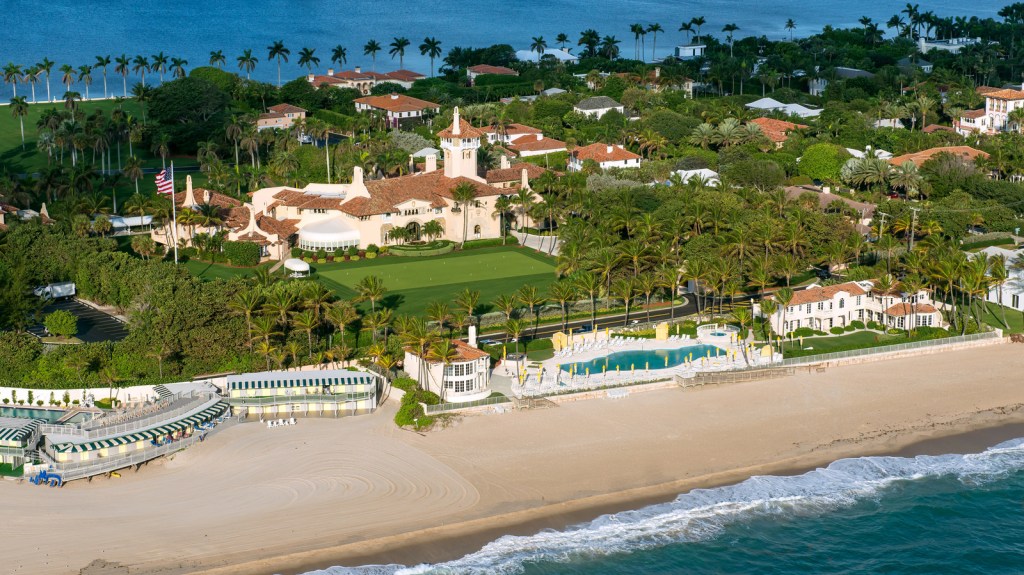
Compare that to the “democracy” of private beaches—like Mar-a-Lago or Jeffrey Epstein’s island. Whatever music that is created there, it sure isn’t Bossa Nova. It makes you wonder what kind of democracy is being promoted there it sure as hell does not promote harmony and cooperation like Frescobol but turns it into a zero-sum game where the rich win and everyone else suffers. Those private beeches make a mockery of a government for and by the people and it turns into a government bought and paid for by the rich and the powerful. And the only flip-flops created there are coming from ambitious politicians anxious to suck at the teat of power who are there to bend the knee.

Personally, I prefer the democracy of the beach to the democracy of the wealthy, entitled, and powerful. But you be you.

Posted in Uncategorized | Leave a comment

The Smoking Snake, My Dad, and The Forgotten Lessons of The Greatest Generation

My wife met my father for the first and only time in the last month of his life.

Three months earlier, I had met this gorgeous, smart, funny woman on an eighteen-day cruise up the coast of Brazil, with a transatlantic passage to Africa and Europe, ending in Savona, Italy. We bonded over many things, not the least of which was that we had both been caretakers to our fathers, in the final stages of their lives.

I went back to Brazil a month after we met, to do a gut check on whether this was just a shipboard romance or the honest-to-God, certifiable real thing. Sadly, her father had already passed, and I never got a chance to meet him, but Elaine put her mourning aside and, over the course of the next ten days, gave me a full tour of Rio. We took the cable car to the top of Sugarloaf. We toured the Tijuca Forest. We visited Christ the Redeemer. I saw the sand and decorative elements of Copacabana, Ipanema, and Leblon. I savored feijoada, farofa, pastels de camarão, and Picanha. I drank the coldest (and most delicious) beer I had ever had. It was wonderful and ticked off all the boxes a tourist might have on his checklist for “Cidade Maravilhosa.”

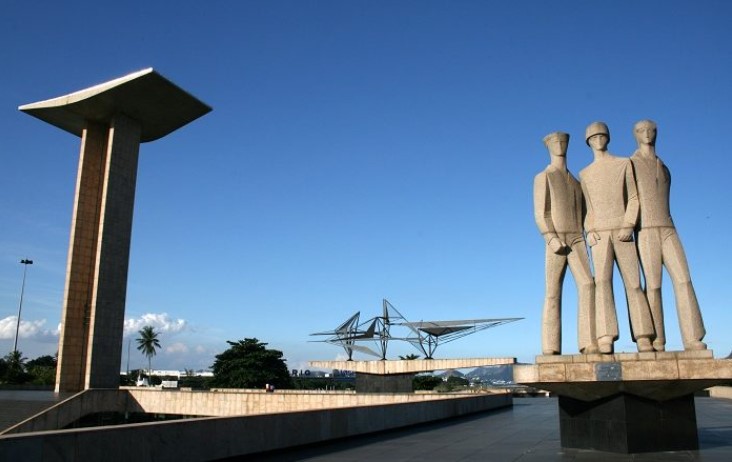
One place that my eventual wife took me, which is not on the normal tourist agenda, was the Monumento Nacional aos Mortos da Segunda Guerra Mundial, Brazil’s memorial to their troops who perished fighting during the Second World War. You may think this an unusual place for a new love to bring another, but Elaine knew me well enough to understand that this was exactly the way to show she understood me.

Elaine knew from our many conversations about our fathers that I was obsessed with my Pops origin story. Born in Vienna in 1925, my dad saw his synagogue burned down two weeks before his bar mitzvah on Kristallnacht. His family managed to escape Austria, arriving in New York Harbor three months after the war began, with no money and no English. By the time he was drafted into the Army five years later, he had completed two years of college. After receiving his commission as a second lieutenant in the artillery, he was sent to Italy as a member of the 88th Infantry Division, where he and his comrades in the Fifth Army fought their way up the boot of Italy until VE Day on May 8, 1945.

He was then, and will always be, my hero.

What I did not know until that day was that among his comrades in the Fifth Army was the FEB (Força Expedicionária Brasileira). They were 25,000 men of mixed race and limited training who wore a shoulder patch depicting a snake smoking a pipe. They adopted this symbol and the motto “A cobra vai fumar” (“The snake will smoke”) because before Brazil joined the Allied forces, there was widespread doubt, both domestically and internationally, about whether the country would actually send troops to fight. A popular saying at the time was, “It’s more likely for a snake to smoke a pipe than for Brazil to go to war.”  Despite being poorly equipped and minimally trained, they showed immense bravery and determination during the Gothic Line offensive and the battles of Collecchio, Bologna, and Montese. Four hundred sixty-seven of these soldiers lost their lives fighting totalitarianism and fascism.

The Smoking Snakes were heroes back home. They became known as the “pracinhas” and were given special privileges, including never having to pay taxes. In 1960, forty years before the U.S. began building its World War II memorial, Brazil completed its monument. Located on Guanabara Bay in the Flamengo Park neighborhood, it is a modern structure featuring a below-grade mausoleum that holds the remains of 467 servicemen who were brought home from Italy. They are commemorated by long, low stone peninsulas of simple marble tablets. An adjacent large space has permanent exhibits, films, and documentaries relating to Brazil’s participation in the European Theater including images of personnel and equipment of the era. The memorial is topped by a granite statue by Alfredo Ceschiatti honoring the personnel of all branches of service, and a metal abstract sculpture by Júlio Catelli Filho honoring the Air Force.

A little more than a month later, when Elaine met my father, we told him about our trip to the Brazilian World War II monument. He cocked an eyebrow and, with a wink, said, “Yes, I remember them well. They were very noisy.”

Last Friday, shortly after Trump ambushed Zelensky in the Oval Office, we were driving by the memorial, and I could not help but think about how the current president has ignored history. How appeasement in Europe—in the Sudetenland and in Poland—cost the lives of 70 million people. (That is more people than live in 95% of the countries in the world.) He seems to have never learned that the only way to deal with a bully like Putin is to punch him in the nose, and if he gets back up, you hit him in the nose again until he decides that bloody noses are not in his best interest. 

That was the lesson the Greatest Generation taught us. It was the reason they created NATO: to ensure that aggression toward any of its members would be met with force, quickly and aggressively. And it kept the peace in Europe for eighty years: the longest period of peace on the continent since the time of Christ.

But what bothers me the most is that the sacrifices the Greatest Generation made for us, whether in the U.S. or in Brazil, are being washed away by a man who cares little for what they gave up to create a better world and  is only concerned with the amount of money and personal power he can claim while being President of the United States.

I mourn for the Republican Party which used to understand the cost of freedom is vigilance against totalitarianism and authoritarianism. Today, they have devolved into the party of sycophants, conspiracy theorists, opportunists and profiteers. 

I grieve for my dad and the Greatest Generation. I only find solace in the fact that most of them are dead, so they cannot see how badly we have fucked things up.

Posted in Uncategorized | Tagged , , , | Leave a comment

Jardim Itanhangá, Carnival and Washington DC

Posted in Uncategorized | Leave a comment

Jardim Itanhangá, Carnival and Washington DC

We live in a quiet neighborhood of Rio de Janeiro, nestled in the shadow of Pedra da Gávea—the world’s tallest coastal monolith (2,769 feet)—and a cone-shaped granite dome (whose name I don’t know and, apparently, neither does anyone around here. I have asked.). The neighborhood, Jardim Itanhangá, translates roughly to “Garden of the Stone,” and its streets and homes are graced with stunning foliage, from golden acacias to orchids of every variety, from Emperor’s Scepters to Bismarck Palms. I could go on, but imagine a tropical forest, and you’ll get the idea.

Its fauna is just as diverse. Instead of squirrels, we have tamarin monkeys (an improvement), big-eared opossums (definitely uglier), hummingbirds, parakeets, egrets, bem-te-vis, and even the occasional capybara.

Needless to say, my usual 2.5-mile trek through the neighborhood is always scenic, interesting, and filled with the constant sense that I’ll discover something new around every bend.

This was never truer than yesterday.

Around mile two of my walk, directly adjacent to a trail leading up to Pedra da Gávea and near a playground for neighborhood children, sits the Wiz Mart. It’s a tiny, overly air-conditioned, self-serve market (a lifesaver for those moments when you realize you’re out of something but can’t summon the energy to trek to a store miles away). It carries everything from cleaning supplies to snacks, frozen dinners to ice cream, beer to Powerade. I stop there almost every day for a sports drink—and, if it’s particularly hot, an ice cream bar.

Yesterday, as I approached this little oasis, I was surprised to see two women emerging in full Carnival attire. One was dressed as an indigenous figure, wearing a thong, headress and a bikini-style top. The other was a samba dancer, complete with dazzling plumage and glittering—if not exactly modest—clothing.

While not entirely unexpected (a Carnival party was happening down the street), it was a noticeable departure from the usual neighborhood wildlife. And it made me realize something: despite having visited Brazil for thirteen years, being married to a Brazilian beauty for twelve, and having watched countless films depicting Carnival, I had no real understanding of what it was—beyond a massive party leading up to Lent. (And, if I’m being totally honest, due to my Hebraic heritage, my grasp of Lent is pretty rudimentary.)

So, I decided to educate myself.

According to my most reliable source, my wife, the predecessor to Carnival was a festival called Entrudo, which may have roots in the Roman festival Lupercalia, a mid-February fertility celebration involving masks, rituals, and street festivities. In Portugal, Entrudo was marked by rowdy street parties where people gleefully hurled water, flour, mud, and citrus fruits at each other. When the Portuguese colonized Brazil, they brought the festival with them, and it became particularly popular in Rio, Recife and Salvador. There, it evolved. The wealthy organized masked balls, while the lower classes continued the tradition of messy street battles. Over time, Entrudo blended with African and Indigenous cultural elements, incorporating new rhythms, dances, and instruments—eventually becoming what we now know as Carnival.

I also learned that Carnival’s meaning is derived from the phrase “without meat,” a reference to the fasting associated with Lent. The excesses of the celebration not only highlight the fleeting nature of worldly pleasures but also serve as a release of inhibitions before entering a more introspective and devout Lenten period. The masks, disguises, and costumes allow people to shed their social identities and embrace the personas they feel truly represent them.

Finally, Carnival is a time when rich and poor, young and old, Black, brown, or white, all come together. It aspires to create a sense of unity before the personal journey of Lent. It encourages forgiveness and reconciliation before entering a period of self-reflection.

All this learning made me think: Perhaps the time has come to bring Carnival to Washington, D.C.

It might serve as a reminder to those in our nation’s capital that the world is progressive in nature. Nothing stands still. What began as a Roman fertility festival, then transformed into a mud-rowing party, has evolved into a grand celebration that ultimately reflects Christianity’s most profound meaning.

It might remind those who have forgotten the fundamental promise of our country: E Pluribus Unum—Out of many, one. Just as Carnival arose from European, African, and Indigenous traditions, the United States is strongest when it embraces all of its citizens.  Carnival would not be the vibrant, joyous event it is without the contributions of different cultures. Similarly, the United States would not be the nation it is without the diverse communities that have made it their home.

Carnival is not about the rich or the poor. It is about connection. It unites people across socioeconomic lines. Our nation was founded as a democracy, not an oligarchy, where the poor and middle class are just as vital to our success as the wealthy, the powerful and elite.

Finally, it would serve as a constant reminder to the current occupant of the White House that forgiveness, reconciliation, and reflection are far more important than personal grudges, vendettas, or the pursuit of power

There is one downside to all of this. By tradition in Rio, the keys of the city are turned over to “King Momo” on Friday morning and serves as the King of Carnival until its conclusion on Tuesday night. By tradition, King Momo is tall and fat. Need I say more. We already have a tall, fat man who thinks he is King.

Posted in Uncategorized | Leave a comment

The Tijuca Forest, Climate Change and Pissing in A Stream

Baby, It’s Hot Outside

How hot? The cisterns that hold our water are located in the eaves of our attic, providing additional water pressure for the home. In the three weeks we have been here, we have never had to turn on our hot water heater to shower. The water that comes out of the tap is warm enough on its own.

There is no doubt in the minds of most Cariocas (Rio de Janeirians) that this is due to global climate change. I would argue that they probably understand it better than most.

All they need to do is look southwest to the Pantanal, the largest tropical wetland and flooded grassland in the world. It provides essential sanctuaries for migratory birds, critical nursery grounds for aquatic life, and refuges for creatures such as the yacare caiman and deer. But it is under threat. Climate change has dropped water levels to nearly half of what they were 20 years ago. Commercial exploitation—through fishing, cattle ranching, pollution, and deforestation—has contributed to the destruction of what was once one of the world’s most pristine ecosystems.

And then, there is the Amazon. The lungs of the world have emphysema. Over the last twenty years, more than 186,000 square kilometers of the Amazon have been deforested. To put that in perspective, that is larger than two-thirds of the countries in the UN—or imagine the entire state of Oregon stripped of trees in a single generation. The Amazon helps absorb the world’s CO₂ emissions. Less forest means more CO₂, which means higher temperatures worldwide. It affects regional and global rainfall patterns, decreases biodiversity, hinders medical research, and leads to the destruction of indigenous peoples’ habitats.

But honestly, Cariocas don’t need to look beyond their own city to understand climate change. In the late 18th and early 19th centuries, the jungle in the hills of Rio was systematically harvested for building materials, firewood, coffee plantations, and livestock grazing. The streams that fed the forest were a major source of water for the city, but without the forest, there was nothing to hold the streams back. When it rained, there were flash floods and landslides. When there was no rain, there was no water, and the tropical city went thirsty.

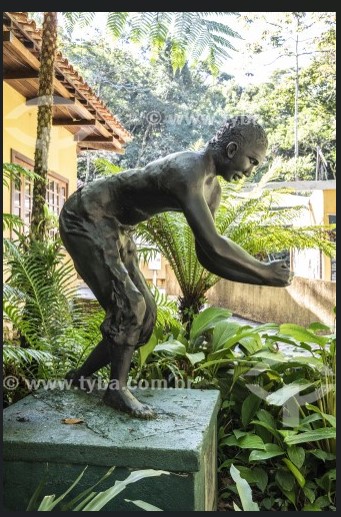
In 1861, recognizing the problem, Emperor Pedro II placed the land under federal control and initiated efforts to restore the forest over the now-barren slopes and abandoned fields. The replanting was carried out by six enslaved people—Elueuteiro, Constantino, Manuel, Mateus, and Maria. Over the next 16 years, they planted over 100,000 trees. Today, the Tijuca National Forest, covering nearly 4,000 hectares, is the largest urban forest in the world and a UNESCO World Heritage Site.

As I walk around our neighborhood in the near-100-degree heat, looking at the forest that surrounds us, I can’t help but think about the lessons we should have learned.

Left unconstrained, individuals and corporations will exploit and destroy the environment to enrich themselves, with no regard for the consequences. It is an immutable law—no industry has ever self-regulated in favor of the greater public good. As Teddy Roosevelt (back when Republicans were the progressives) once said:

“Defenders of the short-sighted men who, in their greed and selfishness, will, if permitted, rob our country of half its charm by their reckless extermination of all useful and beautiful wild things, sometimes seek to champion them by saying the ‘game belongs to the people.’ So it does; and not merely to the people now alive, but to the unborn people.”

Teddy believed, as did Pedro II, as do I, that government must play an active role in protecting the environment—not just for us, but for the generations to come. This includes supporting global agreements such as the Paris Climate Accords and the Rio Earth Summit. It means investing in clean energy initiatives like solar, wind, and nuclear power and setting environmental goals for emission standards in transportation and industry.

What it certainly does not mean is denial.

I cannot deny walking around our neighborhood in the early afternoon, in 100-degree heat, downing a liter and a half of water. And the government should not be denying climate change, as the Trump administration has done—by denying farmers access to climate data, withdrawing from the Paris Accords, rolling back renewable energy support, slashing budgets for climate research, and reducing environmental protections.

Many years ago, I was walking through a forest in the Tel Dan Nature Reserve in Northern Israel with my father and a guide. It is a beautiful place, full of streams and springs, one of the major sources of the River Jordan. At one point, we came across a little boy—no more than seven or eight years old—who was joyfully peeing into one of the streams. Our guide said to him,

“Don’t you know that if you piss in the water, it will come out of your tap in Tel Aviv?”

Without missing a beat, the boy replied,

“That’s okay. I live in Jerusalem.”

Beyond being a wonderful story about the inbred chutzpah of Israelis, it is also a powerful metaphor. Children do not understand the consequences of their actions. It is up to adults to teach them that when you piss in a shared resource, you foul it for everyone.

The Trump administration needs to understand that denying climate change, silencing discussions about it, or refusing to participate in global solutions does not alter reality. All it means is that we continue to piss into the springs we all drink from

Posted in Uncategorized | Tagged , , , , | Leave a comment