Brazil imported more than 4.8 million Africans as slaves—almost eleven times more than the American colonies and the U.S. during its own shameful past. Even more shocking is that 50% of those who arrived in bondage in Brazil died within five years of their arrival. That is mass murder, a holocaust by any definition.
I first learned of Brazil’s ugly past with slavery on my first date with my wife.
We had met the night before when we became dinner companions on the cruise ship where we were both traveling. She was radiant, beautiful, and had a delightful Brazilian accent. How could I say no when, after finding out that I had never been to Salvador, she volunteered to be my tour guide?
If you don’t know Salvador (saw-va-DOH), it was the colonial capital of Brazil and the heart of its slave trade. When you arrive in the upper city and the neighborhood of Pelourinho (it means whipping post in Portuguese) , it looks like a movie set depicting the Brazilian colonial era. The Baroque and Rococo architecture features pastel-colored buildings adorned with decorative tiles, ornate balconies, and grand wooden doors. You are greeted by Black women wearing Traje de Baiana (Bahiana attire)—long, flowing, multi-layered, petticoated dresses with intricately patterned lace blouses, shawls, and head wraps made of patterned fabrics. Their beaded necklaces provide percussion as they move to a beat only they can hear.
I am enchanted.
As we make our way to the Igreja de São Francisco (The Church of Saint Francis), we come across a group of people watching a troop of shirtless teenagers in white baggy pants demonstrating Capoeira. I had heard of this mix of martial arts, dance, and music before but had never seen it performed live. Elaine tells me that this is uniquely Brazilian, created by the enslaved Africans brought to Brazil as a means of self-defense. Their movements are mesmerizing, and we watch and applaud as they demonstrate their skills.
Just before we reach the church, we stop before a statue of a shirtless Black man standing on one foot, holding a large spear, gazing into the distance. His face is proud and defiant. Elaine tells me this is Zumbi dos Palmares, King of the Slaves. An escaped slave, he was the leader of the largest quilombo—a settlement of escaped slaves—in northern Brazil. He fiercely fought the Portuguese and their efforts to subjugate the quilombo until his death in 1695. He is celebrated for his resistance and remembered every year on November 20, Dia da Consciência Negra (Black Consciousness Day).
I am dumbfounded. Not because there is a statue honoring this man, but because I know that the history of enslavement in the U.S. is largely glossed over in most school curriculums. There are still those who believe slavery was relatively benign and that those who were enslaved actually benefited from their enslavement.
I need to make an admission here. I do not care much for churches. As a Jew, they make me feel uncomfortable and a bit paranoid. I wonder whether I will be found out by the parishioners and tossed out on my ear for being a heathen, or whether a bolt of lightning will come from the heavens for failing to accept Jesus as my savior. That said, the Igreja de São Francisco is amazing. From the decorative tiles in its courtyard to its gold-leaf interior with elaborate wood carvings, you can sense that those who built the church were celebrating their God with all the skills they possessed.
As we leave the church, we are confronted by a beggar. He is in a wheelchair, and his legs and arms appear to have been put on backwards. It is disturbing—horrifying, really. It is a punch-in-the-nose reminder of the abject poverty some suffer here, and I cannot get a 20-real note out of my pocket fast enough.
We eventually make our way to the Mercado Modelo and find a table at an outside café, ordering some of the coldest beer I have ever had. It goes down way too easily, so I have another, and Elaine orders us some pastéis de camarão, the Brazilian version of empanadas. As we eat and drink, we are entertained by a series of performers, including samba dancers, Axé, and samba-reggae musicians. When I mention to Elaine how much I enjoy the entertainment, she tells me that the Afro-Brazilian heritage in music and dance is one of the reasons Michael Jackson came to Salvador to film the music video for “They Don’t Care About Us.”
I know the song. It is an anthem about racism:
All I want to say is that they don’t really care about us
Don’t worry what people say, we know the truth
All I want to say is that they don’t really care about us
Enough is enough of this garbage
All I want to say is that they don’t really care about us
Skinhead, deadheadEverybody gone bad
Situation aggravationEverybody, allegation
In the suite on the newsEverybody, dog food
Bang-bang, shock deadEverybody’s gone mad
I ask, “Why do you think he came here to film the video?”
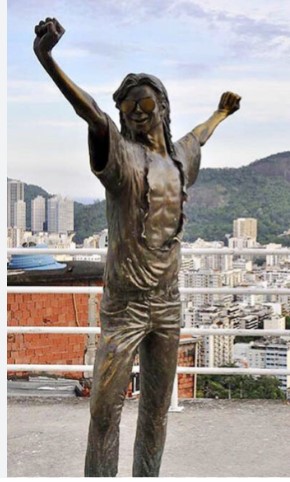
She tells me she believes he came here for three reasons: first, because of the rich musical tradition of this place and the beat he was trying to create, and second, because of the racism that still exists in Brazil and finally because the only country in the world with a more shameful history of enslavement than the US is Brazil. She explains that even though over fifty percent of the Brazilian population identifies as Black or “pardo” (mixed race), racial prejudice is very much alive in Brazil. She tells me that Michael is a legend in the favelas, there is even a statue of him in Dona Marta favella, because he came here to shine a light on the prejudice and poverty they suffer through every day.
I think about that day a lot these days, especially since Trump and his supporters have launched a war on DEI. Brazil, a country where more than half of the population is at least partially of African heritage, recognizes that it has a race problem. They have enacted specific policies such as:
Law 14,553/2023, amending the Brazilian Statute of Racial Equality, which mandates that employers include fields for employees to self-identify their racial or ethnic backgrounds in administrative documents.
Affirmative action policies such as income- and race-based quotas in federal universities since 2012, improving access to higher education for underrepresented groups and leading to enhanced labor market prospects.
The Ministry of Racial Equality, reestablished in 2023, is dedicated to promoting racial equality and combating discrimination.
You cannot fix a problem until you acknowledge you have one. And you have to be blind not to see the racial problem we have in the U.S. Brazil still has a long way to go but at least they understand they have a problem.
This is a long way to say:
Diversity is not a swear word. It means giving ourselves the opportunity to see the world from multiple perspectives. Perspective is the key to seeing the whole picture, not just a single frame.
Equity means providing people with a level playing field. Fair play is at the center of our culture. When there is inequity, fair play does not exist, and we fail as a society.
Inclusion means feeling as if you belong. Many of us have felt like outsiders looking in at one time or another. It is a lonely feeling. Making someone feel welcome is an obligation we have as a society. Understanding how some may not feel included is called kindness, and it is not a sin.
Not far from where we live is the neighborhood of Rocinha.
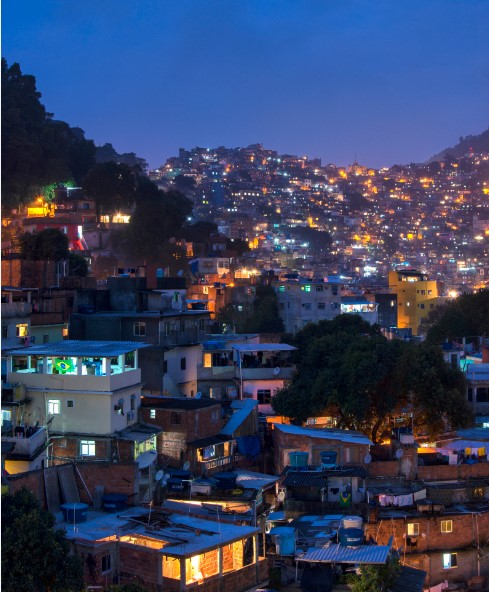
We pass by it—really, through it—every time we travel from our home in Barra da Tijuca to Leblon, Ipanema, or Copacabana. Perched on a sheer mountainside, it commands breathtaking views of the beach and the ocean beyond. At night, it is literally a shining light on the hill.
If this were any other city in the world, the homes here would be among the most expensive.
But this is Rio Instead of luxury living, Rocinha is the city’s largest favela, home to upwards of 200,000 people crammed into just 0.86 square kilometers (0.33 square miles)—a population density nearly five times that of Mumbai.
Favelas are institutionalized slums that emerged when Black, Brown, and Indigenous people left their slavery adjacent jobs in rural areas in search of a better life in urban centers like São Paulo and Rio de Janeiro. Unable to find affordable housing on their less than subsistence wages, they “squatted” on unoccupied land. In Rocinha’s case, that land was a former coffee plantation worked by sharecroppers. They built their own homes—first shanties, which over time evolved into brick structures, often stacked on top of one another, some reaching three stories high. They developed their own infrastructure, frequently tapping into electricity, water, sanitation, and cable services illegally.
You might think the city would have objected to this land occupation. After all, the land was owned. But the authorities either turned a blind eye or didn’t object too loudly. It solved a problem for them. If the poor had somewhere to live, the government didn’t have to invest in housing. A policy of benign neglect took root.
To those who champion unrestrained capitalism and minimal government intervention, this may seem like a perfect solution. The government spent nothing—no reals, no taxpayer funds—while simultaneously creating a permanent underclass to serve the more fortunate.
As anyone who has seen Cidade de Deus (City of God) knows, such neglect has dire consequences. Nature abhors a vacuum. Where there are no rules, people create their own—or, more accurately, the powerful impose their own rules on the powerless.
In the favelas, drug traffickers and militias filled the void. They established their own communities governed by rules outside Brazil’s legal system. Those living in favelas must pledge absolute loyalty to the criminal and paramilitary organizations that control them. In return for their obedience, residents receive protection and occasional rewards. This system, known as narco-populism, sees traffickers providing food, medicine, and cash to struggling families. In many cases, they were more effective than the Bolsonaro government in distributing aid, enforcing quarantines, and providing medicine during the pandemic. They fund community events and enforce a strict code of conduct, punishing petty crimes like theft and assault with severe punishments for the violators.
Police rarely enter the favelas—it’s simply too dangerous. At the first sign of an approaching patrol, lookouts launch fireworks, alerting the entire neighborhood. Armed enforcers prepare for battle, often leading to bloody shootouts that leave scores of residents and police dead.
No wonder many police officers find it heathier and if we are being honest, far more lucrative to stay out.
The result of this cycle is captured in the phrase “Nascer no morro, morrer no morro.” Born on the hill, die on the hill. In other words, those born in the favelas rarely escape the institutional poverty that traps them. They are condemned to a life of servitude, working for the middle and upper classes as maids, laborers, street vendors, or drug mules.
In the United States, we are taught that if you work hard, play by the rules, and use your intelligence, you can achieve anything. The American Dream promises that anyone can rise from poverty to wealth in a single generation.
But that dream crumbles in the face of institutional poverty. And the surest way to create a permanent underclass is by dismantling programs that protect the financially marginalized programs the Trump administration is determined to destroy.
Eliminating the Department of Education and diverting public school funds to private vouchers leaves marginalized communities without the resources necessary to educate their children. Cutting welfare pushes desperate families toward survival strategies that criminal organizations can exploit. Slashing Medicaid would not only lead to higher rates of disease and death but also create yet another opportunity for drug cartels and other predators to take advantage of those least able to defend themselves by providing health services the government declines to provide and generate a market for social media cures that generate even greater problems. .
I could go on, but you get the point. Gutting social welfare programs may save a few dollars in the short term, but the long-term consequences will be catastrophic. If you want proof, just look at Rocinha. Then ask yourself: What do we want to be? The shining light on the hill that is Rocinha or the vision John Winthrop and John Kennedy had for America.
You may remember the kerfuffle X got into with Brazil last summer. For a few months, the social media platform was banned from doing business in the country. At the time, the disingenuous right claimed that Brazil’s actions were an affront to free speech—that people’s rights were being trampled on and that Brazil was not a true democracy.
As with so many arguments from Trump and his acolytes, this could not be further from the truth. In fact, what Brazil did was a protection of free speech. Let me go a step further: the current laws in the United States actually contradict the very concept of free speech. Let me explain.
The Brazilian constitution enshrines and celebrates free speech, particularly after decades of dictatorship. The framers of their constitution wanted to ensure that dissent was protected. However, as in the United States, the right to free speech is not absolute. Brazil specifically excludes hate speech, racism, discrimination, and the deliberate spread of fake news. Their laws also prescribe penalties for slander, defamation, and incitement to crime. When Twitter (now X) refused to comply with these regulations, it was shut down until it agreed to pay a large fine and establish in-country accountability for its actions.
The U.S. Constitution enshrines free speech in the First Amendment, but, as in Brazil, this right is not absolute. You cannot yell “fire” in a crowded theater. You cannot commit slander or libel. You cannot incite a riot. Civil and criminal laws ensure that those who cross the line are held accountable, providing the state and private citizens with remedies for protection. Media companies that violate these protections can be sued—just ask Fox News about their $787 million settlement with Dominion Voting Systems.
These U.S. laws that protect against slander and libel safeguard free speech by ensuring that what is said is truthful and decent, preventing individuals and companies from spreading spurious and hateful lies that cause harm—just as the Brazilian constitution does with its carve-outs.
Unfortunately for those of us in the U.S., we have Section 230 of the Communications Decency Act. This provision states that “No provider or user of an interactive computer service shall be treated as the publisher or speaker of any information provided by another information content provider.” In practice, this means that social media companies cannot be sued in the same way traditional publishers can, even if they disseminate libelous content. Ironically, this section of the law undermines decency and contradicts the ideals of free speech.
There is an old Jewish parable that illustrates why this is so dangerous.
A troubled congregant once approached their rabbi and confessed to having spoken ill of someone in their community, spreading harmful rumors and gossip. They now deeply regretted their actions and asked how they could make amends.
The rabbi instructed them to take a feather pillow to the top of a hill, cut it open, and release the feathers into the wind. Confused but eager to make amends, the parishioner followed the rabbi’s instructions and watched as the wind carried the feathers far and wide.
When they returned, feeling relieved, the rabbi gave them a second instruction: “Now, go and collect every single feather.”
The parishioner was distraught. “But that’s impossible! The wind has carried them all away!”
“Exactly,” said the rabbi. “Just as it is impossible to gather every feather, it is impossible to take back every word of gossip. Once spoken, words spread beyond our control, affecting people in ways we may never see.”
There is no metaphorical wind that spreads misinformation faster than social media platforms. There is no greater threat to free speech than the immunity that Section 230 provides them. In an era of AI, deepfakes, and malicious actors who manipulate the system for their own gain, it is time for social media companies to follow the same laws that govern every other media company and individual in the country.
One final note: Jair Bolsonaro, the former president of Brazil—often referred to as the Trump of the Tropics—has been banned from holding office because Brazil’s courts found that he convened a meeting with foreign ambassadors in which he made unfounded claims about the integrity of Brazil’s electronic voting system.
Just imagine how much better off we would be if we had the same laws as Brazil.
Brazilians do not eat the same breakfasts as Americans.
My friend Chatty… Chatty GPT (I know, it’s a strange name, but she is very smart) tells me that a typical American breakfast consists of eggs, bacon, toast, hash browns, and coffee. Not my breakfast. I usually have coffee and maybe a piece of toast. (But I don’t think anyone who knows me would consider me typical.)
A typical Brazilian breakfast—or at least the one we eat at home—is a roll, fruit (either mango or papaya), and perhaps some cheese. My wife often has a tapioca crepe filled with cheese.
But Americans and Brazilians alike are complaining about breakfast these days.
Brazilians are frustrated because the price of coffee has gone up over 80% in the last year. Brazilians drink coffee all day long—it is as much a part of their national identity as samba or football. So, you can only imagine the political fracas over the cost of coffee, with each of the 28 political parties not in power attacking the one that currently resides in the presidential mansion. This, despite the fact that global warming and a series of storms destroyed a large portion of the coffee crop—factors that have nothing to do with politics.
Americans, on the other hand, are complaining about eggs. (That is no yolk—sorry, I have a disorder.) The price of eggs has nearly doubled to $7.09 from $3.70 last February. Of course, our national yolk is blaming the Democrats, despite claiming he would bring down egg prices on day one. The problem, much like the rest of the Yolk’s national agenda, is based on a big lie. The real reason egg prices have skyrocketed is avian flu, which is running rampant across the U.S.—but we can no longer measure it because Yolk won’t allow us to see that data.
The difference between our countries’ breakfast issues is that Brazil’s coffee crisis has an end in sight. New coffee plants will be planted, prices will come down, and there will be no ripple effect. The U.S. problem, however, will not go away. We have a government that does not believe in science, refuses to share data, and won’t fund the research necessary to prevent future crises. This means the situation will continue unabated for the foreseeable future. Worse, the ripple effect will hit everything made with eggs—which is, well, just about everything. And of course, the price of poultry will rise, because fewer and more expensive eggs mean more expensive chickens.
Which brings us to the Yolk-in-Chief’s platform of lower grocery prices—and, stand by for the big reveal—it was a lie. Shocking, I know. Even less shocking—though far more frightening—is that his followers will believe him when he inevitably blames DEI, the scientific elite, and the far left for the high price of eggs.
Sadly, the yolk’s on us for electing him.
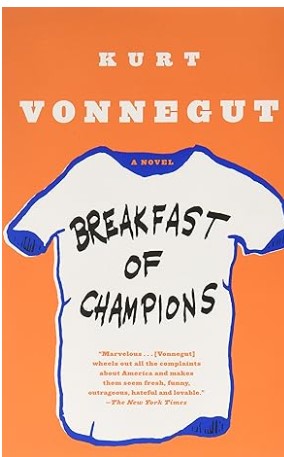
My favorite author’s favorite catchphrase is:“There ain’t no such thing as a free lunch.” When you elect a fool you get what you have paid for.
Sadly, we are about to be reminded of that every time we sit down to breakfast.
Not only is the temperature consistently above 90 degrees, even in the darkest hours of the night (thanks, global warming—oh right, that doesn’t exist because Donald Trump signed an executive order declaring it so…), but the mood of the Brazilian people is heated as well. They are angry at the U.S.
Last night, one of the leading stories on the nightly news was the return of undocumented Brazilians from the U.S. back to Brazil. The condemnation wasn’t about the repatriation itself but rather the callous manner in which the U.S. handled it. Returning Brazilians reported being handcuffed and denied food, water, or bathroom breaks for up to 12 hours. You wouldn’t treat animals that way.
It’s not that Brazilians dislike the USA or its citizens. I know a highly educated, beautiful Brasileira who actually married an American and seems happy—most days. But they are deeply suspicious of Trump because he reminds them of their own Trump wannabe, Bolsonaro. You remember him. He was President for a while, and then, after losing the election, he attempted the same coup as Trump by encouraging an invasion of the capital. Here’s the difference: almost immediately, Bolsonaro was convicted of election crimes and is now barred from running for office.
Brazilians love democracy. They fought for it for decades and have strict laws and a separate court system to ensure elections remain fair and that no one colors outside the lines. They see Donald Trump as an existential threat to their democracy. Let that sink in for a moment—a U.S. President is considered an existential threat to another country’s democracy. There is a lot of historical context behind that, including the CIA’s role in helping sustain Brazil’s former dictatorship, but weren’t we supposed to be the white hats, not the black hats?
The unintended consequences of this are multifaceted. Brazilians are now hesitant to travel to the U.S., meaning Disney World will never be the same. Because of cuts to U.S. aid, the Amazon—the lungs of the world—will likely face increased exploitation, giving the planet a metaphorical case of emphysema. And, in the name of “Make America Great Again” and defeating China in the global economy, we’ve effectively cleared the playing field for them. China is heavily invested in Brazil, with multiple initiatives, not the least of which includes a $690 billion loan.
Making America great again has, in turn, made China great in Brazil—which would only be tolerable if it improved the quality of Chinese restaurants here in Rio. (Don’t ask. It’s awful.)
American exceptionalism—our place in the world—was built on our willingness to fight for democracy and uphold our ideals globally. We were willing to sacrifice our best and brightest so the world could be a better place for all its inhabitants. Donald Trump has dimmed that light so much that, from here, it’s hard to see it at all.
That morning twenty-three years ago began like so many others had for me. I rose early, conducted my morning ablutions, walked the dog and was in a cab heading to my office at the Sporting News before 7AM.
You could not help but notice that it was an extraordinarily beautiful day. The heat and humidity of summer had been replaced by clear blue skies and crisp fall like weather. The type of day my mother used to describe as being “positively Swiss.” It was so beautiful that I hesitated for a moment entering my building so I could enjoy it before putting my nose to the grindstone.
At 8:15 I was convinced that the most exceptional thing that was going to happen to me that day was that my assistant had actually arrived at the office on time and had kindly brought me my second cup of coffee. I thought it was going to be a good day even when I heard an airplane flying low and fast over our heads and casually remarked to her that the FAA didn’t take kindly to aircraft flying so low over the city.
That plane turned out to be the first plane which had lined itself up with the neighboring Empire State building and was flying down 5th Avenue at five hundred miles per hour. We found that out when someone came running in to my office to let us know that the Towers were on fire. We ran to the southern windows of our 27th floor office tower. It was from those windows that we watched in horror the moments that changed us forever.
We saw the second plane hit with a burst of orange flame. We watched first tower crumble and fall. And the second. We had no way of knowing or comprehending what we had just happened:
246 people who had bordered their flights minutes before had cruelly died when their planes had been converted to missiles.
2,606 innocently working at their desks had lost their lives in cloud of flame and dust.
343 firefighters ran into the Towers and never emerged.
60 police officers disappeared into the buildings never to be seen again.
8 paramedics went to save lives and lost theirs instead.
I had no way of knowing that my childhood friend and neighbor Todd Rancke , the first boy I had met when I moved to Summit was among the victims.
After making sure that my staff had a plan to get home, and my address in case they couldn’t I began my walk home. I remember seeing dust covered people, heads down, no doubt in shock, mechanically walking up town.
On Madison Avenue cars were lined up bumper to bumper but there were no horns indicating impatience of perceived slights, just the tramp of feet as pedestrians made their way home.
Cutting across the park, I saw groups of people huddled around boom boxes listening to broadcasts of the grim news of the day. Overhead, unbelievably, I heard the buzz of fighter jets patrolling the skies of my city. At the Imagine mosaic someone had already laid flowers. I remember thinking that the world of Lennon’s lyrics
.
Imagine there’s no countries It isn’t hard to do Nothing to kill or die for And no religion, too
Imagine all the people Livin’ life in peace You
You may say I’m a dreamer But I’m not the only one I hope someday you’ll join us And the world will be as one
Never seemed so far away.
I got money from an ATM because cash comes in handy in a disaster. I shopped at an empty Fairway knowing the city could be cut off from food for days as they shut down all access to the city. I went home and turned-on CNN and waited for the waylaid and the dispossessed to arrive. They came. They went. And we watched endless loops of the Towers crumbling.
I remember the frustration trying to reach my parents on the phone. The collapse of the towers had knocked out a major switching station for AT&T and the cell phone lines were jammed. Only my Blackberry worked.
I will never forget how good it felt when I finally got hold of them hours later and tell them I loved them.
The next morning, I rose early and went for a long run as I was training for the Chicago Marathon which was only weeks away. I ran south along the West Side Greenway. As I approached the Chelsea Piers, I could see the smoke rising from the pile and seeing the nearly mile long line up of Ambulances waiting to assist those who were beyond assistance. I felt I had to do something.
After my run was complete, I went to the American Red Cross HQ near my home and waited for 16 hours to give blood that we hoped would be needed. When I emerged, the wind had shifted and the smell from ground zero now engulfed the city. It was like no other odor I had ever encountered. It was of death, fire and concrete dust and I wondered if this is the smell of hell.
I won’t lie. I didn’t go to bed that night thinking about the lessons we had learned in the last couple of days. At that point I was just grateful for the fact that most of those I loved and cared for were safe and sound. However, in the twenty years that have passed I have thought a lot about that day and what it has taught me.
Be grateful for everything. Every day is a precious day and that I need to do all I can do to savor it.
You don’t own a day you only rent it so you need to do your best and accept the stuff you cannot change.
I have learned to open my heart bigger, to love all, and to accept all for their gifts.
I have learned not to denigrate when I don’t understand someone or how they manifest themselves but instead to try to understand their journey.
Hold all those that I love close to me. They are hot house flowers and could disappear in a moment…love now.
Opportunities come in all forms. Be ready when the butterfly lands on your shoulder.
Prepare for the worst and hope for the best. And if the worst happens to look for the best in people even if they have not earned that trust.
My family, my wife, my sister, brother, brother-in-law nieces and nephews are my most precious gift. I do what I can everyday to make sure they know they are cherished.
Learn to love better every day. It is a skill that will never let you down.
I know we have not learned enough. The days of coming together to solve our common problems have seemed to have evaporated in fake news, invectives and mistrust.
I think about how together we felt as a country in the days that followed 9/11 and how it good felt when everyone had each other’s back. I lay much of the blame for that on our former President and his political allies who rallied to divide not to include. And to be blunt, I have grown intolerant of their bullshit. Last night’s performance of ad hominem attacks, weird tales of pet barbeques, and outright lies confirmed it.
September 11th should have taught us that we are all in this together. That you need to look out for your family, friends, and neighbors. That facts are facts. Cut the crap. Do your part and get over yourself. Ask your neighbor if they need help. Say a kind word to everyone you encounter. Smile at strangers. Every person who died on that horrible day twenty years ago would do anything to be in your shoes.
On Thursday, Donald Trump stated that the Congressional Medal of Honor, the highest military honor we bestow, is not as prestigious as the Presidential Medal of Freedom.
He said that the “Presidential Medal of Freedom is much better” because those who receive the Medal of Honor are often severely injured or deceased. He emphasized that recipients of the Medal of Honor are typically “in very bad shape because they’ve been hit so many times by bullets, or they’re dead,” contrasting this with recipients of the Presidential Medal of Freedom, whom he described as “healthy, beautiful” people.
To be awarded the Medal of Honor, a recipient must go through the following process:
Recommendation by chain of command.
Command review.Chain of command review.
Service Branch Review
Department of Defense Review
Presidential Review.
Congressional Notification.
To be awarded the President Medal of Freedom the only requirement is that the President decides to give it to you.
In other words, there is no comparison. The Medal of Honor is awarded to those who have taken an oath to serve this country and were willing to, or did, sacrifice their life for their country. It is not a political award like the Presidential Medal of Freedom.
Why would Donald Trump say such a completely senseless thing? The secret, I believe, lies in who he has given it to—one person in particular: Miriam Adelson, the billionaire Republican megadonor, whose political advisors were present at Trump’s press conference. He was reminding them that he had given her the most important honor the country can bestow, and she owed him.
Is it a surprise that, after the press conference, Adelson’s political aide Andy Abboud was overheard telling attendees at a campaign event at Trump’s golf club in Bedminster, New Jersey, on Thursday that whatever the GOP presidential nominee needs from Adelson, he’s going to get, according to Abboud and a person with direct knowledge of the matter?
This is what we have come to expect from Donald Trump—quid pro quo for his friends in the billionaire class, with little regard for what his words mean to those who fought and died for our country. They don’t matter.
Allowing a man as base, shallow, and transactional as him to be Commander-in-Chief would be a disservice to anyone who ever fought for this country.
I wake up late in the afternoon and the room is dappled with light and shadow. I make no effort to get up. I have no place to be and where I am seems as good a place to think as any, perhaps even nap a little longer. But then I think of Fennie. She has not been walked since early this morning and she is not averse to leaving me messages I would have to clean up later if her walking schedule is not kept. I look around the room. Fenway, good girl that she is, is laying on the sofa directly opposite my chair making sure that some hobgoblin or some other evil spirit did not bother me while I slept. She is not alone. Sitting next to her is my mother or at least the early twenties version of her. Hair cut so it just touched her shoulders, wearing a white blouse with a princess collar, a navy cardigan and matching skirt. There is a single strand of pearls around her neck.
I am not completely surprised to see her. This is not her first visit with me during the last few months. They mainly occurred during activities that reminded me of her such as going to the supermarket I used to take her to on Saturday mornings or the hairdresser we both used to get our haircut. Or when I felt particularly alone. She rarely said anything. There was no need. Her presence was enough.
Today was different. She asked, “Did you like the book?”
I said, “I really did.” She looked at me the way she used to when I was young. The one she used when I would come home from school, and she would ask how school was. “Fine” was not an acceptable answer. She wanted details. What had I learned that day. Whom had I played with. Had I had any troubles during the day. A full report. Not some dismissive thrown away line. Understanding her look, I continued “You know I love Verne. He writes with joy and a little snark. He beckons the sense of adventure in all young boys no matter how old they are. And he is a hopeless romantic, like me, so reading his book makes me feel as if I am reading a kindred spirit. Even the late nineteenth century style of writing, when the author is being paid by the word does not bother me because he uses glorious words, we don’t use any more like “pedant “and “savant.”
Mom smiled in the way teachers smile to encourage their students to go a little deeper. She asked, “What did you think of the book’s conclusion.”
“It was very romantic.”
“True. And?”
“I think he missed an opportunity?”
“How so?”
“At the end of the book Heather tells Oliver that they no longer need to search for the green ray. Her quest to find the ray, to ensure she finds love, is complete. She has found him, and her quest is complete.”
“And?”
“I don’t agree. Happiness is a constant struggle. Love, once found, needs to be nurtured and cared for. Joy and happiness are temporary states of being. If they weren’t we would never grow. And not to sound like a greeting card, or some television guru, everyone is on a constant journey to find happiness and to make sense of the world. Just because you have it now does not mean you will have it tomorrow. It is a never-ending journey. Not a destination. The obligation that we have to ourselves is to constantly search for our green rays, whatever it is. And if you find it, amen! But it shouldn’t stop because the sun has set on that day. There is always tomorrow’s green ray that needs to be found. And if you don’t see it, if you don’t experience it, that is okay too. Tomorrow gives you another opportunity. It is the struggle and the hope that makes the green ray special.
Mom smiles and says, “Top marks” and opens her arms beckoning me for a hug. As I attempt to extricate myself from the chair my book falls to the floor. I bend over to pick it up and when I look up, she is gone.
I feel the boat’s engines burble off. The boat is adrift, but Captain Kam has, with the skill of a sea goddess, positioned the boat so its stern is facing west. We are adrift. Waiting for the sun’s daily swan song. From where I sit, I can see on my right the black silhouette of the hills of the Kapalua peninsula jutting out into the inky blue of the Pacific. To my left, the northern tip of Lanai and perfectly centered between the two, in a robin’s egg blue sky is the golden sun. The rest of my party has not joined me in the stern. I don’t know why. Maybe they are not interested in postcard perfect sunsets or seeing green flashes. Or maybe they just don’t know that the day is about to give way to the night. Captain Kam and Mo are also strangely absent. Perhaps they have seen too many sunsets for this one to matter or far more likely, knowing the captain, she feels her presence would be an intrusion.
None of my ghosts are here either. Mom, Dad, Desmond, Wen, Duke and Con and all the others have decided that, at the moment, their presence is not needed. I am alone and grateful for the quiet. The sun, now a brilliant yellow, with a tangerine halo, is a perfect circle just centimeters above the sea. The sky above it is an ombre of pumpkin to burnt sienna to apricot.
The last eighteen months have given the gift of time. Time to think unencumbered by the normal daily distractions of life. To evaluate where life’s journey has taken me and to contemplate which path I want to take next. As cruel and unforgiving as Covid has been it has also given me time with personal ghosts. Those spirits, that in other times, would haunt you in the middle of the night, and keep you from returning to your dreams. Most of those phantoms are no longer belligerents and are now allies. I no longer struggle with them but instead, when they visit, they help me in my battles for sanity and self. The few I still wrestle with remind me that the journey continues, and I find peace in that too.
A small gust of wind moves across the ocean’s surface, flattening it as if by an unseen hand. It disturbs a flock of seagulls who were resting in our wake, it brings with it the scent of the clean, crisp briny smell of the ocean and a hint of jasmine and hibiscus from the nearby shore. It is the smell of paradise, or at least this one. I wish that I could bottle it and take it with me. But as I can’t, I breathe it in, hoping that my memory will be an adequate repository for it.
The sun touches the sea. It is now a small globe so yellow it is almost white surrounded by a pyramid of saffron with a terracotta scarf that spans the horizon. It is descending rapidly now. It seems to have cast off Maui’s ropes as it urgently moves for the day to end. I appreciate its haste. How many times over the last sixteen months have I just prayed the day would end? Hoping against hope that when I woke on a new day that the nightmare of fear, disease and failed leadership will have evaporated in the night and been replaced by a world that more closely resembled the normal world that came before. But it never did.
Over time I have come to see it as a gift as had so many others. Instead of plodding along on the course we set ourselves on years ago we have been forced to question it. Confront the lives we are living and decide whether it is what we really want or is there a better way. While I welcome the night, and the rest that it brings, I know longer dread the days because the light of those days has made me who I am, and I am better than I was before.
The setting sun has shape shifted again. It is now a half dome with a core near white light surrounded by a saffron case. The sea is stained with golden highlights and there is a beam of shining gold that seems to start at our boat and run directly into the heart of our sinking star.
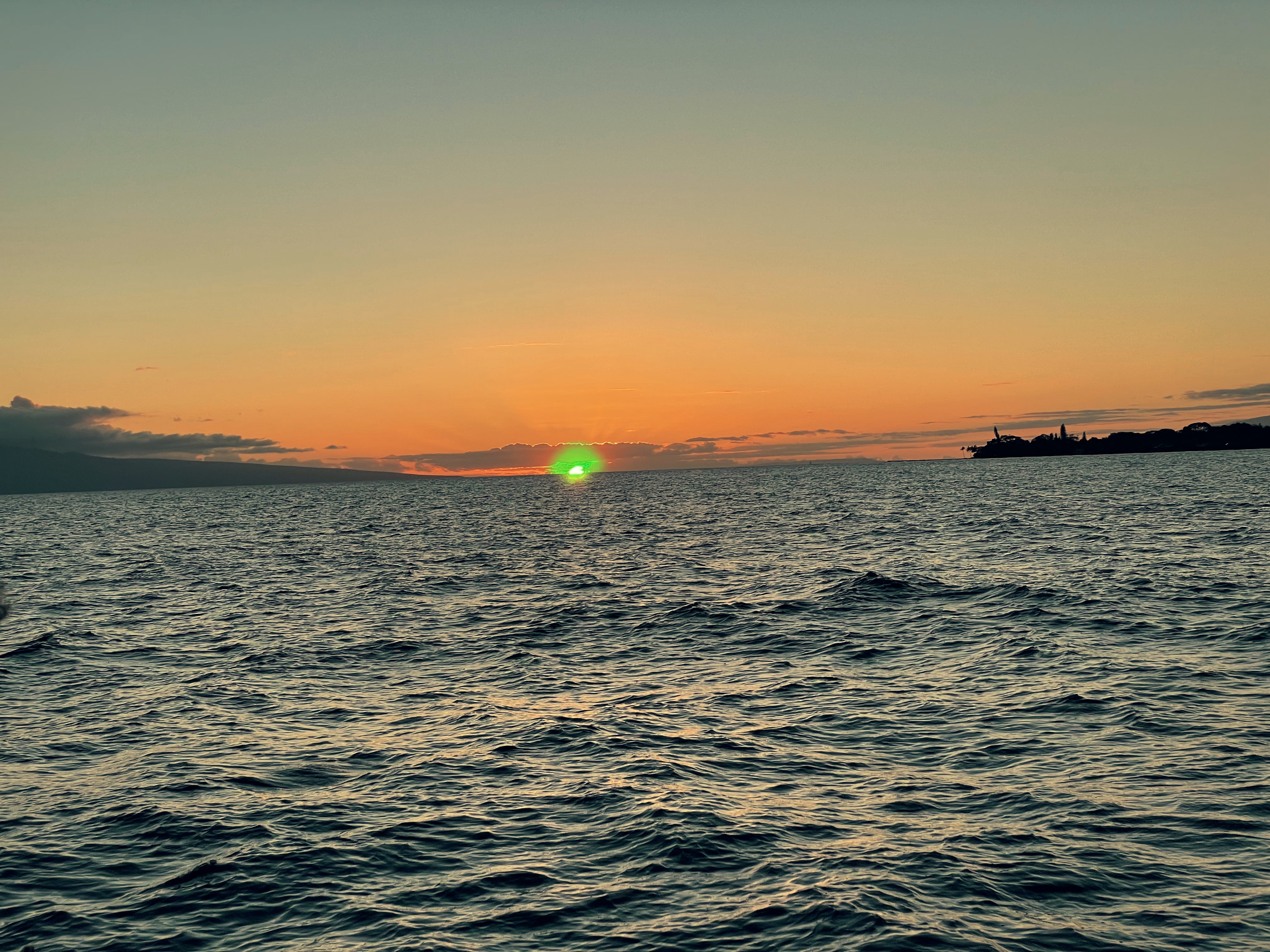
The halo changes. The sky above it is an ombre of pumpkin to burnt sienna to apricot. Slowly, by millimeters it descends into the sea. First a quarter, then a half, and finally just a fingernail of golden yellow. Then, without fanfare it dips beneath the waves and just as I think I will be disappointed once again, there is a brilliant flash of jade.
Kam is at my shoulder. She asks, “Did you see it?”
Without taking my eye of the horizon I reply, “I did.”
“And?”
“I am glad to have seen it.”
“Nothing more than that?”
“Honestly?”
“You don’t need to lie to me.”
“I was a little underwhelmed.”
“You didn’t think it was beautiful?”
“No. It was amazingly beautiful.”
“Then what?”
“I guess that part of it is that I have that looking for the green flash for so long to have it come and go in seconds and with as little fanfare as any other moment in any other day seems incongruous for me. I am not saying there should have been heavenly music and a bolt of energy pass through us leaving us physically and emotionally different, but it should have been more than what it was.”
Kam caught my gaze and gently said “You said that was part of it before I say anything, what is the other part?”
“Had this been even a few years ago, there were so many others I would have delighted in sharing this moment with…not the least of whom were Duke and Con. I wish they were around so I could share with them that I had finally seen the green flash and we could laugh and make jokes about it.”
“But…”
“Now that I have seen the flash, what is next?”
“Are you going to stop looking for it when you see the setting sun? Or are you going to say I wonder if there will be a green flash tonight and wait and see if you can see it again? Of course, you are going to look. It is like any other goal you have in life. When you reach it does not mean that is the end. It is really the beginning of what is next.”
“Then why I am I so sad?”
“Endings are sad until you decide that they are not.”
I look off to the west. The last light of day is an incandescent tangerine hovering at the horizon. I turn and face Kam and say “Perhaps, every once in a while, we have the time and the opportunity to look for the Green Flash. What a gift. If we see nothing but the last moments of the day that is great. We have taken that moment for ourselves. But even if we are lucky enough to see it nothing has changed. Every time I look at a setting sun into the sea, I will still wonder whether I will see the flash or not. I am not going to stop looking for them just because I have seen one. The quest does not end. The journey continues. No matter how many flashes we see or don’t see we will always look for it because that is our nature.
It is the Golden Hour. The time-of-day cinematographers and photographers cherish as it bathes the world with perfect light for their craft. We are heading east; the jade and gold hills of Maui are to my left lit in perfect relief. The light accentuates their steep slopes, precipitous valley and ravines. The few trees that populate these hills stand out like mushrooms in a sea of grass. I am sitting in the aft, facing the setting sun. I am alone by choice. After a shot of tequila to honor Duke and Con, Del, Sam, Hadley and Liam retreated to the bow seating area with the bottle. It is clear their intention is to dissolve the sting of the afternoon with a bottle of Herradura Anejo. I understand. Olive therapy has helped me through more than one emotional crisis. But it was alcohol that killed Duke and memorializing him with drink seems wrong to me.
Kam taps me on my shoulder. She asks with her mild Hawaiian accent “You look all alone back here, are you doing okay?”
I appreciate her kindness and say “Thanks. I am fine. I am content being by myself.” Laughing I add. “It’s how I have spent most of the last year and a half, so I am used to it.” I don’t share with her that the real reason I am sitting by myself has more to do with not spending time with Del and ripping open old wounds than anything else.
She says “Well, I don’t want to disturb you. Just let Mo or me know if there is anything you need.”
I reply and say, “Would you mind answering a couple of non-serious questions for me.”
She gives me a quizzical look and says “Sure, shoot.””
I ask, “Is Namaka, an ancient Polynesian name?”
She chuckles and says, “I think that you know that it is.”
“Sister to Pele, right?” She nods and I share with her the self-satisfied smile of someone who has solved a puzzle. I look off to the west. The sun is hanging a couple of fingers above an indigo sea, the horizon beginning to develop a corona of tangerines and pinks. I say, “About thirty minutes to sunset, right?”
She replies, “Something like that.”
I ask, “Do you think there will be a green flash, tonight.?”
She pats me on the shoulder and with a grin says, “That is a question even I cannot answer but you know what we Hawaiian’s say?”
“No.”
“That seeing the green flash is reminder of Pele’s presence and her volcanic temper.” She pauses and adds sardonically “Like we need reminding.”
The Sea Goddess continues its leisurely cruise in the golden glow of late afternoon. Its wake is a white v on an indigo ocean generating small waves in each direction that diminish the further they travel from their source. Above us, sea birds circle, no doubt looking for a late afternoon meal and perhaps mistaking us for a fishing boat where they can get it without too much work. My father was a birder. When we had been to Maui years earlier, he had spent hours with a pair of small binoculars trying to identify birds that he had never seen before. I remember names like spectacled tern, masked booby, and Laysan albatross. I don’t have his encyclopedic memory of avians nor a pair of binoculars to help me see them better. Instead, I just enjoy their effortless flight, surfing air currents and rarely if ever flapping their wings. If only life were so easy.
I had never heard of the green flash until Conor, and I had gone on vacation to Key West together in our early twenties. We were single and poor, and we wanted to go on vacation somewhere that wouldn’t break the budget and where there was at least a possibility of meeting friendly young women. Key West fit the bill. After our arrival it did not take us long to discover that the kickoff celebration for the night of partying was the daily ritual of watching the sun descend into the Gulf of Mexico from the pier at the foot of Duval Street. In addition to the tourists from the north who had not felt the heat of the sun in months, there were the card-carrying members of the Conch Republic whose lives were caught up in the Margaritaville lifestyle of sun and fun. They earned a living by juggling, sword swallowing, tight rope walking, playing the steel drums and dozens of other ways of having the tourists gathered on the pier fund their lifestyle.
The second time we attended this nightly festival of fun, Conor charmed our way into meeting two comely young women from Miami who had come to Key West as a mini bachelorette party. Kaydee Brown, willowy and blonde was a flight attendant on American Airlines and was the bride to be. Her companion, Leila Tove, was 5’3” with sun-streaked dark hair, large engaging brown eyes and an easy smile, was an account executive with a large Hispanic advertising agency who spoke with a mild Latin accent. They had been fast friends since their undergraduate days at the University of Miami when both pledged Delta Delta Delta (TriDelt) sorority. Kaydee’s schedule wouldn’t allow for a normal bachelorette weekend and this trip had been decided on the fly when her schedule had suddenly been shifted.
Kaydee immediately attached herself to Con. Perhaps she sensed that if you were looking to sow wild oats, he would be the right one to harvest them. It didn’t bother me at all. She was way too loud and way too forward for me and the idea of having an affair with a woman who was about to be married bothered me. I am not a prude, but I know me. I tend to fall in love with people with whom I have sex. And falling in love with a soon to be married woman would not be good for my heart.
Besides, I found Leila far more attractive, physically and otherwise. There was more to her than her party girlfriend. There was laughter in her eyes. She seemed happy with herself and her life, but she was also holding something in reserve. She was not going to share all of who she was with just anybody. You needed to qualify first. She had secrets and if you wanted to plumb them you would have to put in the time first.
While our friends tried to determine how many Hurricanes or Woo Woo’s a person can safely consume within an hour, we would find a quiet corner in the bar and talk. She had not grown up in the United States. Her father, a veteran of the OSS in WW2, had gone to work in South America. She was vague about what his business was, but he moved around quite a bit and somewhere along the way he had married a Brazilian woman and Leila was the only child from that union. When Leila was ten, and they were living in Rio, her mother died. When I asked her how, she changed the subject and would not return to it. They left Rio and moved to Sao Paulo, then Buenos Aires and just before she left for University, Montevideo.
Over the course of the next few days as our friends made them scarce and our hotel rooms became off limits to us, we spent a lot of time together. We found we could talk about anything and everything from her favorite soccer team, Flamengo, to politics where we shared the same progressive outlook, to what we hoped our life would bring to us including family and devotion to our partners. We only had one major disconnect. She was determined to spend her life in Florida. She was a warm weather woman and could not see herself living somewhere the temperature routinely dipped below sixty. I, on the other hand, could not see myself living in a state where every strip mall had a strip club, and the average age was near death.
Our disconnect meant that we could not see a future for us. Still, the attraction between us was palpable. Being together, while wonderful, became difficult. We were like two magnets. The closer we got to each other the harder it was to pull us apart. Something had to give way and on our last night in Key West something did. We were at the end of the pier, standing shoulder to shoulder, not quite touching and hyper aware we were not, when Leila asked, “Have you ever seen the green flash?”
I had no idea what she was talking about and told her so. She laughed and said “You northern boys! You don’t know anything important. The green flash happens every once in a great while just as the setting sun dips below the horizon there is a brilliant green flash. Some say that if you see it tomorrow will be a beautiful day. Other people say that if you see it whatever you hope for comes true.”
Flirting, I said “Really? So, if we see the green flash this evening what will you be hoping for.” I knew what I was hoping for, but she would not take the bait. She just smiled and continued to look to the west where the sun was minutes from touching the horizon.
Being nervous, and at a loss of what to say, I utter “Are you sure the green flash is not some myth created by the local chamber of commerce to drum up revenue for local businesses?”
Leila, still gazing out at the rapidly setting sun, responded by taking my hand and saying “My favorite myth about the green flash is that it has the virtue of making anyone who sees it impossible to deceive in the matters of the heart. If you see it, you will not only be able to see more closely into your heart but read the thoughts of others.”
The sun touched the sea. I have no idea if there was a green flash that evening as Leila and I were too busy kissing when the sun disappeared below the horizon.
That was the only evening Leila and I ever spent together. Distance and timing made sure of that. But we remained friends and over time used to tease each other about the Green Flash. I took the position that the green flash was a myth, and she defended its existence. On occasion I would send her photographs of the setting sun and say, “Yet again no green flash.” She would return the favor like the time she sent me a YouTube clip from the movie “Pirates of the Caribbean.”
Hector Barbossa: “Ever gazed upon the green flash, Master Gibbs?”
Joshamee Gibbs: “I reckon I seen my fair share. Happens on rare occasions. The last glimpse of sunset, a green flash shoots up into the sky. Some go their whole lives without ever seeing it. Some claim to have seen it who ain’t. And some say-”
Pintel: “It signals when a soul comes back to this world from the dead!”
At that point, Leila was living in Los Angeles with her husband and son, so I wrote her back and said, “And we all know that everything created in Hollywood is true.”
But my curiosity about the Green Flash and my cynicism about its existence did not begin and end with Leila Tove. I joked with everyone about it. Conor, the boys, other friends, even my father on our trip to Hawaii.
The Christmas after the trip to Hawaii with my parents, my mother, the antiquarian book seller, gave me the first American edition of the Green Ray by Jules Verne. It is a magnificent book with wonderful illustrations by Mary De Hauteville and a hand colored, imprinted 19th century depiction of seaside life surrounded by a frame of ivy. The note that accompanied the book read, “I overheard your conversation with your dad about the Green Flash in Hawaii and thought you might like it.
I did. I loved it. Not only had books been my escape since I had read the House at Pooh Corner when I was four, but Jules Verne was a particular favorite. His book, 20,000 Leagues Under the Sea was the first adult book I ever read. Mom also knew that books were my weak spot. If I read a book, I could not give it away or even lend it to anyone. Which is why my library has grown to eight full bookcases and a few stacks located at strategic locations around our home. The Green Ray was given a place of pride, un-read on the bookshelf in my living room that contained my most cherished books.
It was not until shortly before I left on this trip that it occurred to me to read it. And then only by accident. I was walking through the living room early one day and the morning light highlighted the colorful spine of the book. It stopped me in my tracks. Mom’s death was still raw and here was a gift that she had given me that I had not even bothered to read. It made the near constant undercurrent of guilt I felt about my mother’s passing acute. I would receive no more gifts from her. To assuage my guilt and perhaps to feel the warmth of Mom’s hug one more time, I pulled the Green Ray from the shelf and settled myself in the brown leather Swedish recliner that used to be in my Dad’s office and now graced my living room and began to read.
I read it in a single four hour sitting only getting up when nature called and to refill my cup of coffee. It is the story of an indulged nearly eighteen-year-old wealthy Scottish girl Helena Campbell who is being raised by her bachelor uncles. She reads in the local newspaper of a phenomenon known as the “green ray.”
What intrigues Helena Campbell is not the visual. Her Uncles are anxious for her to marry. While she is sure they have her best interest at heart she also knows them well enough that when it comes to love they know less than little. The article says “The Green Ray has the virtue of making him who has seen it impossible to be deceived in the matters of sentiment; at its apparition all deceit and falsehood are done aways, and he who has been fortunate enough to once behold it is enabled to see closely into his own heart and read the thought of others.” For her, seeing the green ray is the only way to ensure her future happiness.
She convinces her uncles to go on an expedition so she may see the Green Ray. They travel from their home in Glasgow to the West of Scotland where they hope to catch the phenomenon. Things do not go as planned. First, she runs into the suitor her uncle’s hope she will marry. He turns out to be an unattractive boorish mansplainer who provides anyone who will listen to the history of and origin of everything he sees. He thinks the “green ray” is nonsense. Worse, he ruins her opportunity to see the flash on two occasions.
A weekend junket turns into weeks. She travels from island to island looking for a spot in which she can see the Green Ray. There too she is blocked from the sight of it. Once by directing the ship she charted to rescue a man caught in a maelstrom. That man, Oliver Simpson, an artist and a romantic, becomes sympathetic with her mission and knowing the archipelago well directs her to a deserted island that boasts a completely unencumbered view of the setting sun. But before they can view the sun’s daily departure the island is battered by the remnants of a hurricane. Helena becomes trapped in a cave during the height of the storm. Oliver, heroically, saves her.
That evening, as often happens after a storm, the skies cleared. Helena, Oliver and the rest of their party climb to the highest point of the island to view the setting sun. Finally, the Green Ray is seen, an “incomparable tint of liquid jade.”
It is missed by Helena and Oliver who are busy kissing. Instead of regretting missing the Green Flash Helena tells Oliver “We have something far better still! We have seen the happiness of the legend attached to the observation of that phenomenon! And since we have found it my dear Oliver, let us be contented, and leave to those, who have never yet known it, the search for the green ray.”
The recliner is one of the all-time great napping chairs and even though I am tired from my reading I have to do one thing before I close my eyes. I punch up Amazon on my phone and order a copy of “The Green Ray” for Leila with a note that reads “I think at the very least you will find this book ironic and maybe realize we don’t need to see the Green Flash to experience it.” I am just about to hit the “Place Your Order” button when I remember that Leila is gone. She caught Covid while undergoing treatment for Thyroid cancer. Hers is a ghost I have not been able to confront.
It takes a while to fall asleep and when I do it is not an easy rest.







 Blame it on Rio