And Then

Rothkopf-65

It was our last night in Italy.

The trip which had been planned for months to accommodate the needs and desires of all the participants. There was Rich, my best friend since High School, and his wife who had been living the last 9 months in Saudi Arabia. They were looking forward to throwing off the mantle of Shariah laws they had been living under and enjoying themselves while they were out of the country. For me, it was an opportunity to spend time with my best friend since High School in a country where I spent part of childhood. My girlfriend was there because she had never been to Europe and she knew that whenever Rich and I got together, fun often ensued.

Our journey had begun in Rome 10 days earlier at a Café on the Via Veneto. My girlfriend and I had arrived first as our flight from the US got us to Rome earlier than theirs had from the Kingdom. When Rich and Barb arrived hugs, kisses and all the normal backslapping associated with reunions were exchanged. There were also gifts. They had brought trinkets from Saudi Arabia to give to us and I had brought Rich the worlds ugliest tie. Years earlier we had made a bet that whoever was given this curtain fabric paisley monstrosity had to wear it for the entire day regardless of when it was given or what circumstances the person might find themselves when given the tie. It had been traded many times since then, often under embarrassing circumstances, the last time being when Rich had given it to me at his wedding.

Needless to say, I had been anticipating savoring this moment for a while. He less so. He asked, “Do I have to wear it now.” He was wearing a Hawaiian shirt which did not seem to need the added decoration of paisley cravat.

I said, “You know the rules.”

As he reached for the tie I said “You might want to check the lining before you tie it. But do so carefully.” He flipped the tie over and began rummaging through the lining and quickly found the three joints I had stupidly manage to sneak in the country. He smiled and said “Kopf, my man!”

And the party began.

It lasted three days in Rome where we managed to get jet lag out of our system by walking to visit all the sites in our Bedeckers guides such as The Trevi Fountain, The Spanish Steps, The Parthenon, Vatican City and the Colosseum. We challenged ourselves to never repeat the same pasta and sauce combination. At night we drank a lot of wine and laughed until we cried.

We then rented a car and I was made the designated driver as I had been voted. most likely to get us successfully out of Rome. It is still some of the most stressful driving I have ever done.  But after a number of false steps we were heading north on an Italian A rode. Our destination was Siena where we lucked onto the Palio with all of its medieval glory.

The next day we headed to Florence but not before stopping at a family owned Chianti vineyard where we bought and consumed a few bottles of wine. Fresh chianti is wonderful, and it makes you think like an Italian which is likely why we found driving to Florence so much easier than leaving Rome. Florence was the Duomo, the Uffizi the Ponte Vecchio and we all bought leather jackets. We gorged on the sublime Tuscan foods and dreamt the dreams only Italian wine in the birthplace of the Renaissance can produce.

After three days in Florence we departed for Venice opting to use the winding, mountainous two-lane roads as opposed to the Auto Strada. It made for beautiful scenery and nausea inducing driving for those sitting in the back seats as they were being thrown back and forth with the constant cutbacks. We abandoned the lesser roads for the highway when we reached Bologna and made it to Venice by late afternoon. There, in the car park, where those entering Venice by car are asked to leave their vehicles, we were hustled by a 10-year-old boy who told us we had too many pieces of luggage for the Vaporetto water bus. That we must take a water taxi. He would guide us and when we got to St. Mark’s square, he would arrange for a porter to carry our things. By the time he had finished with us he had managed to scam $200 when the Vaporetto would have cost $15.

Getting hustled before you even set foot in place can tarnish a city for you. But it is hard to remain upset with Venice for very long. Its unique beauty is impossible to resist, and we spent the next few days doing the things that tourists love to do. We visited the Strand. We saw glass made. We bought glass. We took Gondola rides with singing gondoliers. We visited St. Marks church and its square which, along with the gondola, is the symbol of the city.

Now, after 10 days it was our final evening and we were determined to make it an epic night.

We began by having Margarita’s in our hotel room. This was a Rich thing. He thought Europeans charge far too much for alcohol. To save a little money and to practice his bartending skills he enjoyed making cocktails for us in the evening. We then moved onto the Devil’s weed to spur our appetite. Needless to say, by the time we left the hotel we were properly prepared for the evening.

We had made reservations for dinner at the Café Malamocco, a restaurant named for the first settlement on Venice’s lido that specialized in seafood. The restaurant itself was quite dark with a north African ambiance. The food was unbelievably good, and we managed, somehow, to consume several bottles of wine along with dinner. At some point, I made my way to the restroom where I was very confused as none of the sinks had any controls in which to control the flow of water. I thought I must be a lot drunker than I feel because I simply could not figure out how to wash my hands. Just when I had abandoned all hope of proper hygiene a man came in and used the sinks simply by waving his hands underneath the faucet. (In my defense, it was the first automatic sink I had ever seen, and they were not all that common in the mid ‘80’s)

After dinner, we decided to go for a Gondola ride. It seemed fitting for our final night in Venice. When we arrived at the quay to pick up a boat, we found the gondoliers all standing around doing nothing. When we asked them for a moonlight tour of the canals, they, much to my indignation, refused me. They claimed it was too rough. I told them that we didn’t get seasick. They claimed it was too dangerous at which point I might have used a New York invective in describing their cowardice and dereliction of duty. This may have led to harsh words being shared with me using coarse Italian that anyone who grew up in New Jersey would understand.

Fortunately for me, cooler heads prevailed, and I was escorted away by the other members of our party. As that plan had failed, we returned to our hotel to regroup and rethink our evening. After a little conversation, enhanced by a little port and a little more of Bob Marley’s favorite, we decided to go to a club and dance the evening away. On the way out the door we asked the front desk clerk for a recommendation who was only too happy to supply one along with a map and introduction to the Clubs maître de.

We set off with confidence and resolve. But if you have ever been to Venice you know that the streets are narrow with no set pattern and in general very confusing. Even when you are sober. Which we were not. Needless to say, we got lost. Hopelessly lost. For Barbara, Chris and myself this was a sign from God. That we should abandon our quest no matter how noble. For Rich, it was as if someone had thrown down the gauntlet. He was bound and determined to find that club. We persisted. Then we persisted some more and only managed to become more confused about where we were and how we would get to our destination.  The majority view was we should quit this nonsense, but Rich was more determined than ever. When he saw a person walking on the side of the canal, he dashed across the bridge to see if the stranger could provide us with guidance.

We could see Rich show the man the map with the club marked on it and ask in English how we would get there. The man replied in indistinguishable Italian as he was far away. And Rich said, “And then.” To which the man replied in equally indistinguishable words. Rich replied with “And then.” This went on for five minutes. The man speaking and us not hearing always punctuated by Rich’s “And then.” Eventually, Rich thanked the man and return to us on the other side of the canal.

I asked, “What did he say?”

Rich responded “How do I know. I don’t speak Italian.”

Needless to say we abandoned our quest for the club and decided to go to the Piazza San Marco to have one last drink before turning in for the evening.  However, when we got there, we found the Piazza and its cafes were close as it had flooded due to the high seas the gondoliers had mentioned.  This was a rare event back then, only about 10 times a year, and it seemed that most of the young adult population of the city had gathered to celebrate. There were music and people were dancing in the flood waters.

We decided to join them. With an addition of a bottle of vintage Port from our hotel room, we sat in a water bound café and drank and danced until the early hours of the next day. The hangover was epic, but it was worth it for a night I will never forget.

I have been thinking about that night for a lot of reasons lately.

One is because my buddy Rich has been in my thoughts.  His “and then,” has been a running joke with us for over 30 years. Whenever one of us is kibitzing and have lost the point of the story the other will almost always inquire of the other “and then” as a furtive plea to get on with it.

Sometimes when we ask “And then” we will not understand the answer. It is then we need to have faith. Faith that while you may not get to where you set out for you you will get to the place you need to be.

And who knows It might even be an unforgettable night.

Posted in Uncategorized | Leave a comment

Breakfast Food

breakfast2

A Brazilian breakfast is quite different than an American one.

A typical American breakfast might be a couple of eggs prepared the way you like them along, a rasher or two of bacon or breakfast meat of choice (Taylor Ham in Jersey), toast, juice and coffee. You could replace or add to the egg’s, pancakes, waffles, or cornflakes. Regardless of what is included it is designed to be a substantial meal that will stick to your bones so your hunger will not get the best of you before lunch.

A typical Brazilian breakfast is a tad lighter. There is bread (pao.) Cheese (queijo) and occasionally those two together (Pao De Queijo) served with some fruit (we like papaya (mamao)). Coffee is served hot, never cold and please, we are not savages, do not serve cold milk with our coffee.

I enjoy my Brazilian breakfast when I am here. It seems fitting for my environment although after 6 weeks here I would kill for a Taylor ham, 2 eggs over easy, cheese on a Kaiser roll.

Despite the differences there is one aspect of breakfast that is the same in both countries. That is, one spouse hiding behind the veil of a newspaper while the other slowly drinks their coffee and stares off into space contemplating the day ahead. In our case, at least in Brazil, Elaine is the rabid consumer of newsprint and I the dreamer. I do not begrudge her this. One of the reasons that we are compatible with each other is that we both are rabid consumers of the news and love to debate political ideas and concepts.

I am delighted to say that while most often we agree with each other we sometimes do not which just adds spice to the relationship.

As I do not have a newspaper to start my day, I often annoy Elaine by asking her about how Globo (The Newspaper) is reporting the days events. I do this because it is often boring staring off into the middle space but I do actually want to know what is going on here in Brazil and it is difficult to get an English news source on the events in this country. Sometimes this is mundane information. For example, the police arresting a bikinied woman who was violating the cities ban on populating the beaches. And sometimes it is far more pertinent to me e.g. Flights to the United States have been cancelled until further notice.

Yesterday’s news started out mundane but as the story progressed became more and more relevant to me.

News reports had been circulating all day that a Justice Minister was going to resign. Not big news in my world. I only live here part time, I do not vote here, and ministers resign all the time. However, as the story developed, I saw more and more parallels to the US and its relevance increased.

The Justice Minister, Sergio Moro, the equivalent of our Attorney General (separate position here in Brazil), was resigning because the President (Jair Bolsonaro) was demanding he fire the Chief of the Federal Police (equivalent to the FBI) Moro, a former federal judge who had achieved prominence as the head of Brazil’s operation Car Wash that rooted out huge amounts of political corruption in the country and led to the removal of a President from office and the imprisonment of another, claimed that Bolsonaro wanted the police chief removed because he wouldn’t provide access to investigative files on his two sons. Moro, whose reputation as a corruption fighter bolstered the President’s faltering approval ratings, said he was resigning because while the President has the right to fire anyone, he does not have the right to investigative files. Especially when those two files are about his children.

Part of my fascination with this story was that Bolsonaro is often described as a mini Trump (Trumpette, if you prefer.) The parallels between Trumps dismissal of James Comey and his continual interference with the Justice system and this case are uncanny and undeniable as are the inclusion of his two sons in the political process. But what really hooked me was that one of the crimes Bolsonaro’s son was being accused of was spreading fake news.

Similar to the United States, Brazilians have the constitutional right to free speech. However, in this country the law also states that “hate speech” and “fake news” are not protected free speech. Both have specific criminal statutes and you can be arrested for either. It made me wonder, in this day and age, should the US pass a law prohibiting the creation and distribution of fake news?

In the US all of our constitutional rights are limited rights. This means while you have the right to bear and keep Arms, you cannot own a thermonuclear missile. It means despite your right to free speech, you cannot yell fire in a crowded theatre. In general, our rights are limited by their infringement on other citizens rights or constitutional guarantees. In the case of 2nd Amendment, the government can limit the type of weapons you can own. With the 1st Amendment restrictions apply to incitement, defamationfraudobscenitychild pornography, fighting words, and threats.

Thinking about the fake news that is put out by people like Rush Limbaugh, Alex Jones and others of the same ilk or the political memes that come from the right, almost all of them fall within the restrictions to free speech. Yet they continue because there is no adequate remedy to their transgressions. You cannot put the feathers back into the pillow once they have escaped. The fake news spreads as fast as a malicious virus and the infection it causes chokes off the free speech of others because the real news is lost in the fog of the fake.

Donald Trump uses this to his advantage every day. He spits out fake news or false stories and then calls the working press out as fake news which, to some, makes one undisguisable from another. It means that at times of national crisis we do not know who to trust and in the case of Covid19 this has led to 1000s if not 10s of 1000s death.

So shouldn’t we follow Brazil’s lead. Shouldn’t we create a law that makes the creation and distribution of fake news a criminal act. It would certainly allow for a better dialogue. And who knows we might get lucky and indict Donald and his sons.

Discuss over breakfast. Perhaps your spouse will put down the paper

Posted in Uncategorized | Leave a comment

It’s A Small Small World

small

It was an unlikely occurrence.

It was the late summer of 1964 and my brother David, age 8, and I, age 7, found ourselves on a bus from the Aenon Baptist Church from Vauxhall, New Jersey. What made it unlikely is Vauxhall NJ is a predominantly African American town and the Aenon Baptist Church served that community. What were two white, Jewish little boys doing on that bus?

The simple answer is Naomi Stewart, a very robust African American woman with an outsized personality and a generous heart who came to our home several times a week to clean and occasionally babysit my brother and me. A mother of 5 children she did not take a lot of nonsense from us but at the same time knew how to give love. Her hugs were everything hugs should be: warm, enveloping, and soothing. Thy smelled faintly of floor wax.

Those hugs were especially important on November 22, 1963. She is the one who came to my brother’s and my school to pick us up as both of our parents were working. It was she who broke the news of JFK’s death (The school didn’t tell us why we were being dismissed early) and she who held us as we sat in front of our small black and white television as the news of that day developed and held us close as she cried.

We loved her immensely even when she would take off her wig to frighten us. And I believe she loved us back.

That year the New York Worlds Fair had opened in Flushing Meadows New York. It had a Camelotian  theme of “Peace Through Understanding”, dedicated to “Man’s Achievement on a Shrinking Globe in an Expanding Universe”. The fair covered over 600 acres and boasted 140 pavilions, 110 restaurants,  with 80  nations and 24 US states, and over 45 corporations exhibiting. Naturally, every kid in the tri state area and probably further wanted to see the wonderment and the fun that the Fair represented. David and I were no different. I recall we hounded our parents to take us to the fair in the way that only kids can. Unrelenting and not taking no for answer. Unfortunately, both of our parents worked and, as a consequence, could not take us. When Naomi offered to take us with her church group they jumped at the chance to send us.

I have no idea what my parents were thinking sending us with an African American Church Group to the Worlds Fair. I am pretty sure they realized that we would stand out a bit from the rest of the group. My guess is that they either thought nothing of it (good for them) or they thought about it a lot and decided that it would be good character development for us (also, good for them.) They clearly had confidence that we could handle it (good for David and me) I have little recollection of the bus ride to or from the fair which seems to suggest that it was not that traumatic an experience for me even though David has a distinct memory of someone flicking matches at us for no apparent reason.

I remember the fair itself in Kodachrome with bright sunlit skies of French blue and colors a shade or two off from reality. Designs were postmodern and jet age: an interesting combination of rockets incorporated into everything or stark minimalist design where function outweighed form. I don’t recall that David and I were chaperoned at the fair. I believe, and this is kind of horrifying in this day and age, the group sending us off on our own and telling us to regroup at a certain time.

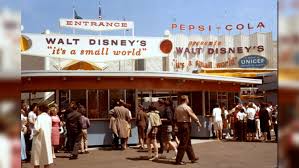
David and I covered a good amount of the fair that day. I distinctly remember the Unisphere Fountain, the spherical steel representation of the earth that was the symbol of the fair. I loved the Sinclair Oil exhibit because for a piece of change you could get an instantly molded replica of Dino the dinosaur (3d printing has nothing on that.) David particularly loved the GM exhibit “Futurerama” which depicted car designs of the future (none of which happened) and reminded me of the Jetsons and a ride that simulated flying across a future world dominated by technology and high design. We both were space geeks and totally in love with astronauts and the space program so we naturally loved the NASA exhibit which had life size representations of the rockets the space program was using at that time. But far and away our favorite exhibit, and the star of the show was the “It’s A Small World Exhibit” created by Walt Disney and sponsored by Pepsi Cola and UNICEF.

The ride was created to be a salute to the children of the world that hoped to promote the theme of the fair “Peace Through Understanding.” To enter the ride, you would board little boats that would take you gently through animatronic displays of children from around the world while listening to that ear worm song “It’s a Small World Afterall.”

It’s a world of laughter
A world of tears
It’s a world of hopes
And a world of fears
There’s so much that we share
That it’s time we’re aware
It’s a small world after all

It’s a small world after all
It’s a small, small world

There is just one moon
And one golden sun
And a smile means
Friendship to ev’ryone
Though the mountains divide
And the oceans are wide
It’s a small world after all

It’s a small world after all
It’s a small, small world

Leaving the exhibit, you could not help but be amazed at the technology that provided such a realistic version of children singing but you were also impressed by the fact that we were a global community. That children, were children everywhere. No matter what they looked like, no matter the form of government these kids could be your buddies. As a child of an immigrant this was a particularly gripping message.

However, the true art of the exhibit was not the technology, not the song, or even the fact that children of the world could unite in friendship. It was the idea fostered by UNICEF. That buddies helped buddies. That there were kids, just like you, from different places who didn’t have it as good as you did. They were hungry and needy and you should help them because they were the buddies that you never met. And when a friend fell down, you helped them up, without expecting anything in return.  Which is why for years afterward you would carry an orange UNICEF box around when you trick or treated. You couldn’t share your candy with your friends from afar but you could help them by collecting a few pennies.

From what I understand, even 50+ years after its creation it is the most played song in the world which might be in part caused by it being played constantly at Disney Parks in Small World Exhibits across the globe. Considering the theme of the ride,  this is both appropriate and delightful.  It also means the theme that we are all in this together is the most popular theme in the world…a theme that is endorsed and promoted by the most American of American companies: Walt Disney.

This earworm of a song popped into my head the other day. The nature of earworms are that you cannot shake them loose. It’s sweet melody and lyrics on endless repeat for hours. I am pretty sure that the cause of this endless repeat was I was an article in the New York Times, “What Is It Like Self Isolating In a Studio Apartment.” (https://www.nytimes.com/2020/04/20/style/studio-apartment-coronavirus.html?searchResultPosition=1 ) Clearly not the intention of the song. But it fit the times and my sense of irony.

But it was this flight of whimsy that t made me think about how small most of our worlds have become.

For most of us self-isolating, we are now confined to a small container that was mostly designed to keep our stuff. (Thanks George Carlin) The larger world beyond our door or property line has faded into soft memories. It gets easier each day to forget the hum drum that used to populate every day life such as commuting,  going to the gym and standing in line at the deli for a particularly delicious Sloppy Joe sandwich (you guys from Jersey will understand) It gets easier and easier to draw our lives like the New Yorker magazines illustration “The New Yorkers View of the World” with our 4 walls the focus and everything nearby in smaller and smaller print.

In these situations, it is easy to fall into the pattern of considering only “me and mine” when making decisions. After all, they are the only world you see every day. I am sure that this is the subliminal motivations behind those protesting the self-isolating rules. An alternative theory might be the people who are protesting these rules are really tired of the company they are keeping. Which, considering their views, seems highly probable.

But for the generations of us who grew up with “It’s A Small Small World” that was not that the message the writers, Richard and Robert Sherman, intended. They saw, over 50 years ago, that the world was shrinking. That it was to consider the world as a whole, not as individual unit. That the global war that had preceded it and that the technological marvels of the jet age were likely to link countries, continents, and peoples in ways not  imagined a generation earlier. They couldn’t possibly grasp the science being perfected as they wrote the song would create technologies would create personal computers, internet and smart phones all of which allow us to travel the globe whether we could leave the house or not creating an even far smaller world.

I know that the little boy who took the little boat through a small world was taken by the optimism of the song. The vision of a world where we were all brothers and sisters. Where if a country stumbles another would help guide it through its troubles. Of course, I was 7. I knew nothing of the world except how to be positive…not a horrible thing. But I contend, the type of optimism, the vision of a connected, mutually dependent world where cooperation…a small small world agenda  is a far better path than current MAGA agenda. perpetrated by Donald Trump and Fox News.

The MAGA agenda is a cynical one. Make America great again is not at all about making us great. We were already great. It was about making America transactional. You need help, great, what will you give me in return. And then make them pay, through the nose, for whatever you supply them with.

This is a fundamentally flawed proposition both from an operational and a philosophical point of view. Operationally, it is almost always better to ask “How Can I Help” and work out the deal points later in terms that allow the client some room to grow and prosper.

The former is a great short-term strategy but fails in the long term because as soon as the customer can, they will bolt for another provider because you act the part of a bully demanding your due. No one cares to do business with a bully. And bully’s get a reputation and once you have that reputation it is hard to shake.

The small small world agenda is a far better strategy. When you ask “How can I help?” you do business as a friend. Human nature is that people like doing business with a friend which creates long term stable relationships that can survive all manor of hardships because friends have your back. A friends reputation is far more resilient than that of a bully.

Trump’s MAGA philosophy makes us a bully and it is already taking its toll. Countries resent us instead of embracing us. Anecdotally, here in Brazil, the media is reporting how we are unfairly trying to corner the market on Covid19 necessities such as masks, PPG, ventilators and testing supplies. They feel bullied by us and have turned to China for help.

Don’t get me wrong. I believe the US has an obligation to get the supplies it needs to protect its citizens but we shouldn’t bully. We should use the example of the lend/lease program during the 2nd World War as example of how to treat this crisis. It is a small small world philosophy to use the Defense Production Act to gear up production equipment and supply the world with these vital supplies. Cannot pay now? Fine we got your back, pay us back when you can. The lend/lease program led to victory in the war but it also led to more than a half century of relative peace and prosperity.

The MAGA philosophy means we are missing this opportunity. China is not. It is embracing the world and supplying it with what it can to help tamp down Covid 19

Trump’s make America great again policies are leading to our decline.

What this have to do with the “It’s A Small Small World Exhibit” at the Worlds Fair. In 1964 Donald Trump been 18 years old and recently graduated from the New York Military Academy. He no doubt would have attended the Fair it was close to his home. I am  convinced that either he didn’t go to the Disney exhibit because the line was too long or it was not sufficiently macho. Or, perhaps he did get on one of those little boats but was too busy trying to “grab a girls pxxsy” to pay attention to the meaning of the exhibit:

It is too late for any type of remedial training for Donald Trump. He is irremediable. But I find it amusing to think of him sitting in one of those tiny boats endless looping through “Its Small Small World” exhibit.

While it is too late for Donald it is not to late t for us to remember that we are all in this together. It is up to us to extend a hand when we see our “buddy” needs help. It is a small small  world and what goes around comes around

Posted in Uncategorized | Leave a comment

The Legacy of A Generation

mlk jr

In April 1988 I had one of the great jobs in the world.

 
I was the Beverage Alcohol Manager of Rolling Stone Magazine. It meant that I sold advertising to the spirit, beer, and wine companies. That is right, I was getting paid to drink and listen to Rock and Roll Music. A very sweet gig. Especially considering I was on an expense account and the magazine was on a tear. We had nearly doubled the magazine’s revenue in the last few years and were recognized as one of the “hottest” properties in the country.

 
What made this job even better was that I worked with some of the best and smartest people with whom I have ever worked. They saw their jobs beyond that of just selling advertising. They believed, as did The Blues Brothers, they were on a mission from God to make the advertising world embrace Rolling Stone.

 
They threw epic parties. I met everyone from Hunter S. Thompson to Yoko Ono to Jacqueline Onassis to Jackson Brown. And without getting too many details it was the roaring eighties and I could get weed delivered via interoffice mail.

 
But what made it special and extraordinary for me is that I loved what the magazine represented. Most people thought it was about Rock and Roll. But from the beginning Jann Wenner, the founder, had said that it would be about “Rock and Roll and all the things that rock was about” which pretty much covered everything. But to Jann that meant that it was about social justice and politics and to that end he hired some of the most brilliant journalist of the time to cover these subjects. Folks like Hunter Thompson, PJ O’Rourke, and William Greider to name just a few.

 
We took the popular culture and made it relevant. And important.

 
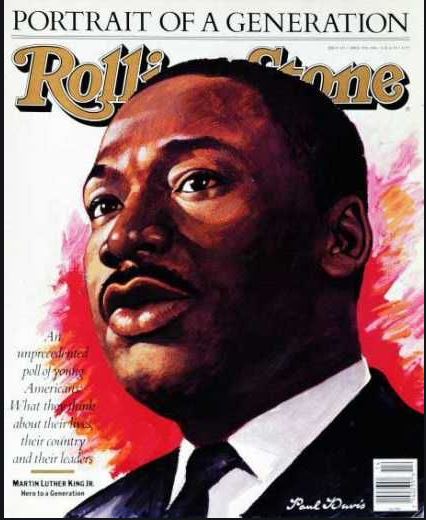
But that April I was especially proud because Rolling Stone’s cover story was not about Guns N Roses, Van Halen, or U2. It was of Martin Luther King Jr. The theme of the issue was “Portrait of a Generation” where the editors had commissioned a survey to find out the likes and dislikes of the generation just then coming of age. MLK had made the cover because he was far and away the most admired person of our generation.

 
I completely agreed with that designation. Some of my earliest memories of television were of George Wallace trying to deny African American students entrance to the University of Alabama and of black protesters being attacked by police with fire hoses and dogs. His message of equality. At the time, and still, I could not understand how someone could hate another based on the color of their skin (or faith…my father had already begun to teach me about the shoah) His words “I have a dream that my four little children will one day live in a nation where they will not be judged by the color of their skin but by the content of their character” spoke to me directly.

 
I was proud of the magazine that day. It reminded us, 20 years after his assassination, the power of his legacy and our obligation to continue to fight for equality and justice for all as the bedrock American value.

 
I recalled all of this the other day when a friend of mine told me about an incident that happened to her niece who is of Asian heritage. She was out for a walk, getting some social distance respecting- self isolating exercise while walking her dog in her reasonably affluent neighborhood in Southern California when a neighbor yelled “Go back to china you fuck.” This broke my heart. I have been the subject of racial epithets a good part of my life and know how small and marginalized it makes you feel. Moreover, there is no good response to this type of racism. You can fight them physically which I did often when I was younger but these days would likely get you arrested. You could hurl insults back to them such as “Fuck you , you fuckity fuck fuck.” But then you are just giving them what they want which is a response so even it lacks full satisfaction.

 
But what saddens me the most is that in the current Trumpian climate in America that this type of verbal vomit is not unexpected or even reviled by many. It made me wonder what happened to this generation where Martin Luther King was our hero to now where overt and subtle racism fills our lives on a nearly daily basis.

 
The examples are easy to find.

 
I am pretty sure we all have friends who believe that white privilege does not exist and in fact believe that white males are actively discriminated against. They often use anecdotal evidence such as the number of African American Dads in commercials as opposed to white males to make their points. The reason they don’t use hard facts is because they don’t exist. It is clearly easier being white in this country than being of color. Every statistic point to it. Employment, education, maternal mortality rate. Even death rate for the Covid 19 virus. So why do so many deny white privilege? Because it is easier to say than I don’t believe in racial equality. That I am embracing racism.

 
I know people who believe, with reverence, that Christians are the most discriminated religion in the world. They point to things such as how in certain middle eastern and African countries Christian suffer mightily because of their faith. They say in the US that evangelical Christians are discriminated against in academia, employment, and their ability to practice their religion they want to (eg anti vax). I have seen no scientific study to bolster these facts and most of the time their argument boils down to my religion is more important than yours and because of that you need to give up your rights. This is opposed, to all religious views will be tolerated so their can be no religious test to things like gay discrimination or reproductive rights to name just a few.

 
Being a Christian in the US is far easier than being Muslim. Being a Christian in the US is far easier than being Jewish. The reason for certain sectors to call for religious discrimination is no more than excuse to spew vile at others. I can hate Muslims because they hate my religion. I have no doubt than MLK jr would be appalled.

 
Bill Maher, the libertarian talk show host and comic, spent a few minutes on why it was perfectly okay to call Covid 19 the Chinese virus during one of his broadcasts. He sited among other things the Zica virus and the Spanish Flu as examples of viruses that were named for places and therefore it was legitimate to give a place designation to the virus. What he failed in mentioning is that Zica is a named for the Zica forest in Brazil where it was first found and we don’t call it the Brazil virus. The Spanish Flu was not named for where the outbreak first took place but for the only country not hiding the illness and accurately reporting on the disease. By both of those naming nomenclatures Covid 19 should either be called the Wuhan Virus or the USA virus. Not the Chinese virus.

 
The only reason I can think of calling it the Chinese Virus is racism or perhaps xenophobia. And Dr.King asked to judge people by the content of their heart…

 
What happened to us that in the time of national crisis, when we are fighting an enemy that is an equal opportunity infector (although minorities suffer more and die at a higher rate due to income and health care inequities) that we feel that it is okay to throw out racial epithets? Shouldn’t this be a time where we come together as a nation and say “Fuck you Fuckity Fuck Disease” we are going to kick your ass through unity and brotherhood?

 
Don’t we as a generation want to embrace more of Martin Luther King Jr equality for all and less of Donald Trump’s model of hatred and racial division?

 
I know that there are many people out there who are frightened of the disease, frightened of change, frightened of losing your place in the world as you see it. But I beg you, that instead embracing racism and hate because they make you feel less frightened, less alone and allows you to give vent to your anger, to reject it and embrace the fact that we can only succeed by coming together.

 
Lets use Covid 19 to come together as a country let alone a world. Lets keep Dr, Kings message and hope alive. Let that be the portrait of our generation.

Posted in Uncategorized | Leave a comment

Fear

The home Elaine built here in Rio is very modern. Imagine three rectangular solids, each slightly smaller than the other and slightly offset, stacked on top of each other. The ground floor of the house was built with the idea that the outdoors should be part of the home and as a consequence the living room and sitting areas are floor to ceiling tinted glass panels that double as sliding doors. During the days this lets the sunshine in, sans the heat, and allows us to look out onto the flora that surrounds our house. At night the tinted glass becomes almost black and gives the illusion of being surrounded by darks wall that protect us and our privacy.

 
It is now early fall here and the almost unbearable days of heat and humidity of summer have relented into a more bearable form. It is still hot during the day, shorts and t’s are the uniform of the day, but at night it becomes much cooler. Often, on these cooler evenings we will pry open the sliding glass doors and let the cooler fall air in while we sit on the couch and chat.

 
The other night was just one of those evenings. Elaine was sitting on the couch, her legs underneath her drinking a frosty Heineken out of glass (she is not a savage) and I, drinking a few milliliters of aged Cachaca. We were chatting about our very exciting day of self-isolating, she very involved in the chat groups in which she participates and I was countering with dialogue about some particularly egregious error (I cannot remember which one as there have been too many) by the current occupant of 1600 Pennsylvania Avenue. And then for a few moments we said nothing. Each lost in their own thoughts.

 
Elaine broke the silence when she looked over at me, almost as if she were ashamed and said, “My darling, I am afraid.” My wife is very courageous. She is a bad ass. She is a jaguar. She is fierce. For her to say, she is afraid is a monumental statement. One that should not be taken lightly. So I asked “What are you afraid of?”

 
She replied “Of everything. This Covid 19 thing. Bolsonaro (Brazil’s Trumpian President) disregards social distancing. He is more concerned about the economy than he is in people’s health (where have I heard that before.) I worry that it is going to get far worse before it is going to get better. All of this dying…”

 
Of course, my first thought was to console her. To make her feel better about a situation that is impossible to feel good about. I offered “My love, to be frightened is a very reasonable response to the situation we find ourselves in. I am scared as well. These are fearful times. But what choice do we have. We make the best decisions for ourselves and for our family based on the information we have and move forward with our lives. Courage is doing what you need to do despite whatever fear you must be feeling.”

 
I could tell that my words were not having the palliative effect that I hope they would. They were not helping her cope with the awful feeling that inhabits your soul when you are inhabited by fear. So, I added “Remember what Franklin Roosevelt said, ‘The only thing we have to fear’ itself. He meant that to carry on we need to dismiss our fears and carry on with the task that is at hand.”

 
Still little comfort appeared in her eyes. “We will get through this together. When you falter, I will steady you and when I stumble you will help me up. “


This made her give up a half smile and realizing that this was far to deep a pond to plunge into right then she changed the subject and pointed to our cat Romeow, who at the moment was terrorizing a small lizard, and said “isn’t he a magnificent hunter.”

 
Late that night, after awakening due to a particularly vivid dream about being at Costco, I began to think about fear. (Middle of the night is absolutely the perfect time to think about fear. Ask Stephen King. It is also particularly well suited for thinking about responses that would have been better than ones you had given during the day. ” As a consequence, I began to think about our couch conversation earlier in the evening. The first thing that came to mind was a quote from a book I had loved as a teenager, Dune by Frank Herbert. (I won’t go into the plot line as it is too complicated nor the particularly awful movie made by David Lynch and staring Sting as it, was awful.” In the book one of the main characters says this about fear:

 
“I must not fear. Fear is the mind-killer. Fear is the little-death that brings total obliteration. I will face my fear. I will permit it to pass over me and through me. And when it has gone past I will turn the inner eye to see its path. Where the fear has gone there will be nothing. Only I will remain.”

 
For a 15 year old full of teenage angst and anxiety the quote had been an important one. It helped me understand that fear will help you make awfully bad decisions. That in the moment of fear it is best if you put it aside but when the moment has passed that you should take the time to understand and perhaps even embrace that fear so that you can better cope with it when it reappears.

 
It was useful advice then and it is useful advice now.

 
This morning a friend of mine died of the Corona19 virus. I am sad for his passing as he was a good man with a jolly outlook on life. But it also spurred on a fear in me. I am terribly afraid of catching the virus and being among those who succumb to it’s ravages. But I cannot let my friends death and the fear that it reinforces in keep me from making good decisions. I will make decisions that while acknowledging the danger of the disease do not overly effect my decision making process.

 
I won’t for example stop my daily walks through our neighborhood. While there is some risk as I encounter a dozen or so people on every walk I think of it is a minimal. I maintain social distancing rules even when the folks I see seem oblivious. These walks help me get exercise and think and are needed to maintain my sanity in these insane times.

 
I will not let it effect my travel plans. This morning I made yet another reservation for Elaine and I to return to the United States. Traveling these days is not a joke. You are spending long hours where their will be large number of people congregating and then even longer in an aluminum tube that is sealed. It is not something that should be undertaken without thought but while fear would keep me hunkered down, a more rational mind would suggest that returning to the US when the first wave is over and where we can have a more robust life makes sense.

 
Fear most of all should not influence our communication with other people either directly or through social media. We are all frightened. (And if you tell me your not I will know you are a liar.) We need to realize when people are being particularly ignorant about a fact or relying too heavily on hope for a solution to our problems that they may be foolish in your eyes but they are also frightened. That they may not have thought through the situation as thoroughly as you or perhaps cannot muster that type of reason. But whatever the provocation they may have provided you they are frightened. And so are you which could lead to prickly and unpleasant conversations that don’t need to be.

 
If you think they are being idiotic, stupid, ignorant, or just being a jackass be gentle because they are frightened and because your response may be infused with fear as well.

 
And with that I rolled over and went to sleep as thinking anymore about fear at that moment would have kept me awake.

Posted in Uncategorized | Leave a comment

Let It Be

Let It Be


Yesterday, a woman who I have known for over a half century posted a meme that shocked and saddened me. It showed two images. One was a picture of an elderly religious Jew being processed into a concentration camp and the other was an open mass grave with images of dead emaciated inmates lying within it. The message of the meme was that the current restrictions on people’s movements due to Covid 19 were the equivalent to that of Nazi’s. In my eyes, it was clearly a supporting meme to Donald Trump’s “liberate” Tweets.

 
I found it shocking that anyone would use death camp images when describing social distancing, self-isolating and other measures designed by local and state governments to keep the disease from spreading. I could not imagine anyone would willfully want to make others sick and perhaps even cause their death. But then again, I had seen an interview earlier in the day with protestors to virus restrictions whose main issues seemed to be personal comfort. (One person needed to go to the hairdresser and another wanted to fertilize his lawn.)

 
Clearly, there were people who thought self-sacrifice for the greater good was not part of the American ethos. I also suspect that members of the greatest generation would bitch slap these takers and slackers.

 
Needless to say, the meme upset me to my core. Not only was this someone who had violated a relationship of over a half century by posting such an image, but she had revealed to me a dark underbelly to her soul as well and to many other fellow citizens. Where they feel their needs are far more important than the national good at a time of crisis. My first inclination was to respond to her meme with vitriol and anger. To eviscerate her verbally, leaving nothing behind except a blood colored skid mark. However, for the last few days I have been writing about kindness and forgiveness and so instead of going back to her guns a blazing I decided to take a beat and think about how I could handle this in a way that was respectful and provide her with a path towards regaining my trust in them.


One of the things I knew about this person was that she was not well versed in Science. For example, I knew her to be an anti vaxer based on non-clinical arbitrary data and was relatively unconcerned about the problems not vaccinating part of the population would create for those who were at risk. I also knew that in the past when I have used statistics to back up arguments, she dismissed them as bad data because they did not match her world view. As a consequence, I thought a more emotional argument would likely be the best approach.

 
What I thought to write her was about the outbreak in New Rochelle, New York. There, one individual infected 100’s of others by going to a religious service. I wanted to describe what each one of those individuals must have felt. The fever, shakes, body racking coughs, the gasping for breath and fear…and for some dying alone in a hospital bed without any comfort. How many hundreds of medical workers would have exposed themselves to the virus just to save those exposed by that single individual. I would have asked her to ponder what it would be like to be that one person who caused all of this illness and pain, knowing if that they had just self-isolated none of this would have happened. Were you this person who caused all this suffering how could you live with yourself afterwards? How would you find forgiveness? Before you seek gods forgiveness you must seek that of those you have injured and how would you do that?

 
One of my father’s favorite sayings was “You can lead a whore to culture, but you can’t make her think.” (He loved puns too) This was not a degrading statement towards women or sexuality. Instead it was a reminder that some people will never be able to think. Knowing the poster of the meme, I knew that asking her to think would be a stretch. As a consequence, I decided against an approach that would require her to imagine herself in another’s shoes. It would be, sadly, beyond her.

 
Perhaps I should ask her to consider the offensiveness of the imagery of the meme and forget the broad political implications. Suggest to her, that children of Holocaust survivors and many others, would find the images offensive. That instead of helping make her point it would drive people away.

 
This was the approach I decided on and I posted on her meme how offended I was as a jew, a son of a holocaust survivor and as a person I was offended by the imagery of the meme let alone the message. She responded by saying she had had a bad week, and this was her way of protesting the increasingly draconian measures taken by the government in California to halt the spread of the virus. She did not apologize for using the images or the offense they may cause me and others. She had a bad week so it was okay.
Needless to say her response did not fill my heart with kindness nor with forgiveness as she had asked for none.

 
It occurred to me that perhaps I could make her better understand the offensive and perniciousness of her meme by re-writing the rabbi’s tale of the gossiper for the age of social media. It would have gone something like this:

 
The Memer

 
A woman posted a meme on Facebook that used offensive images of the holocaust to make her emotional post. Within a few days 1000’s of people had seen the image and while some agreed with her most thought the images distasteful and hateful. She realized that instead of making her point she had just hurt people. She was deeply sorry and went to a wise rabbi and asked what she could do to repair the damage.
After giving this some thought, the rabbi said to her, “Go home, get one of your feather pillows, and bring it back to me.” Surprised by the rabbi’s response, the woman followed his advice and went home to get a feather pillow and brought it to the rabbi.
“Now,” said the rabbi, “go down to the beach and open the pillow and pull out all the feathers.” Confused, the woman did what she was told to do and then returned to the rabbi’s study.
After a few minutes, the rabbi said, “Now, I want you to go back to the beach to find every one of the feathers and put them back into the pillow.”
“That’s impossible,” said the woman, almost in tears. “The beach was very blustery, and the wind has scattered them in all directions. I can’t possibly find them all.”
“Yes,” said the rabbi. “And that is what happens when you post a meme or tell a story about someone else. Once you do it, it fly’s everywhere just like these feathers flew in the wind. Once posted, you can never take them back.

 
In other words, what she had done may, in the long run, be forgiven but could never be undone.

 
But after thinking about this for while I rejected this approach as well. She had not asked me to pardon her for using images that were offensive to her so my story would have little impact.

 
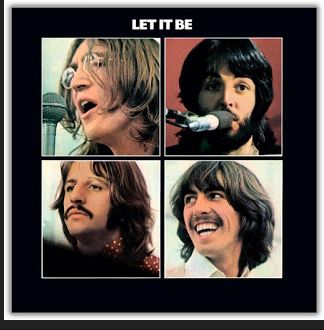
When I was considering the nature of forgiveness the other day, I was struck by some that Rabbi Telushkin had said. That while we are not obligated to forgive those who have harmed us who do not seek forgiveness it is in our best interest that we do so as it frees us from whatever hold they may have on us. Or in Lennon and McCartney’s words of wisdom “Let it be.”

 
So that is what I did with this person who had posted the meme. I wrote to her via IM. I did not want to embarrass her or for that matter draw fire from those who saw nothing wrong and everything right about her meme. My intent was to be honest and direct without being unkind. I wrote:

 
I know you to be a woman who attempts to be kind and do the right thing. I also know that we disagree politically. You seem to feel that President holds no blame in this Covid 19 Pandemic and I believe that the reason you are self-isolating is in large part his fault. I believe that Dr. Fauci has given good advice and you believe something else. You believe that Gavin Newsome has evil intent and from what I can read I believe he is doing the best he can especially considering the lack of care provided by the federal government. All that being said, I would not comment on the meme if was just political. I would have just scrolled on. However, it equated the genocide of Jews during WW2 with what is going on in California right now and thus made a mockery of the death of dozens of my relatives and all those who perished in the camps. That is highly offensive when you should know what is happening in California and elsewhere is designed to keep more people alive not dead. What is more unforgivable to me personally is that you have not taken the post down knowing how offensive it is. That is both unkind and sad. I wish you well in your struggles in California but for now I am going to de friend you as I don’t want to see more memes like the one you posted.


Writing the IM. Writing this. Unfriending this friend. All of it has helped me “let it be.”

 
And now we move on.

Posted in Uncategorized | Leave a comment

But I Think It Is About Forgiveness

project 050


These times are so uncertain
There’s a yearning undefined
People filled with rage
We all need a little tenderness…
But I think it’s about forgiveness
Forgiveness

The Heart of the Matter Mike Campbell, Don Henley, John David Souther


Elaine and I were watching The Crown last night.

 
No, I am not late to the party, but I have just set up Netflix on the smart television that we have in the bedroom and this was the show my wife wanted to watch. While I am not sure of her motivation, perhaps she saw Elizabeth’s and Phillip’s marriage as a role model for our own, or that it had been recommended, I agreed to watch with her despite the fact I made my way through the series long ago.

 
The episode we watched, Season 2-Episode 6-Vergangenheit is the one where Elizabeth discovers that her Uncle David, (King Edward VIII) had conspired with the Nazis to help defeat England including; Telling them the bombing was working so they should continue their efforts and in the process kill thousands of his countrymen; His wife passed secret documents on to the Third Reich. David’s reward would have been the deposing of Elizabeth’s father, King George VI that likely would have meant his death and that of his children (Elizabeth and Margaret.) Elizabeth struggles with the concept of forgiveness. She knows that as a Christian she has an obligation to forgive her “favorite” Uncle, but she struggles wit how “to forgive the unforgiveable.”

 
She calls in Reverend Billy Graham who is “crusading” in England at the time and whose television sermons have impressed her to see if he can provide guidance. He tells her that it is the duty of all Christian’s to forgive. When Elizabeth ask’s “But what if you cannot find it in your heart to forgive?” His response is that if you cannot forgive, you must ask God to forgive you for not being able to forgive. I thought it a wonderfully circular argument but perhaps a way of absolving yourself before you put in any real work.

 
It was also completely different from my understanding of the Jewish concept of forgiveness. I was taught that there are times when a Jew has the obligation to forgive, times where forgiveness is optional and even times when it is forbidden.

 
It is obligatory to forgive someone when the offense in which forgiveness is needed is not irrevocable and the person in need of forgiveness, asks for it. The rabbis teach that the “sinner” only has to seek forgiveness three times (over an extended period.) It is hoped that the person from whom forgiveness is sought will provide it long before the third request but if it is not it is assumed that person has the problem and the sin is forgiven regardless whether it has been given.

 
It is optional to forgive someone when the offense is either irrevocable or the person has committed the offense does not seek forgiveness. A classic example of the irrevocable is slander and the example given is:

 
The Gossiper
A woman repeated a story (gossip) about a neighbor. Within a few days everyone in the community knew the story. The person she talked about heard what had been said about her and she was very sad. Later, the woman who had spread the story learned that it was not true. She was very sorry and went to a wise rabbi and asked what she could do to repair the damage.
After giving this some thought, the rabbi said to her, “Go home, get one of your feather pillows, and bring it back to me.” Surprised by the rabbi’s response, the woman followed his advice and went home to get a feather pillow and brought it to the rabbi.
“Now,” said the rabbi, “open the pillow and pull out all the feathers.” Confused, the woman did what she was told to do.
After a few minutes, the rabbi said, “Now, I want you to find every one of the feathers and put them back into the pillow.”
“That’s impossible,” said the woman, almost in tears. “The window is open and the wind has scattered them all over the room and blown many feathers outside. I can’t possibly find them all.”
“Yes,” said the rabbi. “And that is what happens when you gossip or tell a story about someone else. Once you talk about someone, the words fly from one person’s mouth to another, just like these feathers flew in the wind. Once you say them, you can never take them back.


(The Gossiper is particularly poignant story in today’s world of social media.)

 
And if a person sins against you as a person, and does not ask for forgiveness, you are under no obligation to forgive that person. That obligation to seek forgiveness is totally on them. But it is strongly suggested that you do excuse them otherwise the animosity that you hold for these people becomes a power onto itself and corrupts your good intentions and your life. Why give the people you hate the most in the world power over your life?

 
The instances in which you are forbidden to give forgiveness is when someone sins against someone else and shows no remorse about what they did. The example Rabbi Telushkin gives is the terrorist’s who carried out the attacks on 9.11. They showed no regret for what they did and only regretted the fact that the attacks did not take place an hour later when many more people would have died. Christian traditions suggests we should forgive but Jewish tradition says that forgiveness is up to God.

 
In todays world the most glaring example of the unrepentant is Donald Trump. The damage he has done to our lives, our economy and our republic are incalculable. I personally find it comforting that I have no obligation and I am in fact forbidden to forgive.

 
What I like most about the Jewish tradition is that those who have committed offenses against you are obligated to seek your forgiveness. And you are required to listen and seek a way to forgive them. If you cannot the assumption is that something is wrong with you. As important. If the person who has done you wrong does not seek forgiveness or it is irrevocable in some way, we are asked to let it go. Forgive the offense and move on because it is better for you.

 
Please do not mistake me for something I am not. I have no desire to be the home motivators that have popped up in the wake of the pandemic giving people instructions in how they can turn their daily monotony into something productive. I am not a self-help person although I will admit to reading a couple of those books from time to time.
What I am is someone who occasionally is inspired by something I read, see, or view and because I fancy myself a storyteller, I feel compelled to share.

 
That being clear, it occurs to me that we currently have a lot of time on our hands where many of us are filling our days with idol things like eating too much, streaming videos, and other cotton candy of the mind type of things. Perhaps if we spent a few minutes every day thinking about those we have committed offenses against and seek their forgiveness we could find greater joy in our life today and when we are allowed into the sunshine again. And maybe if we spent an additional few moments everyday thinking about those irrevocable and otherwise unforgiveable offenses committed against them and figure out a way to put them aside, we can bring a little more sunshine inside ourselves.

 
Thanks Elizabeth

Posted in Uncategorized | Leave a comment

Kindness

catie bottle


Kindness is in our power, even when fondness is not.
Samuel Johnson

I have been thinking a lot about kindness over the last few days.

 
Part of this has to do with the country where I am currently situated. My experience has been that the Brazilian people, as a whole, are among some of the kindest in the world. It is considered polite, if not extremely good form, for a Brazilian to invite you to their home for a meal upon meeting you for the first time. I did not know this when I first met Elaine and took it for interest in me. Had I knownthis was just a form of Brazilian politeness who knows how far our relationship would have gone. Sometimes cultural ignorance is a good thing.

 
Obviously, this is in sharp contrast to the type of politeness that us New Yorkers tend to show each other. I can remember after 9.11 how polite and kind we were to each other. We realized at the time that virtually everyone you knew who lived in the city had an emotional stake in the tragedy whether from losing a person close to them or just being a part of a city that had been attacked. We took it easy on each other. We offered polite greetings with sincerity. We were gentle with the little annoyances that happen in cities that are as densely populated as New York. We opened doors and suggested people “have a nice day.” We all noted the new kinder gentler New York and wondered how long it would last because we knew the road to recovery would not begin until we got back to our old patterns of behavior.

 
About a month after 9.11 when crossing 72nd St at West End Avenue a cab decided to enter the crosswalk with a number of pedestrians in it including myself. He honked at us and several of us flipped him off and when he yelled fuck you he was greeted with a chorus of the same in return. I remember smiling to myself as I proceeded on our way knowing our recovery had begun. Even though the epithets hurled at that point were said in pique, there was also a particular brand of New York kindness in them as well. After all, in New York, fuck you is often said as an endearment.

 
But the circumstances of Covid 19 are substantially different than that of 9.11. We did not have to self-isolate after 9-11. Face to face was still the norm. Covid 19 has made us dependent on the virtual and not the real. And while some of that is still face to face using apps like Zoom, Facetime and Skype a large part of our interaction with the outside world is through social media, group chats and the like. The great things about these channels is that they allow us to share our concerns, fears, joy, and humor with our friends and family no matter where they happen to be. In the closeted environment we live in now that can be quite a relief.

 
However, some folks think the virtualness of social media and group chats gives them license to be ruder, less kind, than they would be in person. I suspect that the lack of physical confrontation and real consequences have something to do with that. I actually understand. I am no “Paulyana.” The fear, the frustration, uncertainty confinement and all that Covid 19 have brought us a all combined with the necessity of remaining very civil with those you are locked up with can produce the need to express yourself more directly than advisable on those medium. I have done it myself more time that I care to admit publicly.

 
It saddens me, deeply, that the current occupant of 1500 Pennsylvania Avenue has not helped in this regard. He has, since long before he became President, used social media as an opportunity to belittle, berate, and bully those who had the temerity to question him. It would have been wonderful (albeit a miracle) if he had decided to retire these tools for the duration and instead embraced a more welcoming, kinder message for all Americans. It would have set a tone better suited for our national crisis. It would have provided a more direct path to leaving this crisis with a better sense of national identity than when we entered it.

 
Sadly, perhaps tragically, he has chosen to continue with his belittling, berating, and bullying. He has more often than not fouled the national dialog. But expecting Donald Trump’s behavior or that of his die-hard supporters to change is beyond reasonable expectation.

 
Instead, we need to choose to be better, kinder. If he will not or cannot change then we need to show him how kindness is in our power. How showing restraint, not in what we say, but how we say things can have a positive effect on the national dialogue. Say what is needed to be said but say so in a way that allows for the humanity of others. When confronted speak from facts and the desire to inform not to destroy. That when you are trolled by those spoiling for a confrontation deny them by not replying.

 
John Kennedy in his speech “We Choose To Go To The Moon” said that “technology has no conscience of its own.” I agree. So, it is up to us, no matter how difficult it is, to give it one. As he said further along in the same speech we should choose to do these things “not because they are easy, but because they are hard; because that goal will serve to organize and measure the best of our energies and skills”

Posted in Uncategorized | Leave a comment

Jeni and Sidi Part 2: Photographs and Memories

jeni and sidi


“Photographs and Memories
Christmas cards that you sent to me.
All that I have are these
To remember you. “
Jim Croce

 
I am in my cousin Lia’s apartment in the Jardin district of Sao Paolo Brazil.

 
It is an upscale neighborhood not far from the Avenue Paulista marked by steep hills and trees planted in the European style of urban planning at the beginning of the last century. The buildings are far more European than American. They tend to be more compact, curved, and simple than buildings where I live in New York. No legions of doormen and concierge to greet you. Here it is a single fellow, albeit in uniform, that simply opens a gate and after calling upstairs to announce your arrival leads you to a single tiny elevator that holds four quite uncomfortably.

 
When the door opens to her floor the light in the hallway flashes on. This strikes as me as sensible and odd at the same time. Odd because it is not how we do things back home and sensible in the way it makes no sense for the light inside a refrigerator to shine unless the door is open.

 
The door to Lia’s apartment and she is there all energy and shock of frizzy red gold hair that looks remarkably like my sisters. There is a white mezuzah on her door frame so I touch it on my way into her home. Like her mezuzah Lia’s home is all white. The walls are white. The furniture is by and large white. The only exception to this tone on tone design scheme are the floors which are wood and the table in her living room which is a circle of brown and black wood.

 
Lia insists of giving me the grand tour of her apartment. It is very spacious at least compared to New York standards. It has a huge living room with enough space for both a seating area and a dining room table. The kitchen is an eat in with modern appliances and granite counter tops. There is a large master bedroom and a somewhat smaller second bedroom that doubles as an office. And in each room the walls are covered with works of art, design pieces, and photographs that might have seemed cluttered in another home but somehow seem just right for Lia.

 
Before today I have only spent time with Lia once at a lunch in my parent’s home 30 years previous I recall not really wanting to be there but being present because my father insisted. At the time I did not understand my old man’s sense of family. Perhaps I was too young to understand, although I was in my twenties, but it is something, overtime, I have grown to appreciate more and more. Now it serves as a true north in my life’s navigation. I do recall that Lia was full of energy. That we had a long conversation about Rock and Roll and that she loved Pink Floyd and Deep Purple.

 
I had not met my cousin Roberto before. Our first meeting was that morning at the reception desk of my hotel. He actually took me by surprise. I had gone to the front desk to inquire about a message he left me late the night before. He had left his phone number and I had no idea how to dial locally so I had gone downstairs for telephone instructions when this slender curly haired man approached me and said “Paul?” and when I nodded in agreement he said “I am Roberto!” And so my day of Strauss began.
Roberto and I went into the breakfast room where he and I sat and had coffee and noshed on scrambled eggs, roasted lingucia sausage and hot dogs with a roasted tomato and onion sauce…I love breakfasts in other countries. How people start their day tells you so much of who they are as people. I must admit I was very nervous. Both of my parents were only children. I had never had cousins and didn’t know quite how to behave with them. Roberto was a complete stranger If I hadn’t seen his picture on Facebook I would not have been able to identify him in a lineup. And even then his Facebook posts are all in Portuguese and mostly seem about him driving around in a Winnebago so I had no idea what to expect.

 
Struggling where to begin the conversation I venture “Roberto, I don’t read Portuguese but when I see your Facebook postings, they seem mainly about Winnebago’s. Do you own one? He laughs and tells me that when he was 12 he wrote the Winnebago company and they wrote him back and ever since then he has been obsessed with them and that it has become a big joke between him and his friends. That his posts are often about mythical adventures that he has been having in this “dream” RV.

 
I can tell that I am going to like him. That we are at least relatives in that we share a similar sense of humor and life outlook. Just as I am reaching this conclusion Lia breezes into the room like the force of nature that she is. She hugged me and kissed me and then looked at Roberto and says “He looks just like Ernesto.” It is only then that I noticed that she has shopping bags in each hand and as we sit down she says “I have presents for everyone.” And indeed she does…..a design book for my mother and for my sister, a bolt of native cloth also for my mother to brighten the house. , frames for my brother and myself made of Brazilian wood, a desk card holder for me, little boxes-also of Brazilian wood for sister again.

 
My first thought was oh my god how completely generous and then of course my second thought was “My God how am I going to get these home.”

 
After taking the three bags of presents upstairs, and gathering myself for the day, I met Roberto and Lia in the lobby of the hotel to commence my tour of Sao Paolo. The tour was a compliment to Lia’s personality. It was exuberant, frenetic, eclectic and full of a passion for a city that she considers an extension of her own family.

 
At first we drove through the city with her giving me a running description of the neighborhood…when they were built, what type of people who live there, how beautiful some of the homes were. We go to an art museum to see some piece of modern art that highlight that arts in Brazil. We stop at folk art store in the heart of Sao Paolo’s “soho” and drive down a street where local artist had painted the walls with their works of art that is apparently world famous We visit a furniture store that had a tree growing through its that has a selection of modern pieces that typify the design ideals of Brazil. We drive through the University where she and Roberto studied and where Roberto’s daughter is a student.

 
When hunger called, she takes us to a churrascaria where my plate is constantly billed by a parade of waiters offering up roasted meats of every kind. By the time we leave I feel like I never have to eat again and my first Caipirinha.

 
At one point I called my father on the phone because I knew how much my spending time with our cousins meant to him. I imagine I understand this more than any of his children. Not only because so many of our trips together have been exploring his past but because during his illnesses over the past few years, we have spent a tremendous amount of time with each other often talking about his “lost” family.

 
Not having a big family was a part of my childhood. I never missed it because I never had it. My father grew up with a large family whom he loved in a way that an only child could love a family. It is only as an adult that I have begun to understand the hollowness losing them caused and how much it meant to him to have a family of his own. So I wasn’t surprised to hear the emotion in his voice as he spoke to Roberto and Lia. They are the last shadows of the memories left of that family that once included 13 brothers and sisters. Hearing this conversation. Hearing the emotion in his voice makes very glad that I have sunglasses on as I don’t know these cousins well enough yet to weep in front of them. They don’t realize I what I know. That my father is dying and this may be the last he will ever have the opportunity to speak to them.

 
Our last stop of the afternoon was an Art Museum in what they told me was Sao Paolo’s central park. It is styled in a very European fashion: manicured, planned, clean without the frenetic chaos, naturalness and trash I associate with parks back home. The museum itself was not much of a museum, it was really more of an art gallery with works of Brazilian artist none of whom I was familiar with. But Lia walked me through them with the type of love and pride that a parent reserves for their children.

 
Back in the car, Lia asks if I am tired and would like to rest before our dinner. I am exhausted. I had not slept much on the airplane and the excitement of being in a new place accompanied by the anxiousness of being on a new adventure had kept me from sleeping well the previous night. I welcomed the opportunity for a nap before meeting the rest of the family. Back at the hotel, I flop on my bed and asleep before the second bounce.

 
We are at the table in Lia’s living room. Roberto is sitting next to me and says “Look I have brought something to show to you.” I can see that he has an old brown file folder that you would expect to see when excavating a steamer trunk in someone’s attic. It has completely lost its shape, its edges rounded and bent from use.

 
He opens the file and pulls out a photograph sepiad with age of two beautiful young women. Their hair, short and pulled back in the style of the day. They are leaning together, their faces almost connecting at their elegant cheekbones. Both have a wisp of a smile; you can tell that something else is lurking just below the surface perhaps sadness or an uncertain future or both. Just by looking that these two love each other very much. The date at the bottom of the photograph reads, in a lovely hand, 1922.
Roberto says “The woman on the right is my grandmother, Sidi and it is your Grandmother on the right” The realization of who this and when it was taken gives me a freezeframe moment where the world stop around me and I wrapped in a cocoon of my own thoughts.

 
There is no doubt that it is my grandmother even though my memories of her come only after time and the harshness of the world had worn at her. It is same kind eyes. It is the same face. I flash to memories of her hugs which were always warm, soft and generous and full of a love that would forgive anything. Of birthday cards full of quarters, and of the matzoh ball soup and Wiener Schnitzel with cucumber salad she would make for us whenever visited. Of her smell earthy and real. I think of how she always called me “mein Paulschin” and how when something bad we happen she would say “Guttesvillen”. I think of the “Stern”Magazines my father used to buy for her and how she liked to sip a little “Cherry Herring” to help her sleep.

 
I remembered a time when I thought I would have children how I was wanted to call my little girl Jeni hoping she would grow up as sweet and kind as her.

 
I think of a meadow in Farafeld near the local train station which was really nothing more than a shack. It is a warm spring morning and the field in which we are walking is in bloom, full of yellow flower. It is laced with small creeks that glitter in the sunlight. We were here because as a boy my father had been sent here to escaped the heat of the Viennese Streets and spend time with his grandmother. He tells me that when he heard a train blow its whistle he could always tell whether or not his mother was on the train. How at the time he thought he was psychic. I share with him my own story. How the winter of my senior year I had loss the ring the garnet rings of Grandpas he had given me. That I was so scared to tell him that I used to hide my hand when we were together. How one I had a dream in which Jeni had told me where I could find the ring. When I awoke that morning I had checked the place my grandmother had revealed and found the ring. I had been basking in the glow of finding the ring for only a few moments when the phone rang. It was my brother bearing bad news. Jeni had passed away. In that field in Farafeld I told my father it was not him or I that was psychic, it was Jeni.

 
I realized that from the date on this photograph it must have been taken shortly before Sidi had immigrated to Brazil. I have no doubt that this photograph was taken so that the two sisters would have a keep sake of each other as they were to live a third of a world apart. I have no doubt that both sensed that after Sidi left they would never see each other again. The world was a far bigger place in 1922. No technology or jets to make it smaller. I wondered what at that moment how they envisioned their future? Could she envision the blessings and madness to come.

 
In 1922 she was years away from meeting my Grandfater. My father, not even a gleam in her eye.

 
Could she foresee that he world would be turned upside down a by a former army corporal turned convict turned supreme leader. That before it was over almost her entire family and most of the world she knew would be destroyed and lost forever and she living in the Americas although separated by a third of the world from her Sidi.
I am sure that she could not foresee all that. I am sure that at the time all she could focus on was the nearness of her sister now and how that would soon be taken away from her.
Roberto was saying something and I broke free from my thoughts and I said “I am sorry. I missed that. What did you say?”

 
“Your grandmother and my grandmother, they write to each other all of the time. I have some of the letters and the photos they sent to each other. Here,” he said pointing at the folder I will show you.”

 
I reply “I guess I knew that they wrote each other but until I saw this photograph, I never realized how much they must have missed each other ….but it helps me understand somethings my father and I talked about.

 
Roberto looks at me inquiringly and I respond “My father once told me that he offered to send my Grandmother to Brazil many times and she would always refuse. When he would ask her why she didn’t want to go she would say “It was too hard to say good bye the first time, I couldn’t say good bye to her again.” Looking at this photograph I totally understand that feeling.

 
The next picture he pulled out was of a man with a long face, a mustache that did not quite reach the end of his lips, and who had lost much of his hair. There is a faint smile on his face the laugh lines around his face revelingvthat this was a man who liked to laugh. It was easy imaging him telling a joke. Roberto said “Do you know who this is?” when I replied that I did not he said “This is our grandmother’s brother, Ede.”

 
I flashed to a graveyard in Sopron, Hungary. At my request, my father and I have been on a journey to trace his roots. We had come to Sopron because it was the town in which his mother had been born and he had visited frequently as a child. That morning, despite the fact that my father had been sick with a stomach ailment, he had insisted we find the Jewish cemetery in town. It was challenge. We had gone over hill and dale, down one street and the next looking for this place. With no GPS and no Hungarian language skills we had gotten lost countless times and were on the verge of giving up when we stumbled onto the graveyard.

 
The cemetery was a mess. There were overturned gravestones and overgrown plots but somehow it had managed to preserve its dignity and beauty. I have a vivid memory of my father walking down one of the tree lined paths. It is sunny and with the trees casting shade on many of the graves. From his posture you can tell he is a man on a mission. He is followed by a black and white dog whom seems eager to provide assistance should he need it.

 
The dog it turns out belongs to the graveyard caretakers, three young Hungarian rockers….punks…who lived for free in an apartment in the cemetery in exchange for looking after the place. When we told them what we were looking for them they fanned out through the place looking for the grave we had been looking for. Eventually, one of them finds it.

 
Although the edges white stone of the monument are tinged with the grey of time and pollution, the grave is one of the best kept in the graveyard. The monument simply states his name “Hess Ede” and his dates 1896 – 1968. My father and I stare at the grave for a while and I can tell that he is recounting moments his childhood that I will never be able to access. I recall saying a prayer for Ede and thinking while I never knew him I wish that I had. After a while we place a rock on his headstone and make our way quietly out of the cemetery.

 
Later in the car I ask him how have gotten to be nearly a half century old and know nothing about Ede. It is not said accusationally. It is expression of disbelief in my ignorance. He tells me that he remembers a jolly man. Someone who loved to dance and enjoy himself. That when he would visit Sopron with his mother that Ede’s sons and he would take place in secret “Zionist exercises” in the woods near the town. He can’t quite recall how his Uncle survived the war but he knew that his first wife, Helen…the best pastry chef my father has ever known was transported and murdered at Auschwitz. That after the war he remarried and drove a bus and that his sons had immigrated to Israel.
I say to Roberto “This is the first photograph I have ever seen of Ede. I have been to his grave but I have never seen him.” As if to cure me of my fifty five years of ignorance he proceeds to pull more pictures of Ede out of his magic file folder.

 
One shows Ede and his son in a formal portrait both solemn with their face at angle looking as if they should have a flag waving behind them and their hearts crossing the check. I ask Roberto the name of Ede’s son and he tells me he can’t remember.
There is a picture of Ede in front of one of buses he drove and ask Roberto if this is where he gained his love of Winnebago and he laughs and pats me on the shoulder and says “Perhaps.”

 
Another picture shows Ede in a restaurant in front of all things a Christmas Tree having a bowl of soup. I point the tree out to Roberto and all he does is raise an eyebrow signaling to me he does not understand it either.

 
He then shows me a photograph that is very worn and faded. At the bottom of the photograph it says Bruckner on one side and Sopron on the other side with a small coat of arms. The man in the photograph is quite natty. He has short hair and a van dyke beard. He is wearing a dark cravat, with a wing collar and a suit that buttons high with short narrow lapels. It is clearly from the latter part of the 19th century. When I look at Roberto enquiringly he says “This is our Grandmother’s father. “

 
I have had a fascination with this man for a long time. As I have heard the stories, he was man who had 13 children with 3 wives. But he died when my grandmother was very young, and his wife like the old lady and the shoe who had so many children she did not know what to do, had to parcel out some of the children including Jeni. That is how my grandmother came to live with her mother’s sister Josefine or Pepi in Farafeld. My father adored Pepi and would always refer to her as his Grandmother.

 
I have never understood how a man could go through so many wives….wouldn’t the trauma of losing one or two be enough to put you off marriage for at least a while and to have so many children that you cannot afford them…..I know that my prejudices are based in the second half of the twentieth century and that my Great Grandfather lived in the second half of the nineteenth . I know at the time romantic love was often reserved for the rich and in most cases was neither practical nor advisable. I also know birth control was not something most people practiced and that often having many children was the only way that ensures that at least a few would survive but I cannot imagine having so many you can afford them.

 
At the end of the day though, Great Grandfather showed a better understanding of the world than me. Of his thirteen children only 3 managed to survive the war. If he had less children there would be no me.

 
Roberto then shows me a collection of photographs that had they been named by AA Milne would have been titled “When We Are Were Very Young.” It is a collection of photographs that shows the very early beginnings of my parent’s life together.
One shows my mother in her wedding dress looking elegant and beautiful. She is only 22. My father is looking at her with an adoration that all newly minted husbands should look at their wives. I know from the stories that they have told that this day was very hot…family myth has it that it was so hot that my father sweated through his new blue suit…but in this picture they look cool and calm and collected.

 
Another shows my grandparents on that same day. Marcus is wearing a new suit and shoes and stares into the camera as if he is the cat who just ate the canary. What a journey he had so far from Polish stetytl to Siberian Prisoner of War camp to his son’s wedding on Park Avenue in the capital of the world. My grandmother looks more pensive, as if she is worrying about something or thinking about some far away time and place. Perhaps she was thinking of her own wedding day, pregnant with my father, a new dress and gloves courtesy of my Grandfather. Was she reflecting on their journey as well?

 
There are many pictures of my brother David and I as infants and toddlers. One shows my brother wearing his lunch, fingers, face and clothes covered with whatever he was eating. He looks quite pleased with himself. Another shows him stealing my teddy bear and me seemingly happy with the theft. I am particularly delighted with an image that shows me age 2 ish in animated conversation with my Teddy Bear whom listensas if he understands every word.
There are so many of us as children that Roberto is speeding through them one after another but I stop him when he comes to a photo that I have not only never seen but I am having a hard time placing. It shows my father and grandfather each holding my brothers arm while he sits on Jeni’s shoulder. David is trying to break free of their grip and looks unhappy. My grandmother is smiling and looks as if she is about to giggle. My mother is certainly behind the lens of the camera.

 
Looking at the picture I realize that this picture has to have been shot in the backyard in Denver probably during the summer of 1956.
I am sitting in a hospital room in Berkley Heights NJ. My father is here reccovering from surgery on his neck and various other maladies they have come as a consequence of his hospitalization. For some reason we are talking about my parents move to Denver where I was to be born. He tells me that he had gone on to Denver by himself while David and my mother went to New York to visit with her parents. He recalls that he would work all day long and then spend his evenings looking for a house for his new family to live in. He recounts how it was a very lonely time had been for him…missing his infant son and wife and when he found the house in Cherry Creek he couldn’t wait to call my mother and tell her to get on the next plane to Denver. He tells me that he will never forget the first sight of them getting off the plane and how it filled with him a joy that he didn’t know he possessed. As he tells me this his voices gets deep with emotion and he wells up.
Curious I ask him what month this all takes place in. He tells me that he is sure that my mother and brother came just after the July 4th holiday. Counting back on my fingers realize that this joyous reunion resulted in my conception.

 
The picture I am looking at now has very likely been taken within a few days of my creation.

 
Roberto hands me a photograph of my brother and I, ages 7 and 8, standing with my Grandmother on her porch on Delay Street in Danbury. The picture is dated, in my mother’s near perfect penmanship, November ’64 and it is cold out and we are all wearing coats. David and I both have comics in our hands that we no doubt got 2 for quarter at the Kresges part of the bonus of visiting our grandparents. But there is a look of grief on Jeni’s face and I realize that it must have been taken shortly after my grandfathers death.

 
I have so many memories of that house, both good and bad, and at the sight of the photograph they seep into my brain like water into a dry sponge, plumping my memory with thoughts long since forgotten.

 
I see my grandmother in the kitchen of this house. There is an old white stove with a large blue can of Crisco sitting on its control panel. There is a pot of Matzo Ball soup on the stove waiting to be served and she is frying Wiener Schitzel that she will serve to us with a cucumber salad that is sour and sweet and delicious. She serves it to us on plain plates and glasses she has won at the Danbury State Fair. Above the table there is ceiling lamp that has a chain pull to turn it on and off. The end of the chain pull is a red weight that resembles a stop light. I loved the kitchen and the hugs my grandmother gave me while she cooked.

 
I have an image of my grandfather in the parking lot behind their house. He has a stick in his hand that has a nail at the end. He is patrolling the parking lot for litter and when he sees it he spears in it and places it a messenger like bag that he has slung over his shoulder. I can remember being so embarrassed at the time that my grandfather was so poor that he had to collect trash. It would be years before I understood the life Marcus had lived and how really impressive it was that he managed to make it as far as he had.

 
When we would come to town it went without saying that my Uncle Max, my grandfather’s brother, would come to visit. Like my grandfather he was compact man with a wet gravelly voice from years of smoking way too much. Unlike my grandfather he had come to the United States as a young man, just before the outbreak of the first world war, and after a time had started a successful liquor store. He was in large part responsible for my father and parents to have made it to this country before they were swept from the face of the earth. But I remember most was his pleasure on seeing us. We were his only living blood relatives and as small children he would delight us by showing us how his diamond pink ring would make light dance across the room.

 
On almost every visit, my grandmother would insist on taking us to the Buster Brown shoe store on Main Street. There, are feet would be measured, and a new pair of brown lace up shoes would be fitted…a thumb placed in front of your toes to make sure you had room to grow, and where we would be asked to walk up and down the aisle of store to make sure they were comfortable. I remember loving the picture of Buster Brown and his dog Tyge that were in the heel of each shoe.

 
By the time I met my grandfather, life had taken a great toll on him. He had fought in the war of wars and been captured and sent to Siberia for 7 long years. He had lost a wife, a woman he cared for at least enough to name my father after her. He worked long hours in abattoir taking unused animal parts and turning them into brushes. He was arrested on Kyrstallnacht and thrown into a cell so small that the men had to stand up to sleep… an incident in his life so terrible he never wished to talk of it. When he came to America he had to work hard making hats in a factory. A job that I am sure gave him no great satisfaction from life. He never learned to speak English well and must have felt like a stranger in a strange land. I don’t recall him ever speaking to me directly…he always used my grandmother and father as interpreters.

 
He was very intimidating to a small boy. And his presence scared me and as much as I lived for my Grandmother’s hugs I shied away from him. The thought of this embarrasses me as an adult but it is completely logical to the six-year-old that I was and the memory of him lurks in the picture Roberto is showing me.

 
By now I am a little punch drunk with the pictures my cousin is showing me. Each new photograph seems to be a jab at the body of my emotions. If I were in the ring, I would be clutching my opponent hoping the bell would sound at any second. But I am not in the ring and I have no way of asking Roberto to stop the onslaught of photographs.
Had this been a prize fight the next photograph would have been the knockout blow.
The image Roberto has laid in front of me is of an officer in the United States Army. He looks vaguely Slavic with high cheekbones and half moon face and is far more boy than man. His hair is cropped short and brushed back making his ears appear slightly too large for his head. His peak cap is at a jaunty angle and bears the single bar of a freshly minted lieutenant. His smile is relaxed and confident, the horror of the war he is about to enter ahead of him not behind. You can tell from his posture that he is proud and confident of his abilities.

 
It is a picture of my father that I have never seen and the sight of it and the understanding of what it is and when it was taken overwhelm me and without any warning I gasp a little and let out a sob. Roberto puts his hand gently and kindly on my shoulders to comfort me. Lia brings me Kleenex so that I can wipe away the snot that is now dripping from my nose.

 
I am embarrassed by this emotional outburst in front of these cousins that I barely know and I want to explain to them why it is that I have reacted to this picture in the way that I have. But I can’t not only because I am finding it hard to get words past the massive lump that has developed in my throat but because it goes far beyond a single sentence or even a paragraph.

 
Nearly two years ago my father fell in his bedroom injuring his neck and causing weakness and paralysis. A subsequent operation stabilized his neck but his rehabilitation has proven far more challenging that his original condition. His catheterization has caused numerous infections and massive consumptions of antibiotics which have caused more infections than I can count. I have seen him make numerous strides in his physical rehab only to slide backward when infection has overtaken him. I have seen his temperature spike and listen to him hallucinate when he had an allergic reaction to the medication he was taken. I have seen him lose hope and let frustration get the better of him and I have seen him find the strength and the will to carry on.

 
Despite all this. Despite his decline in health, despite being confined in a wheel chair for nearly two years, despite his occasional irascibility, his courage has always been front and center and a clear example how to deal with the shit hand life sometimes hands you.
I see this photograph of my father. He is so young. So willing to take on the world’s fight and I clearly see the warrior that lies within him now and begs to be set free. I see the man I have always known and the man that I have tried to discover on the journey’s we have taken together.

 
It is a mild spring day and my father and I are sitting in a café in Vienna at 48 Offakringstrasse. It is the building my father spent the first 14 years of his life. He is looking debonair wearing his signature Ray Ban Aviator glasses and tan safari jacket. We have come to Vienna at my request because I am fascinated by his “back-story”.
Born into the working poor of Vienna he suffered through the rise of the Nazi party. On Krystalnacht, weeks before he was to become a bar mitzvah they burned his temple and arrested his father. After being denied access to his school and running the streets for the better of a year and a failed attempt to immigrate to Israel he and his family escaped to the United States. He learned English by watching Ronald Coleman films and reading the dictionary. He excelled in school and eventually made it to Syracuse University where in the spring of 1944 he was drafted. By December he was in the Italian theatre, a shave tail lieutenant with the 88th infantry division 913 Artillery.

 
It took almost a year from the time the war ended until he made it back to Vienna even though he was headquartered only a few hundred miles away in the Italian Tyrol. SNAFU’s and different theatre of wars had conspired against the journey but I had always wondered what that trip must have been like for him? What must have been like to flee a place fearing for your life only to return a short 6 years later as an officer in the conquering army? To leave as a child and come back as a man…to search for all of those he had loved and to find that they had been swallowed up in Hitlers horrors.

 
That afternoon we walked around his neighborhood. He has shown me where his temple was before it burnt down….where he played soccer with his friends before he was not allowed to anymore. Where his cousin Litzi lived and where he went to school before he could not. He has told me stories about an evil land lady who would be vile to the Jewish tenants of her building and especially vile to their children. I have learned of his gang that he would run the streets with and how in an effort to defend himself he had bought a pellet gun that his mother made him return. Of his desire to immigrate to Israel and become Zaki ben Mordecai and of how his mother and other women in their building would take on sewing piece work to earn money.

 
I can tell it has been an emotional day for him evoking echoes of a world whose music has long since faded and while I don’t want to open any old wounds I am obsessed with what his return to Vienna was like for him.
Taking a sip of my beer, I let my curiosity get the better of me and ask “Did you come back here to this building when you returned to Vienna.”

 
“Sure.”

 
Trying to imagine the scene in my head I ask “Wasn’t it military regulations at the time that if you were a visiting officer you were required to wear your class A uniform?”

 
“Yes.”

 
“So when you came back here was there anybody left?”

 
My father shakes his head and says “no.”

 
Thinking about it I ask “Was the awful wife of the superintendent here?”

 
He says “yes”

 
I say “So there you were, grown six inches, wearing the uniform of United States Army Officer, did she recognize you?”

 
He replies simply “yes.”

 
I ask him “How did she react to seeing you?”

 
He pauses before answering and then says quietly “She was scared.”

 
I wonder so I ask “How did it make you feel?”

 
He looks away not wanting to catch my eye and then says “Good” and then changes the subject.

 
Now I am seeing, for the first time, what this woman saw. Until this moment I have never seen a picture of Lt. Ernst Rothkopf before. He has only existed in my imagination. But instead of feeling fear I feel love. And, instead of seeing a conqueror, I see a hero, a member of the greatest generation, a person who like many of his time saved the world and created a new one so his children could live without the burdens that were placed in from of them. I see the hero that only a son can see. A hero that has shown courage every day for the last two years. It is only years later that I learn the timing of the story is different and that my father’s war time experience is shadowed in a secrecy so deep that even on his death bed he will not share it.

 
Roberto pats me on the shoulder and I hand the photograph back to him and he says “Lets go to dinner.” So we do

 
Much later I am back in my hotel room. The room is dark the only light the faint glow from my computer on a desk across the room. I am lying on the stiff mattress and rough sheets that my hotel features. The room is quiet and there are no sounds except my own thoughts.

 
I think of Roberto and Lia. Two people who I knew of but didn’t know before today. Family without context or emotion…now they are my brother and my sister…I think about how I can repay them for the kindness and love they have shown me today but quickly realize that it is a debt that cannot be quantified, it is priceless, yet it never needs to be repaid because we are family which is yet another gift they have given to me.
I think of my Grandmother and her sister Sidi. How they created a collage of their life apart through photographs and letters. How they saw their families grow sharing the moments that meant the most to them…of soldiers going off to war…of weddings and new families created from the ashes of the past…I think of their last photograph together and all it said of the love between these sisters.

 
I think of a bond so strong and a love so deep they chose never to see each other again. Each when offered an opportunity to visit each other declined for the same reason. That the first parting had been so wrenching they could not bear to go through it again.

 
I think of how the world has changed since my Grandmother and her sister said good bye to each other 80 years ago. For them to communicate with each other was not the simple task it is today where can just turn on a computer and within seconds be seeing each other where ever you happen to be in the world. For them communication took a commitment of time and of effort. Pictures needed to be taken, developed and printed. Letters need to be handwritten and thought through. Stamps needed to be bought and the post office visited. Then the long wait for a reply.

 
I am old enough to remember what waiting for a letter was like. The crushing disappointment when that days mail brought you nothing bills. The excitement and exhilaration one felt when the letter you had been hoping for finally arrived. I wonder what it is better, today’s instantaneous conversations or the more elegant, letters of day gone by. I can think of positives and negatives on both sides but in the end my thoughts turn to Jeni and Sidi.

 
I think of the love that they had for each other. How for most 60 years they waited by their mailbox’s for word from one each other. How they shared the triumphs of their families and the losses that they both must have felt when they found that their family had been swept away by the war. I think of the joy they must have felt when they recognized each other’s handwriting on an envelope and how many times each letter was read over and shared.

 
I think about two sisters who loved each other so much that they could never see each other again.

 
When sleep finally comes I dream of family.

Posted in Uncategorized | Leave a comment

Sidi and Jeni

I woke up this morning at around 4am and was unable to fall back to sleep.

 
There was really no reason for this except perhaps in these days of self-isolation I am getting a little bit too much rest and too little exercise. Or it could be incipient stress dealing with the fact that we are in a worldwide pandemic where the leaders of Brazil and of the USA seem incompetent and that a small but vocal part of the population don’t believe in science.


(Note to self:One should not look at Facebook when one wakes up in the middle of the night.) Maybe it was that I was missing our home in the United States a little too much after having a Facetime chat with Rosie yesterday. (She seemed less than enthused about the technological marvel that allowed us to speak.)

 
As often happens with middle of the night thoughts ricochet. They bounce off of each other. The fact that I was in Brazil and able to see and talk to my dog in real time made me think of my Aunt Sidi who arrived in Brazil nearly 100 years ago leaving her 12 brothers and sisters, including my Grandmother Jeni behind. When she left Hungary, she must have realized that it was highly unlikely that she would ever see her family again. That the only communication she would have with them for the rest of her life would be with letters that would take weeks if not months to reach her.

 
Thinking about that, especially in the light of my current situation where I am 4000 miles away from my family and friends in the United States with no practical way of making it home any time soon, made me realize how fortunate I am for the technology we have today. Yesterday, for example, I texted with my sister, my dog’s cares giver and my nephew. I blogged about my reading addiction. I IM’d with brother in law, my niece, and several friends. I emailed my landlord, sister and several friends. I had arguments, laughs and a few quips with folks on Facebook. I Skyped with my personal trainer so she could get my growing ass moving. I paid a few bills and managed to send to my family some treats so that their time in quartering in place would have a bit of serendipity. (Not the restaurant although I love their frozen hot chocolate.)

 
How lucky am I to be so far removed from many of those whom I love and care for yet able to communicate with them in real-time. It makes me feel far less isolated and homesick.

 
All of which brought me back to Sidi and Jenni. It made me realize, once again, the courage it took in those days to emigrate to a new country. It made me wonder if I could only communicate by letter or the occasional phone call what life would be like for me now. Waiting for weeks or months for a letter to come and then having to disinfect before I could even read a word. How lonely would I be?

 
But back then I would have never met Elaine. I would never had been able to court her. We could not have conducted a trans continental romance let alone marriage.

 
Thank god for modern times. Even with its pitfalls.

Posted in Uncategorized | Leave a comment