The Crown: Chapter 5

project 010 (2)

Late that night, I was awakened to the sounds of my father being ill in the bathroom. I walked to the door and asked him if there was anything that I could do to help. He told me no, and then asked that I leave him be. There are few things that make you feel more inadequate than hearing someone you love being sick and not being able to help them.  Listening to your elderly father be sick is even worse.  In addition to feeling helpless, you feel the world has gone bottom up. You are now the caretaker when the reverse has always been true.  I retreated to my bed and slunk under my goose down comforter. When he returned to his bed quite a while later I asked him if there was anything that I could do for him.  A disembodied voice from the dark replied “ no.” Thankfully it was not too long before the sounds of his snores vibrated through the room.

Once awakened from a sleep I find it difficult to find my way back to the land of nod.  Add to that the worry of sick father and sleep was out of the question. The memories Pops had shared with me, our visit with Paul, being in Vienna, the scene of the crime if you will,  and all t that had been shared with me that day became a whirlpool of thoughts and emotions that kept pulling me down to the dark place of what ifs and how comes.

Staring into the dark I was particularly struck by the story of my father and the confrontation he had with his former land lady. After being terrorized and frightened by her for years had terrified her. My father had not sought revenge but karma had prevailed and the joy he felt from it was a feeling that anyone who has ever watched a movie or read a story where the hero prevails can understand. The fact that he was embarrassed by those feeling was an insight into my father as a person. Like all of us he was capable of moments of joy for moments of personal triumph and schadenfreude. However, my father’s embarrassment over his emotion reminded me of the depth of his heart and his true kindness.  It reminded me of the values he tried to teach me and how he was the model of the man  I always will aspire to me but so often fail at.

Even at the grand old age 50 my father continued to be my hero

As happens when you are searching for sleep my mind drifted. Why had my father chosen not to be a spy? It seemed so romantic to me. Would I have made the same choice he had? Put University on hold and become a spy? I likely would have lived in the moment, not thought of the long term ramifications. Pops and I not only look like but what ever DNA that makes people think in similar ways we share and I was trained, by the master, to think like him. It made his reasoning, or at least what he claimed to be his reasoning to simple for me to believe. It was similar to the explanation he provided me when I had asked him why he had chosen Psychology as a major at Syracuse and his response was “The line was shorter than Zoology.” While there may have been an element of truth in his statements there was something he was not saying and probably something he did not want to or was incapable of sharing.  His explanation lacked the depth of the truth. It made me wonder what parts he was leaving out What was he not telling me? What was I missing? It would take another 6 years and a death bed confession before I would begin to understand what he had left out.

As moments of our day continued to swirl into my awareness the image of Paul Grosz’s standing at attention to greet my father paused. It remained there much the way colors drifted across your vision after an old-time camera flash. As much as I had heard of my father’s childhood, as much as I thought I had known about it,  I knew not nearly enough. Had he been reluctant to tell those stories or had I not been listening? Had I taken his childhood for granted and been satisfied with the stories I had heard. For example,  I had had no idea until that afternoon what an operative my father had been. How running the streets in Vienna after Anschluss had been no game for my father and his friends. It had been a battle of survival with a timer constantly ticking in the background not knowing when it would go off and your piece cleared off the board. It provided Dad with an instinct to survive and belief that he could out think and survive any situation presented.  itself there was no doubt. It had infused  him with a  sense of optimism that never ceased to amaze me.

My last thoughts before drifting off were of the feelings of gratefulness I felt on having been able to spend the day with Pops and learning things about him that I had always wanted to know but never knew I needed to know. I wondered what questions I had failed to ask because the biggest learning I had that day was that my father, whether by training or life experience, my father did not give up the secrets of his past easily. I had to learn to ask better questions.


Three days later I found myself in Baden, Austria sitting outdoors at Café in the Hotel Herzoghof. It was a beautiful sunny late spring afternoon with the park directly adjacent to where I was sitting  vibrant with color, sound, and life. The color came from an amazing array of plantings in the park. Yellow, red, and white tulips surrounded flourished in flower beds surrounding the central fountains and paths. Carpets of purple white, yellow and red pansies lay in many of the lawns as if placed there by Persephone preparing for a nap. Hydrangea’s and Lilacs abounded and filled the air with the scent of spring.

The sounds come from children at play enjoying the warm afternoon and sudden freedom from their parent’s hands. The soundtrack of their fun was provided by an Oompah Band playing in a bandstand. 100 meters from where I sat.

I was alone. My father had arranged a massage. It was after all a spa town and after his illness for last several days well needed. For me, it was a good time in a  peaceful place to reflect on the last few days.

We had left Sopron, my grandmothers, this morning. It was a perfect day for a drive with soft sunlight, a feint breeze and mild temperatures. I knew the Austrian countryside would be beautiful alive with the beauty of late spring. But it was more than that.  My father has been very sick in Sopron. Whatever the gastrointestinal illness that first manifested itself in Vienna really took root here. He spent most of his time there asleep or in the bathroom. Our  room despites its open windows has taken on the smell of a sick room and the bathroom lacking any ventilation whatsoever has a fetid evil smell somewhere between third world slit trench and an unclean litter box. I am convinced that the nausea and uncomfortable feeling that I had are from these conditions. For that reason I was happy to have this place in my rear view mirror.


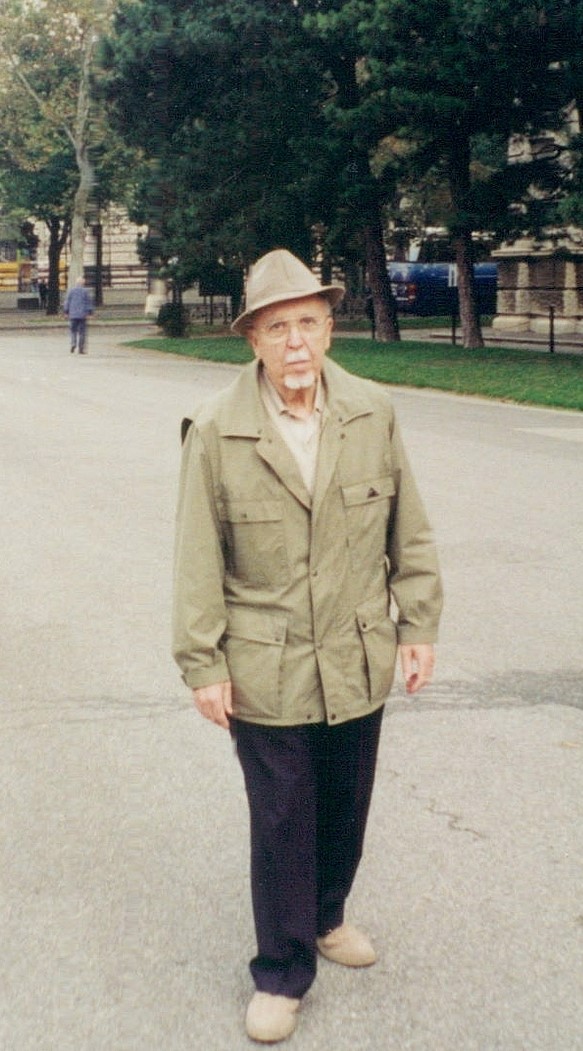
After I loaded our Opel Astra with our luggage I go in search of my father. I find him in the most unlikely of places doing the most unlikely of things. He is in the dining room of our hotel eating breakfast.  I am not eager to eat this morning and for some reason I decide to watch him, as opposed to joining him.  He makes his way through the breakfast buffet. He is wearing his typical uniform wearing of a light blue shirt of which he has so many and that he has worn for so many years that I secretly call it Ernie blue, twill pants that he has in a variety of khaki colors including the brown that he is wearing today, and dark brown half boots that he has had in some variety for as long as I can remember. It is an outfit that is neither in style nor out of style, practical and I decide that is as good a metaphor for my father as I can think of.


He is not moving well this morning. His shoulders are stooped and he is bending forward at the hips. Instead of lifting his feet he is shuffling them a little bit more than normal. He is walking old today and I don’t like it. My pops shouldn’t be walking old. He should be standing straight up and walking tall like he is in my memories. These are things that we can fix through better exercise and stretching that he finds boring. I vow silently when we get back to the states that I will work with him on core exercises that should help him to regain his posture.  I know that the likelihood of my father doing these exercises is slim.  I also know that I have to try. I don’t want my Pops looking or feeling old. It implies too many things that I would prefer not to think about.


When I finally make it to the table I find my father fully engaged in breakfast. Not only has he picked up some picked some yogurt, cheese and breads from the buffet but he has ordered some scrambled eggs from the waiter. I am impressed but not surprised.  Impressed that my father’s recovery from this bug that had laid him low just a couple of days ago had progressed to the point where he would eat a substantial breakfast before getting into a car. Surprised because my father has always been a big eater. In fact, the thing that made him seek out medical help when he developed lymphoma was that he could not eat an entire sausage so I am happy that he is eating.


The waiter comes and asks Hungarian what I would like for breakfast. At least that is what I think that he said as I don’t understand a word he is saying. I reply in the only words in Hungarian that I can speak with any sort of confidence “Coca Cola.” My father looks at me and asks “Don’t you feel well?” knowing that drinking soda, let alone Coke,  is not something that I regularly engage in.


“No, no I am fine. I am just not that hungry and my stomach is a little queasy so I don’t want to push it. I don’t want to tell him that this morning that I was forced to take two Immodium and had nearly thrown up for the first time in nearly 20 years. I don’t want to tell him, given my druthers,  I would be in bed asleep.  I don’t want our trip together to be about me being sick. I don’t want my father to feel like he has to take care of me. This is our chance to explore together and I don’t want to be the one who, excuse the expression, shits the bed.


We leave Sopron on a route that takes us directly past the house in which my grandmother was born.  As we pass it I am filled with memories of her. She always made me feel loved and complete. Her hugs a comfort and provided safe haven.  I think about how she smelled. I picture her smiling at me and shaking her head in the way that she did sometimes. This is where it began for her and as a consequence for both my Dad and me. So as I drive by I wave and say “Good-bye Grandma.” I looked over and see my father staring at the red house as we drive by and I wonder what he is thinking. My memories of her are and when she was older and life had taken its toll. When she was a stranger in a strange land.  His memories of her are from this place and from a time where life had not extracted so much. And even though my grandmother has been dead almost 30 years I miss her and I wonder what it must be like for him to be without his mother for so long. Her funeral is the only time in my life I have ever heard him sob.


Our mission before we leave town is to find the cemetery where my father’s Uncle Ede is buried. Until this trip I was not aware of my father having an Uncle who survived the war. My understanding had been of the 13 children by three wives of my great grandfather, only my grandmother and her sister, Sidi in Brazil, had survived the war. But that is how this trip had been so far. Uncovering the veil of the past. Part of that process had been visits to many graveyards in the “five town” region in Hungary looking for my father’s long-lost relatives, the Hacklers, Hess’s and Tischlers. In many cases, these graveyards are locked and I needed to jump the fences to see if there is anything worth seeing. At some point I ask my father what he hopes to accomplish by visiting these places and after a pause, and in moment of transparent emotions replies “So they are not forgotten.”


After many wrong turns, several stops to ask passerby’s for directions, a few false sitings and almost having given up hope we finally find the cemetery we are seeking. It is clear that the Jewish Community in Sopron has diminished to the point that they no longer take good care of their burial places. It is overgrown with weeds and wildflowers. Trees are not trimmed, tombstones akimbo and walkways between graves have become barely discernable paths. We are trying to figure out how to find my father’s Uncle’s grave when a man with a purple wife beater t shirt, shaved head and bad teeth along with a woman dressed in goth sheik approach us. Somehow, they were able to communicate they were squatters in the cemetery’s only building and that they are also took care of the place. When we told them whom we were looking for, they helped us search and within a short period of time the young man shouts out  that he has  found Ede’s grave..


His grave was one of the few that have the appearance of being well maintained. We stand there for a few minutes and silence and then I ask “What do you remember about Ede?”


He smiled and in a bit of a far away voice said “He was your grandmother’s baby brother and the ultimate survivor….He escaped from Russian POW camp in World War 1. I am not sure how he survived the Nazis…perhaps he had protected job or was hidden by the Communist underground. His wife Helene, I remember as being very kind to me and a very good cook, was not as lucky. She was caught and transported to Poland where she was murdered by the Nazi’s.” His voice trailed off and he was quiet for a few seconds.


“Did they have any kids?”


“My father smiled at the thought. “Yes, two boys. Karl and Bela. When I would visit Sopron we sometimes would go off into the woods with the local Zionist organization who were trying to teach us how to avoid being captured and escaping.”


“What happened to them?”


“I am not really sure. I know at some time, (my guess is that was during the early days of the war when Hungary was not yet full of German troops), in some unknown manner, made their way to Israel.  They may still live there.  Bela wrote to my parents during the fifties.  He was married then and had one daughter.  We lost track of them.”


“Those are the ones you ask me to look up every time I go to Israel business?”


“Yes.”


“So what happened to Ede after the War.”


“He came back to Sopron. Got a job as a bus driver. Remarried and was eventually pensioned and died of natural causes.”

Mission accomplished, we place stones on Ede’s tombstone and make our way through the overgrowth, weeds, and akimbo gravestones to our car. I know better than to ask him about his thoughts. He will only crack wise or make a joke. Instead I concentrate on driving and leave him to his thoughts. For a long while we drive  in silence.


We cross the Hungarian/Austrian border with barely an acknowledgement from the Guards of either country. Apparently, we do not look worthy of them wasting their time on and just like I do when I clear customs or enter a country anywhere, I feel like I have gotten away with something. It is a nice feeling and soon the car is speeding down A2 at 140km hours.


As on the trip to Sopron, my father is the navigator. He is blessed with a great sense of direction and the map reading skills the army teaches its officers. He has also been to this part of the world many times. So I have faith that he will get us to our destination of Fahrafeld. I believe that our passage on B and C roads has more to do with happenstance than design


It is sunny and warm and our windows are open and the smell of flowers and freshly cultivated fields fill the compartment of the car. Whether it is because of our stomach problems or the fact that my father and I have spoken more in the last three days than we have in years we are not talking very much. We pass the time looking beyond our windows. We pass through vineyards with their meticulously kept vines greening and in bloom. . There are small farms that look dainty by American standards, with freshly cultivated tracks and farmers atop green tractors often wearing brightly covered overalls.  There are fields densely packed with yellow bright yellow flowers.  We pass through small towns that look like they belong more in n gauge train set than in real life.


At one point I comment to my father that everything looks familiar enough to be comforting but just different enough that we could be in an episode of the Outer Limits. But he is lost in some thoughts beyond the reaches of the car and does not respond. I drive on.


We are in the hills now and the scenery has changed from farms and fields to meadows and trees. Not to far from Pottenstein which is the nearest town of any size close to Fahrafeld my father yells at  me “Turn right, turn right here” in the same tone he used to use when he was teaching me to drive. I do my best not to let his tone of  voice get the better of me but for a few minutes I am one pissed off 17 year old whose father is doing him no favor by teaching him how to drive. I slam on the breaks and still manage to make the turn a little faster than I probably should have.


Dad realizes that the tone of voice that he used is not appropriate and as he has done so often in the past when this is the case, changes the subject. He says “ I know where we are now. You see that building up there on the hill, that is horticultural research station for the University of Vienna. I remember it from the last time we were here.”


He says this with satisfaction and there is also an element of excitement that I have not heard in his voice on this trip. So I ask him “Are you excited about going to Fahrafeld and he replies in a manner that is typical of him “I don’t know if you would exactly call it excited….”


I can tell that what is to follow is a discourse on the appropriate word for how he feels and I turn down the volume. I realize that this discussion is just a way for my father to mask his feelings. For whatever reason traveling to this place has brought more emotion to the surface than all of the other things we have done on this trip. More than seeing his best friend in the hospital; more than visiting the graveyards of his relatives; more than visiting the house his mother was born in. As he talks in the background I wonder why he feels so emotionally connected to this place. All I can remember him telling me about Fahrafeld  is that he used to go there to visit his Aunt in summer and it is the place he learned to love buttermilk a beverage that to this day he claims is the best drink in the world to relieve the heat of a summer day.


So after he has finished talking I say in my best smart ass way “You know I didn’t listen a lot to you as a kid, tell me about you and this place.”


He reminds me that when my grandmother was very young her father died.  Her mother had to figure out a way to manage a household with 13 children with no husband.  Some of the younger kids who could not contribute to the livelihood of the family were parceled out to other relatives. Little Jeni, age 4, was sent to Fahrafeld to live with her Aunt Pepi her mother’s sister. She lived there until she was 14 when she sent away to a technical school to be a seamstress. My grandmother always thought of her Aunt as her mother. It was natural for her to farm her only son to her during the summer season. Dad tell me that he would arrive by train in the early summer and not leave again until school was about to begin. He tells me that his Aunt Pepi was the only grandmother he ever knew and says so in  such a wistful voice and I know that I cannot press further.


We come to a T-intersection and my father tells me to take a right. I look at the sign and it says Rt 212. When I suggest the irony of the Rt, 212 being the NYC area code, to my father and he just nods his full attention on the road ahead and trying to find Pepi’s house. The road is of the type that German performance cars were made for. It is narrow, winding, and well maintained. It is also quite picturesque. Along the driver’s side of the road is a fast-moving stream about 5 meters wide that you can see the occasional fly fisherman and fields full of wildflowers and what appear to be Dandelions. On the right side are small cottages, the Austrian version of a cape, in brightly colored hues and a mountain dense with trees.


After about 5 minutes we pass a white rectangular sign with the word Fahrafeld written on it.  Almost immediately upon passing into the town the road becomes canopied by trees on either side. The houses become more frequent and my father, who is normally calm to the point of stoic, is visibly agitated and keeps telling me to slow down. I look in my rear-view mirror and see that a long line of traffic has built up behind us and tell my father that I really can’t slow down much more. This news is greeted with a harrumph and visible annoyance. The town itself is beautiful with small cottages and what can only be described as chalet’s in various bright colors densely populating the right hand side of the road. On the stream side, it appears that they have created a small park with paved paths and flower beds. The town does not last long. A couple of minutes at most and before too long we see the same white rectangular sign with Fahrafeld written on it only this time there is a red slash going through it.


My father who was agitated before is now quite upset and I can tell by the way he tells me to “turn the car around” that he is royally pissed off. I see a picnic area on the right-hand side of the road and I pull into it hoping to use it as a jug handle to turn around. I don’t want to drive with my father this annoyed. I don’t want to have an argument with him and I know that in his current state the 17 year old in me could come out at any moment so I pull the car over and park. He barks “What are you doing?” and I respond that the scene in front of us…. a grassy meadow dotted with dandelions, a farmhouse with a red roof surrounded by trees, framed by a mountain in the background…is lovely and I want to take a photograph. I take my time and probably more photographs than I should but the result is what I had hoped for as my father is visibly calmer when I re-enter the car.


I try to go slower as we go back through town but the road is a very busy one and before too long there is once again a long line of traffic behind us. When I see in the middle of this village a place to pull over I seize the opportunity.  My father is looking around and tells me in a very disappointed tone that he thinks that we may have come all this way for nothing as he can’t spot his Grandmother/Great Aunt’s house and that he is afraid that it might have been torn down. I can tell that he’s upset and wish that I could find the words to comfort him but I can’t so I remain silent.


He says you see that over there. I nod. He says that is a war memorial and lists the names of the dead from this town. One of the kids I use to play with as a kids name is listed there. As I pull back onto the road, I think about how bizarre a world we live in. How two childhood friends could end up on either side of a war and one makes it and the other does not. It reminds me of how random life is and as always I am disturbed by this.


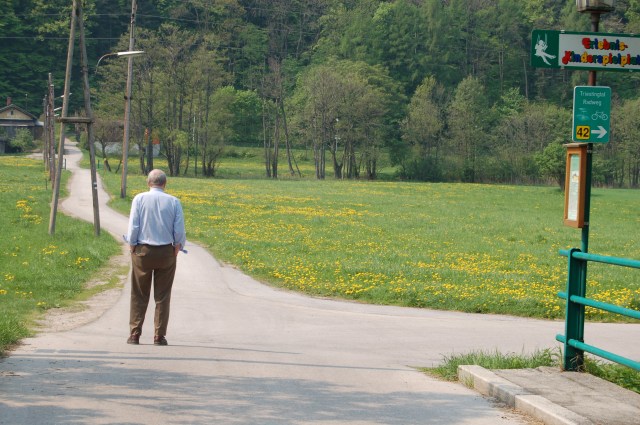
I am broken out of my thoughts by my father yelling at me to pull over. Luckily, just beyond a small bridge passing over the stream,  I spot a place to pull the car off the road and park.. My father points at a light blue house with a red tile roof and only windows facing the street and says “That is your Aunt Pepi’s house….they have clearly renovated it but that is clearly her house.” His tone of voice which just minutes earlier had been harsh and upset is now that of relief and delight and I can tell that seeing this house has transformed him in a way that I can’t imagine.


We both get out of the car and study the house from the distance. My father is wearing his signature Ray Ban Aviator sunglasses so it is hard to figure out what is going on inside of him but there is a whisper of a smile on his face so whatever is going on I suspect is a good thing.  As I pull my camera from the backseat so that I can take photographs of the house my father turns and walks towards the bridge. My fathers steps are small and deliberate, probably  the result of the long drive, and it upsets me to realize that he is walking just like the octogenarian he is.  I snap a few photos and when I finish my father  is turning the corner onto the bridge and disappears from sight.


I hurry to catch up with him but when I turn the corner my father is nowhere to be found. Instead I see a 10 year old boy standing in the middle of the bridge, surveying the scenery, as if he were a Prince and this was his own private kingdom.
Posted in Uncategorized | Leave a comment

The Crown: Chapter 4

Grosz Paul


The following afternoon found us in another cab. We had spent the morning doing errands among them going to the National Bank of Austria where my father banked a small pension given to those who had been forced to flee the Nazi’s and a quick stop for espresso and cake at Demels.  Our destination on this sun drenched but alpine cool afternoon was to visit my father’s boyhood friend Paul Grosz. For the last several years he had been suffering with Parkinson’s disease.  Recently, his symptoms of body tremors and stiffness, confusion, and an inability to communicate clearly had forced a hospitalization. As a consequence our first stop was to pick up Paul’s wife Henni at their home.

Despite being named for him, and being my father’s oldest if not best friend, I had only Paul twice in my life. The first time was on my only previous trip to Vienna when I was 7. My memories of that trip are few  but I have a vivid memory of visiting the Furrier shop Paul owned. He gave me a mouse that was made out of mink that I adored. That is until I lost him. The other memory I had of him was when he had visited the United States shortly after I had become a Bar Mitzvah. In honor of becoming a man, he had given me a beautiful Seiko chronograph with an orange face that I wore for years and still cherish. Other than those two meetings, that he had been the leader of the Jewish Community in Vienna for decades, and the rare stories from my father’s childhood, I knew very little.

As the cab maneuvered in traffic I asked “When you returned to Vienna did you look for Paul?”

“Of course.”

“How did you find him.”

“I went to the furrier shop his father owned. But he wasn’t there so I went to the apartment they used to live in and was told they had moved but the folks there had a forwarding address. I made my way over there and I found his mother. Paul was not there but she, in the best Viennese tradition and despite the shortages the war, invited me in for coffee and cake.  While we were  having coffee with her Paul  arrived. ”

“That must have been one hell of a reunion? I mean you had done it. Survived. And then to just show up on his doorstep wearing the uniform of an officer in the  American Army? That is a whole new definition of the term shock in awe!”

He paused and replied. “He just acted, as did I, like we had just seen other the week before. Hi Paul. Hi Ernst” He grinned, a self-satisfied smile  and said “We didn’t need to anything more. We knew what it meant.”

“What did it mean?”

“We survived.”

I nodded,  knowing that while I understood the words,  I had no idea what it really meant. I don’t think anyone who is not a survivor can understand the jumbled emotions that go along with that status.  I asked “Why didn’t they leave?”

“It wasn’t that easy. You had to get permission to leave. You had to get permission to go somewhere else. We had your Uncle Max who managed to get us a visa to the US and I had gotten permission to immigrate to Palestine. There were limited spots and many were not that lucky. Some thought they could wait it out…survive the Nazi’s. I suspect because Paul’s Mom was a Christian  and I  Paul’s mother they thought they could wait it out. ”

“How did they manage to make it through? ”

“Paul’s mother’s family hid them and I think they spent some time living in the sewers. U-boaters.”

We fell into silence. I knew from a life of living with my father and how he told stories of those years during and surrounding the war that what happened was lmore complicated than the responses my father was giving me . I knew, for example,  that at the beginning of the war nearly 200,000 jews were living in Vienna and that many, up to 130,000 had managed to find other places to live including places like Singapore. But those who left, left almost all their wealth and belongings. Where ever they went they had to begin their new life with little but the sentimental items like photographs and other family ephemera they managed to carry with them.

Of the 60,000 Jews left in Vienna when they closed the border only 2,000 survived the war. Paul had managed to win one of the most horrific lotteries of all time.

When we pull up in front of Paul’s home I am hit with another wave of Déjà vu. I had been here before when I was six. I remembered they had a back yard where my brother and I were delighted to be able to play after weeks of travel. I seemed to recall an airplane with a rubber band motor. As we walk up the front steps, we are met by Henni. She greets my father with hugs and kisses and then me with the same. She then steps back and taking us both in while commenting on how much we looked alike. We were ushered into her parlor because in proper Viennese fashion as she has prepared us a little cake and coffee so we would not go to the hospital with any hunger.

Over the coffee and cake she explains that Paul had been admitted to the hospital because his Parkinson’s had progressed to the point where he was no longer able to take care of himself, that his ability to speak had become limited and that the Dr’s had thought that a change in medication would help him with his tremors and communication. This had been going on for the past two weeks. She was, in the gentlest of ways, trying to prepare my father to see his oldest friend now altered by this horrible disease.

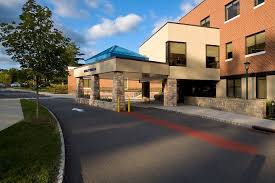
Vienna’s General Hospital is different than any hospital I had ever visited. It is a high rise. 22 stories tall with a motor lobby for cabs and cars drop offs and a mini mall that contains everything from flower shops to McDonalds. It was more like visiting an apartment complex in Miami Beach than a hospital that had originally been established in 17th century.

A high-speed elevator takes us to the 21st floor where Paul’s room is located. Hennie leads the way to Paul’s room with my father and me in her wake. He is not there. She suggests that my father go to the nurse’s station and see if they have seen Paul. Apparently,  despite his currently being confined to a  wheelchair and troubles speaking, he liked to socialize. While Henny and I remained guard outside Paul’s room my father made his way down the hall. There, in wheelchair, sat his old friend. My father walked up to him and when Paul recognized him,  he pushed himself up slowly out of his wheelchair and despite  tremors stood at attention for my father who returned the gesture. No words were spoken. Two old soldiers who had fought many battles together saluting each other without a word. 70 years of friendship encapsulated without a word. The silence a part of their code. Why speak of things that are not capable of being understood or where words are inadequate.

Their silent tribute to seven decades of friendship continues to be one of the most moving moments I have ever witnessed.  The thought of it still brings me to tears.

It was decided that all of us trying to sit in Paul’s hospital room would be uncomfortable and an inconvenience to his roommate. Instead, after straightening Paul up a little bit and gathering up his caregiver, we all head downstairs to the Hospitals coffee house. I expected a little cafeteria space such as we have in our hospitals at home with too much Formica decorated in colors out some industrial design handbook with bad food that would increase a cardiologist’s bank account.

I should have known that in this city that invented the coffee house, where patisseries and pastries were part of their birthright, a hospital coffee shop would be far superior to what is found in the US.  It was decorated in browns and brasses, the tables of real wood, with no Formica. The menu had everything from Schnitzel to Sachertorte. And apparently smoking was on the menu as well  because everyone in the restaurant seemed to be smoking and a blue haze hung just below the ceiling.

We arranged ourselves around a square table. My father and Henny on side. Paul and I on the other with the caretaker sitting on the end closest to Paul. My father was an innately polite person. He had the ability to take awkward social situations and somehow ease them into the normal. For example, once when my brother and I were quite young, perhaps 6 and 7, we were having dinner one summer’s evening at mother’s mother home. She decided to serve as a starter cantaloupe soup. Not the normal cuisine for us  kids who thought tomato soup and grilled American Cheese sandwiches were high billafare.  We declined to eat the soup with ewws  and grosses that might have made our grandmother feel badly. My father, in an effort to disguise the bad behavior of his children, told her how much he loved the cantaloupe soup and proceeded to eat both my brother’s and my portion. Family myth is that he was sick for days afterward.

Dad could tell that this was a very difficult situation for Paul. His verbal skills had deteriorated to the point where getting a word out was painfully labored. This was made even more tortuous by the fact he wanted to speak English so that I would feel a part of the conversation. As a consequence a pattern emerged pretty quickly at our table. I would ask a question and Paul would try to answer. If he got hung up or frustrated in finding the words my father would help him complete his thoughts.  Paul would react and try to expand a little a to me.

After we had ordered coffee and some Austrian pastries my father told Paul that the reason we had come to visit was because I was interested in writing a story about what it must have been like for him, to return to the Vienna at the end of the War… a jewish boy forced to flee his homeland only to return a few later, a man and an officer in the conquering army.

This embarrassed me a bit. I am not a professional writer and I didn’t know if I could even write something worth reading.  As I tried to conceal my discomfiture I asked Paul “What was your reaction, when you saw your old friend in your mother’s living room, wearing an US Army officer’s uniform?”

Paul glanced over at my father, and then back at me, his large eyes gleaming with a sense mischief and said in his halting tone. “It was good to see him.”

“Were you surprised?”

“No. I was pretty sure that he would turn up sometime.”

I could tell that he was going to be every bit as difficult to get information out as my father so I decided to change tack a bit. I had heard stories for years of how my father had a group of friends who roamed the streets of Vienna after the I said to Paul “Who was the leader of the gang you two were in.” I knew that as close as my father and Paul were that part of what defined their relationship was a fierce competitiveness and I was not above tossing a grenade to see if I could some details beyond single sentences from them.

They held each other’s gaze for a few seconds and then my father replied “He was.” but in such a way to make sure the listener knew he was just being gracious. And Paul smiled back and said in a halting way but with the same inflection as my father, “He was.” And then they both laughed knowing that had both outsmarted me.

Frustrated, but somewhat undaunted I persisted. I asked Paul “What was the name of you “gang.” He smiled and responded stuttering a little bit “The Wolf…wolf pack”and smiled eyes gleaming as if the thought of this band of miscreants brought back every good childhood memories from schools.

“How many people were in this gang.”

Paul held up his hand and said “Four.”

“Who were the other two?”

Paul began “Walter…” and seemed to get hung up and my father added “Eduard…Eddie.”

There was a pause as if the thoughts of these childhood gang blocked out the present for these old friends. As if their friends were now seated at the table with us. Enjoying a smoke and a coffee with their old comrades. I knew how special this gang was to my father. He had been telling us about them since we were small children asking for bed time stories. He would tell of the adventures of Ted and Hugi and their desire to escape Vienna in a makeshift submarine they were creating in a fishing shack on the flood plain of the Danube and the adventures they had along the way.

Wondering whether these bedtime stories were based in fact I asked “What this gang of your do?”

Again, my father exchanged a look with Paul and said “Mostly, we tried to find a way to get out of Vienna. There was always some rumor of Singpore, Palestine or some other country opening up for visas’s or a kindertransport to England or anywhere safe.  We tracked these down and let our friends know.  Or when people needed someone for an odd job. We needed the money. It cost money to leave and we…..” Here my father paused I think because he was trying to determine whether or not to tell the story “or get protection. I bought a bb gun for protection but when my family found out they made me give it back.”

Paul nudged my elbow and signaled that he wanted to have something to write with him. My father obliged him by handing him the pen that was perennially in his pocket. Paul then took a napkin on it drew what appeared to be a stick with five branches growing out of its top. He said “The wolfs paw.” He then drew a line through the second branch sticking up from the stick and said “Me.”

My father jumped in and said “That is how we used to leave messages to each other. If we had been some place and wanted to tell the other we had been there we would draw the wolf’s paw and depending on what digit was crossed we could tell who it was. I was the first, Paul was the second and so on. “

“But what kind of messages would you leave each other.”

“Well when we found that abandoned row boat and had a scheme to get it to work again…we needed to leave each other messages on what was needed without giving away who was working on the boat because if the authorities found out we surely would have been arrested.”

“So the Hugi and Ted stories were true?”

“Well lets just say there was some fact in the fiction.”

“What happened to the boat.”

“It disappeared. We went to work on it one day and it was gone. Whether someone else saw it and stole it or the Nazi’s found it and towed it away we never knew. But it scared the shit out of us.”

I paused before asking the next question because I think I knew the answers but wanted to make sure that I had the facts straight.

“If we found something that we thought would be valuable a job or coffee or some such or if there was trouble we had symbols for them all.”

I asked, reluctantly “What happened to them…the other members of the Wolfpack?”

Paul replied “Walter I used to see around for a while and then he disappeared one day. One day he was there and the next gone and no record as to what happens I thought he had managed to escape. After the war I found out he died at Malthausen.”

“And Eddie”

My father replied “Eddie….” and sighed and then said “He got out before all of us. A kindertransport to England where he lived with in Lancastshire with two school teachers. When he turned 18 he enlisted in the RAF and on the very last day of the war his plane crashed and he was killed. Poor bastard.” A silence fell over the table.  I didn’t realize it at the time but my Dad had been in touch with Eddie from the time he left Europe until shortly before he was drafted. After my father’s death we discovered he had saved the letters for over 70 years and had even written a short story about being in England and searching for some trace of his old friend and Wolfpack member.

There was a pause in the conversation. The memory of Edi and Walter of the memory of the adventures of the Wolfpack hovering over the table like the cigarette smoke at the tables adjacent to us. It made me realize that the salute Paul had given my father by getting out of his wheelchair and standing like a soldier at parade rest  was more than courtesy afforded to any old friend. It was a salute to their old comrades and friends. Paul’s and my Dad’s survival and a tribute to Edi and Walter there fallen comrades.

The conversation proved exhausting to Paul. His nurse signaled that it was time to leave and our coffee klatch broke up. We said our goodbyes n the lobby.  Hennie, the aide and Paul returned to his room. Pops and I to the motor lobby to catch a cab. As the taxi pulled away from the hospital my father said to me, “I need a drink.” I understood. I needed one as well.


Posted in Uncategorized | Leave a comment

The Crown: Chapter 3

project 051 (2)


The next morning was another beautiful mild spring day and after a hearty breakfast at the hotel we went for another stroll. This time we headed out towards the Opraring and the Ringstrasse as our initial destination was the Kunsthistoriches Museum which contains the amazing art collection of the Hapsburg’s.  I remember being struck by the beautiful gardens we passed with lilacs in full bloom and gardens full of newly bloomed and brightly colored tulips.

When we arrived at the museum Pops chose to sit on a bench opposite the statue of Empress Marie Theresa while I gave the museum the once over. It was not that he did not like the museum but the standing and the stairs would be a challenge for him. And moreover, despite the sophisticate he was, he had a low tolerance for museums. 30 minutes to an hour and he was done.  Add to that the fact he had been there before, sitting in a garden, soaking in the Viennese spring seemed ideal choice for Dad..

The collection of paintings and antiques were amazing in their depth and scope. But what struck me most of all was the realization that this had been an Empire, for five centuries a leading power in Europe and Vienna its capital. And for a time, it was the center of the Universe. And then, after World War 1 they were suddenly an insignificant capital, in an insignificant country. It helped me understand the Anschluss and why most Austrians accepted annexation by Germany and becoming part of the Reich. They wanted their empire back.

Gaining an understanding of Austria’s vainglory did not diminish my contempt and anger at what they had done in their misguided attempt to reclaim empire. It was said while Germans were successful anti Semites, Austrian’s were pro’s.  Worse, the Austrians had never fully accepted their role in the Holocaust.

My tour did not take long as, like my old man, I have a imited tolerance for museums. I love the art. I love the history but if I take any longer than an hour in a museum I get cranky. I found my father sitting on his bench, enjoying the spring sunshine and  it looked as if he might have even managed to slip a quick nap in while he waited for me.  I asked him if he was tired and told him if he wanted we go back to the hotel we could.  He needed to be up for what was next and did not want to push him too hard. What was to come next would require a huge reservoir of emotional energy that would be a challenge even for me.   He told me he was ready in a way that suggested that he thought I was coddling him. To prove himself ready, he set off at a brisk pace  to the Karlsplatz, a light rail station, a few blocks away. When we arrived my father without seeking guidance from anyone  picked the #44 trolley and jumped on board.

I asked my father “We’re Jews allowed to take the trolley after Krystalnacht?”

He pursed his lips into a pucker, as if he was sucking on a sour memory,  and said “No.” I wanted to ask him how he got around but I could tell he was far away and no doubt my questions would annoy him so I got lost in my own thoughts instead.

Our destination that morning was  #48 Ottakringer Strasse, the apartment where my father was born and lived his entire life until he left Vienna in 1939. It was a central part of our family mythology about my father’s childhood. My grandparents were very poor. My grandfather worked in abattoir, cleaning hides and getting them ready to be tanned. A job that was brutal on the body and crushed the soul for very little money. My grandmother worked as a seamstress making handmade ties at home. All they could afford was a two-room apartment that had a kitchen, where my father slept, and a living room where my grandparents slept. The bathrooms were shared privy’s at the end of the hallway and the refrigerator was, weather permitting, the ledge outside their window. It is this apartment that the Nazi’s invaded on Krystalnacht and arrested my grandfather and terrified my father.

My father, who never talked to us about that night, wrote to us what he called a “minor memorandum” on the 50th Anniversary of that awful night.

A MINOR MEMORANDUM TO MY CHILDREN

ON THE FIFTIETH ANNIVERSARY OF KRYSTALLNACHT,

        NOVEMBER 9 AND 10, 1938

I don’t intend to make this a big deal literary effort or a weepy emotional debauch.  I simply want to tell you what I remember about Krystallnacht. So you should remember as well. And if there are to be others like us, so you can tell them. Nothing big! Just a small and portable lesson about the planet we live on and the hazards of being a little different.


Krystallnacht did not start for me until November 10, 1938. I knew that von Rath had been shot by Gruenspan but I knew nothing about what was happening all over Germany during the night of the ninth.  I was 12 years (12 10/12 ths )old and I was asleep.

I was still lying in my bed, at about seven on the morning of November 10, when there was loud knocking on our door. I heard my father and mother (your grandparents ) talking to some people. Several stormtroopers (SA) had come to arrest Jewish men.  The entrance to our apartment was through the kitchen and all this was taking place in the kitchen.  After a few minutes I heard one of the Brownshirts ask whether there were any other male Jews in the apartment. Grandma said only my little boy.  I dont think they believed her because they came into our mainroom, where my bed was.  I closed my eyes and pretended I was asleep.  They came to my bed and they looked at me and they must have decided either that I was too young, or that I looked too fierce to mess around with since there were only six of them. So they took just grandpa with them and they left. 

As we later found out, they took grandpa to the local police station.  From there they marched him and others to the Rossauer Kaserne, a military barracks.  He was lucky because he had a roof over his head.  Many other Jewish men were taken to a large soccer stadium and did not have a roof over their head.

Grandpa had been fired from his regular job as a bristle processor a couple months before.  He was earning some money by helping a carter hauling the furniture of Jews that had been kicked out of their apartments. The cart was pulled by one brown horse.  Grandpa had a job scheduled for that morning. 

Grandma sent me to help the carter in grandpa’s place. May- be grandma was a tough Hungarian cookie who did not want the Rothkopf’s reputation as men of their word sullied, or maybe we needed the money, or perhaps she wanted me out of her hair so that she and Aunt Mitzi ( who lived in the next apartment and whose son Walter and friend Albert were already on the way to Dachau) could weep in peace.   

I don’t remember exactly where I met the carter but it was  at his client’s apartment near the Jewish section of Vienna. We loaded the wagon with furniture.   I sat next to the driver on the high bench behind the horse.  Then the brown horse slowly pulled us through the streets towards the place where we had to make our delivery.

Groups of people were standing in front of the broken windows of Jewish stores, gawking while Brownshirts were putting their owners through their paces — handing over business papers, washing the sidewalk with lye, licking Aryan employees shoes clean. Anything that would keep the cultured Viennese crowds amused.  We passed a narrow street that led to one of Vienna’s larger synagogue.  The alley was jammed with jeering onlookers.  Stormtroopers were throwing furniture and Torah scrolls through the big main door into the street.  One side of the roof (I couldnt see the other and you know what a sceptic I am ) was afire.  I remember very vividly the twists of whitish-yellow smoke that were curling up the slope of blue tiles.

Farther on we passed another synagogue that was fully ablaze.  The police had made people stand back from it.  I suppose they feared for their safety.  A fire truck was parked down the street. The firemen were leaning against their equipment, talking and smoking cigarettes. Everywhere there were clusters of people, in a holiday mood, gathering around smashed Jewish stores. Little groups of Jews, both men and women, were being led along the sidewalk flanked by squads of SA men.  The Jews were made to do all sorts of menial chores.  Someone told me later, that one elderly Jew asked to go to the toilet.  They made him go in a bucket and then forced him to eat his feces.

By now I was beginning to figure out what was going on. I sat high on my horsey throne (just like the Duke of Edinburgh when he drives his high-stepping pair, except that I didn’t wear an apron ).  Whenever we passed a sidewalk event or other happening, I pulled down the wings of my nostrils (I thought I looked more Christian that way), staring straight ahead, but watching the Nazi street theatre out of the corners of my eyes. The driver, who was also Jewish, was a hard old soul.  I dont remember him saying a single word to me, all day, about what was going on.  Maybe he thought I was too young to hear about such things.

I dont remember much more detail.  I got paid.  The trolley I went home on was crowded.  I kept staring out the window so that people wouldn’t notice the handsome Jewishness of my face.  Beyond the rattling trolley panes, the peculiar happenings of November 10, 1938 were still in progress here and there, even as the day’s light was fading.

When I got home, grandma and Mitzi were still weeping.  They had just come back from the police station but grandpa and the other Jews were no longer there.

Grandpa came home ten days later.  He had spent that time in a room with 500 other people and one water faucet.  They did a lot of military drill ( was this the beginning of the Hagganah ?) and exercises — push-ups, deep kneebends, and the like.  Some who didn’t do so well got beaten up. He never told me whether they did anything to him.  But then I wouldn’t tell you either.  Grandpa was lucky.  A lot of the Jewish men who were arrested on the 9th and 10th of November were sent to the concentration camp at Dachau.

Not one single synagogue was left intact in all of Vienna.  That really screwed me up because I was nearly thirteen. You need to have a Torah to become a Bar Mitzwah and you need to have a table on which to lay the scroll while you read. And how was I to get a fountain pen now?

The dead, of course, are dead.  They are mourned by those who remember. Tears dry. Bruises heal. Razed synagogues become  parking lots.  Injured dignity heals although slowly.  What hurts most to this day is impotent compassion for those who were swept away. 

In order to have faith in our quality as human beings, we need to remember! And thats why I am writing you this note. 

As the trolley made its way I recalled the words my father had written nearly 20 years before and I tried to imagine what it must have been like as a 12 year old boy to have to have your house broken into the middle of the night, have your father taken from you, perhaps never to return and then being forced to go and do your fathers job, while atrocities were happening all around you, because you needed the money so badly that you didn’t have a choice. What must have it been like to see your neighbors making your co-religionists lick their boots and clean their sidewalks with toothbrushes. To see your synagogue burn to the ground just days before you were to become a bar mitzvah after studying for years to achieve this milestone right of passage.

I couldn’t imagine what he had gone through.

My father jostled my arm to get my attention and said “We’re here.”

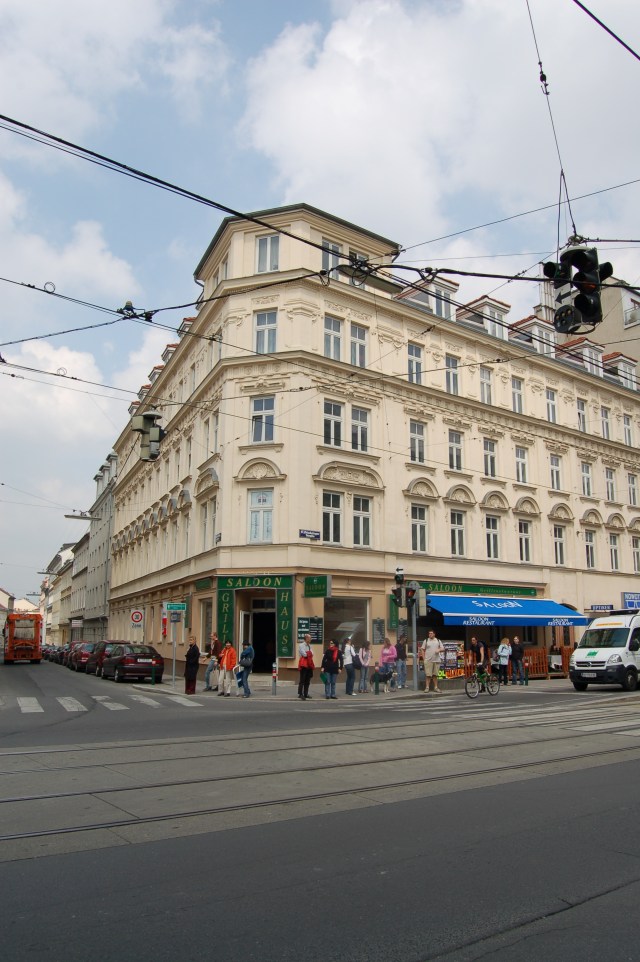
There, astride the corner of OttakringerStrasse and Bergsteggasse was a 4 story,  L shaped Belle Epoque building, the color of ripe hay,  with a mansard roof.  The main entrance to the building was a beveled corner at the intersection above which a blue and white sign with “48” printed on it. Embracing the outside of the building was a small café with a blue awning that looked as if it was the place where the neighborhood drank its coffee and beer.

Pops pointed at the building and said “See the third floor, 2nd window over, that was our apartment.” A feeling of déjà vu rippled through me as I realized my father and I had this very same conversation over 40 years previously on my first and only trip to Vienna. It was so long ago that fragments of the trip are all that remain in my consciousness. My parents cutting me off after my third hot chocolate. Seeing a Tom and Jerry cartoon in German.

I had, when I thought about this moment in preparation for the trip, realized that coming back to his childhood must evoke powerful memories and emotions for my father. More than just the Holocaust and all it wrought. But of motherly hugs, and family gatherings. Of fatherly love and the complicated man Marcus had been both loving and angry and the occasional beatings these unexorcised emotions would generate. A childhood of happiness and deprivation that would help create the man that would one day be the father that his children adored.

Now we were here at the site of those sweet and sour memories and for a moment was so overcome with the emotion of the moment I needed to turn my back on Dad so he would not see my tears. Eventually, the light changed, and I followed him across the street.

We walked up the front steps and into the dark foyer of the building. It took a second for my eyes to adjust to the lighting and when they did I saw a set of broad stairs that led up into the building. I turned to my father and asked “What are you thinking about? ”

He paused, reluctant to share his thoughts and replied “ I was thinking about the wife of the superintendent of the building. She was a nasty piece of work. She hated having Jews in the building and would scream at us kids every chance she could get. She would say vile things and scared the shit out of us.”

“Didn’t your mother say anything to her.”

“What could she say without getting us thrown out of the building or worse.”

I decided to change the subject. “Really, no bathrooms in your apartments.”

He smiled and said “Yes. If you had to go the bathroom you had go down the hall. Except when I small and we kept a honey pot in the kitchen so I wouldn’t have to go outside…. The Super’s wife always yelled that we were fouling the bathrooms and making her life miserable.” He paused and said “You should go up and look.”

I replied “No. I have seen enough and I don’t want to have explain myself to the current tenants. Lets go outside and get a beer.”

Once seated, and beer ordered. I asked “When you got to Vienna at the end of the War how did you find a place to stay.”

“You have to remember that Vienna, at the time was an occupied city. I went to Army HQ and asked them to assign me visiting officer’s quarters. I can remember they had a hard time finding me space as the city had a lack of housing due to the war and eventually assigned me a room that I had to share with another officer.”

“Did you two get along.”

“Yeah he loved that I was a native and I knew where everything was and could of course speak the language.” There he hesitated as if contemplating whether he should share something with me and then said “He even tried to recruit me. “

“Recruit you how.”

“He wanted me to stay in Vienna and help them with intelligence work. He thought that I might be an asset.”

“Really!” I said honestly surprised. “What unit was he in?”

“I can’t remember.”

“Come on”

“I remember that his arm patch had a horse’s head, like a chess piece on it.” (Years later I would surmise from checking out arm patches on Wikipedia that this was the insignia of the 650th Military Intelligence Group.)

“Why didn’t you do it?”

He smiled at me, into a benevolent way that suggested that there was no way that I would understand what he would say, and replied “I wanted to get back to school.”

He was probably right to think that I wouldn’t understand because to me it sounded like he could have been James Bond if he wanted. Even at 50 I couldn’t understand giving that up. But thinking about this years later, knowing what I know now, I realize that my father had already lived too exciting a life. That what he craved was a less interesting, not more interesting, life. All things considered I could appreciate that.

I said “I didn’t mean to go down the side track. What I wanted to get to is what was required of visiting officers.”

“What do you mean?”

“I mean what did you wear. You didn’t wear fatigues or civilian clothes. You wore your class A’s right?”

“Yes.”

“So did you come here when you came back looking for your relatives.”

“Yes.”

“And did you see your landlady.”
“Yes.”

“And did she recognize you despite the fact you were 4 years older and had grown a foot since last you seen her and were now an officer in the US Army?”

“Yes.”

“How did she react?”

He looked away from me and I could see on his face that he was retrieving a very specific moment,  likely in full 1040p resolution and Dolby sound and said “ She was scared.”

I smiled at his simple response and asked “How did that make you feel?”

He paused,  as if a little ashamed of his emotion,  and said “Great. ” I was not ashamed of the smile I had my face at the thought of a tormentor of my father scared of my father. The thought of it made my day.

We were quiet for a few moments and he said “Lets go for a walk. “

Crossing the street we headed down Weyprechtstrasse and after a block or so we paused and he said “This used to be a park where me and my friends would play football.”

I asked “Was it grass?”

“No, gravel. It used to cut it us pretty good.”

“I can imagine.”

We resumed our walk after a very short walk my father paused and pointed to a plaque on the side of a building. It read “Hier stand eine um 1885/86 nach planen des archiiteten Ludwig Tischler Erbautes Synaggoge. Zerstort in der Reichskristallnacht am 10.November 1938” (Translation: Here was a synagogue building built around 1885/86 after the plan of the architect Ludwig Tischler. Destroyed in the Reichskristallnacht on 10 November 1938.)

My father says, in a voice that is supposed to convey nonchalance but sends the exact opposite message “This is where my synagogue was before the bastards burned it down.” He paused and said something to me that he had said many times before “I didn’t even get a fountain pen” referring to a once traditional present for a young Jewish boy when he became Bar Mitzvah.  This time, though, it struck me full force how hard he must have studied to become a bar mitzvah, how heartbroken, horrified, disappointed and devastated to see his temple be burn to the ground by a mob just weeks before fulfilling that dream. How that night changed his life forever. That every time he mentioned not getting that fountain pen, it meant more than not getting a gift, it meant the death of a dream and the end of whole period in his life.

It broke me and I started to weep and noticed my father was doing the same. I swore to myself there and then that I would get him his fountain pen and kept that promise later that year as a present for his 81st birthday. It must have meant something to him because after his death I found the card and the pen in his top desk drawer. The card read: “To Zaki ben Mordecai: Abba…a little late, but better late than never…Love Daniel Ben Zaki.”

We turned the corner and after a few more blocks came across another belle epoque building but this one had a huge gold coat of arms, a shield boarded by angels on its sides and a bust of Hermes above, on its façade. He pointed and said “That is where Litzi, Aunt Leni and Uncle Benno lived.”

“Litzi emigrated (alone) to Belgium, how or why I don’t remember,  where a family named Weening became her foster parents.  When the Germans invaded she fled with them to unoccupied France.  They then made their way (on foot) across the Pyrenees, and then somehow  Mrs. Weening, Lizzi, and her foster sister got themselves to Jamaica, where they were interned.  Mr. Weening was badly wounded while serving with Dutch Forces in the Normandy Invasion.

“Walked?”

“Yes. In fact Litzi says the woman who was taking care of things walked over the Pyranees wearing high heels”

“What about Benno and Lenni?”

He was arrested in 1938 and sent first to Dachau and then transferred to Weimar-Buchenwald.  Sometime in mid-1939 he was released on the condition that he leave Germany within 72 hours.  He got a visa to Italy (Milan) where we saw him as we passed through in November 1939.  Because his visa was no longer valid, he managed our meeting by leaping on our train while it was in the switching yard and then rode into the Milan station with us, where he managed to disappear immediately on the platform.  The Italians finally interned him in a camp in  Southern Italy (Alberobello and Ferramonte in Bari)  .  The British liberated the camp and he attached himself to the Jewish Brigade, whom he served as a laundry worker and later worked for American troops in Naples.

“Wow. The guy always scared me a little but he must have been some tough son of a bitch to survive all that. And Linni?”

“She stayed in Vienna, living underground what they called a u-boater.” One of her life savers was her gentile sister’s baptismal certificate.  She never left. She hid with people all over the city. I think a good part of it in the red light district. “

“Unbelievable story. I can’t even imagine what they must have gone through” I replied and then mentally chastised myself because for years I had remembered them as the horrible couple who had babysat my brother and I whom hadn’t  allowed me to have potato chips when I wanted them.

We walked a little farther down the road until we came across a white multiple story building with Schule Der Stadt Wien or School of the City of Vienna in red letters across the front of the building. He said “this is where I went to primary school.”

Deciding that we had been too serious for too long, I tried a little humor on him. I said “Is there a plaque somewhere.”

He smiled and replied “Smart ass.” And we walked on until we reached a very imposing, very federal looking building that said “Bundesfaschule fur wirschatliche Frauberlufe” which I in my very bad German roughly translated as “Federal School for Women.” Pops said “This is where I would have gone to High School.”

“But it says that it’s a woman school.”

“It wasn’t then.”

Then something occurred to me. “What do you mean would have gone to high school. I thought you started high school here.”

“No. I was about to but after Krystalnacht Jews weren’t allowed to attend secondary school.”

“Krystalnacht was in November of 1938 and you didn’t immigrate until a year later….What did you do with your days.”

His reply, slow coming as if he didn’t want to open up a can of worms said “I hung out with my friends. Lets get a cab.” I could tell he was tired and even though I wanted to know about what he had done during his year out of school I was quiet. I figured we would get there eventually and for now I was content to let my father have the peace of his own memories and for me to process all that I had learned that day.

Posted in Uncategorized | Leave a comment

The Crown: Chapter 2

drei husaren

But you know that when the truth is told…
That you can get what you want or you can just get old
You’re gonna kick off before you even
Get halfway through
When will you realize, Vienna waits for you?

Billy Joel “Vienna”


European Airports always remind me Richard Scarry’s childrens books. Perhaps this is because I had just learned to read when I first went to Europe or the illustrations had a very European look that I couldn’t place until I went there. Or perhaps it was the color palette. I don’t really know but I do know that when I arrive at a European airport I am always disappointed that the ground crews are not humanized foxes, pigs, cats, or rabbits. And so it was when my Father and I landed at Vienna International Airport in May of 2006.

In the end, it had not been difficult to convince my father to go to Austria with me. While I am sure that my desire to understand his war experience and write a story about it was a part of the decision-making process I am pretty sure that it not take a lot unction to get him to go. One factor was no doubt to see his oldest friend in the world, my namesake, Paul Grosz. He had been suffering from Parkinson disease for many years and the chances were if my father didn’t visit him soon he would miss the chance to have one last talk with him.

Another reason it had been relatively easy to convince to embark on this trip with me was that despite all the pain and suffering he had experienced in Vienna as a child,  and the heartbreak he discovered on his return as a young man, he still loved the city. It contained the memories of his childhood. Those memories most of us hold most fondly. And knowing my father’s optimistic attitude and perhaps sharing some of the same brain chemistry, I know that the tough times had faded to the background while the memories of families, of his friends, and the good times had been burnished over time and visiting the city added to the polish the remembrances of a long ago childhood.

What made this trip even remotely possible is that he and I were good travel companions. Over the course of my adult life we had been on a number of adventures together. In 1988 he and I spent 10 days in Israel exploring the country and both living out childhood dreams of visiting the Jewish homeland. In 2001 we had gone to Alaska, another bucket list trip for both of us, in celebration of my father’s recovery from Lymphoma. We knew how to be together. When to chat and when to be silent and when to give each other room to be by ourselves. We saw humor in many of the same things, and could point out things to each other that we would relish. He knew, as did I, that no matter what happened on our journey, it would be enjoyable because we would be together.

When we had made the decision to go,  we agreed that I would “cover” the airfare by using the mileage. My work had me on the road constantly and I had collected enough miles on American Airline’s to procure us two business class tickets to Vienna.  He would be responsible for the hotels and meals. Using mileage meant that instead of flying nonstop to Vienna we would have to change planes at Heathrow and go to the British Airways terminal from Terminal 5 where American Airlines planes operated. At the time, I didn’t think this was a big deal because I had nearly 2M airmiles under my belt and changing terminals was just what one did.

What I had not thought of at the time I booked the ticket was that my father was 81 and due neuropathy, a lack of sensation in his feet, he had difficulty walking. I never thought of him having difficulty doing anything. There were times where I saw him frail. When he was suffering from Lymphoma and going through chemo. Or, once when we were in Alaska, I saw him stumble getting into the water and had wondered about him growing old but I never thought of him having difficult walking. For a large part of my life he had walked two miles to work each day even though we lived in the suburbs. The man who always wanted to go on hikes. His hair may have been grey in places but even at 81 there was still a hint of color. He still worked every day and several times a week he would drive himself to Columbia University to teach, with students or supervise experiments. He went to the gym three times a week. But old and have trouble walking? Not my Pops. I never thought of him that way. That is until we got to Heathrow.

Heathrow, in addition to be one of the busiest airports in the world, is an endless warren of terminals and walkways. You literally have to walk kilometers to get to your aircraft. It was apparent from the start that Dad’s neuropathy and perhaps a long flight made it difficult for him to walk.  My father had for years been suffering from a gradually increasing neuropathy of his feet. It meant that for the most part he could not feel the bottom of his feet which, of course, made walking quite difficult. As a consequence it was a challenge to him walking the long corridors of Heathrow’s terminals which was observable by his style of walking. He had to set himself in motion by throwing his arms forward and then conduct a march on a short stride on the balls of his feet, arms moving in sync with his feet. At the time, and perhaps a bit too romantically, I thought of it as the march of an old soldier.

As we walked along, I wanted to help him. Perhaps stop and call for a wheel chair or some other form of transport that would make the navigation of the corridors of Heathrow less of a challenge to my Dad. Or maybe I should offer to take his carryon bag or slow the pace or even take frequent breaks. But I knew from long experience that this type of offer would be denied. It would offend his sense of independence and strength. It would be an impeachment of his role as father and protector. It would deny him his manliness.

Walking with him, watching him suffer silently, made me feel dreadful. Had I been more thoughtful I would have arranged for some type of transport acceptable to him that would allowed him to walk less. I had been insensitive and less than thoughtful and the result was an impossible situation where because of my father’s manly code I could not interfere.  I could only watch him suffer. I swore an oath that I would try to be more cognizant of my father’s age and challenges. I would try to be a better son.

Many long corridor, a customs check , a security check and two bus rides later we finally arrived at the British Airways terminal. Like many international terminals this one resembled more an upscale mall than it did a transportation hub. Neither my father or I are shoppers so we sought refuge in the British Airways club. While not exactly posh, it was terribly British with understated elegance of faux antique furniture. It’s breakfast buffet included baked beans and grilled tomatoes which personified along with marmalade and toast British breakfast cuisine to me. In short, it was a lovely place for us to rest before we made our way to our connecting aircraft. When we left to go to our gate I grabbed Dad’s bag before he could object.

The flight to Vienna is short but long enough for a nap which I happily took. I fell asleep before take of and only woke on landing. As we taxied to the gate, I smiled. It still looked like a Richard Scarry illustration.

Outside the airport we picked up a Mercedes cab and headed into Vienna. It was a beautiful May day with blue skies, puffy white clouds and mild temperatures.  The cab was warm, so I cracked the window and gazed out, mesmerized. Not because the scenery was spectacular, mainly open fields intermingled with a few industrial parks that had a far neater, more elegant look than their American counterparts. But because that is what I always did when taking a cab from the airport into a new city. It was a city’s overture I wanted to hear it.

I looked over at my father. He was wearing an outfit so common for him it probably should have been trademarked. He wore khaki pants with a light blue shirt, safari jacket and Ray-Ban Outdoorsman aviator style sunglasses. He was lost in thought and I wondered if he was remembering what this part of Vienna looked like before and when he had returned at the beginning of the occupation.

I asked “When you returned to Vienna at the end of the War what time of year was it?”

He looked thoughtful, like he was thinking about what he should say, and replied “I really can’t remember.”

“What do you mean you can’t remember? You remember everything!”

“I just don’t remember.”

“Well, can you remember what the weather was like.”

“No, not really except it was not too cold nor hot.”

“So it was likely Spring or Fall?”

“I guess.”

At this point I was getting pretty frustrated with my father’s non-response responses. So I asked, no doubt in an irritated tone “Can you remember what year it was?”

“I think it was 1946.”

“But you were in Europe since early 1945. Why did it take you so long to go the 300 miles from where you were stationed in Italy to here.”

“It was not that simple.”

“Why”

“Because I was stationed in the Mediterranean theatre of war and Vienna was in the European theatre. And that made it harder to get permission because you had to deal with two commands.”

“But, weren’t they even a bit sensitive to your special circumstances?”

“No. Not really. My commander was a real son of a bitch and kept turning down my requests.”

“So what did you do.”

“I went above his head.”

“How?”

“At some point I had to take some papers over to the commanding general and I took the opportunity to plead my case. And I think it go my Captain’s ass in hot water because I got permission to go pretty soon after that.”

“But you can’t remember when that was.”

“No. Now will shut up so I can enjoy the ride into the city?”

I shut up. I didn’t think it strange for him to ask me to shut up. I tend to chat and ask questions when I am in new situations. I think his asking me to pipe down had more to do with the fact that we were on the outskirts of the city proper and the “real Vienna” was revealing itself.  No doubt he was caught up in the thoughts we all get when we return to a place that is full of memories.  What I did think strange is my father’s elusiveness on the details of his return to Vienna. How could he not remember the time of year? Not only had he had the months in which we had planned the trip to contemplate that but I didn’t think it was a detail that I was likely to forget and his memory was every bit as good, if not better, than mine. But instead of questioning this further I too got lost in the sights and sounds of Vienna.

After checking in to our hotel, The Schlosshotel Romischer Kaiser we decided that going to sleep, despite the fatigue and jet lag of travel, would be the wrong thing to do. Not only would a nap do more harm than good to our sleeping patterns but we were both anxious to get about. For my father, to rekindle old memories and for me to get a sense of city that the last time I had last visited when I was 7. After dumping our bags in our room, a large one bedroom with full size bed for my dad and a sleeping nook with single for me, we walked a block to the Kartner Strasse, a pedestrian street that runs from the Opera to St. Stephens cathedral. My father wanted to walk the few blocks to the cathedral and as we walked I saw him morph into the Viennese he was. Instead of walking with hands by his side, his hands were clasped behind his back. His chin was tilted just a little higher. We strolled rather than walked.

At the time, I didn’t question the reason my father wanted to walk to St. Stephens. It is the city’s landmark and seemed a natural destination. It was one of the few clear memories I had from my only trip to the city nearly 50 years before. But years later I would wonder whether these first steps in Vienna were really a pilgrimage, of a sort, for him. Eventually, we found our way to a café and ordered a lmid afternoon pick me up which in Vienna is an exquisite pastry accompanied by an espresso. As my father ordered for us I remember thinking how easily he slipped into Viennese German with all the “ahso’s.” This was the language he learned to think in. I wondered how speaking the language of his childhood along how being here must effect him.

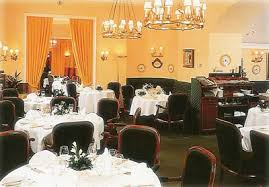
That evening my father decided that we should go to the Drei Husaren an ultra-traditional Viennese Restaurant.  Located near our hotel, it had been open since the early ‘30s. As we walked in the door we were welcomed by golden yellow décor, a tuxedoed matre di and a pianist playing a classical piece. The tables were immaculately dressed with white linen table cloths.  peaked napkins and more glassware I had in my first apartment.  It was as if you had entered a time portal and time stood still.  I wondered whether this comforted my father in remembering the halcyon days before the war or was it triumph or sorts for him. Being able to afford this restaurant, which was beyond comprehension for his family when they lived her,  a symbol of all that he had accomplished since.

I was probably over thinking this. Knowing my father, and his lusty relationship with food,  he came for the cuisine and it did not disappoint. The Leberknoweelsuppe ( liver filled dumpling in a chicken broth ) was outstanding. The Wiener Schnitzel the best  I had ever eaten outside my grandmother kitchen, and their dessert cart that would make grown men weep. The two excellent bourbons I had enjoyed with my meal aided my digestion wonderfully and made my tongue loose enough to push my father a bit on his history. The whole reason for this trip after all was for me to get a better understanding of what it must have been like for him, fleeing for his life only to return as an officer in the conquering army.

When the coffee arrived I asked “Do you mind if I ask you a few questions about your Army career. I want to make sure that I have the timeline correct.”

“Sure. If you must.”

“Well if I am going to write this story I would love to get the facts straight.”

“Go ahead.”

“You entered the army in the summer of 1944.”

“Yes, my draft board had issued me a deferment so that I could complete my sophomore year.”

“How long was basic training.”

“I don’t remember.”

“Two months, 3 months?”

“Probably closer to 3 months.”

“So if you entered the Army in the Summer of 1944 you probably finished basic training in September or October.”

“I guess so.”

“And you went to basic in Texas.”

“Yes. Fort Wolters.”

“So, did you go to OCS immediately after you finished basic”

“Pretty much”

“Did you have to take a test to be any officer or did they have some other way of selecting you?”

“No, you had to submit a request and then the Army decided whether you were selected. And I didn’t know whether I wanted to become an officer or not.”

“Didn’t you want to become an officer?.”

“I don’t know. I had a friend in basic and he thought it was a good deal. So I applied and was accepted.”

“Is that why you became a citizen in Texas…so you could go to OCS?”

“Yes.”

“Where was OCS?”

“Fort Sill, Oklahoma.”

“When did get there….I mean what month.”

“I don’t remember.”

“Was it right after basic?”

“Pretty much.”

“So, if you finished basic in October. Then November would have been the earliest you entered OCS.”

“I guess so.”

“And OCS took 8 weeks right? That is why 2nd Lieutenants were called 8 week wonders.”

“I think the Artillery school took a little longer. Probably 12 weeks or so but I really can’t remember.”

“Well if it took 12 weeks the earliest you could have been shipped overseas would have been February. Right.”

“Then if you were in theatre before the end of the War then you probably got there sometime in late February or early March of 1945 right?”

“I guess. To be honest Paul the dates I really don’t remember. I just remember thinking it was cold. But can we end for this right now and head back to the hotel.”

Posted in Uncategorized | Leave a comment

The Crown: Chapter 1


the Crown


I grew up at a time when World War 2 was a recent memory. It was a part of the collective Zeitgeist

Children played war games, and everyone wanted to be a GI. No one wanted to be a “kraut” or a “nip.” We though being a soldier was considered your patriotic duty and an honor, untarnished by Vietnam and the politics of the post war era.  It was a time when buying a car from Germany and Japan were considered un-patriotic; when goods from Japan were considered second rate, if not junk, and all things Germans, were viewed suspiciously.

The war was real to me. Not in a history book sort of way. I did not know then that 60 million people had died in the war. That even though I knew that Jews had been murdered in camps I had no idea that it was 9 million. And if I had known those figures as a child those numbers would not have meant anything to me.)

It was real because I could walk into my friends home and see souvenirs that their fathers and family proudly showed off. I recall a friend proudly showing me a German helmet with a bullet hole in the temple. Another buddy proudly showed the deactivated pineapple grenade t his father used as a paperweight. Or the German luger that another’s father had liberated from a dead “kraut” and now kept in a locked trophy case. As a very young child I remember telling my father, with great excitement about an American helmet a friend had shown me.  After describing it to him he proudly showed off his firsthand experience by telling me that the helmet was missing its inner liner which was key to keeping it from falling off and then reminding me that GI’s never buckled their helmets else an explosion would blow their heads off.

My father’s mother proudly carried around a fragment from a hand grenade in her change purse that my father had sent her claiming that it had just missed him.

The War was a tangible part of my childhood in other ways. When we went to Europe with my parents in the early 60’s we saw first-hand evidence of the war. The elevator operator at the old Excelsior Hotel on Piccadilly had a stool to rest the part of his leg that remained after a land mine had taken the other part.  The rubble in vacant lots in Rome. The roof of St. Stephens cathedral in Vienna still bearing the damage from allied bombing raids. Even the comic books we bought bore the imprint of the as they were printed in black and white due to shortages.

It was real when relatives told of their escape from the Nazi’s. They told tales of hiding, degradation and deprivation that were scary but so captivating I hung on every word.  Relatives, including my grandparents would tell tales of lost parents, brothers and sisters, uncles and aunts, and cousins who were never heard from after the war.  Their sadness and sense of loss was conveyed through spirit more than words for they rarely gave details of their experiences or showed their grief other than a sense of sadness even a child could perceive.

The 2nd World War was the social currency for kids and adults alike.  Either you served or you didn’t. If you didn’t you better have a good excuse like being too young or having a heart condition.  Even then, it would not provide an antidote for the shame of not being a part of the generation that tackled fascism and made the world safe for democracy. It mattered on the playground and at cocktail parties.

Without question during my childhood the US was giddy with the glow of “we did” and the imagination factories of the entertainment industry were turning out epics to remind us of our glory.  “The Longest Day,” “The Guns of Navaronne,” “The Great Escape,” “Kelly’s Heros”, to name just a few, headlined in theatres. At home we could watch, on our 5 channels of programming classic movies such as “Casablanca,” “Stalag 17,” “Run Silent Run Deep.” “Sands of Iwo Jima,” “From Here To Eternity” and so many others that I can see say with  confidence that not a week of my childhood went by without a snip of it World War 2 deposited itself within my consciousness.

Television was equally adept at keeping the coals of our success in the war glowing. My brother and I loved the television show Combat! (the exclamation point being a bayonet)  an episodic television how that recounted the adventures of a platoon of American soldiers fighting Germans in France shortly after D-day. We loved that show so much we would often play “Combat!” with our friends in the neighborhood fighting who would play “The Sarge” or The Lieutenant. Behind a friend’s home there was a dirt “mountain”,  in which we would  stage elaborate battles based on imagination and of course what we learned from television and movies.

These games were often augmented by the toys we had been given to us by our parents like Tommy Guns  (like the Sarges).  Children’s combat uniforms including helmets and other accessories.
There were bazookas that “really fired”. Cap hand grenades. Legions of toy soldiers and models by Revel where you could make submarines, tanks and all sort of aircraft.  Our camping gear mimicked what GI’s had been given during the war. The tin mess that folded onto itself that was a pan and plate, the tin cup that wrapped around it, the l shaped flashlight that could be clipped to your belt and often came with a red filter as not to be spotted by the enemy.

Even in the early morning hours, the time between when we got out of bed and when our parents awoke we found our way to World War 2. It was not uncommon for Sunrise Semester or Modern Farmer to lose our attentional, though we did get quite an education on the importance of nitrogen to the soil and Robert Frost’s poetry, and turn to my parents bookshelves. One book we returned  to often was called “Up Front”, a collection of cartoons drawn by Bill Mauldin for Stars and Stripes. It depicted two grizzled GI’s, Willie and Joe, citizen soldiers, as they made their way from Normandy to Germany and their experiences with battle, Army bureaucracy, and life in a war zone. We didn’t understand much of it on a deeper level than a puddle but it made us laugh. One such cartoon, that is indelible to this day,  depicted a US Calvary soldier next to his jeep whose axel is broken pointing his pistol at the Jeeps hood and covering his eyes as if he was putting down a horse. We earned that GI’s spent a lot of time in mud, didn’t shave often, and the beverage of choice was something called Cognac.

There was another book that attracted our attention. It had an army green cover with an image of a Blue Devil holding a shield in one hand and a sword in the other. Titled “The Blue Devils In Italy: A History of The 88th Infantry Division in Italy. We knew this was Dad’s “outfit” and while we either couldn’t or didn’t want to read the book, we looked at the cool photographs and imagined what it must have been for pop. Had we shown more curiosity at the time (I am not really blaming myself as I was child whose reading skills were still with Dick and Jane) we might have noticed that the rosters in the book that listed the men who served in each unit in the division. Had we paid attention to those rosters it might have saved a lot of questions later on.

The war even managed to find itself into our night time story. We knew my father’s story. It was part of our family lore. An immigrant, who escaped Nazi Austria just in the nick of time, was inducted into the Army at the age of 18, fought his way up the boot of Italy with the 88th Infantry Division as a 2nd Lieutenant in the artillery. We were told he was the youngest Lieutenant in his division and that the only reason my mother’s father had accepted my father as a suitor was because he had been an officer in the army.

We would ask Dad about his exploits during the war. He, like many of that greatest of generations, was reluctant to discuss his service. However, at bedtime when he asked what story we wanted him to tell us, he would, from time to time,  share little blurbs of his life in the service. He would tell us about Cookie the pilot of the piper cub observation aircraft that was assigned to his artillery unit. Or was Cookie his driver? Time has a way of eroding childhood stories. In any case Cookie was always doing something interesting like placing sandbags underneath his seat in case they ran over a mine  so it would blow his nuts off. (The word nuts would always make my brother and I giggle.) Or the story of my he told of crossing a bridge in a jeep to see if it could support the weight of 105 mm howitzers when the span collapsed and being saved from drowning when his trench coat, inflated with air due to the fall, had served as a life preserver.

The bedtime story I loved and asked for most often, I didn’t even realize was a war story until much late. The story was of two boys who were walking along the banks of the Danube one afternoon when they happen upon a broken-down old rowboat. They are desperate to leave Vienna because of the Nazi’s, so they scheme to convert the rowboat into a submarine. They could then float past the Nazi’s patrols to the Black Sea and escape to Israel. The stories were episodic, recounting the adventures the boys had trying to get the materials they needed for their ship and avoiding detection by the Germans and those who wished them harm.  Similar to old time movie serials they often left us hanging just before we would go to sleep.

Once,  when I brother and were both in single digits,  we were playing on the street with a bunch of friends, a kid threw a piece of wood that had an nail sticking out it. The stick hit my brother in the back of the head. I still remember the wound, a bloody whole surrounded by scalp. I am sure at the time that I thought it penetrated my brother’s skull but in retrospect I don’t think so as I saw no bone or gray matter. I am not sure why it fell to my father to treat the wound nor why I was included in that triage.  To comfort my brother he told him how he used to be bullied on his way to school. How they would call him vile names and try to beat him and how he too had a spear hit him in the head.

Or when visiting Vienna in the early 60’s with my parents we visited with my father’s boyhood best friend Paul.  They delighted in telling my brother and I stories of their gang and the trouble they got into while growing up on the streets of Vienna. We especially loved the story of how my father and Paul had gone into the sewers to go beyond police lines to see the fire that was burning at the site of the old World’s Fair.

Although I did not know it then many of the stories were from the time when they Nazi’s denied Jewish boys the ability to go to school.

As we grew older, more of my father’s life, the World War and his life in the service became known to us and incorporated in our family’s mythology.

My grandparents, through the intercession of my grandfather’s brother Max, has managed to get visas to enter the United States three months after the war began and a year after Kristallnacht. A night in which my grandfather was arrested, and jailed for a week. The night the synagogue my father and his parents belonged was burned to the ground denying my father the opportunity to become a bar mitzvah. A sadness he carried with him for the rest of his life.

Part of the story of his arrival here was his first glimpse of the Statue of Liberty and how it made him feel like he was finally safe and how the darkness of the past years had been shed.  He bestowed on her the honorific “ladily”, perhaps a bastardization of the little English he knew at the time, which he would call out to her whenever he saw her. Even 70 years later he could tell you the make and model of the car his Uncle had picked them up (Buick)  in and how on that first meal on American soil he ate a pound of butter because he was hungry and he thought it cheese.  America was a land of plenty.

When I first heard this story as a child I had no concept of hunger. What real deprivation was all about… We were not a rich family but I had never missed a meal or lacked anything I needed so I had no real understanding of what it meant to escape and find safety; to know deprivation and hunger and suddenly have your fill. But what I did know was when my father told these stories I knew what it meant to him. Not because he was melodramatic or overtly sentimental about it but because of the joy in which he told this story. It was a hallmark of the optimistic spirit that was a part of him until the very end.

We were told that we he entered the Danbury Ct school system at the age of 14 they initially placed him elementary school because of his lack of English skills. He found this humiliating so he focused on learning English. He claimed he learned much of his English by going to Ronald Coleman movies and reading a dictionary,  facts borne out by a slight English accent when he spoke and the fact that he often used words so obscure that most native speakers would never  have uttered them. And once the English hurdle was overcome he moved through the grades quickly because of his intelligence and excellent Viennese schooling. (This is even more impressive when you consider that he had not attended school since shortly after Kristallnacht as the Nazi’s were denying Jews access to a secondary education.) Remarkably, perhaps incredibly, he graduated at 17 and entered Syracuse University as a Freshman just three and half years after his first glimpse of “ladily.”

We were told that my father was desperate for an education and to get a college degree. As a consequence, instead of waiting until the fall semester and enter with the majority of the class of 1947 he matriculated that summer. So by the time he appeared before his draft board in December of 1943 he had already completed his Freshman year of college. Drafted into the US Army. He served basic at Ft. Wolters Texas where he was naturalized and went on to Ft. Sill Oklahoma for OCS and Artillery school. On completion of his training he was shipped to Italy where he became a member of the 88th Infantry Division, The Blue Devils, who fighting their way up the boot of and ultimately being stationed in Gorizia, north of Trieste, a little less than 300 miles from Vienna where his adventure began.

One of the stories my father used to tell us about his service was his struggle to get to Vienna at the war’s conclusion. It was no secret that the Nazi’s had been carrying out atrocities against the Jews, although the extent of it was still not fully known, and my father was desperate to go to his native city to see his family and those few friends he had left behind. He was stymied in his attempt by his commanding officer who my father often described as a “son of bitch,” no doubt an expression he had picked up in the army. Eventually, after many repeated requests being denied, my father had an opportunity to speak with the commanding general who overruled my father’s superior officer and granted my father leave in Vienna.

The route my father took to Vienna is unclear or is just not remembered by me. But it was by rail and there were many stops and several places where he need to switch trains. At one of these stops, he had decided to walk around the town to stretch is legs and perhaps scare up a little breakfast when he came across a British Army office bent over examining something in a store window. My father called out “Walter!” and the man turned around and was in fact my father’s cousin Walter and to my father’s last breath he claimed that he recognized him completely by the outline of his derriere.

It was usually there that my father would cut off his stories about his return to Vienna. Or if he were to discuss he would just tell us that he found no one. But details about those days he spent in Vienna were harder to come by than a fact at a Donald Trump press conference. And for the most part I was willing to let it go at that.

February of 2006 found me at Byrd Library on the campus of Syracuse University. I had to come to the campus, as I had most winters since my graduation in 1979, to see a basketball game with a group of guys with whom I had gone to Syracuse. It was our annual trip into the way back machine where we could relive much of our college behavior such as eating slices of pizza at the Varsity or late night donut runs to satisfy the munchies brought about by other behavior we had enjoyed in college or going to crowded bars and pretending that we were still a part of the mating dances that occurs in speak easies near college campuses. These weekend’s always left me nostalgic about the very good times I had a college…I had a hard time remembering the bad…and often a little sad as my life didn’t seem as well planned or lived as my friends who were by and large happily married, raising kids, and doing well in their respective careers. And while I had a good job, was in a steady albeit stale relationship, I still had the niggling feeling that I was not living the life I was meant to live. I knew I was not living the life that I wanted to live.

Shortly before I left for my trip, my father and fellow SU alum, had asked me to see whether I could find for him a poem he had published in the campus literary magazine….The Tabard shortly after he had returned to Syracuse 60 years previously. So while “the boys” had taken off on a self-guided tour of the new buildings on campus and to smoke a joint on the quad I took a walk to the Library to see if I could find a copy of this lost poems of my father: Bar Adriatic. The woman at the research desk was very helpful. Yes, they did have copies of the Tabard from 1947. Yes, I could look at them. And was there something in particular that I was looking for so I told her. She told me to wait and within a few minutes I was handed an actual, not digital, copy of the The Tabard’s Summer 1947 issue. Calling a magazine would be generous as what it was a collection of verse mimeographed on colored paper and stapled together but it clearly meant much to my father.

I had copies made and went to a carrel to read.

Bar Adriatica by Ernst Rothkopf

Their Streets are narrow, dark, and full of people.

Strange people,

Saying what I cannot understand.

Their Virgin Prostitutes, their children dirty,

Full of strange deals, crying to me:

HEY JOE, CIGARETTES TO SELL, JOE?


And in the shadows of their great cathedrals,

On the sidestreets , in the parks,

Their misery bears fruit for me.

In a night’s entertainment,

ME MOLTO GOOD JOE, SLEEP WITH ME.

The day is coming to a close.

The sentry watches

As soldiers streaming to the city

Pass by his lonely post,

The chilly, windswept road is endless.

And lined with strange facades.

NOT AT ALL LIKE AMERICA


Where are going, Al?

The passing soldier hails me,

And, not knowing the reply, I answered “The Bar Adriatica”

And so we joined in our Journey…

TO FORGET.


On the outskirts of the town is a tavern,

Full of lights and a band blaring.

The Cognac good

The women pretty

Not a bad place to forget,

Here on the Border.


Now out I look from the Tavern’s window

And see,

That the streets are filled with howling angry people,

Crying for what might bring

What they have not,

And hating all which is not them.


You, crowd, jamming the Main Street,

Serb and Croats,

You have tilled your poor, ungrateful soil.

Education is the privilege of your rich,

The burden of your Poor.

HOCEMO TITO!


Your hunger and your cry for self-respect

Need Something,

And across the border they will say:

Comrade, let us be your guide.

All others hate you, dwell under our star and cry:

ZIVEL TITO!


Plato and Aristotle lived on more fertile plains.

Ignorance is a horrible disease

And yet without pain.

And through the ruins of the world are shivering

with memories and balcomies,

Your own soil soaked with blood.

You cry:

WE WANT TITO! WE WANT JUGOSLAVIA


Italian Youth in the Side Street,

Laugh not,

Your hunger weaves a different, equally horrid pattern

You have a marble God that does no wrong,

A marble God, a State

VIVA ITALIA


Glorious regiments, Queens of Battle,

Colors bright and waving

The mutilated dead are but monuments,

The ruined villages, crossed swords on History-maps

DEATH TO BOLSHEVISM!


That extra wrinkle in your mothers face

Is called Tunisia

Long ago, rouge has covered the sorrow on

Your brothers window’s face.

And the rattle of the guns is remembered only

In the need that their destruction has created,

And yet you shout,

VIVA ITALIA! DEATH TO BOLSHEVISM


They meet on the corner,

Insult each other,

Lie, then shout, then stones hurl through the air,

Clubs, Tear-gars, Pain and Screams

The scene, familiar as a summer-storm approaching

Brings all the long forgotten sorrows to my ear.

And behind THIS window the band plays,

A WALTZ.


No longer could I stand the noise around me.

Their cries of hate,

The laughter of their women,

I drained my glass and flow into the street.

Cringing.

For I knew my friend would say

WHERE ARE YOU GOING, AL?


Reading the poem I knew It described the part of his military experience that had to do with the occupation of the Trieste region of Italy and the post war arguments that the Italian’s were having with Yugoslavs over the border. I knew he was trying to describe what it felt like to be a member of an occupying army and trying to keep the peace. I knew that like many soldiers he was trying to describe experiences and emotions that civilians can’t really appreciate. I knew that he wrote well and that at the time his poem must have resonated with those who read it.

And the poem resonated with me as well. Just in a different way that the author had intended.

When my father had written this poem, he was barely 21 years old. Yet by that time he had survived a childhood of poverty and depravation in Vienna; He had survived Kyrstalnacht and the fear hatred and persecution of the Nazis since the Anschluss, He had immigrated to a new country mastered the language and the schooling well enough to attend a prestigious University. He had fought a war and survived and returned to a quiet campus in upstate NY where the war was fought in factories and students main concern was how to remove salt stains from their shoes and pants. I wondered if he could share his experience with other returning GI’s or was his experience so unique that it could only be expressed through poetry or was it part of a code returning soldiers adhered to do where silence about your experience was part of the experience. We did what we needed to do so let us move on. The stoicism of the greatest generation personified. Maybe this is why he had been quiet about his experience all these years.

What I didn’t notice at the time was a clue about his service which had I noticed would have prompted me to ask him many questions that perhaps  there would not be such a big mystery after his death. But for now I was happy to find the poem for him, I knew he would be delighted to have unearthed it from its tomb in Byrd Library.

The drive home from Syracuse the following morning was rough. The “boys” and I had spent the evening practicing college drinking habits on nearly 50 year old livers and the result for the following day included the need for massive quantities of coffee and Gatorade, and an intolerance for food and noise of any kind.  This was exacerbated by the fact that Central New York was producing one of its most famous products, snow, causing the highway to become two black tracks where car tires had cleared the snow and produced a deliberately slow driving experience despite my Black Grand Cherokee’s four wheel drive. A focus on the road, a cerebral cortex recovering from alcohol, the quiet of being alone in a car without radio or passengers, was as good as place as any to be reflective and the uncovering of my father’s poem the day before provided fodder for thinking of his life and mine.

What must have been like for my father to return to Syracuse at the beginning of his junior year? I had no doubt it was different from mine.  During the summer previous to my junior year  my beloved father had read me the riot act about my grades. While I was not in any danger of flunking out I was struggling academically. Mostly C’s with an occasional B and D to keep things interesting. My father’s message was that there were far less expensive institutions in which I could have an average academic performance and that if I didn’t get my act together that is where I was going to end up. I had returned to campus with a focus I had not had before. I set up a routine. Morning classes. Then working at an on campus restaurant, The Rathskeller, from lunch through dinner and then on to the library where I studied from early evening until 9 or 10PM. It worked. C’s turned to B’s, no more D’s and the occasional A.

When my “pops” had returned to campus before his junior year for the winter term in 1947 had he gone directly from the Army to school? Had he taken time off to decompress or had he plunged back in? How had he coped from the regulations of the army to somewhat more free spirited academic life. Had he just considered himself just another GI returning to the states from Army service or had he felt like he had done something special. What must of it felt like coming back to a college campus untouched, except the building of Quonset huts, after spending the better part of the past two years in a place ravaged by war…after seeing the city he was born in rubble, its populace used to confections and pastries, reduced to begging GI’s for chocolate.

Wasn’t my father’s true year junior year spent fighting in Italy and experiencing a continent pull itself back from the brink of Armageddon. And it shamed me to realize while I had blithely navigated the stacks at the Byrd Library hoping my father would not pull my ticket on school he was navigating Army bureaucracy and a destroyed Europe trying to find his way back to Vienna to find out whether his family and friends had managed to survive the Nazi’s and the war.

By now dawns first light had turned the black and white of driving in the snow into a uniform grey. Snow had begun to fall a little harder and a difficult drive became harder.

Perhaps one of the hardest thing for anyone to do is to recognize one’s shortcomings. I am no different. Most of the time I move through my life without as if I were devoid of faults or foibles. It takes triggers for me to realize my shallowness and lack of introspections. For example, on 9-11 I was living in NYC, had heard the first plane fly overhead and seen the second plane crash into the second tower with my own eyes. I had seen both buildings collapse and had to walk home while fighter jets had circled overhead. That night as I lay in bed and watch CNN play the collapse of the towers over and over I fell into a fitful sleep marked by dreams of people unable to tell those they loved their final thoughts, apologies for unintended slights, or express their gratitude for the love and kindness people had shown them.

When I woke I called my Dad. I told him that I had never really thought much about the sacrifices that he and my mother had made to raise me and to put me through school and how grateful I was for the life they had given me. He had initially tried to downplay my gratitude telling me that they were happy to have been able to give me what they could. But I persisted and when eventually he told me “your welcome” which made me feel as if, at least in a small way, had become a better person for showing gratitude where only acceptance had been shown before.

I realized on that snowy, hungover, painfully slow drive home that one of the things I had never done enough of with my father is ask him enough questions about his time in the army. The 2nd World War had been a central theme of my childhood. My father’s service and his history had been a source of pride and even wonder all my life yet other than a story or two I knew nothing deeper than a very few times, and places. I had no idea of his feelings and his emotions. For reasons I can’t explain except for perhaps the sense of storytelling that I possess I fixated on the return of my father to Vienna. I wondered what it must have been like for a boy of 14 who had fled his home fleeing from religious persecution, personal violence and war, to return a foot taller and officer in the conquering army. It was beyond anything that I could comprehend and it was a story that I not only wanted to know but one that I would love to share.

It was a week before I could make it out to my parents’ home to give my father the poem he had written 60 years before.  As it was a Saturday, and I wanted to grease the skids for a favor I was going to ask my Dad I stopped at Barney Greengrass, “The Sturgeon King” on my way out of the city to buy some of my father’s favorite foods: Smoked salmon, sable, Natches Herring, chopped liver and bagels. My father love to eat, perhaps because of a childhood of deprivation, perhaps because he could support it with his 6’2” frame but it seemed a good idea to ensure good favor with good flavor.

My father was a a contradiction in many ways. He was a slim man who liked to eat. He was optimist even though he had every reason to be a pragmatist… to name just a few of the contradictions that defined him. One of his incongruities was that he was both guarded with his feelings and capable of expressing great emotional simply but powerfully. For example, when I came back from visiting Auschwitz, a place where many of our relatives had been murdered including my grandfather’s sisters, I  brought him a stone from one of the camps crematoria. I didn’t say anything and just handed him the stone. He looked at it and his face became tight with an understanding of where that stone had been and as he placed the rock in his pocket he said, in a choked voice, “thank you” and with that simple expression and phase I knew all that it meant to him. Years later this was confirmed when after his death, I discovered it in his bedside table.

Sitting in his office I watched as he re-read his opus magnus from his return to academic life, a poem he liked enough to send me looking for and whose publication quite probably stirred the fire of the writer he always wanted to become. I watched as the emotion streamed across his face like a creeper on at the bottom of all news channel. I could see pleasure on his face akin to finding a five-dollar bill in a pair of pants you have not worn in a while. I saw reflection in the way an 82 year old man looks back on 60 years…the roads taken and the paths not followed.  The opportunities lost and memories found. I wanted to tell him what the poem had meant to me but sensed that the timing was not right. The moment belonged to him so I said nothing.

Eventually we made our way to the kitchen where my mother had laid out all the goodies I had brought from Barney Greengrass. My parents have always been the people I enjoy talking to the most. Both are highly intelligent, engaged with the world and read the ink off the NY Times on a daily basis. So, while I cannot remember what we discussed that day I have no doubt the conversation was lively and engaged but eventually the conversation turned to my upcoming 50th birthday and how I would like to celebrate it.

I told them that I didn’t want a big huhu over my birthday. Turning 50 was not necessarily a milestone that I wished to dwell on. However, there was something that I did wish for.  I looked at my Dad and told him that I wanted to go to Vienna with him. He said “Why the fuck would you want to do that? “

I told him that his poem had made think about a lot of things. How despite what I knew of his army service I really knew very little because he didn’t talk about it very much. That while I knew about his arrival in this country I knew very little of his departure from Vienna nor his return 6 years later.  That the poem had inspired in me the desire to understand what it was like to flee a city as a boy, a refugee from hate and terror,  and then return a young man, and officer of the conquering army and that I didn’t think it was something that I could understand by just talking about it at the kitchen table or his office.

For me to truly understand what that experience must have been like I needed to go there with him.

His response, was pretty typical for him. “So what? A lot of people experienced the same sort of thing. What I did was not that special.”

I said “We can agree to disagree on whether your experience is unique. No matter what it is unique to you and to our family. But are you asking what is the point?”

“Yes. What’s the purpose? What are you going to do with it other than have some kind voyeuristic understanding of what I went through.”

He was being difficult but I knew what he was driving at. My father always wanted me to write. He thought that I had a gift and he thought I was wasting it by trying to earn a living in the advertising business. I replied “I want to write a story about it. I want to understand what it must have been like because I think it is more universal than just your experience. I think that what you went through and how it ended up for you is something that people not only can relate to and I do think it is special  but I also think that is a story that is fading fast with time and deserves at least the chance to be told. “

He shook his head, a Mona Lisa like half smile on his face, untranslatable but I took as him feeling complimented by my desire and a wish to make my desire a reality but a reluctance to relive those experiences again. For a few moments he was silent and said “Let me think about it.”

Posted in Uncategorized | Leave a comment

Looney Tunes

porky


I saw a post today that stated the most important lesson, we have learned from the Covid 19 crisis is which of our friends are racists.

While there is no doubt that is true, I think there is a bigger lesson.

The most important lesson we have learned from the Covid crisis is which of our friends, acquaintances and elected officials are Daffy. As in duck. In other, words Looney Tunes. (I classify racism, especially in its benign form where people do not realize they are racist, as a form of crazy e.g. self-delusion, etc. This does not make it any lest pernicious and awful. Just sadder.)


The other day I heard Mike Pence talk about the federal government response to the Covid 19. He was proud of the fact that the Federal Government had let state and local government take the lead on virus protection and response. This despite the fact that the virus is a national problem that does not discriminate based on state lines; that the lack of federal leadership led to shortages where supplies were needed, stockpiling when none was needed, price gouging and most importantly vast amount of human suffering and death. How is it that the richest country on earth, is having one of the worst responses to the crisis?  We are supposed to be the world leader, but we should not aspire to be that on infections (2.7M) and deaths (128k) and break records on infections per day as we did yesterday (50k.)  But then Pence went to claim credit for New York’s, among others, response to the virus when they had nothing to do with it. If this was not enough, he then praised the federal government’s restraint in not having federal guidelines on mask wearing despite the fact it is the best way to curb the spread of the disease.

This is Looney Tunes idiocy. It is like Elmer Fudd ever thinking he can outsmart Bugs Bunny.

The governor of Florida said that he would not walk back his steps to reopen the state. It means that people can go to the gym without any restrictions. Eat inside restaurants which can be filled to capacity. He vetoed legislation that would allow distance learning for those wishing to graduate high school. This despite the fact the state is averaging 10k new infections per day. DeSantis claims that this is because of increased testing which is among the most idiotic responses of all times because there are still 10k cases per day. This will, in short order,  overwhelm the health care system. But DeSantis is not alone in his Looney Tunes behavior.

There is the Lt. Governor of Texas, whose state has ignored guidelines and because of it now has 8k new cases per day. He said that they will continue to ignore advice from the leading expert in the field. Did not Einstein define insanity as doing the same thing over and over again and expecting different results. Sadly because of the state’s decision to ignore common sense 2,600 people have died and 175,000 made to suffer let alone the suffering of all their families.

This is Looney Tunes idiocy. It is like the Coyote thinking he will ever catch the Roadrunner.

There are people that I know who post about “White Lives Matter” despite the fact they know the “Black Lives Matter” movement is making sure that we are all treated equally under the law. They refuse to see white privilege and belittle what African American is endure despite the fact that is evident in their lives, easily viewable on video, and is documented in every imaginable way. Then they claim not to be racist even as they voice support for the couple in St. Louis who pointed an “assault weapon” and a pistol at peaceful African American demonstrators or defend monuments of traitors, and seditionists, and racists as historical objects that should be preserved.

Their believing they are not racist is Looney Tune’s crazy. It is like Sylvester ever thinking that Tweetie will be a meal.

Then there are the anti-maskers and anti vaxers who adamantly believe that asking them to wear a mask in public or getting vaccines is violation of their rights. They claim to be pro-life but say that being vaccinated or wearing a mask interferes with gods laws despite the fact that doing those things save lives. They are not pro life. They a pro themselves at the expense of anyone else.

This is Looney Tunes foolishness. It is like expecting Pepe Le Pew not to look for love.

I have “friends” who regularly post about the horrors being brought about Alexandria Ocasio-Cortez, Ilhan Omar, Rashida Talib, and Ayanna Presley for their “anti-American” stances on issues but have never once criticized Donald Trump. Not when he tears down institutions, defies the constitution, and rips apart the country with divisive and often racist behavior, tweets, and public statements. They excoriate Pelosi and Schumer political agenda but say nothing when Trump ignores that Russia has placed a bounty on American soldiers and instead invite the Taliban to Camp David and the Russian’s to join G7. They scream about fiscal irresponsibility but say nothing when Trump passes tax laws that benefit corporations and the wealthy which never make its way back in the economy. They belittle Andrew Cuomo of NY,  Jay Inslee of Washington, and Phil Murphy of NJ despite the fact their states have led the way in overcoming the pandemic while never uttering a word against Trump’s lack of response that has resulted in 2,7,00,000 cases, 130,000 lives, and 40 million jobs.

They say nothing when, in the midst of a pandemic where people need health care more than ever and 11% of American are unemployed, Trump sues to remove the affordable care act.

This is Looney Tunes stupidity. It is like believing that Marvin the Martian will ever conquer the earth.

Finally, there are people I know and respect who despite knowing what Trump is and all the damage he has caused this country… the complete bumbling of the Covid 19 crisis, self-enrichment, crushing debt, and lack of progress on virtual any front…continue to defend their vote for him. They tell me that Hillary was flawed. She was not likeable. They defend their vote despite knowing that Hillary, like her or not, would have outperformed Trump’s pathetic performance while in a coma. Not admitting that is not only delusional but dangerous and juvenile. If you needed a guide to take you some where would you choose the person you like the most or the person who has the best qualifications?

Not admitting your own failure of judgement is  Looney Tunes madness. It is like believing that Daffy Duck will speak without a lisp.

As Porky would say “That’s all folks!”

Posted in Uncategorized | Leave a comment

Heart-Less: Part 3

echocardiogram


Before I leave the testing area, I find a washroom. While I have sanitized my hands twice since entering the building, I know that Purell, while good in a pinch, is not nearly as good as washing. And considering, that this place is far more likely to be ripe with disease than any place I had been since my flight home, I wanted to make sure that I followed protocols. I also took the opportunity to change masks.

My cardiology appointment is in the Lawrence pavilion which is directly adjacent to where I am. I enter the building. I am confronted by two staff members who direct us to Purell our hands and to take our temperatures. The greeter who directs me is properly masked and does her job with great efficiency. But as I am walking away from the entrance, I notice the other greeter is only wearing her mask over her mouth. Her nose is completely exposed.

As I climb the stairs to Cardiology on the 2nd floor (I have no desire to get on a crowded elevator) I silently fume that a medical facility would have someone who greets half the people entering the building with such compromised precautions. It is dangerous. It sends the wrong message to people. I realize that getting worked up over this before a cardiology appointment is probably contraindicated so as I await my stress test, I try to think of reasons why this person was half masked. Perhaps she has a compromised pulmonary system, or she has a cold so breathing through a mask properly positioned would be difficult. But that did not make sense. Why would the Medical Group put someone who cannot use a mask at its front entrance? I eventually decide that it was simply a mistake.  That the greeter didn’t notice the mask has slipped from her nose. It allows me to move on so I can worry about something closer to my heart, my upcoming stress test and echocardiogram.

The rational side of my brain said not to worry. While I am not a health freak, I am an exercise junkie. I have run marathons, triathlons, and in normal times I go to the gym for an hour plus almost every day. When Covid marooned me in Brazil I walked three miles almost every day and continued when I got home to Chatham. The inverted T wave was not anything new. Six or seven years ago my EKG had shown the same thing and the subsequent stress test had given the physicians little concern. And since then I had lost weight and exercised more. Nothing to worry about.

Doubt, though, is insidious. It invades almost like a virus. Just a small infiltration gains strength until eventually it overpowers your more logical thoughts. Especially when the mortality rate for Covid 19 patients who have cardiovascular problems is far higher than those who have no underlying conditions.   What if I did not get my high cholesterol under control in time and now have blocked coronary arteries? You used to be a smoker…what if that compromised your heart? Didn’t Grandpa die of a massive coronary?

As usual for the Medical Group, I am kept waiting in the socially distanced waiting area far past the time of my appointment. It allows my doubts to blossom like desert flowers after the rain.

The team that gave me my stress test were dressed like Covid warriors. Each had a gown on over their scrubs and were equipped with masks, face shields, and gloves. My friend Sue is a therapist who believes one of the good things to happen from this epidemic is that we have learned to “read” people from their eyes. The eyes of my tester’s showed what one hoped from a health care professional: certainty, kindness, compassion, and a dash of humanity. It was reassuring and allowed me a modicum of relaxation as they placed electrodes on my chest, and a blood pressure cuff around my arm. The nurse practitioner, who was administering the test, told me she would take it easy on me as I had to wear a mask. And she did. I barely broke a sweat. As they were removing the sensors from my body, she explained I had done “just fine.” Blood pressure was normal. Heart rate climbed and fell appropriately, and inverted T-wave was stable. In other words, according to the stress test, I was fine.

If you have just passed a cardiac test, sitting in a cardiology waiting room is a humbling experience. Most of the people who surround you are not as fortunate as you. You can see from their grey pallor, hesitant steps, and furtive glances that the news they have received is not as positive as yours. It is a moment where you can pause and thank the great architect in your universe for this moment of grace. I realize this and say a prayer.

It is also boring. No television at which to rage. No magazines to distract. People watching is uncomfortable and unkind considering the circumstances of our gathering. I turned to the modern-day superhero of boredom; my iPhone. I thought I would mindlessly wander through the fields of Facebook, distracting myself with the joys, pet peeves and angsts of those people whose paths had crossed with mine. And for a while it was comforting. Monaliza baby girl was growing and still her mother’s pride and joy. Frank was giving a video lecture on some newts he had found near his home in Virginia. Bob was properly outraged at Trump’s latest tweet.

All was well until I came across a video that had been posted by Harper (the prettiest girl in my eighth grade class whom I had not seen in 50 years) I enjoy her posts not only because in addition to seeing how someone you had a crush on before you had ever kissed someone was up to but because she and I were political still soulmates.. She hated Donald Trump with at least the same burning intensity that I did. Of late, she had been particularly outraged over his lack of leadership during the Covid-19 crisis and the insensitivity, ignorance and boorishness of his supporters fighting against common sense measures to fight the disease such as social distancing and wearing a mask. Her post’s comments said “Douchenzzles” and was linked to a video titled “Anti-Maskers Lose It Over Mask Mandate.” It was a clip of people testifying in front of a commission in Florida who were considering imposing a requirement for citizens to wear masks in public.  Curiosity got the better of me, so after placing my earbuds in, I click play on the video. It was as horrifying as any slasher movie ever produced.

A woman who looked just like my next-door neighbor opined “I don’t wear masks for the same reason I don’t wear underwear…. things need to breathe. “

A white-haired grandmother, wearing a mock police uniform testified “We were going against God’s breathing system.”

A person who looked remarkably like my best friend in 2nd grade mother’s said “You are obeying the devil’s law and will be arrested for crimes against humanity”

Another person testifying screamed they these “communist dictates that trampled on our constitutional rights”

One person claimed that since much of our communication was non verbal that requiring people to wear masks would expose us to increased pedophilia and sex trafficking. There were several folks who testified that mandating mask wear was violating their constitutional rights although they were vague about which constitutional right was being impeded.

I turned off my phone. It was heartbreaking for this cardiac patient. How could people who claimed the divine forget the golden rule? How could those who claim to love our constitution ignore the fact that fundamental to it is it “life, liberty and the pursuit of happiness” and spreading the disease because you failed to wear a mask ignores all of those principals. How could people who I am sure saw themselves as great neighbors be so unneighborly.

Thankfully, before I could explore this death spiral anger, pity and frustration my name was called.

The echocardiogram technician dressed in the same battle gear as those who administered my stress test. She led me into an examining room where I was asked to take my shirt off and lay on the exam room table. An echocardiogram is similar to an Ultrasound conducted on pregnant women but instead of looking for a fetus they are examining the structures of the heart. My inverted t-wave might indicate structural issues with my pump that would not show up during a stress test such as blocked coronary arteries, misfunctioning valves, or other things that thump thump in the chest. From a physical point of view, it is gentle on the patient. All that is required of you is to lay there and occasionally breathe while the technician manipulates a lubed probe across your chest and side. Despite, the fact that the hardest thing that I have to do during the test is to look at an amateurishly drawn sky on the ceiling, I am nervous. What will this test reveal? We know that my heart is functioning well but is there a defect inside ? Am I okay?

The answer is yes. At the end of my exam, the echocardiast tells me that while only a Dr. is authorized to  tell me the specifics of the “study” , everything looks fine. They would not be letting me leave otherwise. I smile underneath my mask when it occurs to me that I will be leaving the Medical Group with a “good heart.”

Sadly, that good heart feeling does not last long. As I am leaving the building, I see the greeter who was wearing a mask but not covering her nose. She has not wrapped that rascal. I do not know whether or not she has been tested for the disease recently and is disease free. I do not know whether or not she has a medical condition that makes it difficult to breathe through her mouth. What I know for sure is,  at best this is a terrible example for a medical facility to set. But she could also be exposing hundreds if not thousands to the disease.

I think of countless things I can say to her but, at this point , all I want to do is get as far away from her as possible. I vow to write the group when I get home about their lax practices.  An act,  I try to convince myself, has more impact than an individual confrontation. What it lacks is immediate satisfaction. As a consequence, as I walk to the car, I seethe. I think, “A burden that I have been carrying for months has just been lifted. I don’t have to worry about whether I have heart problems. My heart is good. And this bitch with her reckless disregard for others has just ruined that moment.”

One of the truisms that guide my life is that you are responsible for your emotions. When you are hurt or angry, it is up to you whether or not you want to be consumed by those emotions and let them have power over you.  Or, you can use their energy to launch you in a different direction. If a person makes you angry, staying angry is just giving them power. You can choose to do that, or you can choose to let those emotions go and give yourself power by finding a more centered place. Invariably, at least for me, if I do that, the decisions I make are far better than when I let my emotions control my behavior.

I will not allow this woman to ruin what should be a moment of relief and wellbeing.   So, as I climb into my car and begin my ride home, I focus on what should be the headline of the day.  “I have a good heart…I have a good heart…I have a good heart.” It serves as a mantra, relaxing me and allowing the focus on the positive: “I have a good heart.” As often happens when my anger is cleared away, I begin to see the wider panorama of my petty annoyances during the day and since my return to the United States.

What connected the greeter wearing the mask that only covered her mouth, to the inconsiderate parents who children terrorized the testing facility to the women who chose to broadcast their phone calls without a mask in a crowded environment? Why was it that wearing a mask, a simple act that is effortless seem to be an afront, even a battle cry for some.? Why did Donald Trump work so hard at downplaying a national disaster and fail to pick up the mantle of leadership in this crisis every single time he had an opportunity to do so?

It would be easy,  and perhaps even correct, to say that these people were ignorant or stupid. Perhaps they did not know that in every single case where masks have been mandated the spread of Covid 19 had been retarded and in some cases completely halted.

But I did not think that was the case. I have done my best to avoid the news since the outbreak began in March. I have glanced at news sites, read the occasional post on Facebook but I have not studied the disease in any focused manner. But even I who has tried, for the sake of his sanity,  to maintain low news input knew that the single most effective way to prevent the diseases spread is to wear a mask.

Perhaps they are simply crazy. Certainly, some of the people who testified before the commission in Florida had a vastly different sense of reality than I did.  But as Hunter S. Thompson said ““The Edge… There is no honest way to explain it because the only people who really know where it is are the ones who have gone over.” In other words, I cannot tell if those folks are crazy because I am not crazy enough to judge them.

More importantly, some of the things that I have railed against seem more deliberate than crazy. Trump not wearing a mast even when a sign says everyone must wear a mask is a premeditated political act. Whether he wants to convey invulnerability, strength, or bravery it does not matter because it is intentional. Not stupid. Not crazy. Purposeful.

What connected these things? Something did. I knew it. But similar to Tantalus grasping for the apple just beyond his reach the unifying factor in all of these things eluded me.

I had a teacher who once told me if I had a problem that I was having trouble solving I should focus on the part of the problem that I could solve. In this case, the only part of the conundrum that I utterly understood was why I felt the way that I did.

Every person on the face of the planet should realize what an awful disease Covid 19 is by now. It is impossible for them not to know that is not a simple flu that will go away if we ignore it. Prayers will not rid the world of this disease. Science and knowledge will. Science tells us that wearing a mask and being socially distant reduces the number of infections and decreases the death rate. Our hope for salvation will come through science whether it be through a vaccine or treatments that mitigates the disease’s ravages.

Why does it bother me so much that people are ignoring these facts? Some of it has to do with self-preservation. I have no desire to get the disease. The idea of being so sick, possibly being hospitalized and ventilated or even dying scares the hell out of me. But I am healthy so if I follow the rules: wash my hands regularly, wear a mask in public and maintain social distance I have a better than average chance to avoid this disease. Even if I catch it, I have great Dr’s and good insurance that will provide me with the best possible chance of beating this disease.

I know that I am fortunate. I can wait this disease out financially and emotionally.

But I also know that there are so many people who do not have what I have. They have preexisting conditions, elderly and frail, or other factors where catching the disease means a death sentence.

40 million people in the United States have lost their jobs due to this disease. Millions more each week Covid goes unabated. Some of these people are living paycheck to paycheck with little or no savings. Each day the crisis goes on unabated means one more day of despair, hunger and increasing debt. Every day that it continues it means they are without adequate or any insurance which means catching the disease will mean bankruptcy and a financial ruin that may never get repaired.

I have huge compassion for those folks. I know that if I do something as simple as wearing a mask, I am helping to protect those people and give them a better chance to weather the Covid 19 storm.

Thinking all this allows me to imagine what my mother used to say when I would exhibit compassion. She would say “You have a good heart.”

I smile to myself. So, I do. Dr. certified. But what does that say about the greeter, the phone talker, the bad parents, the testifiers and the Donald? Do they have “bad hearts.” With the exception of Trump, I do not think I can make that judgement. I do not think that they are evil.

What do you call those people who know that wearing a mask, washing hands or maintaining social distance will help make sure that their neighbors, friends and fellow citizens don’t suffer disease and hardship but choose not to do it.

As I pull into my garage the right word occurs to me. They are heart-less. It is not that they don’t have any compassion. I cannot make that judgement. But it is truly clear that they have less heart than they should.

The garage door closes. I am home. And, since this is where the heart is, I go inside.

Posted in Uncategorized | Leave a comment

Heart Less: Part 2

smg

Going to a medical facility these days is nerve racking. However, I have been a patient of this group of Dr’s since before I can remember and this particular campus was less than a quarter mile from my childhood home.  Both of those circumstances helped mitigate my fears. If you add to that general sense of comfort, the numerous emails I had received from them about the extensive procedures they were undertaking to ensure patient safety such as mandatory temperature check, hand sanitization at every entrance, required mask wearing and enforced social distancing in waiting areas made me relaxed about entering the facility if not the tests.

I felt, as much as you can about any place can these days, that my safety was paramount.  Here  the idea of “neighbor” and “first do no harm”  would be practiced. After all, by definition the people on a medical campus would be at risk and we as good neighbors would do what we could to respect each other and protect each’s others health and well-being.

I could not have been more wrong.

One of the positive aspects about the pandemic is that parking is easier to find. I found a place directly adjacent to the entry of The Whitman Pavilion.  I put on my mask and walked up the front steps to the entrance. There stood a patient, mask off, blocking the entrance, having a heated conversation with someone on her cell phone. I could, due to a vivid imagination and having watched too many internet videos, almost see the plume of microdroplets dispersing in the air around her. How can I pass without covering myself with her cloud of contaminates? I felt like saying something rude in Portuguese so she would not understand what I said about her but with enough force that she would move but settled for a loud “Ahem.” It worked. She moved to an adjacent sidewalk. But it left me with the first of many unanswerable questions.

Why do people think they need to take off their masks to speak on their cell phone?

Inside the Group, it was as advertised. I was directed to sanitize my hands visa vis a handy automated Purell dispenser, my temperature was checked via a digital infrared thermometer and  I was directed to a waiting room that had been modified to ensure social distancing. All of the above served to lower my blood pressure over the incident outside and reassure me.

One of the things I really despise about Dr.’s offices is how they make you wait for scheduled appointments. While I understand that things do not go as planned and delays occur this happens with such smooth regularity, I am sure it is planned. Overbooking makes for a steady income but is a statement that the physician believes their time is more important than yours. At the medical group this means that you have to watch, via flat panel display, the local NJ news channel. Under normal circumstances, this would be benign news about the local tomato festival or the opening of a dog park. However, these days almost all of the news, including on the NJ news channel, is about the pandemic, the increase in infections, and how sick it makes people. I understand the need to distract people while you are purposely making them wait, the shiny object that diverts your attention from your timing being wasted, but it did beg a medical question.

Why would medical professionals purposely expose people to information that createxs far more anxiety than answers and instead of distracting patients it makes them antsy to leave this viral hotbed.

I could have distracted myself with my smart phone. Surfing the web. Reading the paper. Playing games or finding out what stupidity was on Facebook. But my strategy was not to take my cellphone out of my zippered pocket. I did not want it exposed to whatever evil pathogens might be lurking here should I receive an urgent phone call and need to answer it. And normally, waiting rooms have magazines to distract you but in the age of Covid, they had been removed. As a consequence, I had no choice but to listen News 12  and their news stories about how victims of the disease had their immune system destroyed and were taking months to recuperate and the story of one New Jersey family who had lost 6 members.

I was greatly relieved when a nurse in shield and mask came to fetch me for my  2nd Shingrex shot. Just before I left for Brazil, I had a physical. It was the source of all of my appointments today. One of the things I was told during that visit was that the previous vaccine for shingles, which I had gladly taken, was only 40% effective. But the new and improved shot had 90% efficacy. My father would have raised hell about the medical corporations foisting drugs on us they knew were ineffective and then charging us more for a new drug that was better and that certainly went through my head when I was provided with this information. However, I also had known too many people who had suffered through shingles and had no desire to join that club.  As a consequence, I agreed to the inoculation which would require two shots to be fully immunized.

With a newly punctured arm, I departed the building. The same woman was still chattering away mask free on her cell phone at the entrance. Under my breath I gave her a Brazilian benediction of “File de Puta” as I passed but she continued her conversation, nonetheless. Perhaps she thought I was sneezing…

My next appointment was on the other side of the medical campus. Being the health nut I am and , as my next appointment was still an hour in the future, I decided to drive over and park there. At least then I could wait in my car, limiting my exposure to other folks. While waiting I engaged in two of my favorite activities: Listening to my Audible Book, (Robert A. Heinlein’s newly discovered book “The Pursuit of the Pankera.”) and people watching.  The book was good, the people watching  disappointing. The latter not because of lack of people to watch but because of what I am observed them doing.

It was lunch time and the view out my car window was of the driveway that circled the campus. As often happens on large office complexes a number of the employees used the drive as a place to stretch their legs and exercise by walking multiple loops around the property. Most of these folks were dressed, not surprisingly, in scrubs. While not disturbing it was a concerning as the purpose of scrubs is allowing health care workers access to clothing that could be easily washed and not exposed patients to potential contagions. I guess this would not have been too concerning except that the average group size was five, often tightly packed so they could converse with each other without wearing masks.

I get it. Exercising in masks sucks. I know because I had done it every day for the past 3 months. It makes it more difficult to breathe, when they get damp due to perspiration they stick to your face, and communication is challenging. But I put up with it because I thought it was protecting my neighbor. It is what I hoped they would do for me. But here were health care workers who had been on the front lines of the Covid 19 pandemic in NJ. They knew the danger of this virus yet they were behaving in what I thought was a reckless fashion. Perhaps this was because they were letting down their guard as the worst of the crisis had passed. Or, maybe they were similar to battle hardened troops who knew more about the battle than I, the greenhorn with nothing but book knowledge and a sense of self preservation, so I should not let their behavior concern me too much.

My next appointment was the one in which I was most hopeful. I had arranged to be tested for the Covid 19 antibodies. Elaine and I had been in Asia, on a cruise ship, during the early stages of the outbreak. When we had returned from our journey, I had felt lousy for a week with a sinus infection and light temperature. Since, then I had worked near the epicenter of the NY outbreak in Rockland county, been on numerous airplanes and had been residing in a country with the second largest number of infections in the world. I had ample opportunity to be exposed and in my heart of hearts hoped that I would test positive for the virus’s antibodies.  Even though my understanding is that they don’t know if having the antibodies prevent you from a recurrence of  the disease I thought (with my vast amount of medical training) that if I had the antibodies and the disease did not lock me down I could (sorry for the play on words) breathe a lot easier about catching the disease.

The location for the testing was the cafeteria of the medical complex. It is a low lying building with a patio outside where diners can enjoy their meal al fresco. When I arrived at the facility, masked up, I followed the signs to where there was supposed to be a que for testing. As I approached the entrance, I was stopped by a uniformed but unmasked security guard who scrambled to place a mask on his face. He explained, while holding a mask over his face,  that testing would not resume until 1 and I should wait until then to line up. I look for and  found an unoccupied  table properly social distanced from other and waited.

It was a good place to look at fellow testees. There was a woman with her mask serving as a cravat talking loudly into her cell phone that was on speaker. I have a long-standing problem with people speaking on cell phones in public but aside from that don’t you think that if you are here to be tested for a disease you should cover up. Masks do not interfere with your ability to yap.

A Mom and Dad were nearby with their two out of control pre-school children. The kids did not want to wear their masks. They thought nothing of running without masks around the patio like it was there personal  playground. My mother’s reaction to this type of behavior would have been very judgmental.  I had, as a child, heard and felt her displeasure when I was misbehaving. Clearly this Mom and Dad had a different style parenting and judging by their children’s behavior an inferior one to Moms. And, while most parenting books place an emphasis on teaching your children to share, I don’t think any of them would think highly of teaching your kids to share Covid 19.

And then of course were the outliers. I mean that two ways. Not only were they on the periphery of the patio but they were wearing masks and social distancing from people.  My survey of the area had identified far more non mask wearers (I include in that tally those who were their masks as neck warmers and those who didn’t see the need to cover their noses) than mask wearers and by and large the nons didn’t think social distancing rules were meant for them.

Let me summarize. We are in the middle of a pandemic that has killed approximately 5% of those infected in the United States, in one of the states hardest hit by that pandemic killing almost 11% of those infected, at a medical center where people are sick and particularly susceptible to infection, getting tested for the virus because either you had it or think you have it, and you chose not to wear a mask. What are you thinking? Which brought me to my second imponderable question of the day.

Do people believe that this pandemic will disappear magically, and they have no responsibility in helping vanquish it?

Personal responsibility used to be the mantra of the party currently in power. However, they have seemed to have abandoned it for the axiom “Every man for themselves.”

Standing there in line I tried to adopt my only mantra if for no other reason than to prevent my mask from steaming my glasses. Perhaps some of these people had medical conditions that prevented them from wearing masks? It could be that have been misled and believe that you can only catch the virus in an indoor environment? Maybe they had been brainwashed by Fox TV into believing this was only a slightly more severe flu and they were only getting tested to prove that the whole thing was a hoax. Needless to say, my mantra didn’t work, my glasses still fogged, and my blood pressure continue to spike.

Testing, when it finally resumed, was quite organized. You were invited to wash your hands, scanned for fever and asked a number of questions about symptoms you may or may not have had. Your name was then checked off a list, a piece of paper was vital information on it handed to you, and you were directed to a large room with a group of work areas with modular office like partitions were strategically placed around the periphery. Each of the technicians wore a Tyvek suit with hood, masks, shield, and gloves. After being directed to one of the booths. The technician patiently (irony) tells you she is going to poke your finger take a drop of blood and wait ten minutes to see if you have no antibodies, the antibodies you produce during an active infection, or the antibodies left behind when you have recovered. After the droplet of blood is harvested, there is time to kill and I ask her how the Covid 19 crisis has been for her. I can only see her eyes and they speak volumes as she tells me how horrific it has been to be on the front line. The overwhelming illness, the long hours, the illness and death of friends and colleagues.

I ask her why she thinks that people are not wearing masks? And she just shakes her head but before she can utter a word of explanation, the room is filled with a horrific wail. The type of cry you would expect to hear from someone who is having their toenails removed with plyers or their skinned burned with cigarettes. It turns out it is not torture. It is one of the bratty kids who is begging her mother not to have the test with the same decibel level of 747 on take off and the pitch of a soprano. She is terrified and I am ashamed to admit I have a schadenfreude moment. I know this is beneath me but somehow it seems apt that this little girl whose parents had let her endanger the rest of us with her maskless play were somehow getting retribution for their folly.

But her behavior also seemed a metaphor for the past three months. We as a country run around as if nothing is wrong and then scream and wail when we are tested.

The wait seems interminable. Watching a test kit of a timer is the Covid equivalent of watching paint dry. Added to that the screams of two children piteously begging anyone who would listen not to force them to have the test. When the timer finally hits the ten-minute mark it is revealed that I have no antibodies for Covid 19. I neither have or have had the disease. I am grateful for the first and disappointed for the latter. Life would be far simpler if I could worry less.

[Part 3: Tomorrow 6/30/20]

Posted in Uncategorized | Leave a comment

Heart Less: Part 1

casablanca

Four weeks ago, I returned to my home in the United States.

It was not an easy decision to return, the hardest part leaving my wife behind. This goes beyond the fact that she is charming company and often laughs at my jokes. Her physical presence in my life is reassuring. Hugs, handholds, kisses and propinquity do more to shake away the darkness and fear that lurk in the corners of everyone’s minds these days. As much technology as we have these days, Zoom and Whatsapp can provide visual assurance but they can not provide the tactile. I knew when I made the decision to leave Brazil, that I would be leaving this all behind. And not just for a finite period of time when I knew I would be able to gather her up in my mind but for an indeterminate period that only the gods of travel and American Airlines could shed lite.

I also knew that I needed to return to the United States. When I had left in early March for a one-week holiday in Brazil I had some medical issues that were hanging over my head. My electrocardiogram showed an inverted T wave that concerned my physician. She had asked me to have a stress test and echo cardiogram to make sure that there were no underlying problems that needed to be addressed. Initially, this was of little concern for me as my t-wave issue is not new and has been examined before and the fact that I do vigorous exercise nearly every day led me to believe that this was a Dr. using extreme caution. However, as the news of Covid 19 spread and it became clear that those with cardiovascular disease had the highest death rates my concern grew. What if there is an underlying cardiovascular disease and I catch Covid? This started as a small fear tucked neatly away in the back of brain and grew proportionally with negative news on the disease. I needed to have this checked out. I needed to eliminate the fear or confront the problem and the only place I could do that was in the United States.

I also knew 10,000,000 people, that we know of , have contracted the diseases worldwide. More than 500,000 have died. Cities across the globe have been locked down, their citizens facing  hardships that were unimaginable 4 months ago.  International and domestic commerce has come to a screeching halt. There is no normal. There is not even a new normal because every time we think we have reached a point of stability; something happens to disrupt it. In other words, even though I have  a very healthy ego and knew that my challenges, while meaningful to me, were as Rick says at the end of Casablanca, “the problems of two little people don’t amount to a hill of beans in this crazy world.”

What I always loved about that speech at the end of Casablanca and in fact about the greatest generation attitude towards the 2nd World War, was that we are all in this together. We all had a roll to play. If you could not fight then you could collect scrap. If you could not collect scrap, then perhaps you would do your bit by planting a victory garden. Victory would occur only if we all did our part. That collective spirit, a generation rising to the challenges it faced, is what earned them the title the greatest

It does not take a great deal of intelligence or even imagination to understand that this is a global problem where regions, individual countries, and their peoples need to band together to solve a problem. During the 2nd World War that is exactly what the Allies managed to do. They put aside old feuds and rivalries and established a command structure that allowed the individual countries to maintain command and control of their troops while develop strategies and tactics that would allow them to act as a single fighting force. Each of the countries managed to motivate its citizenry, those not fighting to be part of the effort to defeat the enemy. Rosie the Riveter “We Can Do It.” In Britain, “We Work or Want.”

.

A cursory understanding of the 2nd World War can illustrate what would have happened had the allies decided to fight their common enemy on their own. The English forces in France after the collapse of the French Army were driven into the sea and only saved by the miracle of Dunkirk. The Russians Army was driven back to Moscow.

The only country in the world that could pull all the pieces together to defeat Nazism and the Japanese Imperialism in the 2nd World War was the United States. When our name was called at Pearl Harbor our leaders marshalled an isolationist country into becoming the machine that would ultimately defeat our enemies. It was that victory, where we were the leading force in the coalition that won WW2 that made American the leader of the free world. It made American great.

While in Brazil it was dismaying, to say the least, to read about how the person who had vowed to make America great again, was forgetting our history and doing the opposite of what history had taught us. Instead of creating a global coalition that would work together to help defeat the virus he actively worked against it. It started when he disbanded the team on the National Security Council who were in charge of a pandemic response because he thought it wasteful. It continued when instead of believing the data our security apparatus was giving him and following the advice of epidemiologist, he ignored the problem calling it just a flu that would disappear when the temperature rose a few degrees.  He withdrew funding from the World Health Organization because he didn’t like what the data, they were providing the world. Instead of marshalling a federal response to the disease, he let individual states fight it out over limited resources and if a governor had the temerity to disagree with him he would threaten to withdraw any federal support.

What makes me particularly sad is I love history.


History, if narrated properly, is the best story. What stirred my passion for history were the great men accepting their mantle and leading their people to a better safer world. Churchill on the brink of Britain’s collapse saying, “Never in the history of human conflict have so many owed so few.” Or, “We shall go on to the end. We shall fight in France, we shall fight on the seas and oceans, we shall fight with growing confidence and growing strength in the air, we shall defend our island, whatever the cost may be. We shall fight on the beaches, we shall fight on the landing grounds, we shall fight in the fields and in the streets, we shall fight in the hills; we shall never surrender.”


Or FDR’s Fireside chats where he would talk one on one to the American people about the challenges we had to face and telling them “The only thing we have to fear is fear itself.”


Even John Kennedy, flawed man and President, inspiring us to the stars when he said “We choose to go to the moon in this decade and do the other things, not because they are easy, but because they are hard, because that goal will serve to organize and measure the best of our energies and skills, because that challenge is one that we are willing to accept, one we are unwilling to postpone, and one which we intend to win, and the others, too.”


The current occupant of 1600 Pennsylvania Avenue has no idea how to govern let alone motivate. His drive to be President was not due to civic duty but for greed and power. Those deadly sins have distorted true north on a compass and we lose our way.


The sad consequence is that when our leader does not lead, chaos ensues. People do what they do for themselves and forget about their neighbors. Instead of moving forward hand in glove, it becomes cat herding.

Add to this turmoil, invective, dissent, distrust of social institutions and media and putting politics above policy into every move he made. It becomes a ripe stew where citizens do not know where to turn in a crisis for reliable information that makes them feel safe and that things will be okay. It turns neighbors against neighbors, friends against friends, family and family not arguing about how they can help each other but why they are wrong are about the decisions they have made based on politics not science.

How many lives would have been saved had he led?  Demonstrated leading by example by wearing a mask or socially distance or any of a dozen other things that would have help move us forward he decided to go another way.  He chose not to either through incompetence, stupidity, greed or the type of narcissism that leads you to believe that whatever you do is great.

Social distancing and wearing a mask became another trick of the liberal elite pulled to keep real Americans from getting together.

The sad irony was that Donald Trump had an opportunity to attain the exaltation he has always believed he deserved.  And he blew it. Instead, he will be reviled as the worst president in the history of the United States killing more Americans than the Korean and Vietnam conflicts combined, creating more unemployment than any other President in history, the worst race riots since 1967, and creating a generational depression.

With any sense of justice, the number 45 will be banned for use by all sports team because its synonymousness with failure and bogus stats.

I knew this all before I got on the airplane to get home. But I knew it intellectually.  I thought that people were believing the Dr’s, health care providers, and experts on what we needed to do tamp down the pandemic. Where a safe path could be blazed that balanced people’s health and the need to make a living. I thought the personal responsibility that used to be the mantra of the Republican party would become all of ours. That if we took responsibility for our own behavior that beating this pandemic into submission would be the result.

Which is why when I returned to the US, I quarantined myself for two weeks. Through my travels I knew there was an opportunity that I could have contracted the Covid19 virus. It was my responsibility to make sure that if I had become contaminated that the infection would stop with me. I had a sufficient food supply for the duration so no deliveries would have to be made to my house.  The most challenging part was putting on a mask when I went outside to walk the dog and maintaining the proper social distance from my neighbors who were out strolling as well but I have been skilled at crossing the street since I was six.

I did not use the time to catch up on the news via the network and cable news channels. Since the Covid19 crisis began in March I had not listened to any broadcast news. This was partially due to being in Brazil, but I could have, had I chosen to, watched CNN or even the network news online.  However, I had no desire to listen to endless loops on how the effluence had hit the rotating blades. Broadcast news tends to go where the images are instead of following the story. Reading trusted journalistic sources such as The New York Times, Wall St. Journal triangulated where we stood in the world and provided me with a understanding of the news that resembled the truth more accurately than any single source would.

As a consequence, I was aware of the political dissent in this country about common sense, practical, and life saving steps to battle Covid such as social distancing, mask wearing, and the closing of all but essential services. (Much of the same descent was happening in Brazil fueled by their mini me Trump Bolsonaro). But I assumed that this was the news media blowing up isolated incidents like they do when their camera angles make you assume a crowd is large when, in fact, it is small.

My walks around my small townhome community had done nothing to dispel that impression. It is not crowded here and those whom I encountered on my walks with Rosie either assiduously maintained social distance or wore masks or both. This made me feel secure, but it also made me feel like I had neighbors, not just folks who lived adjacent to me. Neighbors care about each other and the fundamental message of most known religions is “Love thy neighbor as one loves thyself.”

My first forays back into the new normal world did nothing to dispel the idea that despite the destructive and divisive leadership from the White House that people were being neighborly. Visiting my sister in Montclair I noticed folks in her neighborhood were practicing basic precautions as that had in my neighborhood.  Even the folks I passed in cars seemed in tune with the message as many were either wearing masks or had them hanging in the car. The only hiccup to this kumbaya feeling I had come when I went to the Magic Fountain, a legendary soft serve ice cream stand in my hometown. While waiting in line to pick up my pre ordered black and white shake an elderly woman was ahead of me inline without a mask and had not received the memo on social distancing as well. But it was outdoors, and she was of an age where many feel that rules do not apply so I wrote it off and focused on enjoying my delicious black and white shake.

It was these positive experiences within the community that allowed me to think that at least in my part of New Jersey that we were all working together to defeat a common enemy. While not quite the efforts of our parents and grandparents during WW2 we were all still singing out of some hymnal.

Or at least so I thought, until I visited the Berkeley Heights campus of the Summit Medical Group

Posted in Uncategorized | Leave a comment

The Boy Who Saved Summer: Part 4

wind chimes


That night, while Zach and his parents were eating dinner, he sprung his idea on them. “Mom and Dad, Pops and I were talking about summer today and I told him about how I didn’t want it to end and that I wanted to figure out a way to keep it from ending. He told me that the best way that I could save the summer was by remembering it and when I asked him how  he said that when the things are really important to people they put them in Museums.” Zach paused to look at his parents who at this point had a look of bewilderment on their face….. “And I would like to start a museum of Summer….”


Zach’s parents were both a little taken back and amused at the same time. His Dad said “Well that is certainly a very interesting idea and very creative but have you thought about where you are going to put this museum?”


“Well I thought we could put it in the basement. It is bit messy down there but I could clean it up….other than that their would be plenty of room to put the the….what do you call those things like they have at the Natural History museum?”


“You mean exhibits?” Zachs Mom said.


“Yeah there are plenty of room for the exhibits and then when ever anybody wanted to remember summer all they would have to do is to go to the basement.”


“Zachie what type of exhibits were you thinking about?”


“I don’t know exactly. I was actually thinking of asking each of my friends to create their own and maybe Pop’s would want one or Mrs.D. and if you want to make an exhibit you could make one too. And I was thinking that it might be fun…” and he paused.


“Yes” said Zach’s Dad knowing that the pause was probably going to cost him something.


“I was thinking it might be fun to make it a party. We could invite everyone who was making an exhibit and we could have cake and ice cream from Caties.”


“Zach I don’t know” started Zach’s Dad “It is an awful lot of work.” He looked at his Mom knowing she was easier to convince and tried to give he that look that always seem to make her say yes and said “Please Mom. It is really really really important to me.”


Zachs parents looked at each other. They realized that their son had their heart set on this and to say no would just mean days and days of pleading because Zach could be relentless in getting the things that he wanted. They also loved the fact that he had been so creative and had used so much initiative. So Zach’s Mom said simply “Okay” and after some consultation it was decided that the grand opening of the museum and the party would be held in 10 days time on the Sunday before school began.


The next week and a half were a blur of activity.


The first thing the next morning Zach rounded up the gang from around the neighborhood and they all met at the lean to.  He did his best to explain what it was that he was trying to do. How much he had loved summer and he didn’t want to end and thought that making a museum was a great way to do that and it was something that would be all of theres even though it was going to be at his house. Rachel Roberts asked what they would need to do. Zach told them that all they needed to do was figure out what their favorite part of summer was and put together a display of that.


Rachel said “You mean like those diorama things we do for school” and Zach said “ Yes, exactly like that.” When a few of the kids expressed a little bit of doubt about the idea Zach told them there was going to be a party they quickly changed their mind.


Cleaning the basement proved to be a lot harder work than Zach had originally thought. It was an old house and the basement had not been cleaned since they had moved into the house 9 years earlier.  There were lots of boxes in there, even som that had been left by the previous owners and his mother insisted that go through each one of them to make sure there was nothing valuable in them. Then he had to haul these boxes, some of them as big as he was, out to the curb, for the garbage men to pick up. Thankfully, the house had a set of storm doors that led directly out of the basement otherwise he never would have been able to get all the boxes out. Then he swept out the place making sure to get rid of all the spider webs located in the rafters and mopped the floor. When he was done he was exhausted but the basement was spotless and his parents very proud of his efforts.


Zach was not the only one working hard.  His mother had ordered and sent out invitations. She and her husband had decided that Zach’s museum was a good excuse to have the neighborhood over for and end of summer gathering.  Decorations had been purchased and a caterer engaged. However, she did all the baking herself. There she had outdone herself with a three layer coconut cake, chocolate chip and oatmeal cookies, and two of Zach’s favorites raspberry pie.


His Dad was also quite busy. He purchased sawhorses and plywood to build the tables for the displays. He made a sign that he mounted over the storm doors that read “Museum of Summer with shiny gold letters and a green background.


On the day of the party each person who was making an exhibit brought their display into the basement covered with a white sheet that would only be removed when everyone went through the museum for the first time. Zach wanted to be surprised about the displays and much more importantly it would be more fun this way.


Zach was extremely excited as he looked around at the party. All of his friends were there and almost all of their parents. Mrs. D was there, as was his Grandpa and of course his parents who at that moment were busy getting drinks for and making plates of food for their guests.


Zach walked up a couple of steps to the porch doors and cleared his throat. Pops and he had written a little speech and now seemed like a good time to give it. He said “Welcome to the grand opening of the first museum of summer.” Everyone cheered and his mother much to his surprise put two fingers in her mouth and gave a really loud whistle. “Everyone” he continued” has worked really hard to put together the exhibits and I wanted to thank everyone for helping to make this museum possible.” There was more cheering and he resumed “No one knows what the displays are yet as they have all been covered in sheets to keep them a secret. So what we are going to do is all walk down into the basement together and as we get to each display the person who made it will take off the sheet and they will tell us what it is and what it means to them! Is everybody ready?”


And with that Zach ran down the steps crossed over to the storm doors, opened them and descended into the basement followed by the rest of the party. The basement which had an exposed beam ceilings was essentially one very large rectangle. Arranged along the wall, on the tables that Zach’s dad had built were 12 displays each covered in sheets ina variety of colors.


Everyone paused at the first display and Zach yelled out “Whose is this?” Becky stepped forward and with the help of her Dad pulled the sheet from her exhibit. Underneath it was a replica of the flag that she had made for the lean too….the same t-shirt with the black dog and the 10 hand painted stars on it. The only difference between it and the one at the lean too is this one was a pale red while the one back in the woods was a light blue.


Someone yelled out “Why did you make it?”  Becky blushed a little and said in a shy voice that got a little louder as she went a long “Well everyone liked the flag I made for the lean to and I really like our trips in the woods especially when we told stories so I thought this would be perfect for the museum.” She paused for a second and then said in a very shy voice “And this time I asked my Dad before I used one of his t-shirts.” Everyone gave her a round of applause and as a group they moved over to the next display.


Krissy Bradbury pulled off the sheet on the second display. It revealed a large packing box in which the front and the top had been taken off. The bottom of the box was covered with sand with a couple of figures that looked suspiciously similar to Barbie and a couple of her friends arranged in various beach poses. On the left was an 8 x 10 color photograph of what appeared to be an old house. At the back of the box was a photograph of the same size of the ocean and on the far right a picture of a very old tree with many many branches. Krissy said “My best memories of the summer are at the Cape. And that is the picture of the house we have there and over there is the water and on the right is a picture of my favorite tree. And the people playing in the sand are supposed to be me and my friends but I couldn’t figure out how to do that so I used Barbie instead.”


And so it went, as each display was reached the person would reveal what was underneath and tell why they had created it. Rob Kelly’s was just simply a dodgeball because it was his favorite game in the whole world which made Zach rub his knee.


Drew Spiro’s was a fish mounted on a piece of wood.


Mrs. D. had a photo album full of photographs from a trip she had to made to Italy when she was younger and when asked why she had picked that she just blushed smiled and wouldn’t say.


Tommy Hughes display were a collection of baseball cards and Red Sox hat along with a scorecard from the game


Pop Pop’s was just a flashlight with what looked like a plate of cookies and some milk. When asked he said in somewhat husky voice “I like telling ghost stories to my grandson.”


His parents had surprised him by putting a Bruce Springsteen t-shirt over the top of old sewing mannequin.. Zach got very embarrassed when they told the group that this was their favorite memory of summer because it was their first kiss.


Finally, there was only one display left: Zachs. He went over to it and pulled the sheet off revealing a large wind chime on a metal stand with photographs attached to each of the chimes. There were pictures of all the people who mattered to him: His friends,  Byron, Pop-Pops, Mrs. D and his parents. He reached out and touched the lowest hanging of the bells and touched it and it rang. Zach said “ I couldn’t figure what memory was most important to me. They all mean a lot. Which got me to thinking that what was really important to me was the fun that I had with everyone….I decided to put it on the wind chime because that is the sound I hear in my bed as I am thinking about my day and right before I go to sleep.”


People applauded and some even came over to shake Zachs hand and tell him how much fun this was. And for a long while many circulated around the exhibits looking at each one , savoring the memory of summer it represented for the creators. But eventually people began to drift off. Tomorrow was the first day of school and it was time to go home and get ready for fall.


Later that night Zach lay in bed. He could smell the fresh cut lawns, and the barbeques, and the fresh chlorine smell from the pool at Union Field.   He lay in the dark listening to the sounds of the summer night going outside his window, crickets bleating, the rustle of trees and a train’s whistle in the distance. His eyes closed and smile crossed his face when he thought about how summer had been saved. It could never leave him now


The wind blew. The wind chimes jingled.  Sleep came.

Posted in Uncategorized | Leave a comment