
There is something to be said for spending a sunny summer Friday morning in Montclair with your sister.
First, per a long-standing and ironclad agreement with said sister, I must note that she is much, much younger than me. Exactly ten years, eleven days, and four hours younger, to be precise. Hardly worth mentioning—except she insists I do. And, yes, it means we’re from different planets, otherwise known as generations. I am a Boomer; she is Gen X. I had Captain Kangaroo. She had Sesame Street and Mr. Rogers. Naturally, this means we share DNA, but not always a worldview. Which is often refreshing—though occasionally like running your head into a brick wall.
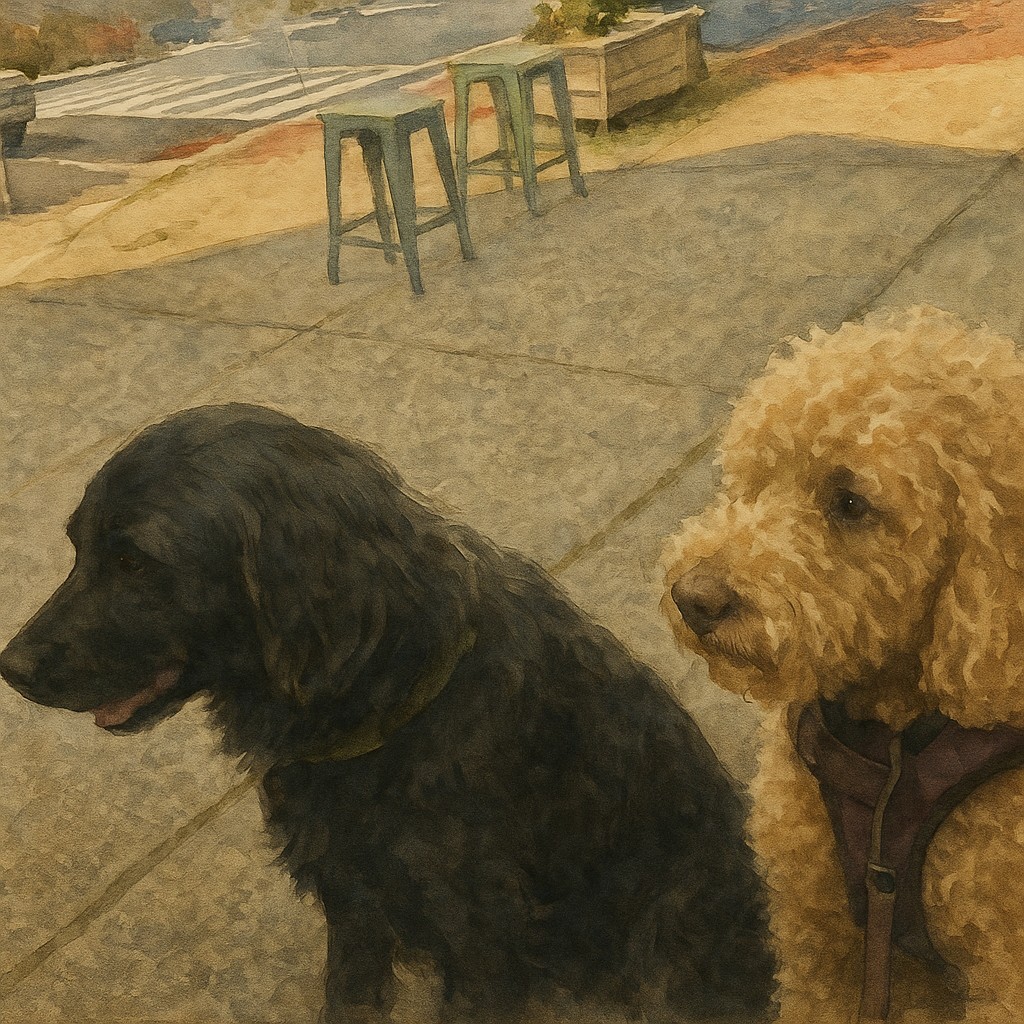
We weren’t alone. Our furry companions joined: Rosie, my ten-year-old labradoodle (basically a Gund plush toy come to life), and Norman, my sister’s very handsome eleven-month-old pup. (And yes, with her married name being Bates, the Norman reference is not lost on anyone—cue ominous violins.) Their cuteness guaranteed constant interruptions from passersby eager to gush, coo, or witness a canine bark-fest when another dog dared to invade their orbit.
Our chosen corner: Watchung Avenue and Park Street, right in Montclair’s Watchung Plaza. A sweet spot of shops, eateries, and world-class people-watching. No seat beats the bench outside Local Coffee—especially when donuts are involved. Their red velvet donut, stuffed with cream cheese icing, practically forces Homer Simpson noises from anyone who bites in.
This sibling summit wasn’t just about donuts and dogs, though. In a few days, I’m off to Brazil for nearly a month. Having once been stranded there for five, I no longer take departures—or returns—for granted. So, carpe sister. Grab hugs while you can. They’re grounding, comforting, and in the Magaverse we’re currently trapped in, they’re borderline medicinal.
Naturally, politics entered the chat. One of the first topics? Trump’s joyfully antagonistic approach to Brazil. Not just the 50% tariffs slapped on them (despite the U.S. enjoying a trade surplus), or the absurd lectures about Brazilian democracy (which, frankly, seems to be working better than ours—Brazil’s Trump, Jair Bolsonaro, is banned from office for ten years and facing trial for insurrection). No, we ended up discussing my wife’s fear of returning with me to the U.S. After all, Washington has recently revoked visas for Brazilian Supreme Court justices, health officials, and their families as pressure tactics. Combine that with the steady drip of ICE horror stories in Brazilian media, and my wife’s concern that MAGA’s crusade might spill into her own travel plans doesn’t seem far-fetched.
In the past, I would have reassured her with: “This is America. We don’t persecute people for no reason. Our justice system is fair.” But that ship has sailed, sunk, and rusted at the bottom of the ocean. Today, the Justice Department feels like Trump’s personal vendetta machine, churning through Adam Schiff, Letitia James, entire law firms, TV networks, prosecutors, and even FBI agents from January 6 cases. Instead of pride in our democracy, I now feel the secondhand shame of a parent watching their kid throw a tantrum in the cereal aisle.
Stuck as we were in despair, my sister pulled out a video of a woman ranting about the “Triple MAGAs”—those who proudly voted Trump three times. Her take: if they were truly consistent, they’d boycott every restaurant with flavors beyond boiled potatoes and sauerkraut. The woman had a point. America is a country of immigrants. Every culture adds to the feast. MAGA’s worldview? If you’re not white and European, kindly exit stage left.
That sparked my own rant. Polls show only 3% of Democrats and 29% of independents think Trump is doing a good job—while 88% of Republicans are still drinking the Kool-Aid. Which makes today’s GOP look less like the party of Lincoln, Teddy Roosevelt, and Eisenhower and more like a movement Adolf Hitler would have RSVP’d “Yes” to.
Of course, our musings were interrupted by a gaggle of young girls and their parent, who—like everyone else that morning—wanted to pet our dogs. Once the requisite cooing ended, I launched into my “other than” theory.
Growing up, my sister and I didn’t look, pray, or act like most of our neighbors. We were Jews; they were Christian. Their hair was straight; ours curly. They were slender; we got labeled (and I still hate the word) “husky.” We made friends, yes, but we always felt different. That’s where empathy comes from. When we meet others who are marginalized, we get it.
But here’s the rub: in every group, someone will make it their mission to cast others as “other than.” It props up their fragile egos, masks their insecurities, and builds a world where Jews need not apply, gays stay hidden, and Black people ride in the back of the bus. A world that embraces “others” terrifies them. (Donald, are you listening?)
The tragedy? Everyone, at some point, feels “other than.” The difference is empathy. Those who have it lean in. Those who don’t build walls and demonize.
By then, the donuts were demolished, the iced coffee drained, and the dogs were sniffing out hydrants. My much younger sister and I hadn’t solved the world’s problems. But we’d laughed, ranted, hugged, and eaten donuts together. Which, for now, feels like victory.


 Blame it on Rio