Today marks the eighty-sixth anniversary of my father’s arrival in the United States. In our family we treated the date like a small holiday. Maybe it didn’t have the sparkle of Hanukkah, Christmas, or the cluster of December birthdays in our house, but it carried its own quiet reverence. It was a day to pause, acknowledge what this country gave to my father, and—importantly for a family with a serious sweet tooth—to eat cake.
I’m fairly certain this holiday was my mother’s invention. It fit her sensibilities: an excuse to visit Segal’s Stationery for coordinated tableware and, as a lifelong history lover, a chance to remind us of the meaning behind the day. But my father never objected. It gave him an opening to tell his story.
For much of his youth he must have felt like an outsider—first in Austria, where the country of his birth stripped him of dignity, opportunity, and eventually safety. Then again in America, where he was a “stranger in a strange land,” dropped into second grade until he learned English, marked by an accent, viewed by some with suspicion. Yet here, finally, he became part of something. A citizen of a country that said he mattered. A piece of the grand American experiment that once called itself the “greatest nation on earth.”
He was home.
This nation gave him a place to live without fear, to work and dream without persecution, to build a life judged by merit rather than ancestry. He cherished that citizenship in a way those of us born here can’t fully grasp.
One memory captures it. My father always did his own taxes, a process that turned the house tense for days. When he was finally done one year, he asked my mother to sign the forms. She glanced at the total owed and casually remarked what a shame it was that they had to pay so much. He exploded—then launched into a heartfelt lecture about why citizenship here was priceless and why paying taxes was a small offering for the protection and freedom this country gave him.
Immigrants often possess a deeper patriotism than almost anyone else—born not of slogans but of gratitude. And yet, today, they are among the most vilified groups in American political life. The demonization pushed by Donald Trump and his MAGA allies contradicts everything this country claims to value.
Consider his recent attacks on Somali immigrants. Like my father, they came seeking safety—a chance to escape famine, civil war, religious persecution, and to build a future under a Constitution that promised equality and opportunity. They came searching for the same promise that brought him here: a homeland where their children could grow without fear.
Instead, they are met with rhetoric like:
“We’re going to go the wrong way if we keep taking in garbage into our country.” “I don’t want them in our country.” “Their country stinks, and we don’t want them in our country.”
Somalis are hardly alone. Haitians “eat their neighbors’ pets.” Mexicans are “rapists.” Muslims are “terrorists.” The only immigrants consistently praised are those who fit a narrow, preferred profile: white, Christian, and South African. The targeted cruelty echoes the very forces my father fled—a bitter irony that would have pained him deeply.
This moment is not about classic American ideals—the rule of law, equality, checks and balances. It’s about power. It’s about a man willing to wrap himself in the flag while hollowing out its meaning, twisting patriotism into a tool for dividing Americans from one another.
The country that welcomed my father no longer exists in the same form. The freedoms he defended in World War II are strained by a government increasingly flirtatious with authoritarianism, Christian Nationalism, and policies that entrench privilege rather than expand opportunity. The new arrivals—once the lifeblood of the American story—find doors closing.
Today, I’ll still celebrate his arrival. I’ll still have cake—baked from my much younger sister’s new cookbook “The Secret Life of Cookies.” But I’ll also use the day as a reminder of what we’ve lost this year, and what we must fight to restore. The work of renewing America’s promise—and honoring the gratitude my father felt every day he lived in this country—falls to us now.
When I was a kid, I assumed this was because the food was excellent and my father enjoyed eating more than anyone I knew. He truly savored savoring. But that wasn’t why he held such a deep affection for the holiday.
He believed Thanksgiving was the ultimate American holiday. While celebrations of gratitude exist in almost every culture, our Thanksgiving—with its customs and traditions—was uniquely American. I used to think that, as an immigrant, he felt a special attachment to the holiday because this country saved his life when it opened its doors to him and allowed him to build a life he could scarcely have imagined growing up on the mean streets of Vienna.
I no longer think that fully explains it.
The events of the past year have given me a clearer understanding of what the holiday truly represents. And while my father may not have articulated it this way, I believe something deeper was at work.
Let me explain.
The original Thanksgiving story centers on the 1621 harvest celebration shared by English settlers—often called the Pilgrims—and the Wampanoag people in early colonial New England. The settlers had arrived the year before and endured a brutal winter, losing nearly half their number to illness and starvation.
In the spring of 1621, the Wampanoag, led by Massasoit and aided by Squanto, helped the settlers survive by teaching them how to grow corn, fish local waters, and hunt in the region around Plymouth Colony. That fall, after a successful harvest, the settlers held a multi-day feast to give thanks.
The gathering—about 50 English settlers and roughly 90 Wampanoag—likely featured venison, fish, corn, and other seasonal foods rather than turkey and pie. It wasn’t called “Thanksgiving” at the time, but later generations would come to see it as a symbolic moment of cooperation between Indigenous people and European settlers.
Put more plainly: a group of people, seeking freedoms and opportunities their homeland could not provide, arrived uninvited in a new land. They were utterly unprepared for its realities and died at an alarming rate. The people already living there could have turned their backs on them. Instead, they chose generosity. They shared knowledge, food, and skills—helping the newcomers survive.
Overwhelmed by that generosity, the immigrants held a celebration to express gratitude for their new home and the people who helped them endure.
Thanksgiving—at least its origin story—is a story of immigrants giving thanks for the generosity of their new country. It is also a story honoring the grace of the native people who helped them succeed.
My father arrived in the United States three months into World War II. Aside from strong intellect and a survivor’s will, he possessed few practical skills that translated to American life. He spoke no English. He had no understanding of how things worked here—illustrated memorably by eating a block of butter his first night in the country, believing it was cheese.
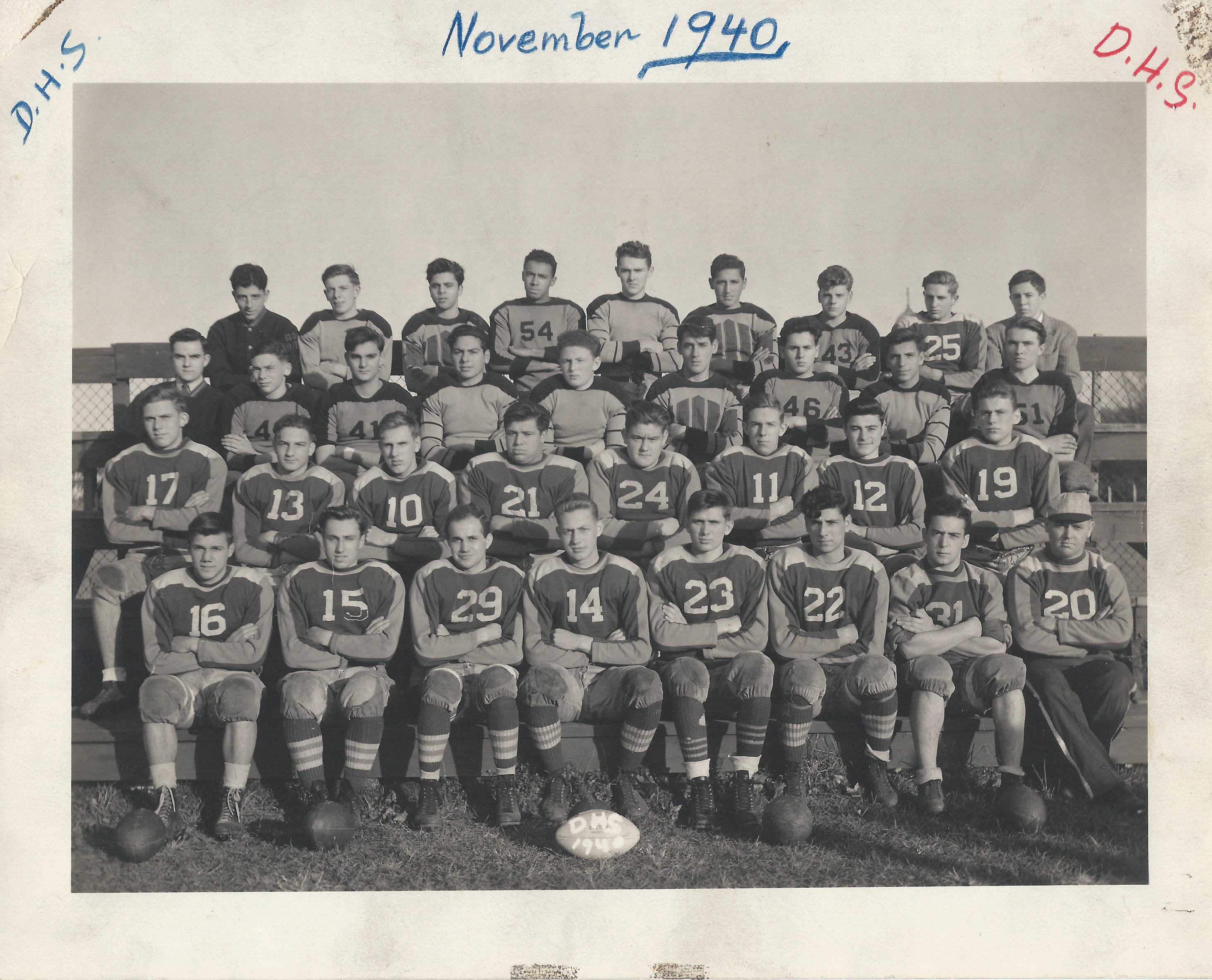
But the people of Danbury, Connecticut were kind to him. They helped him learn English and understand the rhythms of American life. So much so that just three and a half years later, he entered Syracuse University as a freshman.
His story was the Pilgrims’ story, told in a different era.
Perhaps one of the lessons we should take from the original Thanksgiving is that people who come to this country are much like our founders. They are pilgrims in search of a better life. We should help them find their way—because who knows? Perhaps one day there will be holidays and endless school pageants celebrating what they helped build.
I suspect our clueless leader, spending Thanksgiving with sycophants at Mar-a-Lago, will miss this meaning entirely—despite having an immigrant wife himself. Grace, kindness, and empathy do not seem to be part of his lexicon.
Still, that doesn’t absolve the rest of us.
We can remember the true meaning of this holiday. We can celebrate those who came here searching for something better—just as we pour the gravy or ask for the second slice of pie.
I went looking for the Old Grey Lady the other day. For as long as I can remember, she has been a part of my life—educating and informing me in a way few others ever did. She was known for being responsible about what she said and how she said it. Her mission was simple: “All the News That’s Fit to Print.” You could rely on her for in-depth reporting about the world around you. You didn’t have to worry about her getting the facts wrong or trying to manipulate you. — certainly more consistently than the guidance counselor who once suggested I consider accounting.
That’s why Life magazine anointed her with the sobriquet “The Old Grey Lady” on her 100th birthday. Old because she had reached a century. Grey because she was conservative (in the traditional, not political sense), sober, and rich with information. Lady because she carried herself with dignity, restraint, and respect. The kind of woman who’d raise an eyebrow at your grocery cart, but politely.
But I’ve been concerned about her for some time now. She seems to be slipping. Like many in the older demographics, her views appear to be drifting toward the Fox News side of things. She has normalized Trump’s behavior by calling lies “unsubstantiated claims,” treating political coverage like campaign events, and presenting misinformation alongside verifiable facts in the name of “balance.” A bit like a relative who dooms scrolls themselves into a PhD in everything.
That shift has forced me to reevaluate my relationship with her. I used to read her every day as my baseline understanding of what was happening in the world. I no longer do that. I now subscribe to AP, The Guardian, and The Independent. I still visit her for the crosswords, but I only read her articles when a friend shares one on social media that grabs my curiosity.
But that’s life. Things change—sometimes for the better, sometimes for the worse. Instead of getting angry or hurt, the wisest move is often to simply let go. We had a good run. You changed. I changed. Time to move on. Vaya con Dios. See you when I see you.
That go-along-to-get-along attitude evaporated the other day. A good friend asked me if I had read the Times piece titled “Did Women Ruin the Workplace?” That’s a hell of a headline. It sounds more like something Greg Gutfeld or Sean Hannity would write than anything fit for what was once a bastion of progressive thought. Whiskey Tango Foxtrot. It’s the sort of headline that makes you double‑check the URL to ensure you didn’t wander onto The Onion.
A quick Google search revealed two things. First, the “article” wasn’t really an article. It began as a podcast hosted by Ross Douthat (and yes, “Douthat” is a name that practically begs for a puns), a conservative columnist who blends Catholic moral reasoning with politics. Nothing inherently wrong with that, but it does tell you where the conversation is headed. After all, Catholic doctrine forbids abortion under any circumstance, rejects gender theory, and does not provide for women in leadership roles within the Church. Which is fine, but it does tend to give the conversation a faint whiff of incense and pre-approved conclusions.
Second, they changed the title. It is now “Did Liberal Feminism Ruin the Workplace?” The original headline could—if you’re generous—be chalked up to clickbait. The new one is worse. It assumes feminism can be neatly split into “liberal” and “conservative” camps, which is disingenuous at best and misleading at worst. It reinforces the false cognitive frame that “conservative” is good and “liberal” is bad. This despite the fact that feminism, by definition, is progressive. It challenges the status quo and demands equal rights for women in the workplace.
Then the conversation deteriorates. The contributors claim that workplaces have become “too feminized,” that traditionally masculine values—risk-taking, competition, hierarchy—are being diminished in favor of supposedly feminine traits like empathy, consensus, and safety. Really? Says who? When did risk-taking and hierarchy become exclusively male, or empathy and consensus exclusively female? Apparently taking a breath before making a decision is now considered a feminine trait. Fortune 500, take note.
If your opening argument in a conversation about feminism is a blatantly sexist premise then maybe you have started your journey on the wrong path. (Sort of like the people who want to visit Australia but end up in Austria. There is literally a desk for them at Vienna’s airport.)
Another thread in the discussion suggests that cultural changes brought by liberal feminism—emphasis on equality, anti-harassment standards, family leave—have disrupted the “old norms” of the workplace. First of all, huh? How do equality, anti-harassment, and family leave negatively affect a workplace unless you don’t believe in equality, want the right to harass, or think families are a bad idea? And second, every workplace book written in the last 25 years has praised decentralized decision-making and flatter hierarchies.
What makes the whole thing especially frustrating is the lack of data. So here are two simple facts:
1. Worker productivity has never been higher. 2. Job satisfaction is near a 40-year high. Not that the podcast bothers with any of this, of course.
Clearly, feminism has influenced the workplace—but the evidence shows it’s been a net positive.
I could go on, but why bother? The piece seems more intent on blowing smoke than addressing real issues. Here are two real ones:
• Why does a 17% pay gap between men and women still exist? • Why do women represent nearly 30% of executive management but only 10% of CEOs?
The Old Grey Lady has lost her way. Time to put out a “Silver Alert.” “All the News That’s Fit to Print” has turned into a place where clicks matter more than content and where the appearance of balance outweighs the facts. As I said, things change. But I used to trust you. Now I can’t. Maybe one day you’ll return to your former glory. But for now, I just need to say:
I used to be a news junkie. It was a habit I inherited straight from my parents. My father would practically read the ink off the New York Times every morning—not every article, maybe, but every section. It was how he warmed up for the day and ensured he knew more than most people in the room. He liked that.
My mother kept pace. She read the Times faithfully, maybe not quite with my father’s monastic focus, but she always knew what was going on in the world. And when the subject turned to books or literature, she left everyone behind. After my father died, MSNBC became her most loyal companion.
Our childhood dinners always ended with the Huntley-Brinkley Report. So of course the habit rubbed off on me. For years I read three papers a day: the Times for depth, the Wall Street Journal for business, and the New York Post for its unmistakable headlines and shameless gossip. (Huma Cuts Off Wiener!)
Then came the internet, 24-hour cable news, and a shift in my ritual. I still read papers, but online, in bigger gulps and with pickier appetites. I watched CNN while grinding away on a StairMaster, or listened to it on satellite radio during long drives. And I loved it. I loved being fully informed, able to hold my own with friends, and at least keep pace with my brother—the MSNBC contributor and Washington insider—and my sister, an editor, writer, and podcaster. Following the news genuinely brought me joy.
And then Donald Trump took a giant dump on it.
Since the start of his current term, every news cycle has been swallowed by his criminal, chaotic, grifter-in-chief circus. ICE arresting U.S. citizens because they “looked illegal” and holding them without due process. Press conferences from a newly gilded Oval Office where only word salad was on the menu. Accepting a 747 from the Qatari government and claiming he could keep it after leaving office. Even just listening to him speak felt like sandpaper on the brain. It became horrifying, and then exhausting, and finally nauseating.
I didn’t quit cold turkey. But when I did tune in, it was the way I used to watch horror movies as a kid—hands over my eyes, fingers barely parted, ready to snap them shut the second things got unbearable.
And here’s the thing: I’ve lost count of how many people have told me the same story this past year. Folks who used to devour the news now can’t even nibble at it, all because of Dozy Don.
That point hit me the other day as I was driving to meet a friend in Northern New Jersey. My audiobook, Grey Dawn by Walter Mosley, wasn’t cutting it. The podcasts I dip into now and then all had snoozers as guests. My Sirius friends Conan and Howard weren’t making me laugh. I could’ve put on music, but it didn’t feel like the right note for the mood.
I realized I missed my old friend: the news. Back when it felt objective, before it had to contort itself around a President for whom considered thought is a foreign concept and facts are whatever he tweets in bold letters.
I wanted it back. I missed it. But I also knew I couldn’t stomach it under the current circumstances. Every smirk, every insult, every trip into Trumpverse sent my blood pressure spiking. And when you’re driving two-and-a-half tons of Detroit steel at 65 mph, losing control isn’t ideal. If only there were a way to game the system…
That’s when it hit me. Not another car—an idea.
Introducing what may soon be the most popular game in America: Trump: Dementia, Felon, or Huckster. While listening to the latest dispatch from Trumpverse, players pick which part of the President’s psyche seems to be driving the story:
Dementia – for confusing statements, memory mix-ups, or reality-detached comments (again: not a medical diagnosis — just the public behavior).
Felon – for anything tied to legal trouble, investigations, court drama, or Department of Justice battles (no guilt implied — it’s the vibe).
Huckster – for salesmanship, contradictions, grifts, and hype-for-profit posturing.
The goal isn’t accuracy. It’s to be funny, fast, and savage.
Sample Questions
Q: In a CBS interview, Trump confessed to blindly signing off on pardons for his buddies. Dementia, Felon, or Huckster?
A: Tricky one. Blindly signing whatever someone hands you is a classic “Dementia” move — assuming he’s telling the truth. It might also be Huckster, since giving himself “I didn’t know what I was signing!” cover conveniently shields him when the pardons go sideways… like the drug trafficker he granted clemency who later assaulted a nanny and a three-year-old child. And of course, there’s a Felon angle here too. If pardons were being offered to campaign contributors? Well, that strays into federal-offense territory. Discuss.
Q:Trump recently demanded that the DOJ cut him a $230M “apology check” for prosecuting him on 37 federal counts, including election interference and illegal retention of classified documents. Dementia, Felon, or Huckster?
A: This is a brain pretzel. Huckster is the obvious call — big number, big grievance, big noise. After all, grand juries did indict him, and the only reason the prosecutions paused was because the Supreme Court ruled a sitting president can’t be tried. But there’s a Dementia argument too. Paranoia and persecution delusions often show up in cognitive decline. And Felon? Well, demanding money from officials who could be fired if they refuse starts to look like extortion. Again: discuss.
Q: At a rally, Trump claimed that “millions of illegal votes” were cast against him — again — and promised a “special team” to finally uncover them. Dementia, Felon, or Huckster?
A: A classic triple-threat. “Millions of illegal votes” is vintage Huckster — the kind of oversized claim you’d use to juice a crowd or hawk a miracle supplement. But the memory-loss routine (“again”) nods toward Dementia territory; repeating debunked stories as if they’re brand new fits that pattern. And Felon isn’t far behind: assembling “special teams” to chase nonexistent enemies has a history of crossing legal lines.
And that, my friends, is Trump: Dementia, Felon, or Huckster
Will it fix the current stat of journalism? No. Will it lower your blood pressure? Probably not. Will it at least give you a fighting chance at surviving another news cycle without screaming into a throw pillow? Possibly. Maybe. We can dream.
So go ahead: pour a drink, take a gummy, gather your friends, turn on the headlines, and let the Trump carnival wash over you. When the next wild quote drops — and it will, probably before the commercial break — you’ll be ready. Just shout “Dementia!”, “Felon!”, or “Huckster!” with conviction.
For the better part of the last twenty years, on the anniversary of Kristallnacht, I have published my father’s “A Minor Memorandum to My Children on the Fiftieth Anniversary of Kristallnacht: November 9 and 10, 1938.”
He wrote it for his children so that we would never forget the horror of that night — and the genocide that followed. His hope was simple: we remember what happens when a society loses its humanity. What happens we begin to treat a group of people as less than human. When we call people names instead of trying to understand who they are. When we forget what we share in common. When a nation decides that the only way it can feel good about itself is to demonize and denigrate others.
He never wanted another living soul to endure the hell he and his family faced that night. I publish his story each year to honor his memory and his wish that we never forget.
But we have failed him — and the six million who died in the camps, the fifteen million Allied soldiers who perished fighting for us, and the fifty million civilians who were slaughtered.
How do I explain to my father that in today’s America, if you call yourself an anti-fascist, you can be labeled a terrorist? That, as I write this, masked men are breaking into people’s homes, arresting them, and sending them to other states or countries without due process or habeas corpus?
How do I tell him that the President and his supporters reject the welcoming spirit engraved on the Statue of Liberty:
Give me your tired, your poor, Your huddled masses yearning to breathe free, The wretched refuse of your teeming shore. Send these, the homeless, tempest-tost to me, I lift my lamp beside the golden door!
How do I explain that they have slammed that golden door shut and now seek to welcome only 7,500 white South Africans and that Christian nationalism has become a core tenet of the Republican Party?
Can I make him understand that a country which once offered refuge to those fleeing totalitarianism and violence now separates parents from children, hides them in secret prisons, and sends them back to places where despair, brutality, and death await?
What words could justify the sight of the same Army he served in now roaming American streets against the will of the people? Or that the Justice Department, once the envy of the world, is being wielded as a weapon against the President’s critics?
How can I tell him that this administration has criminalized homelessness and mental illness rather than confronting their causes — that instead of building affordable housing or funding treatment, we arrest the suffering? The mentally ill and the homeless were among those rounded up on Kristallnacht, and a quarter-million were murdered in the camps.
How do I explain that his generation’s greatest achievement — transforming the ashes of war into a vision of decency and shared humanity — is now on life support? That the determination to build a fairer world, one rejecting the tribal hatreds that nearly destroyed civilization, is dismissed as naïve?
That the hard-won advances for civil rights, women’s equality, and justice — achievements built by his generation — are now derided as “woke”?
Those legacies should have stood as monuments to him and his peers. Yet today, that progress, paid for in blood, is being squandered by prosperity preachers who worship wealth instead of wisdom, and by frat-boy politicians who mistake cruelty for strength and insults for insight.
When Nick Fuentes and his anti-gay, Christian and white nationalist, Hitler white washing and
Holocaust denying message is being accepted as mainstream and promoted by the Heritage foundation there is only conclusion you can draw.
We have forgotten. And in forgetting, we have failed my father — and all those who reminded us to Never Forget.
We are no longer on the road to fascism. Our country is in the hands of fascists. Denying that fact — or sugarcoating it in any way — is worse than forgetting. It is malignant neglect of our duty as human beings who swore we would remember.
My father’s story follows.
A MINOR MEMORANDUM TO MY CHILDREN
ON THE FIFTIETH ANNIVERSARY OF KRYSTALLNACHT,
NOVEMBER 9 AND 10, 1938
I don’t intend to make this a big deal literary effort or a weepy emotional debauch. I simply want to tell you what I remember about Krystallnacht. So you should remember as well. And if there are to be others like us, so you can tell them. Nothing big! Just a small and portable lesson about the planet we live on and the hazards of being a little different.
Kristallnacht did not start for me until November 10, 1938. I knew that von Rath had been shot by Gruenspan but I knew nothing about what was happening all over Germany during the night of the ninth. I was 12 years (12 10/12 ths )old and I was asleep.
I was still lying in my bed, at about seven on the morning of November 10, when there was loud knocking on our door. I heard my father and mother (your grandparents ) talking to some people. Several stormtroopers (SA) had come to arrest Jewish men. The entrance to our apartment was through the kitchen and all this was taking place in the kitchen. After a few minutes I heard one of the Brownshirts ask whether there were any other male Jews in the apartment. Grandma said only my little boy. I dont think they believed her because they came into our mainroom, where my bed was. I closed my eyes and pretended I was asleep. They came to my bed and they looked at me and they must have decided either that I was too young, or that I looked too fierce to mess around with since there were only six of them. So they took just grandpa with them and they left.
As we later found out, they took grandpa to the local police station. From there they marched him and others to the Rossauer Kaserne, a military barracks. He was lucky because he had a roof over his head. Many other Jewish men were taken to a large soccer stadium and did not have a roof over their head.
Grandpa had been fired from his regular job as a bristle processor a couple months before. He was earning some money by helping a carter hauling the furniture of Jews that had been kicked out of their apartments. The cart was pulled by one brown horse. Grandpa had a job scheduled for that morning.
Grandma sent me to help the carter in grandpa’s place. May- be grandma was a tough Hungarian cookie who did not want the Rothkopf’s reputation as men of their word sullied, or maybe we needed the money, or perhaps she wanted me out of her hair so that she and Aunt Mitzi ( who lived in the next apartment and whose son Walter and friend Albert were already on the way to Dachau) could weep in peace.
I don’t remember exactly where I met the carter but it was at his client’s apartment near the Jewish section of Vienna. We loaded the wagon with furniture. I sat next to the driver on the high bench behind the horse. Then the brown horse slowly pulled us through the streets towards the place where we had to make our delivery.
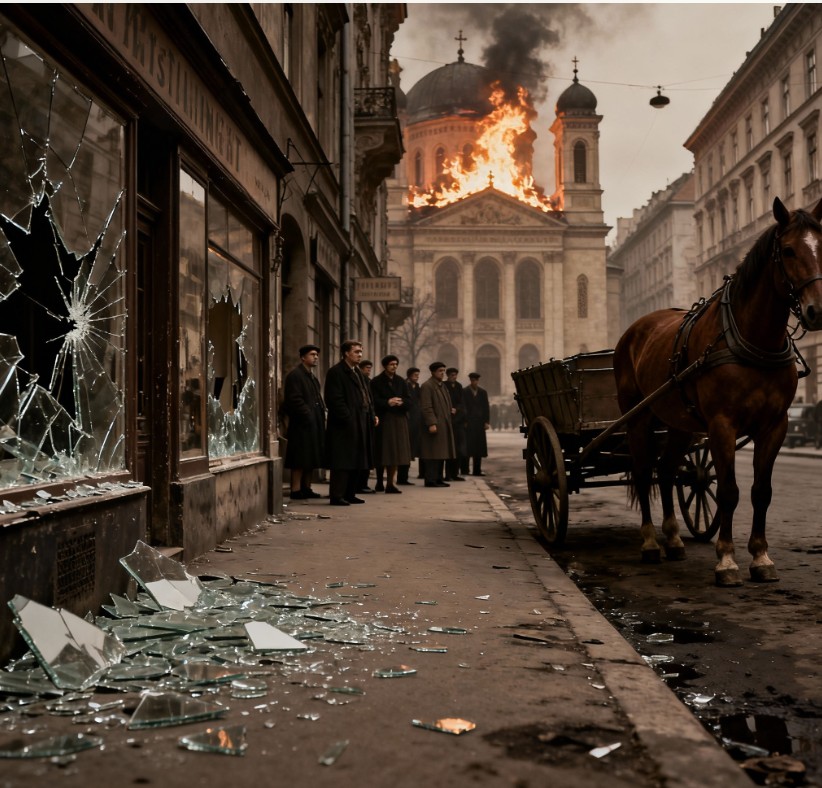
Groups of people were standing in front of the broken windows of Jewish stores, gawking while Brownshirts were putting their owners through their paces — handing over business papers, washing the sidewalk with lye, licking Aryan employees shoes clean. Anything that would keep the cultured Viennese crowds amused. We passed a narrow street that led to one of Vienna’s larger synagogue. The alley was jammed with jeering onlookers. Stormtroopers were throwing furniture and Torah scrolls through the big main door into the street. One side of the roof (I couldnt see the other and you know what a sceptic I am ) was afire. I remember very vividly the twists of whitish-yellow smoke that were curling up the slope of blue tiles.
Farther on we passed another synagogue that was fully ablaze. The police had made people stand back from it. I suppose they feared for their safety. A fire truck was parked down the street. The firemen were leaning against their equipment, talking and smoking cigarettes. Everywhere there were clusters of people, in a holiday mood, gathering around smashed Jewish stores. Little groups of Jews, both men and women, were being led along the sidewalk flanked by squads of SA men. The Jews were made to do all sorts of menial chores. Someone told me later, that one elderly Jew asked to go to the toilet. They made him go in a bucket and then forced him to eat his feces.
By now I was beginning to figure out what was going on. I sat high on my horsey throne (just like the Duke of Edinburgh when he drives his high-stepping pair, except that I didn’t wear an apron ). Whenever we passed a sidewalk event or other happening, I pulled down the wings of my nostrils (I thought I looked more Christian that way), staring straight ahead, but watching the Nazi street theatre out of the corners of my eyes. The driver, who was also Jewish, was a hard old soul. I dont remember him saying a single word to me, all day, about what was going on. Maybe he thought I was too young to hear about such things.
I dont remember much more detail. I got paid. The trolley I went home on was crowded. I kept staring out the window so that people wouldn’t notice the handsome Jewishness of my face. Beyond the rattling trolley panes, the peculiar happenings of November 10, 1938 were still in progress here and there, even as the day’s light was fading.
When I got home, grandma and Mitzi were still weeping. They had just come back from the police station but grandpa and the other Jews were no longer there.
Grandpa came home ten days later. He had spent that time in a room with 500 other people and one water faucet. They did a lot of military drill ( was this the beginning of the Hagganah ?) and exercises — push-ups, deep kneebends, and the like. Some who didn’t do so well got beaten up. He never told me whether they did anything to him. But then I wouldn’t tell you either. Grandpa was lucky. A lot of the Jewish men who were arrested on the 9th and 10th of November were sent to the concentration camp at Dachau.
Not one single synagogue was left intact in all of Vienna. That really screwed me up because I was nearly thirteen. You need to have a Torah to become a Bar Mitzwah and you need to have a table on which to lay the scroll while you read. And how was I to get a fountain pen now?
The dead, of course, are dead. They are mourned by those who remember. Tears dry. Bruises heal. Razed synagogues become parking lots. Injured dignity heals although slowly. What hurts most to this day is impotent compassion for those who were swept away.
In order to have faith in our quality as human beings, we need to remember! And thats why I am writing you this note.
There’s a moment in every democracy when the fringe stops being the fringe. It’s not when an extremist gains followers online, or when their rhetoric briefly trends on social media. It happens when institutions that once stood as gatekeepers begin to open the door. That’s why the growing embrace of Nick Fuentes by groups like the Heritage Foundation isn’t just a warning light—it’s a klaxon.
Fuentes is not coy about his worldview. He has praised authoritarianism, advanced a self-described “Christian nationalist” vision for America, and repeatedly promoted white nationalist ideas. He has denied or minimized the Holocaust, praised segregation, and openly admired Adolf Hitler—infamously claiming that Hitler was “cool” and insisting the regime “wasn’t that bad” compared to modern America (sources: Southern Poverty Law Center; ADL; Fuentes livestream archives). He has positioned LGBTQ+ Americans as enemies of the nation and called for the eradication of what he considers “degenerate” culture.
For years, these positions were dismissed as the rantings of someone sealed inside the darker corners of the internet. But something has shifted. When a major policy institution like the Heritage Foundation—long considered a pillar of mainstream conservatism—begins to entertain, wink at, or amplify the themes that animate Fuentes’s movement, the line between conservatism and extremism doesn’t blur. It moves.
This isn’t about partisan identity. Republicans and Democrats alike should care when a political ecosystem starts warming to ideas once recognized as dangerous. The American right has always had its ideological range—from libertarians to evangelicals to national security conservatives—but it has also had boundaries. Those boundaries are now eroding.
The danger isn’t that Fuentes himself becomes a figure of mass appeal. The danger is that his ideas—anti-gay, authoritarian, ethno-nationalist, historically revisionist—start to seep into the bloodstream of institutions with real influence on policy and culture. That’s how extremism becomes normalized: not with a bang, but with an invitation.
Democracies don’t collapse because a single extremist rises. They collapse when ordinary people stop recognizing extremism for what it is.
There’s a moment in every democracy when the fringe stops being the fringe. It’s not when an extremist gains followers online, or when their rhetoric briefly trends on social media. It happens when institutions that once stood as gatekeepers begin to open the door. That’s why the growing embrace of Nick Fuentes by groups like the Heritage Foundation isn’t just a warning light—it’s a klaxon.
Fuentes is not coy about his worldview. He has praised authoritarianism, advanced a self-described “Christian nationalist” vision for America, and repeatedly promoted white nationalist ideas. He has denied or minimized the Holocaust, praised segregation, and openly admired Adolf Hitler—infamously claiming that Hitler was “cool” and insisting the regime “wasn’t that bad” compared to modern America (sources: Southern Poverty Law Center; ADL; Fuentes livestream archives). He has positioned LGBTQ+ Americans as enemies of the nation and called for the eradication of what he considers “degenerate” culture.
For years, these positions were dismissed as the rantings of someone sealed inside the darker corners of the internet. But something has shifted. When a major policy institution like the Heritage Foundation—long considered a pillar of mainstream conservatism—begins to entertain, wink at, or amplify the themes that animate Fuentes’s movement, the line between conservatism and extremism doesn’t blur. It moves.
This isn’t about partisan identity. Republicans and Democrats alike should care when a political ecosystem starts warming to ideas once recognized as dangerous. The American right has always had its ideological range—from libertarians to evangelicals to national security conservatives—but it has also had boundaries. Those boundaries are now eroding.
The danger isn’t that Fuentes himself becomes a figure of mass appeal. The danger is that his ideas—anti-gay, authoritarian, ethno-nationalist, historically revisionist—start to seep into the bloodstream of institutions with real influence on policy and culture. That’s how extremism becomes normalized: not with a bang, but with an invitation.
Democracies don’t collapse because a single extremist rises. They collapse when ordinary people stop recognizing extremism for what it is.
We can debate tax policy, education reform, and foreign aid. But we should not be debating whether America should revisit its stance on Hitler, rewrite the Holocaust, or resurrect the idea of a nation defined by race or religion. If organizations like Heritage want to maintain their place as serious contributors to public life, they cannot treat this ideology as just another voice in the marketplace of ideas.
Some ideas are not part of the marketplace. They are the fire. And we should know better than to play with it.
Some ideas are not part of the marketplace. They are the fire. And we should know better than to play with it.
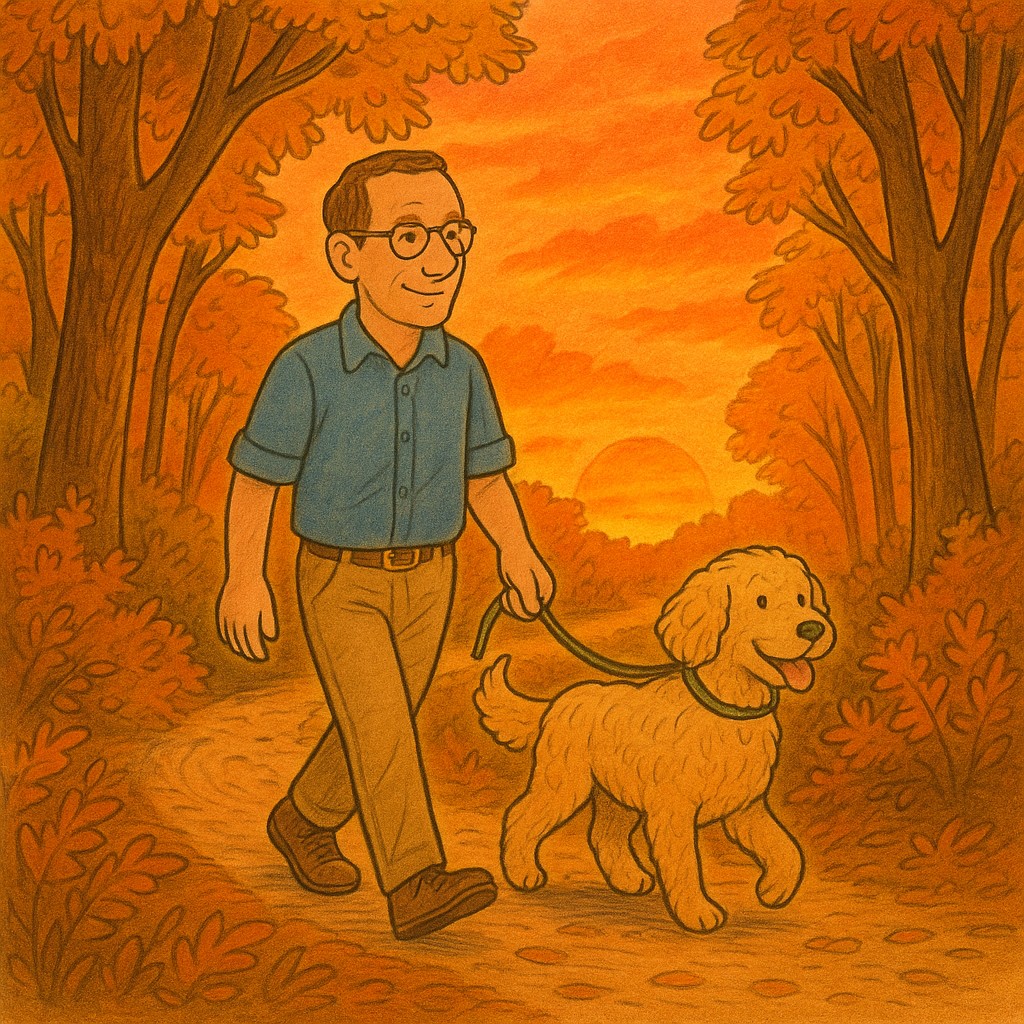
The first walk usually happens around 8:30 in the morning. By then, I’ve already braved the long commute from my bedroom to the kitchen for coffee—my daily fuel—to my desk so I can put in a few hours of work before the day’s demands drag me down any number of unexpected rabbit holes. Our morning walks give me a chance to clear my head and prepare for whatever the day has in store.
Our evening walks, on the other hand, often take place just before sunset. By that point, most of my neurons have been fried beyond recognition. The constant multitasking and digital demands of the day have usually reduced me to something close to drooling. That twilight walk offers more than just the chance to stretch my legs; it’s a separation ritual—a way to step away from the screen and into the fading light. Sometimes the sky even puts on a technicolor show, a quiet reminder that beauty still exists beyond the browser window.
I should mention that I live in a fairly idyllic place for dog walking. Our townhome community sits tucked in the woods beside a river and a county park. For us humans, it’s wonderfully quiet, except for the occasional birdsong or the honking of Canadian geese. For Rosie and her canine friends, there are plenty of in-scent-ives—a rich network of smells demanding frequent stops and careful deposits.
In the end, we both get what we need from our walks. I get the peace and quiet to sort through the day’s twists and turns, and Rosie gets to check in on her friends who’ve left her messages along the way.
This past Thursday, though, had been particularly challenging. I hadn’t slept well—which isn’t unusual, but it’s always draining. A work project was moving as fast as it could, though not as fast as I wanted it to. And for reasons known only to Verizon and God, my internet connection had decided to operate at a glacial pace.
Still, those are the usual daily nuisances—irritations that dissolve after a few minutes in the cool evening air, walking beneath the setting sun. What truly bothered me that night was reading that the Republican Party had decided to use SNAP benefits as a bargaining chip in budget negotiations—negotiations that would raise healthcare costs by over 100% for 44 million Americans. It made no sense. Starve 42 million people so you can make healthcare unaffordable to 17% of U.S. citizens.
Rosie, meanwhile, had discovered a scent so exquisite to her canine senses that she was rolling in it with complete abandon. Behind her, the sun—deep yellow, fringed with orange—hung low above the trees.
Her ecstasy reminded me of something I had read after adopting my first dog, Yankee. I wanted to be a good pet owner, to make sure I was doing right by him. A Google search led me to an article on what it meant to be a good Jewish pet owner. I’m not religious, but I was curious. The article said feeding your pet before yourself was not only moral—it was a duty. Animals depend on us; they can’t tell us when they’re hungry. Letting them suffer while we indulge ourselves is wrong.
Aren’t the people who rely on SNAP benefits also dependent on us? Why should they suffer because a man who’s never known hunger wants to give billionaires and millionaires, most of whom have never known hunger, a tax break?
By now Rosie had moved on, nose to the ground, searching for one of the many rabbits that populate our little corner of suburbia. As she pulled me along, I tried to remember what other obligations my faith of origin asked of us. In preparation for my bar mitzvah, I had learned that visiting the sick was a mitzvah—a good deed. But Rabbi Bial reminded us that God’s compassion wasn’t to be admired from afar; it was to be emulated. Feeding the hungry wasn’t optional. It was a duty.
I’d fallen down one of the metaphorical rabbit holes I try to avoid on our evening walks. So I sat down on a bench at the crest of a small hill. The sunset had turned neon orange, the clouds lit up for their nightly curtain call. I pulled out my phone and wondered what other faiths said about caring for the sick and the hungry.
Here’s what I found in those few minutes on the bench:
Islam: The Prophet Muhammad said, “Feed the hungry, visit the sick, and free the captive.” Feeding the hungry is among the highest forms of charity.
Catholicism: Feeding the hungry is the first corporeal act of mercy; caring for the sick is another—both acts of God’s love made tangible.
Evangelical Christianity: Feeding the hungry and healing the sick are living expressions of faith, following Christ’s example of compassion.
By then the sun had slipped below the horizon, leaving the world brushed in burnt orange and mauve—the days reminder of what had been.
Rosie and I resumed our walk as the streetlights flickered on. Rosie was no longer interested in rabbits. Some other scent, perhaps a fox, a deer or her boyfriend Duke, a very large Rottweiler, had caught her interest. But I was still trapped in my rabbit hole.
My memory and sentiments were shaped by the members of the greatest generation and their parents. They had searing memories of the great depression and the world that was left behind after World War 2. Hunger and the hungry were a part of their life experience. The words of Franklin Roosevelt “True individual freedom cannot exist without economic security and independence. People who are hungry and out of a job are the stuff of which dictatorships are made.”
Their stories, their guidance formed an indelible belief that to preserve the freedoms and liberty we have it is essential that we feed the hungry, we take care of the sick and we give a hand to those whom need to be lifted up. This not woke. It is being kind in the way that religions ask us to be. It is also smart. The chain that holds are democracy is only as strong as its weakest link and right now Donald Trump, Speaker Johnson and MAGA Republicans are doing there best to destroy those bonds.
By the time Rosie and I made it home to our home it was fully dark. A crescent moon shown brightly in southeastern sky.
Normally when I return from these walks, the stress and pressure that has built doing my day have been released. Not today. I had made the mistake of going down that rabbit hole and it had made my mood almost as dark as the evening sky because I can’t see an end to the MAGA madness.
But my father came home from the Second World War with an expression: “Illegitimus non carborundum.” It’s soldier Latin for “Don’t let the bastards get you down.” I’ve always taken it as a call to action — a reminder not to let others grind down your resolve or your sense of purpose. That choice is always yours.
So the first thing I did, after reminding Rosie what a good dog she is, was go to my computer and make a $50 donation to the Community FoodBank of New Jersey. And on Tuesday, I’m going to vote my conscience — and click every lever on the Democratic side.
Not the modern kind of walking, where people are glued to their phones, but the old-fashioned, head-on-a-swivel kind. D.C. is full of history, and if you don’t pay attention, you’ll miss something important — something you’ll probably regret later.
I was standing on Pennsylvania Avenue near 16th Street NW, just outside the White House, when I saw a crowd pressed against the iron fence that keeps the uninvited from dropping in on the President. Everyone knew what they were watching. You’d have to be living on another planet — one with bad cell coverage — not to know that *The Great Destructor* had turned his attention to the East Wing. He’d once claimed he only wanted to build a grand ballroom worthy of the United States, promising construction nearby that wouldn’t touch the structure itself. Now it was clear: that had been just another lie. The East Wing was coming down.
I decided I needed to see it. I wanted to witness the metaphoric embodiment of the current administration’s policies. The fence was lined with people, but I spotted an opening and stepped forward.
It was a horrible sight. The destruction of historic buildings often is. The heavy excavators, with claw-like attachments tearing at the structure, reminded me of vultures feeding on the newly dead — one of those scenes you want to look away from but can’t, out of respect for what’s being sacrificed.
“You know, they used to call it the People’s House,” a man standing beside me offered.
Still transfixed by the destruction before me, I replied without looking, “Yes, and just look at it now.”
He continued, “Do you know when they started calling it that? John Adams was the first resident, and Jefferson carried on the tradition. They wanted the country to understand that while they lived there, it was a rental — that the landlord was ‘We the People.’”
His words resonated with me. It was the symbolism of the White House I’d grown up believing in — the history geek in me felt that deeply. I turned and saw a well-dressed man of average height with a solid, athletic build — barrel-chested, a thick, well-groomed mustache, and round wire-rim glasses that couldn’t hide alert blue-gray eyes. He radiated energy.
I extended my hand. “My name’s Paul.”
He grinned. “You can call me Ted.” (As if I didn’t know.)
“Well, Ted,” I said, “what else do you know?”
He replied, “Did you know that both the East and West Wings were built during the first Roosevelt administration? He wanted the residence to be a true home for his children, so he built the West Wing to house the presidential staff and his office, and the East Wing to welcome visitors to the White House.”
“So this guy is literally tearing down the part of the White House designed to be open to the people — to build a ballroom he wants to name after himself.”
Ted sighed. “That’s right. Just to build a ballroom for state dinners that happen about three times a year.”
I shook my head. “What gets me is that he was supposed to get approval from Congress, the National Park Service, and other agencies before making changes to the White House — and he didn’t. He lied, said it wouldn’t touch the original structure. And now look. He just did it, knowing there’d be no blowback from Congress.”
A woman to our right, overhearing, chimed in. “Well, at least we’re not paying for it. He says the funds for the new East Wing are all coming from private donors.”
Annoyed, I blurted out, “Aren’t we, though? Have you seen the list of donors for this monument to bad taste and kitschy architecture? Amazon, Google, Meta, Lockheed, Palantir, Altria, Blackstone, and the Adelson Family Trust — all have a vested interest in keeping the President on their side. And those are just the ones we know about. There’s no public list, no transparency. It’s better than bribery — same return, zero risk of prison.”
The woman retorted, “Well, didn’t Teddy Roosevelt do the same thing when he built the East Wing? Didn’t he do it without approval from Congress or anyone else?”
I resisted the urge to tell her that Fox News shouldn’t count as a primary source and said instead, “Not even close. Roosevelt used money from an existing budget to renovate the White House, and he did it to preserve the idea of the People’s House — so citizens could visit the Executive Mansion without interfering with the work of government. This isn’t preservation. It’s a vainglorious waste of money, time, and resources.”
Glancing back at Ted, then returning my gaze to the woman, I added, “If anything, Trump seems determined to destroy as much of TR’s legacy as possible. Teddy was a conservationist. Trump wants to drill in wildlife preserves and calls climate change a hoax, despite overwhelming evidence it’s an existential threat. TR created the precursors to the FTC and the FDA — he made sure our food was safe and our medicines didn’t kill us. He believed corporations could pursue profit but not at the public’s expense. Trump doesn’t care about any of that. He believes businesses should operate without regulation — to make as much money as possible, regardless of who gets hurt.
“Teddy championed, funded, and built the Panama Canal — arguably one of the most important pieces of infrastructure in history. This guy can’t even finish a wall.”
I took a breath, then continued, “And while we’re at it — Teddy Roosevelt was everything this guy isn’t. He reportedly read one to three books a day, while the current occupant hasn’t read one since *Dick and Jane.* TR authored 38 books and published over 150 articles. The current occupant can barely string together a coherent sentence. Roosevelt earned the Nobel Peace Prize for mediating the Russo-Japanese War and creating the framework for the Treaty of Portsmouth. Trump thinks he deserves one because he claims he can end wars with a tweet.
“Roosevelt received the Medal of Honor for his heroism at San Juan Hill. He felt an obligation to fight for his country, while this guy paid a doctor to say he had heel spurs.”
I paused, looked the woman on the right in the eye, and added, “When Teddy Roosevelt left office, he was celebrated as a hero in nearly every country he visited. When this guy leaves office, the world will just breathe a sigh of relief.”
A hand landed on my shoulder. I turned to see Teddy smiling.
“Bully,” he said.
I smiled back and unable to resist, add. “Yes. He is that too.”
“No,” he said, laughing. “I meant it the other way — first-rate job.”
The waiting room outside HR only has two people in it.
Sitting opposite each other both are busily avoiding making eye contact with each other by paying far more attention to their cell phones than was required. The one of the Bespeckled with round tortoise shell frames and off the rack suit white shirt and rep tie the one he had the look and the insincere smile of a moderately successful real estate agent who had not sold a house in a while.
The one of the far right looks like a former goth who has tried to go mainstream and forgotten to remove his eyeliner and mascara. His closely cropped beard originally grown to project confidence and cover up an insincere chin and baby face misses the mark on all of them. If you saw him hanging outside a 7/11 at night wearing a hoodie you would get into your car as quickly as possible.
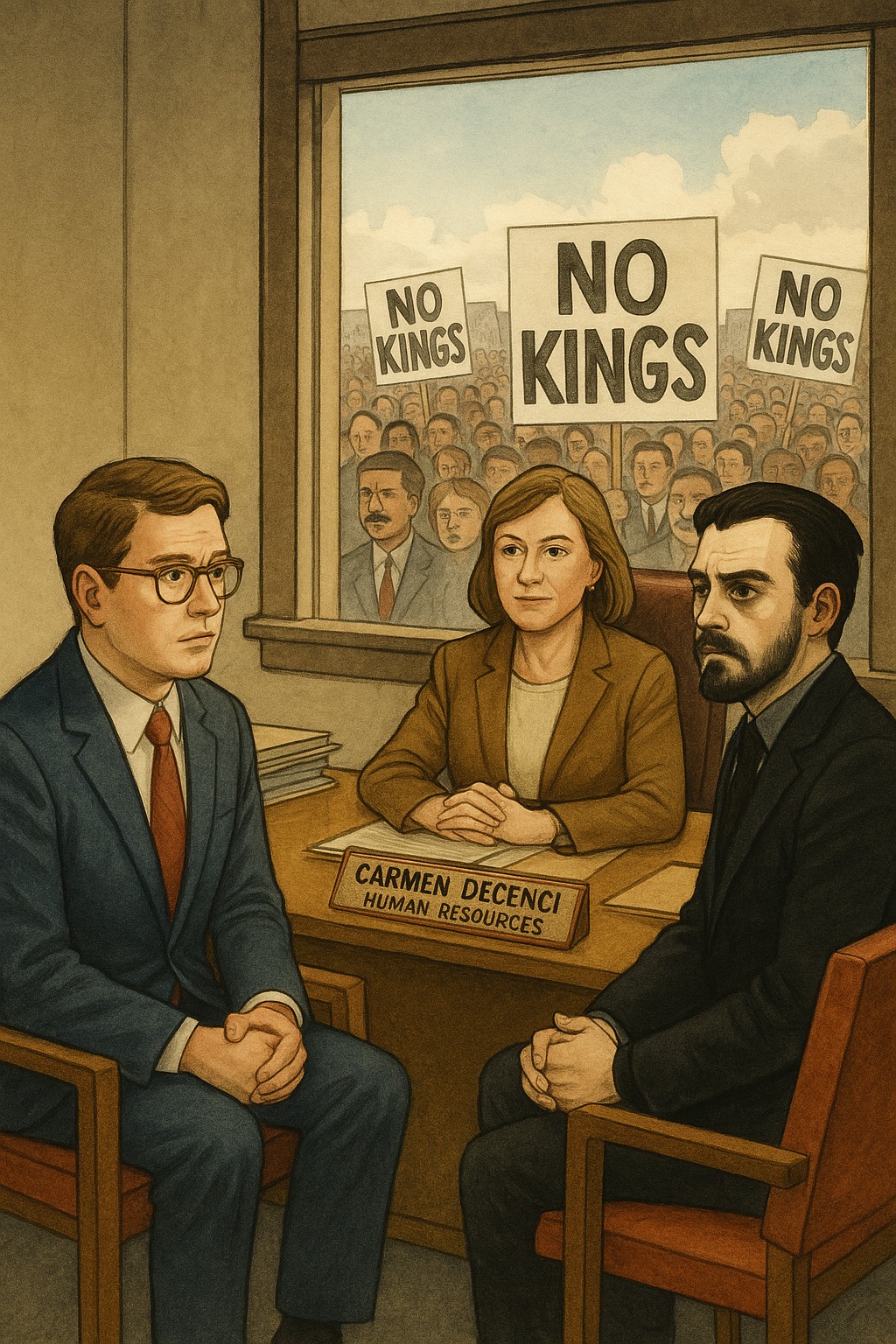
The door opens and a kindly looking woman in her mid-forties and wearing a neutral colored, well cut pant suit emerges. She beckons both them into her office. They make themselves comfortable in midcentury modern chairs whose burnt orange upholstery looks as if it has been visited by a few too many backsides in recent months. She sits behind her desk, which solid build would look at home in any mid-level bureaucrat’s office in Washington. Behind her is large window, which from her third floor office depicts Pennsylvania Avenue with hundreds of thousands of demonstrators holding placards and banners that even from this distance you can see say “No Kings.”
The woman gives the men a few moments to look out the woman in the hopes that they will add more gravitas to their meeting. But both men assiduously avoid what is going on outside and busy themselves with an examination of their professional manicures. Sighing she says “Gentlemen, let me introduce myself. My name is Carmen Decenci and I am the head of Human Resources. Do you know why I have called you in today.”
“Jesus, I hope its not about any of that DEI BS. You know how much the boss hates that stuff.” said the former goth and potential 7/11 parking lot stalker.
“Mr. Vance let me disabuse you of a couple of things. First, DEI is not BS. It is system that ensures that we find the most qualified candidates regardless of whether or not you played Lacrosse with them in high school or belong to same country club. It makes sures that the upper mobility that is the cornerstone of our democracy functions the way it should.”
“Yeah, well…”
“Let me continue. The person you are referring to is not the boss. He is the President. He serves the people. Not himself. Or at least that is the way the constitution sees the job. Look what is going on outside the window. Those people are the real bosses and their the ones who demanded I ask you to my office.”
Vance looks down and mumbles. “Whatever. He still won’t like it.”
Ms. Decenci continues “But today we are not talking about DEI. We have a couple of other issues that are demanding our attention today.” Shifting her attention to the bespeckled man who has been amusing himself with his favorite activity, twiddling his thumbs she says “Mr. Johnson, didn’t Arizona just elect a new member of Congress.”
“Yes, but…”
“I am not finished yet. So the people of Arizona have expressed their wishes yet you have not seen fit to swear this person in yet. Why is that?”
Johnson adjust his glasses and responds “The House is not in session.”
Sharing a look she normally reserved for her children when they are trying to avoid responsibility for something they have done she says “I know that. But aren’t you the guy who calls the House into session.”
“Well….”
“And isn’t the reason you have not called the House into session because despite having a majority you cannot seem to pass a bill that keeps the country running.”
“But the Democrats won’t pass the continuing resolution we want.”
“Yes. I know. But isn’t that how democracy is supposed to work. Both sides can’t what they want, so they compromise and find a middle ground both can live with? And by keeping the house closed no compromise is even possible. How is that responsible government?”
“But…”
“Rhetorical question. What I have heard “pointing a thumb out the window indicating the loud crowd outside “Is the reason that you can’t compromise is the Dems want to make sure millions of people don’t lose their health care and millions more premiums become so high they won’t be able afford it. Don’t you think everyone deserves healthcare in this country. Not just the rich, the fortunate and members of congress?”
“I don’t see…”
“Again, not a question. You can hem and haw all you like but my obligation as head of HR is to remind that your job as Speaker of the House is to serve everyone. Rich, poor, democrats, republicans. And right now you are not coming close to doing that. You won’t even swear in a duly elected member because you are frightened you might lose your job.. Your job is to do your job. Not cower in fear.”
Vance looking at his watch interrupts “Pardon me. Is this going to be much longer. The boss invited me to watch him play golf and he promised me I could wash his balls this time and I don’t want to be late.”
Carmen Decenci shares a sardonic smile with Vance and says “I was just getting to you. I want to talk to you about that group of “Young Republicans group chat. You know the one where they said “I love Hitler,” “You can’t expect Jews to be honest.” “Rape is epic,” referred to African American’s as “monkeys” people from India don’t bathe often and referred to the neurodiverse as retards.”
Vance sighs and says “C’mon. It was just a bunch kids telling stupid jokes. It is what kids do especially young boys. They tell offensive jokes. I am sure there are college group chats that are far worse. People need to grow up and not be offended so easily.”
“Which demonstrates exactly why you are here. As a leader you have an obligation to stamp out hate speech, wherever it comes from, not excuse it. By saying boys will be boys you are giving permission to anyone who wants to engage in antisemitic, racist and sexist language. What makes it worse is that these “young Republicans” are not so young. Most of them were in the thirties and forties. There were many in the group who are your age. But instead of taking the opportunity to instruct and correct you gave these miscreants cover.
Vance opened his mouth to say something and Camren Decenci held up hand signaling him to be quiet and then said in the ice cold tone of someone who has gone past and into the furious and says “You failed as a leader. Your failed as a human.” Then addressing both of them says “ I wish there was someway that I could insist of both of you changing your behavior. Unfortunately, I don’t have that power but “again pointing out the window at the people gathered below “Those people do. And when you are going to be reporting to the unemployment office not HR.
Outside, the chants swell louder—No Kings, No Cowards, No Compromise Carmen leans back, folds her hands, and says quietly, “History has a flawless HR department, gentlemen. It always conducts its exit interviews, sometimes with ballots, sometimes with bullhorns, but always on time. Now get of my office before I have to throw you out.”






 Blame it on Rio
Eighty-Six Years Ago, My Father Found Home
Today marks the eighty-sixth anniversary of my father’s arrival in the United States. In our family we treated the date like a small holiday. Maybe it didn’t have the sparkle of Hanukkah, Christmas, or the cluster of December birthdays in our house, but it carried its own quiet reverence. It was a day to pause, acknowledge what this country gave to my father, and—importantly for a family with a serious sweet tooth—to eat cake.
I’m fairly certain this holiday was my mother’s invention. It fit her sensibilities: an excuse to visit Segal’s Stationery for coordinated tableware and, as a lifelong history lover, a chance to remind us of the meaning behind the day. But my father never objected. It gave him an opening to tell his story.
For much of his youth he must have felt like an outsider—first in Austria, where the country of his birth stripped him of dignity, opportunity, and eventually safety. Then again in America, where he was a “stranger in a strange land,” dropped into second grade until he learned English, marked by an accent, viewed by some with suspicion. Yet here, finally, he became part of something. A citizen of a country that said he mattered. A piece of the grand American experiment that once called itself the “greatest nation on earth.”
He was home.
This nation gave him a place to live without fear, to work and dream without persecution, to build a life judged by merit rather than ancestry. He cherished that citizenship in a way those of us born here can’t fully grasp.
One memory captures it. My father always did his own taxes, a process that turned the house tense for days. When he was finally done one year, he asked my mother to sign the forms. She glanced at the total owed and casually remarked what a shame it was that they had to pay so much. He exploded—then launched into a heartfelt lecture about why citizenship here was priceless and why paying taxes was a small offering for the protection and freedom this country gave him.
Immigrants often possess a deeper patriotism than almost anyone else—born not of slogans but of gratitude. And yet, today, they are among the most vilified groups in American political life. The demonization pushed by Donald Trump and his MAGA allies contradicts everything this country claims to value.
Consider his recent attacks on Somali immigrants. Like my father, they came seeking safety—a chance to escape famine, civil war, religious persecution, and to build a future under a Constitution that promised equality and opportunity. They came searching for the same promise that brought him here: a homeland where their children could grow without fear.
Instead, they are met with rhetoric like:
“We’re going to go the wrong way if we keep taking in garbage into our country.”
“I don’t want them in our country.”
“Their country stinks, and we don’t want them in our country.”
Somalis are hardly alone. Haitians “eat their neighbors’ pets.” Mexicans are “rapists.” Muslims are “terrorists.” The only immigrants consistently praised are those who fit a narrow, preferred profile: white, Christian, and South African. The targeted cruelty echoes the very forces my father fled—a bitter irony that would have pained him deeply.
This moment is not about classic American ideals—the rule of law, equality, checks and balances. It’s about power. It’s about a man willing to wrap himself in the flag while hollowing out its meaning, twisting patriotism into a tool for dividing Americans from one another.
The country that welcomed my father no longer exists in the same form. The freedoms he defended in World War II are strained by a government increasingly flirtatious with authoritarianism, Christian Nationalism, and policies that entrench privilege rather than expand opportunity. The new arrivals—once the lifeblood of the American story—find doors closing.
Today, I’ll still celebrate his arrival. I’ll still have cake—baked from my much younger sister’s new cookbook “The Secret Life of Cookies.” But I’ll also use the day as a reminder of what we’ve lost this year, and what we must fight to restore. The work of renewing America’s promise—and honoring the gratitude my father felt every day he lived in this country—falls to us now.
Share this: