Fairy Dust by E.Z. Rothkopf

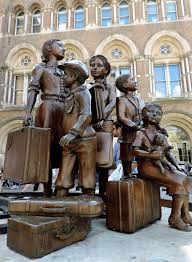
kindertransport

When we were boys of twelve he seemed a little older than the rest us.  Sooner than in any of the others in our small group, a knotty corner of his soul had begun to surface.  It wasn’t anything dramatic or startling.  But apparent to all of us were the beginnings of uncommon frugality, an unusually careful, somewhat melancholy husbanding of  resources, that rose and moved like knuckle bones under his boyish skin.


I never fully knew what kind of man he became.  Eduard Stein was raised in a cramped tenement  in a shabby, workers’ district of Vienna.  The Nazi horror scattered German Jewry abroad.  Just before his fourteenth birthday, he left Austria on a Kindertransport, organized by an international relief committee.   At the railroad station, Eduard kissed his parents good- bye and shook my hand.  His eyes remained dry.  Tears would have been wasteful.   The  relief committee brought him and others to England.  Shiploads of Jewish children arrived there and dis­appeared in the stone towns and villages like quicksilver cast upon gravel.  Shortly after the war started, I managed to get to America.  Eduard wrote me there.  He had been evacuated to the countryside to escape airraids.  He was living with two friendly spinster school teachers in a small town, C., in Lanca­shire.  The address of the their cottage was Cobble Grove.  No street listing.   I thought that was exotic. It fitted perfectly into the England of my imagination — snug villages and castles, fog, warm wool, and wet cobble stones, Little Lord Fauntleroy, Sherwood Forest, and Edgar Wallace.

To my regret, his frugal temperament leached his letters of the color I was seeking.  I wanted green country lanes and thatched roofs, unbelievably large breakfasts, African hunt trophies,  and baronial manors.  All I got was meager and bland descriptions of people and places. His prose was dominated by functionalities and numbers.  Miss Bramston is teaching me English by reading the daily newspapers with me .  My walk to school takes fifteen minutes. Free, interesting lectures are given at Cloth Hall every second Tuesday evening.  The most recent talk on English wading birds was very well attended. I have the use of a bicycle but it has no hand brakes.  My ladies give me an allowance of three shillings per week.  He steadfastly avoided giving me fragrant heather and heath. There were neither lowing sheep nor mediaeval castle ruins.

His parsimonious outlook was also apparent in his dry replies to my glowing reports about America. “ Fairy Dust, “ he would write. “Just Fairy Dust !”  His spinster guardians apparently used that quaint expression frequently.  He had become enamored with its sound and used it often as a mild English oath in an otherwise German letter.  Whenever he suspected the accuracy of my descrip­tions, he would exclaim “more Fairy Dust.” ­Eduard could not believe that suits were sold with two pairs of pants.  It smacked of crude bragging to him. “ Fairy Dust,” he’d write.  Ice-cream sandwiches appeared as adolescent fantasies to him. When I mentioned them in a letter, he promptly replied with  “Fairy Dust” in capital letters.   Truth seemed to him what was frugal, economical, and within the reach of his ex­pectations.  Exaggeration and embroidery were wasteful.  I had the feeling from his letters that he did not object to lying per se, if it were easy and needed.  He simply begrudged the ad­ditional effort that was required by invention and  self‑indul­gent imagination.

Eduard’s disbelief grew as our lives entered divergent channels and gained momentum in new directions.  I wrote him of plans to go to college.  Would Eduard advise whether I should choose anthropology or zoology as a career?  He scoffed and mocked me as pompous and unrealistic.  Doctor of Philosophy indeed!  Doctor of Vanity and Pretense!  More Fairy Dust!  He requested that I stop puf­fing.  Was I planning to enter my uncle’s grocery business ?

Eduard took a commercial course in school and was appren­ticed in a solicitor’s office.  He took bicycle trips in the Pennines, first  with his two spinster guardians and, later, with disdainfully referenced girls.  The girls, who also worked at the solicitors,  never had names and were always referred to as colleagues.  He nearly always closed his letters by assuring me “that the Nazis will get their come uppance.”  Like a mild black Amen to a prayer.   Once he wrote, “ Miss Bramston wants me to say to you, God help Hitler if a Lancashire man or woman got hold of him.”

He steadfastly refused to feed my inflamed expectations about the Blitz.   I imagined twisting con trails over his sky and Dorniers roaring low over flaming buildings in his village.  Only alerts, he wrote, or a bomb dropped harmlessly eight miles out of town in a deserted stubble field.  My fevered curiosity was grist for the mills of realism and frugality that ground in Eduard’s head.  It appeared to please him to play sober counterpoint to my blood‑bright musings.

If  there was a vulnerable chink in Eduard Stein’s armor, it was Lisa, his younger sister. She had also come to  England and lived with an English family in Bradford.  He wrote of his visits with her with warm, almost fatherly, pride.  Eduard seemed jealous.  His sister’s foster parents were too possessive, he thought.  They did not recognize his precedence.  He fussed about Lisa’s religious education and complained about the devious methods by which the Bradford family kept Lisa from visiting Eduard in C.

In those days I often imagined Eduard and Lisa, during their rare encounters. They walked towards a green Lancashire hill along a lonely hedge‑seamed path.  She holds his hand.  With his free arm Eduard draws melancholy arcs in the blue sky and speaks softly of their dear mother and father far away.  He tells her about how just and generous their father was and how warm and loving their mother.  Eduard’s face is serious and yet serene.  He was shielding his sister from the deep pain that wrenches his heart.

Deep down, I did not really believe that their meetings were like this but I wanted it to be that way.  Very likely Eduard Stein and his sister sat in a railroad station or on a park bench if it wasn’t raining.  Lisa would be chewing licorice sticks that her brother had brought her and he would discuss her school work and ask her riddles.  They would have cake together in a tea room with putty-colored walls.  Over a fly‑specked table cloth, Eduard would shower his sister with advice on how to deal with her foster parents.  Then he would walk her to the bus for the lonely trip back to Bradford.

As time went on, I began to sense a certain restlessness in Eduard’s letters.  Things were not going as well as he had hoped.  He never complained or let me know in any direct way that he was dissatisfied.  A thin gray veil seemed to have settled over his personal landscape.   The solicitors office in which he worked, the courses he took in night school, scatters of girl colleagues who were his partners at local club dances or whom he escorted to the cinema,  gradually moved more and more out of focus until they were only mentioned and never described.  It was as if his increasingly frugal writing style saved him the trouble of admitting to a small but growing feeling of frustration.  Something unstated constricted his life in C. and the home of his kindly guardians.  Before he had been almost totally preoccupied with the local scene.  Now he was slowly turning his face to the world.  It made him restless and discontented.

His letters switched abruptly from German to English and the frequency with which he mocked my reports from the American Eden increased.  Cars, suits, generous allo­wances from my relatives, and over‑stuffed furniture were dismissed as Fairy Dust.   Eduard did not treat material possessions with frivolity but yet he teased me relentlessly about my breathy adolescent assertions about the seemingly lush material setting in which I lived.  I merely described the small wonders that a small Massachusetts city held for a Viennese street boy’s eyes. He acknowledged my observations with disdain.  Sparta despising the luxuries of Athens.  I sensed he thought it wrong that I should live in a more affluent setting  because I was not as serious about life as he and because I did not husband my resources as well as he did.

Eduard Stein’s sixteenth birthday was an unusually important day for him.  According to British law he became a full fledged enemy-alien on that date.  This meant bothersome restrictions of movement (Fairy Dust ) and an unwanted abstract identity.  His thoughts turned to emigration then.  Eduard had some distant relatives who lived on Atlantic Avenue in Brooklyn and he hoped that they would be able to bring him to America.

Nothing much happened. I telephoned them twice on Eduard’s behalf.  They spoke to me with unenthusiastic,  cold voices.  Perhaps they already had more problems in their lives than they could handle.  They did not want a refugee boy who had to be fed, housed, and clothed.  The relatives on Atlantic Avenue were obsessed with the possi­bility that Eduard was or might become disabled or ill and would require perpetual care.  It seemed a very odd sort of fear to me.  But they spoke with a strong show of prudence, intoned with the taut inflections of realism.  I listened with my heart and thought of Eduard,  wandering forlorn amidst the green lanes and in the thatched villages of the distant, besieged island.

When I think back on this period, the pace of my memories seems to be slowing.  The intervals between our letters were getting longer.  Recollections crawl by like time-lapse photography.  Once, shortly after his seventeenth birthday, Eduard sent me a photograph and I was startled to see the angular face of a young adult.  He looked lean, with prominent cheek bones, and a curiously lopsided, large nose.  If Eduard had been in a Massachusetts high school,  his nickname might have been Moose.

When the  possibility for emigrating to America failed to materialize, Eduard began to write about joining the RAF. At first he described it as a clever, practical opportunity for attending college.  The RAF sponsored college training for flight officer candidates.  Eduard thought it would be advantageous to try for that.  He increased his course load in night school.  More mathematics, more physics !  He wrote with conviction about spherical geometry.  His letters were all about successful swotting, adroit handling of  test questions, and expense saved by having the RAF send him to college.  After a while, however, the glow in his letters about the advantages of free college training paled and he wrote very soberly that he wanted to fly a Spitfire. Flight Lieutenant Stein !

One day after a longish interval in our correspondence, the letter came.   Edward was in the RAF.  The censor did not allow an exact geographical address but he wrote with frugality-tempered pride that he was taking basic RAF training in the northwest of England.  The ladies at Cobble Grove and his lady colleagues at work had given him a farewell party.  There had even been a cake made with carefully saved sugar rations.  Soon he would go into advanced training.   Military service was important.  Calisthenics were making him tough and he was learning a lot.  Although it was difficult to be chosen, he hoped for pilot school because he looked forward to useful college courses.    In any case,  flying would prepare him for the world of tomorrow, he said.  A somewhat milder tone  crept into his prose. Perhaps it was wonder.  Leaving C. had brought revelations.  There were sights to be seen–free entertainments for airmen.   RAF-blue became him, he wrote.  The canteen was staffed with very attractive ladies.  A family he had met at a synagogue had invited him to their home.  He closed by wondering why I had not yet joined the military services.  Was I exempted because of my studies or did I have flat feet ?  “Fairy Dust! “ he wrote.  “Its time to get off your duff.  Get in the army.  Come to Europe, where the action is!”    He encouraged me to “get cracking” and he wished me well.  It was as close to extravagance that Eduard ever came in a letter.  It was the last letter I ever received from him.

I wrote to him several times after that.  Told him that I had been drafted, was taking training,  and would soon be coming over to rescue him.  The usual sort of young mens’ brag.  They were sent to his RAF address but I am not sure that they ever reached him. There were no answers.

I landed in France six weeks before the German attack in the Huertgen Forest.  When the Battle of the Bulge was over, I was a staff sergeant, with a Purple Heart, a Bronze Star, and two frozen toes.  Four months later, my platoon rolled through the screaming horrors of Dachau, and then went on to liberate dancing Lippizaner horses.   Six weeks after VE day I got five days compassionate leave in Vienna.  The city was a dusty, rubble-strewn wreck, haunted by hunger, guilt, and hatreds. Wandering through the barren streets of my old neighborhood,  I was racked by resentment and biting sorrow.   In Eduard’s old apartment building, I found Eduard’s aunt who had been liberated from Terezin and had returned to Vienna.  In a pale voice, she told me that Eduard’s parents had disappeared in the ovens of Auschwitz.   Eduard was dead.  Killed in the RAF.  His sister, Lisa, had written that Eduard had been in the crew of a heavy bomber.  Returning from a mission, the badly shot-up Lancaster crashed at landing and Eduard did not make it out of the wreck.

I do not remember reacting very strongly to the news.  Perhaps this was because every day of my leave I confronted half-remembered acquaintances and strangers with the burnt-out faces and glowing eyes of the K-Zetnik,  who recited the list of dead as if they were prayers.  The sheer heart-wrenching mass of these recitals may have dampened my immediate grief at Eduard’s death.  Perhaps it was because the news had reached me from fourth- or fifth-hand sources and that information about the circumstances of his death was so meager.  I drank several toasts of raw, throat-searing plum brandy to him that  night, and then, filled with murderous melancholy,  drove back to my billet.  To this day, I am sure, some Viennnese tell of their close escape from a viciously driven American jeep on a summer night in 1945.  And that was that.

Refugees are more inclined to cultivate and preserve their memories than those who have not been uprooted.   I did not have all that much to remember about Eduard.  As young boys we had been friends and schoolmates.  After we were separated, Eduard offered me skimpy glimpses of  rustic Lancashire and brutally abbreviated sketches of the town and people among whom he lived.  His letters showed the growing  power and convictions of an adult but he remained as conservative and frugal as before.  Now, in retrospect, my imagination further compensated for the penury of his descriptions.  The English town in which he lived became greener, a place of thatched cottages and sunny gardens.  His spinster guardians, the school teachers, had ruddy full faces and bright blue eyes.  They wore stout walking shoes and tweed skirts, and spoke in friendly but energetic accents.  His girl colleagues were wise with female wisdom.  They wore saucy miniskirts,  made love in the heather and bracken of summery moors, and knew how to live with human failings.

As I grew older amidst the brisk rhythms of my American world, Eduard’s C. became smaller, sunnier, and even greener and its  inhabitants lived in ever boskier harmonies .  I developed a strong yearning to visit C.  The warm, friendly people of that town would share  their memories of Eduard with me and provide me with a passport to a fading past.  Traveling in time to an imagination-embroidered place is a dangerous undertaking.   What I knew about C. had been filtered by Eduard’s frugal sensibilities.  What’s  more, he had seen the place as an outlander, who had been wrenched from his human moorings by  a political catastrophe.  Yet, my dark yearning defeated sensible caution.  Twenty years after Eduard’s death, I was invited to read a paper at an international meeting of sensory physiologists in the University of Leeds.  C. would not be far away.  I could not resist.  Alea jacta est.

In preparation for my trip, I tried to call Eduard’s relatives in Brooklyn, whom I had contacted on his behalf, twenty years earlier.  After several failed attempts, I finally managed to speak to a confused old man, with failing memory, who did not seem to remember Eduard, but gave me the sister’s address in Bradford.  I wrote to Lisa immediately.  My letter was full of questions.  What did she know about his final flight ?  Where his school-teacher guardians still alive ?  Where could I find them ?    Where was Eduard buried ?  Where ? When ? How ?  My letter was five pages long.  Two days before I left for England, the letter was returned to me — addressee unknown.

London’s unaccustomed colors, moods, and rhythms provided pleasant relief from the stable routines of my American life.  It was a sensory feast for me: tides of traffic swirling around islets of royal pomp,  the silver-gray of fading elegance mingling with the provocative vulgarity of Carnaby Street rags,  glimpses of well-used docks heaped high with Thailand teak, and Pakistani women in brightly colored pantaloons, polishing the brass of marble commercial palaces. The imminence of an excursion into the past had made me a little queasy.  The cosmopolitan glitter of London restored me.  But the malaise returned at the airport on the way to Lancashire.  Leaving the polyglot babble of the international crowds in the central terminal hall at Heathrow and entering the local departure lounge, I found myself among whispering groups of industrial and commercial men going to Leeds/Bradford.  It was as if a switch had been thrown. A dun veil fell over the day.  It constricted and threatened.  Quiet suspicions which had hatched like basilisk eggs throughout the years began to stir.

Seated in the crowded aircraft, waiting for take-off, my dread grew.  Outside, a slow steady rain pelted the greasy, black tarmac.   The cabin air was stuffy   and reeked of hair dressing and stale cigarette smoke.   Hemmed in by a mass of steaming wool suits, I gasped for air.  Fatigue came to my rescue  and I was soon asleep.             When I began to waken, I was high over the Midlands under a bright blue sky.  The ground below was hidden by an almost continuous blanket of clouds.  Here and there, a gash appeared in the dense gray layer, and allowed a glimpse of a landscape imprisoned in deep gloom.  To my sleep-addled brain, it seemed as if I was floating in a celestial vessel amidst almost unbearable luminous beauty.   My feather-light chariot rode high in the sky while the clouds below, shot through with gobs of fibrous gray, sealed off a dark and evil world beneath.  I suddenly had the feeling of some sentient presence forming along the wingtip and following the aircraft in its soaring course  through bright space.    With startling vividness I sensed Eduard just outside the cabin window enveloping me with a strong aura of familiarity and closeness. I even thought I smelled the scent of licorice, one of Eduard’s favorite confections.  The total effect was so strong that it brought me quickly to full wakefulness.  The recollection of what I had just experienced was tremendously vivid.   I shivered and my arms and legs felt thin as paper.  I had to force myself to look out the window again to prove to myself that there was really nothing out there.  Any more?

When the plane landed in Leeds, the specter of Eduard on the wing was still strongly with me.  It was as if I had met him again and found some new knowledge about him through that meeting.   Something had pinched my soul with force.  As I started towards C., I ached somewhere and was yearning for remedy. My hired car took me through a gnarled brocade of plane trees, shrouded in dung-yellow fog.  Here and there a thorny wreath of sunlight crowned the trees  and pierced the haze with spikes of light.  The road twisted through the narrow streets of villages: Bromhope, Otley, Ilkley, Addingham.   Rugged walls of blackish stone lined the curving road.

I thought the stones were coated with an unfamiliar lichen or moss, but at a stop I discovered that the walls were blackened by soot.

The fog was left behind, as the car climbed the winding road towards a low saddle set in stocky hills.  A craggy castle hung on the slope overlooking the pass.  Lancashire  spread below me bathed in sunlight.   A flock of sheep was grazing in a green meadow flecked with heather.  My heart leaped.   This was the setting that I had vainly hoped to find in Eduard’s letters long ago.

The joy died quickly as I drove into C. Power shovels had torn great holes in the street and angry lines of trucks and cars crawled around huge mounds of brown earth.  The squeezed stone facades of the buildings lining the high street had forfeited their rustic benedictions long ago and stared at me with sooty grins, toothed with the enamel signs of cheap appliance shops.  In the relentless pressure of traffic there was no respite for collection and mental refitting. I was pushed along lines of worn shopfronts and soiled sidewalks.  Gray crowds eddied past displays of peagreen orlon blankets, chromed tea kettles, and the apoplectic stains of clothing-store windows.  A pub stared sourly from its dun shell of corroded stone.  Before I knew it the traffic had carried me out of town.

I pulled the car to the side of the road and sat there watching the passing traffic.  Somewhere nearby a pump was straining to suck muddy water from a huge hole in the roadway.  Each thump  of its creaking heart flooded me with deeper melancholy. I had to move to pull myself out of this funk.  A drink would help but I knew I could not get myself to venture into any of these dark stone pubs that I had passed.  I could not deal with friendly prying questions or with suspicious eyes.  To find Cobble Grove,  the place where Eduard and his kindly English school ladies had lived!  Something would happen there.  There would be someone who had known him and who would be able to talk with me about him.  Someone whose strangeness and reserve would dissolve in reminiscences about an airman, long dead, but still remembered.  Or perhaps there was the solicitor’s office.  Perhaps someone would remember him there.  I  keenly regretted not having made advance contacts or inquiries before my departure.

Pulling back into the road, I drove back to town, looping through side streets.  My senses were keen.  I was a hunter looking for some sign of my quarry, looking for the ghost spoor, the thread to  past.   A woman was moving on the narrow sidewalk, carrying fruit in a bulging net bag.  She was walking slowly up a gentle slope, her buttocks swelling and receding under her ample skirt.   Was she one of Eduard’s girl colleagues who would remember the laughter of a summer afternoon in the Pennines long ago?  I passed her without slowing.  The surface of the landscape was too smooth.  I could gain no purchase for my curiosity.

The narrow back street funneled me to an old country highway. Nearby, a gas station stood starkly alien in its red and yellow enamel sheen amidst a small group of time-worn stone buildings.  I stopped for gas.   The pale-faced attendant,  draped in electric-blue overall that were much too large for him, grinned when he heard me speak.  “You’re a Yank, aren’t you ?”  he said.  He was too young–not even alive when Eduard walked this street.  He had never heard of Cobble Grove.  Maybe there never was such a place.  Maybe I had made it up.

I drove to the center of town and parked the car.  Perhaps there was a convenient police station where I might inquire about Eduard’s old residence?  Or may be some municipal office ?  I could even stop some place for lunch and ask there.  Cities have better guides about their  distant than their recent past.  I was curiously irritated by my inability to gain a productive grip on the situation. I felt helpless.  My parking space proved to be further from the center of the town than I had thought and the slow discovery of that fact added to my annoyance.   I walked through the gray, hard street, cautious and weary–a tiring hunter in a strange stone forest.   The police station, when I finally found it, was on  a small square with a dusty little park in the center.   The thought of telling the desk sergeant that I was looking for the house of someone who died twenty years ago made me uncomfortable, and I did not enter.  Across the street , an old man was sitting on a bench feeding a flock of cooing pigeons.  In the center of the small park was a small stone monument.  I walked slowly past the cooing birds and towards the slab.  As I neared it,  the hackles in back of my neck rose as if a grave-cold hand had touched me there.  Chiseled in the crest of the stone were large airman’s wings.  In bold, raised letters the stone announced  “In grateful memory of the men of C. who gave their lives for their country while on service in the Royal Air Force during World War II, 1939-1945.”   Below  the inscription were four columns of names.  I froze, unable to read further.  It was not Cobble Grove and the pastoral vision that I had been pursuing in my hesitant search but rather some sign of him, some remnant, some spoor.  I searched for Eduard as a splinter of a youth that I had lost and it had left a jagged edge.   This column offered, at last, a tangible link with Eduard.  Other remnants might have worked in the same way– some person who had known him, a picture, a used room, a glimpse of  his school or of the solicitor’s office in which he had worked.

I read the tablet. Sixty-two names in four columns.   I read again.  No Stein ! All there was between Wm.  Sanders  and E.M. Stoddard  was the smooth regular interval of dressed granite.  After Stoddard was J. Talbot.  There was no trace of Eduard.  I must have read ten times through those four graven columns.  Frantic !  Perhaps they were not in alphabetic order!  Perhaps they were ordered by row rather than columns.  But, no ! His name was not there.  There was no sign of Eduard.  It was as if he had never been.

I walked to the bench across from the old man’s pigeons and sat down, stunned and drained of energy. What could have happened ?  Anti-semitism in C. ?  Prejudice against foreigners with Germanic names ?  A mix-up in a Whitehall records office ?  My reaction was physical.  The visual world constricted.   I saw the old man throwing bread crumbs to his gray flock.  The rest of the square surrounded the narrow tunnel of my vision like a stone cocoon.

It must have taken fifteen minutes or more before the world came into focus again.  The old man had been watching me and now he smiled.   Encouraged,  I rose and walked over to him.  Had he ever heard of Cobble Grove?  There was a long pause.  “Ah, yes indeed!” The Grove had been  a group of four old stone buildings, standing together at the west end of town .  They had been used  as private homes, probably since before the end of the last century.   Ten years after the war, they were sold.  Some of the houses were, he thought,  still standing.  A developer had made them the centerpiece of a fashionable resort hotel.  It was a recreation of an old English coaching inn with an upscale restaurant.  “Very luxurious and very popular with the tourists,” said the old man with a wink to me.  He never asked me why I was interested in Cobble Grove.  He showed me on my map where to find it.  The hotel, he said, was now called the Inn by the Grove.

The  approach to the inn was a long,  sunken road lined with gnarled wind-twisted trees.  Was my road lined with rowan trees. Rowan trees ?  Were these rowan trees ?  I had never knowingly seen a rowan tree in my life.  Yet it seemed to me that the trees with the scarlet berries that lined the sunken road to the inn ought to be rowan trees.  Some half-digested, half-remembered tatter of superstitious knowledge from a lecture and a book demanded it.  Daylight was failing rapidly. I saw bloody rowan berries in the dark branches and my belly tightened.

A light fog had settled on the landscape but it came down no further than crowns of the trees, and hung there, forming a faintly luminous tunnel for the road. I had feared myself lost but now I could see, in the fading afternoonlight,  what seemed like hotel buildings in the distance.   As I increased my speed,  I was startled by a dense flock of blackbirds,  which had been roused from the trees by my head lamps, and swept across the road before me like a huge black rag.  Spooked, I was glad to pull into the well-lit comfort of the  hotel parking lot.

The main part of the inn was a tall techno structure framed in polished metal and faced with wide expanses of golden glass.   A purple marquee led into a large, elaborately ornamented lobby, dominated in its center by the reception counter, an altar of teak and green marble. Beyond the reception, yawned the entrance to a labyrinth of brightly lit sitting rooms.  An American bar was on my left and through the open door on my right, I could see, amidst a small forest of potted palms,   the elegantly-set tables of a restaurant awaiting the evening’s guests.  Crystal chandeliers sparkled.  All looked rich, brash, and shiny.  Eduard’s school teacher guardians would not feel entirely comfortable in the new Inn by the Grove, I thought.  Where where the stone houses of Cobblers Grove amids all this splendor?

As I crossed the lobby to the reception desk, guests were beginning to gather at the bar, and a small band of female musicians in long gowns were setting up their instruments in a corner.  I had called from downtown C. to reserve a room and the clerk greeted me with practiced courtesy.   “  I can give you a very nice room on the fifth floor overlooking the lagoon,” she said. “or perhaps  you would prefer to stay in one of the Old England stone pavilions with a view of the gardens ?”

Old England pavilions ?  Could one these have been Eduard’s home?  Where these stone pavilions the remnants of Cobblers Grove ?

My question seem to startle the clerk and she examined my face for a few moments as if she were trying to gage my motive for  asking the question.  Then she shook her head.  “Cobble Grove?   I never heard of that.   I’ve been told that these stone buildings have been here for a long time.  When  the hotel was built they preserved the old gardens and they rennovated the stone buildings and made them part of the inn.” She fixed my face with what I guess they learn in hotel school to be the open and sincere look.

“ Our tourist guests really love the stone houses.  The cottages have been done like an old English inn — you know oak beams and dear little cozy corners — but with all the best modern facilities.”  She was pushing a little.

I instantly warmed to the thought that I might sleep where Eduard had lived, but I wondered whether I would be able to find out which was the house in which the Bramston sisters had sheltered Eduard Stein.  The clerk took my hesitation for resistance.

“Perhaps you would rather stay in our very comfortable main building,” she added quickly, “some of our guest feel more at home in a modern main building.”

“The stone cottages will suit me fine,” I said.   She seemed almost surprised.

“ Then I will give you Room 23 in the Holly Cottage,” she said quickly, “I am sure you will find it very comfortable.”

“Take this gentleman’s luggage  to Holly 23,”  she called in the direction of the three youths who were standing around the bell desk. The bellhops studiedly avoided looking in her directions.  Finally, after several ignored summons, one of them peeled away from the group and came to pick up my bag.

Through a door in the rear we stepped from the dazzle of the lobby into the late afternoon gloom of an old garden.  Dense stands of flowers lined the low walls –hedge roses, daisies, and poppies.  Their colors were fading in the twilight  but their scent was strong.  These are old plantings, I thought, they might well have growing along those walls while Eduard walked in this garden.

Our path took us past the white cast-iron skeleton of a gazebo, standing surrounded by a dark wreath of miniature ornamental trees, in the center of the plantings.   The whole garden was dissolving around me in the uncertain light.  I had the strange feeling that the young bellman who was carrying my suit case was becoming ill at ease as we approached the stone house.  Although my heels crunched loudly on the gravel path behind him, he kept turning his head nervously over his shoulder, as if he were worried that I was no longer following him.   At the door he stopped and without looking directly at me, he said,

“You sure you want to stay in this spooky old place instead of the mod main hall ?”  He was working painfully hard to force a smile into his face.  “There isn’t even an elevator in this building.”

“There are only two floors.  Don’t you think we could manage .”

“I guess,”said the bellhop,  laughing nervously and ferried me through the door. It was clear that he did not think highly of my choice of accomodations.

The first floor of the building, which must have held family rooms once, had been completely gutted.  All the interior walls had been ripped out and the entire ground floor had been converted into a small banquet or meeting hall.  It now stood empty except for stacks of tables and purple chairs.

Anticipating my question, the bell hop shrugged his shoulder, “Your room is upstairs, sir!”  and turned towards a steep stairway that led to the second floor.   As I started to climb the stairs, the hair on the back of my neck rose  and  a chill swept from my shoulders to my heels.   The narrow stair case was suffused with  a sweet, spicy smell.  The scent was faint but it was unmistakably that of licorice.  My strong visceral reaction annoyed me.  This odor  was  most likely from a cleaning fluid they had used on the floor.  But licorice had been Eduard’s favorite candy.  The candy had been in short supply in war-time England and he had once even asked me whether I would send him some.


My room was standard upscale American motel with a large bath, shining in faux marble,   equipped with two sinks, a bidet, and a gold hair dryer.  The only bow to old England were two worm-eaten dark beams that were embedded in the ceiling.   My windows faced the garden.  I stuck my head out and inhaled the evening air.   Music from the band in the main building was drifting back to me.  It sent an another icy wave rolling up my back.  They were playing  one of those cheery, familiar Strauss waltzes. It might have been “Wiener Blut” or perhaps “Tales from the Vienna Woods,” but I felt unsure.    I stepped back into the room.  The familiar, comfortable modern motel interior offered some shelter from the spooky English garden.


Perhaps someone on the hotel’s staff  knew something about the history of Cobble Grove and might even be able to tell me where Eduard’s spinsters, the Bramstons,  had lived.  I did not have high hopes, but nevertheless I washed hurriedly, and quickly returned to the main building.     My dinner was served in a festively-lit dining room.   A vase with freshly-cut was at the center of my elegantly-set table.  Music drifted in from an adjacent room.  The fare was better than I had expected.  Clear bouillon with golden lumps of marrow,  an excellent entrecote with small brown potatoes, and a fine  piece of well-aged Stilton.  I managed to make my way through a bottle of Bordeaux.  I was quite mellow when I finished, and had almost forgotten what brought me to the Inn at the Grove. Small parties of other guests rose one by one, and wandered past me into the comfortable sitting room  that adjoined the dining hall.  The sitting room was decorated in luscious red and pale green.  In the center of each table was a gilded lamp shaped like a pineapple. I asked the waiter to serve my coffee and brandy there.

The other guests were mainly prosperous-looking couples who seemed to know each other.  A few bridge games had started.  I settled back in a comfortable settee and watched the tranquil scene in a bemused, slightly alcoholic haze.  Before long, a  rather fleshy, well-dressed man walked across the room to sit in a nearby chair.  His eyes had been on me for some time.  As he sat down, he winked at me and smiled,  “You’re a Yank, aren’t you ?”  There was hardly a trace of question in his voice.  “I said it to Brenda, the minute you walked into the dining room.   What brings you to our corner of Lancashire ? “   Professionally-friendly business travelers usually set my teeth on edge and I try to get away from them at the first opportunity.  He was in electric pumps.  But the bordeaux had mellowed me and my interest in Cobble Grove caused me to slide into a conversation.  I did not tell him why I had come to the hotel, but told him that I had always been interested in the English countryside. “ We don’t have many thatched cottages in America, “ I said.

We talked about C. and Lancashire.  He laughed at my surprise that there were factories amidst the rustic dells.   Dark satanic mills had not loomed in my imagined landscapes.

“ Center of the rag trade,”  he said.  Then he looked at me very intently.  “I had you all wrong, “ he continued, “ I thought you came to the Inn because of the ghost.”  I had almost expected it. “A ghost ?” I asked.

“Yes, a ghost!  Of course, educated men like you and me, are likely to be a bit skeptical, but the locals believe that one the old stone cottages of this inn is haunted.  The maitre’d was talking about it only yesterday.”   My electric pump companion looked at me speculatively.  I could see he was warming to the tale.  “You will enjoy this,”  he said, “ Clarence, that’s the maitre’d, says this ghost is no friend to the management of the inn.   It appears the spook doesn’t approve  of good living.    He haunts only the big spenders.  You got to run up a big tab to have the  ghost come to your room. He must have a tap on the cash registers.  Whenever someone who is staying in the cottage throws a big bash for themselves , they are in for it.  Order caviar, pheasant, or the bubbly, you will have little rest that night.  You will not sleep despite what the old Veuve Cliquot might have done to your brain.  The ghostly apparition  is  too much for some guests.   I heard that a few have checked out of the inn in a panic. They say that right after midnight, a rumble will start in the rafters and a mild cool wind will stir the curtains and fill the room with a sweet herbal smell — some say like licorice. Then come heavy foot steps,  and a groaning, complaining, and bitter, hollow laughter    Those who have had the experience hold that the ghost calls out something to them.  What he says isn’t very clear and there has been a lot of debate about it.  Most claim, he cries  “Fair n’ Just!  Fair n’ Just!” over, and over again in a shrill dark voice. “Fair n’ Just!”  An uncommonly frugal spirit, this ghost– cannot stand their bit of fun.  He must have been a Scot, when his body was about and thriving.  Don’t you think ?”

Posted in Uncategorized | Leave a comment

God Laughs (Part 5)

Garulos

The first place I ever visited in Brazil was Sao Paulo. It was the city closest to the port, Santos, from which my cruise was departing. It was also the home of my cousins. My grandmother’s sister’s grandchildren. For a family that was decimated by World War 2, all relatives are precious, but my cousins Lia and Roberto are incredibly special. They are both unbelievably smart, kind, and woke and they embraced as if the prodigal son returned. They could not wait to show off their city and they spent a day and a night doing just that.

I learn from them that Sao Paulo has a metropolitan area that has over 21 million inhabitants which makes it the largest in Brazil, the Americas, and the Western and Southern Hemispheres. It is also an “alpha global” city meaning that it is a center of finance and business whose actions can have a serious impact on the global economy. It is the richest city, by far, in Brazil and sees itself as the leader in commerce, arts and entertainment. My cousins show me many of the cities cultural institutions and shopping areas but also provide me with a sense of the city beyond that. I see a city of the future. Where the population is so dense that cars are only allowed to drive on designated days (if your license plate ends in even number, even number days, etc.) Where there is a thriving helicopter taxi business allowing businessmen and the wealthy to avoid the crawling traffic down below. This is both a matter of convenience and of safety as the wealthy need to do what they can to prevent kidnapping and robbery.

As we approach the city of Sao Paulo I think of this first trip and of the motto of the city that I learned during the last Presidential election in Brazil:  “I am not led, I lead.” Sadly, in respect to the Covid 19 this is true. It leads Brazil and South America in infections and deaths, even with bogus statistics that only show the tip of the viral iceberg.

The highways in Sao Paulo resemble the dioramas I recall from “The City of the Future” exhibit at the New York Worlds Fair. Multiple highways embedded within each other. The center highway is designated for cars passing through the area and has extremely limited exits. The next layer is for those who are planning to leave the highway eventually but not immediately and the outer layer is those who plan to exit locally. It is a system that if you are unaccustomed is confusing and stressful. But Marcus is an experienced driver and with a little help from Waze manages to exit off the highway and onto the approach road to Guarulhos International airport.

The airport is the largest in Brazil. Each year 40 million passengers pass through its portals. In normal times, the access roads would be crowded with cars ferrying passengers to the terminal. The din of airplanes taxing, taking off and landing would be audible even through the closed windows of an automobile. On the long approach road to the terminal we see no other cars. We hear no aircraft. It is oddly unsettling.

Normally, when you arrive at the departure level of an airport you have an exceedingly difficult time finding a spot by the curb in which you can exit your vehicle. There are traffic wardens and police officers to direct you, whistle you along or tell you to leave. Finding a space at the curb is not a problem. We are one of three cars at the terminal. The silence is deafening.

I stiffly get out of the car after our six-hour drive. Marcus gets my rollaboard out of the trunk and places it on the curb for me. As I fasten my backpack to the handles of my bag, I wonder how to say thank you to this man who has risked life and limb to bring me here. I do not know enough Portuguese to express myself adequately. I cannot give him a hug or even a handshake. Instead, I simply say “Obrigado” and hope that he can see the depth of gratitude in my eyes. I think he can because his response “Bom viagem, senhor Paul. Vá com Deus” is rich with emotion.  As he drives away, I suddenly feel very alone.

I have transited through Guarulhos airport many times in the past. Its terminals are often so packed walking requires more dodging than crossing a midtown street against the light. The terminal I enter is silent. Normally, where you would see scores of passengers standing in line to check in you see just a few groups of people milling about. It is as quiet as a cathedral.

I look for and find the entrance to passport control and make my way towards it. Halfway there I pause. This cannot be right. There is nobody in line at all. The last time I cleared customs here the line was 45 minutes long. But I am not mistaken. There is no que. As I enter the line I am greeted by two persons clad from head to toe in white Tivek suits and respirators who signal to me that wish to see my boarding pass and passport. They take a cursory glance at my documents but then place a handheld device near my forehead to take my temperature. They wave me on, apparently feverless.

There is an elaborate Disneyworld type maze set up entering passport control. It is devoid of people yet I have to make my way through all of the twists and turns to reach a passport control officer. She asks for my documents and when I hand them to her, she asks me to remove my mask. I know it is necessary but nonetheless it makes me feel uncomfortable. I have been wearing it for more than six hours and has become a part of me; my protection against an unseen enemy who is ready to attack me given any opportunity. But I comply and when she signals me to put it back on I do so quickly. She asks why I have been here so long and I tell her, with unexpected emotion, that my wife is Brazilian and we have a home here. When will I return to our home in Rio again? When will I see Elaine again? I don’t think the officer sees the flush of my lament as she hands me back my papers.

I look at my watch. It is 4:30 pm. My flight is not scheduled to board until 10:40 pm. I need to find a place where I can hunker down for the next six hours where I will have the least chance of exposure to the virus. But first I have an errand to run. Whenever I travel overseas, I try to bring back to my niece and nephew large Milka chocolate bars. They are way to old for this sort of a treat, but I persist in giving it to them as I hope it reminds them that they are never too far from their Uncle’s thoughts.

The concourse that leads to duty free is so empty that I can hear the squeak of my rubber soled shoes as they contact the floor. Most of the stores are shuttered and dark. Signs on the metal grates protecting them say they are closed due to the Virus and promise to return once the crisis is over. I doubt the posters of the sign have any idea of when that will be nor whether they will have the financial where with all to open then. Brazil, I think bitterly, is on the brink and the government seems unwilling or unable to help prevent it from going over the cliff.

Will Elaine be able to escape this mess in July? If not then, when? Will I need to come back to pull her from the morass of economic depression, disease and the subsequent social unrest that is sure to follow. These thoughts stab at my heart.

DutyFree is open. But they do not seem to be taking the pandemic very seriously. The clerk who comes to assist me in my search for chocolate and Cachaca only puts on a mask when he approaches me. The cashier never puts one on at all and I stand 2 meters away as she rings up my purchase. I hate the fact that she needs to touch my credit card, boarding pass and passport. I shiver as I collect them and the items I purchased and when I have moved out of sight from them, I  quickly douse my hands with alcohol gel.

I go in search for a “VIP Lounge” in which I can while away the next six hours in relative safety.  They are located on a balcony that overlooks the shopping area and are accessed by a set of slow-moving escalators that, today, are devoid of passengers. The first club I approach is American Airline’s Admirals Club. I have belonged for years and hoped against hope that had remained open despite the limited number of flights leaving the airport. They were shuttered and dark. I saw that around the corner there were two additional clubs. One operated by Sala that I could have paid to sit in and an American Express Club whose membership was payed for with my Platinum Card.  I went there.

The receptionist upon seeing me enter the club puts on her black mask and asked me politely in Portuguese for my boarding pass and credit card. As she played with her computer and further contaminated my documents, I surveyed the club. It was a large modern room with high ceilings and a design palette of neutral colors and grays.  Divided into several seating areas, I am delighted to see that the club had the foresight to block adjacent chairs, and couches to ensure that people maintained social distancing.  Other than me there are only two other people in the room. A middle age man who sits in a banquette near the bar area with his mask keeping his neck warm and a woman in her early 30’s, with short dark hair, gayly talking on the phone without mask or inhibition. From all the animations I have seen on television and the internet I can easily visualize the bloom of microdroplets emanating from each of my fellow travelers.

When the receptionist hands me back my papers I find a seat as far as I can from these two as possible  and then quickly visit the bathroom where I wash my hands to the full verse of “Miss Mary Had A Steamboat.”

Posted in Uncategorized | Leave a comment

God Laughs (Part 4)

A-Brazilian-Forest-Harboring-200-Million-Termite-Mounds-Spotted-696x464

A few minutes after we pass the academy I let Marcus know that after three hours my bladder has reached capacity. He pulls off into a rest area that resembles those on American Highways along with a food court with multiple options, a gift area and modern “banheiros.” The food courts are empty despite it be a time when many people would pause to eat, and I take this as a sign that Brazilians who travel by car are taking the pandemic seriously. Those hopes are quickly dashed when I walk into the bathroom and see several employees hastily put on their masks as I enter the lobby. It reminds me that no place I go for the next 24 hours is safe. That I must be on overly cautious in all situations if I am to remain unscathed by the virus during my journey. Needless to say, I hasten my visit as much as possible and spend an inordinate amount of time washing my hands.

This section of the trip is bucolic and beautiful. The road winds next to and sometimes over a wide river that looks unblemished by modern times. The countryside is a combination of farmland, copse of trees and small valleys that we would call hollows back home. It is the type of scenery that makes you wonder what it must be like to live here. The type of scenery that makes it is easy to daydream.

In my case, it is less daydream and more daymare, a runaway and frightening imagining that takes place during the day. My trip to the bathroom has frightened me, beyond reason, to the fact that I could be exposing myself to the disease. That I have willing exposed myself to a disease that has infected 6 million worldwide or roughly the population of Rio and killed over 600,000, the equivalent of the population of Boston. I am in a country that has done little or no testing yet ranks 3rd in the world in verified disease cases.  A country that has all but abandoned any pretense of control and prevention. It becomes far too easy to recall the images of the quick lime covered mass graves in Sao Paulo. From there it is not a far cry from the images of the sick, facedown on hospital beds, ventilators breathing for them, with wire and tubes leading from their body. I think about how these people are totally alone, except for masked and gowned caregivers, without distraction, left only to feel their disease and ponder whether they will recover.

It is too easy for me to imagine in one of those beds. Petrified and alone. Without Elaine. Without family. With all too fervent imagination pondering my survival. These thoughts roil my stomach and embarrass me. I feel as if I am a coward.

To calm my overactive meanderings of the mind I think about how I have equipped myself.  I have many cloth masks that Elaine has managed to gather for us, most of which fit well enough. But I know that masks only really help you if it is being worn by someone else. They are designed to protect your fellow travelers not you. I also know, because I have worn most of them, that some fit better than others and none of them are medical grade but merely make do in light of a global pandemic. I pass through one cloud of virus containing microdots and I am toast.

Part of my protection pack are 3 small containers of alcohol gel.  that I can use to cleanse my hands and, if need be, surfaces. But I know that while washing my hands, cleansing them from germs is a must, it is not a panacea. It is just a tool. A single step that will lessen the chance of getting the disease but does not 100% the eliminate the risk of getting disease.

I wonder “Have I made the correct decision to leave our home Rio?” I was relatively safe there. Behind two walls with only limited interactions with the outside world that could produce infection and disease. I remind myself that the reason I am leaving is not because I feel unsafe there, even though at times, I do, I am leaving because I need to take care of my health, which I can not do in Brazil. I need to find a way to make a living. I have a family I want to see, hold and hug. I yearn for puppy love.

While these thoughts help, I know I am caught in a vortex of negative thought. It is not productive and contains seeds of fear and indecision that, if they take root, had the potential to incapacitate me. To ease the swirl of destructive thoughts, I try to recall the virtual visit I had with my physician a couple of days before. I had made the appointment because it had been so long since I had picked up prescriptions at my pharmacy that they needed to be renewed by her. Also, I wanted her to prescribe me an anti-anxiety medication. I know me. As long as I am moving forward. Pushing towards something, I am okay. The minute I stop. When I have time to contemplate my imagination switches into overdrive and the result is exactly what was happening now, a “death” spiral of negativity and thought. Dr. Pettee understood and was only too happy to write me a script for Alprazolam. But she also wanted to know what I was doing to plan for my trip and the precautions that I was taking.  She listened carefully and then told me the only other precaution she would recommend is “not touching my face.”

I had taken her advice seriously and, in the days, leading up to my journey I had tried to practice not touching my face. It is not easy. Especially in Brazil where mosquitos and other insects find the faces of gringos especially delicious. Your first instinct is to swat at them. Beat them away. But you cannot if you are practicing not touching your face. This was compounded by the allergies I suffer from in Brazil that require me to take Claritan daily. It helps but it does not take away all the symptoms. Your nose itches and you want to rub it. Your eyes are irritated, and you know that you could get relief by quick removal of the gunk that has built up in the corner of your eye. It is maddening, and nearly impossible not to touch your face but I persisted, practicing until it almost became second nature to twitch instead of rub, blink instead of remove, and when all else failed just grin and bear it until the moment past.

It reassured me that I had a plan that was Dr. approved. But despite the precautions made, I also knew that no matter how carefully I planned, no matter the elaborate steps taken to ensure my safety, that luck and providence would play a large part of me making it through this disease free. And I knew what a practical joker god was.


HaHa God.

I knew I need to distract myself. To move my mind away from the risk I was taking onto to something that would occupy my mind and disrupt the swirl of negativity circling the drain of my consciousness. The answer appeared outside my window.

We were passing through farm and pastureland and there were large irregularly shaped conical mounds. Had they been pink they would have looked as if the earth had acne. I recall from the trip that Elaine had taken to Sao Paulo years before that these were termite mounds. I use my phone to Google “Brazil Termites” and discover that the north eastern part of Brazil is the home of almost 200 million termite mounds, averaging 8 feet high by 30 wide, they cover an area the size of Great Britain. Some of the still active mounds were started 4,000 years ago. The kicker is that this biological phenomenon, an insect culture dating back seven centuries previous to the birth of Moses, was only discovered a couple of years ago.

We live in a culture and a society where we think that we know the planet we live on yet something as gigantic as this, an insect culture that has thrived for 4 millennia and is only now being discovered. It boggles me and reminds me of Socrates’ axiom “The more you know, the more you know don’t know.” It also rings a distant bell for me. Wasn’t there a movie in the ‘70s the prophesied the world being taken over by insects: The Hellstrom Chronicle? It envisioned a post-apocalyptic world run by insects. Seeing these mounds, knowing what I know now, it seems less far fetched that it did 50 years ago.


[Part 5 06/02/20]

Posted in Uncategorized | Leave a comment

God Laughs (Part 3)

VF wedding


The highway leads us out of the city and into the industrial zones in the near suburbs. They are not pretty. They look as if they were designed by Army engineers at the end of the 2nd World War and left to rust and grime up since then. This is not entirely fair but it is what I think as I stare out the window of the car.  I really do not have anything else to do as Marcus speaks no English and I speak only a few words in Portuguese, many of them swear words that Elaine has taught me as an amusement.

Occasionally, Marcus stops to pay a toll. He is the politest toll payer I have ever known. He greets the toll takers by name and when they return his change he politely says “obrigado “and wishes them “Vá com Deus.” Pulling away from the toll area he reaches into the center console of the car and, finding a dispenser of alcohol gel, squirts a large amount onto his glove covered hand and quickly rubs it into both hands. It reassures me that he is so safety conscious. It also makes me nervous and I decide to gel, in an overabundance of caution, every time he does.

The road leads through the hills that surround Rio. They are covered in the rich vegetation of the Atlantic Forest which contain everything from trees that look as if they came from the imagination of Theodor Geisel to the more common place. Some are alight with blooms in shockingly vibrant colors and others with various hues of green. The road itself is steep, full of switchbacks and we often have to slow our journey as trucks can do no better than low gear on the incline. For awhile I am captivated by the rich variety of flora and a view but like a hypnotist swaying watch they eventually lull me into the middle space between wakefulness and sleep where one thought drifts easily from one to another with no rhyme or reason.

I think of my friend Rich, dead less than a week after a long battle with brain cancer. We had been each other’s wingman for 47 years. We were brothers who did not share DNA. It would have been he that I would have backstopped this trip. Asked him whether or not I was making the right decision to return to the United States. He would have given me his unvarnished opinion and I trusted him enough to let it sway me in whatever direction he pointed. Who would I turn to now for counsel and opinion now that as much as I might talk to him it would be unlikely that he would answer. It was he that I would call on this journey to tell him the absurd, funny, ironic or mundane parts of my journey. I would have to find a different way to share my stories, but it would be without the benefit of his wit and slightly askew sense of humor.

I wondered what his take would be on the United States to which I was returning. He and I shared the same view of the Orange Roughian who currently resided in the White House: an incompetent vulgarian who cared not a bit about the constitution, whose only desire was to turn the country into one where he and his cronies could make money without regard if it destroyed the fabric of the country. Even after having a chunk of his brain removed, he had seen the threat he posed for the human values and decency we had been taught our country represented. Rich and I never talked about Covid19. He was already in hospice by the time it had begun its rampage. But he was a businessman. He would have seen the Administration’s response for what it was: political, incompetent, and lacking any semblance of leadership. There is no doubt we would have joked, with gallows humor, about it all. There are others that I will be able to engage with about this ongoing disaster, but his voice will be missed.

We would have talked about the death of George Floyd. Rich had lived for years in Minneapolis. It had been a home and where his youngest son, Sean, had been born. The question we would have asked each other “Is why has the death of this black man in the custody of police sparked so much upheaval and uproar…far more than many others that were equally outrageous and horrifying.” I would have argued that it was a perfect storm. A President who through word and Tweet dog whistles demonstrates his racism daily which has empowered his racist supporters to come out from the woodwork of our country, like cockroaches, to say and do vile things. Combined with a pandemic, turned racial by 45 (the Chinese Virus) that not only sickened millions and killed over a hundred thousand but also infected a huge portion of the United States with cabin fever in addition to widespread incipient anxiety. Added to an underlying condition where communities of colors have felt the bitterness of not being listened to or yelled down when they say anything at all. (Colin Kapernack’s taking a knee to protest against the disparity of justice between communities of color and white and the backlash including his ban from the NFL is the easiest example.) I would have told him adding all those things together is more explosive than adding diesel fuel to ammonium nitrate. I am sure he would have agreed but he also would have added his own spin which sadly, now, I will never know.

The road emerged from the mountains and the forest onto steep hillocks of pasture lands. Here the roads still wound but less acutely and the verdant pastures were stocked with white cattle and the occasional horse or donkey. It was beautiful. It was monotonous and soon the lack of sleep from the night before caught up with me and after a few nods fell asleep.

When I wake, we are on a long straight highway that more closely resembles the interstates in the US. To my left you can see jagged mountains rising out of the plains and to my right industrial areas and pasturelands. I see a convoy of military trucks carrying armored personnel carriers and their troops heading past us in the opposite direction. My first thought is what is Brazil’s military up to? There is a lot of tension between the Bolsonaro government and the military. This has a long history. It was the military that ran the government of Brazil from 1964-1985 and since they relinquished power that have stood in the background ready to take over if they find the country slipping. Many in Brazil would welcome this as life was more predictable under the dictatorship and they have forgotten its excesses and the lack of freedom.  But as ominous the convoy looks, I soon realize that there is a far simpler solution. I can tell from what I remember from a previous trip to Sao Paulo we are approaching the Academia Militar das Agulhas Negras, the West Point of Brazil. Elaine’s father’s Alma Mater.

Jose Affonso Vierira Ferreira was a three-star general in the Army and he, like my own father, was responsible for our meeting. Our decision to take the cruise in which we met was in part because we had been both taking care of our fathers, both dying from kidney, and needed a break. We had bonded telling each other stories of our fathers and our love for him. When I had told Elaine a few weeks after we had said goodbye on the docks of Savona, that I was coming to Rio in a few short weeks, I had hoped to meet him. I wanted to meet him and let him meet the man who hoped to love and cherish his daughter. Tragically, he died just one week before I was to arrive in Brazil.

Funny God.

I was so saddened by my inability to meet him that I wrote him a posthumous letter.

Dear General

Late this afternoon, your daughter wrote to me to tell me of your passing. My hope sir is that your body which has been so tormented of late has freed your soul and that it has found a better place. A place where the vigor of your youth is close at hand…a place where you are at ease and in no pain…a place where you can soak in all the love the universe has to offer.

I am only sorry sir that we did not have a chance to meet. I know we would have much to say to each other.

I think that I would have started our conversation sharing with you the love and admiration that I have for your daughter Elaine. I would have told you that she is a bright star in a dark universe and that her intelligence, charm and beauty make her worthy of her name. That the love I have for her is real and that I will do whatever I can to take special care of her heart, to make sure she never feels alone, and that her happiness is always put before my own.

I would also have wanted to share with you something that I know you already knew; how much your daughter loves you. From the moment I met her she shared with me her joys about the times you spent together. She told me stories of your trip to the World Cup, of sharing a cabin and adventures and of your trip to America with its circuitous path. But it was not the stories that mattered, it was the glow in her eyes as she told the stories that told me all I needed to know of the very special love shared between father and daughter.

I would have complimented you sit on the daughter you raised. I know that one of your regrets in life was that you did not get to spend as much time with your daughter as you would have liked but I think that you more than made up for that with the gifts that you have given her. She is a good soul and possesses a kind heart and that was not created in a vacuum. Those are values you helped give to her. She has the love of the truth and is honest. Those are gifts you shared with her. She is thoughtful and intelligent and those are things you imparted on her. She is beautiful both inside and out and I know those are qualities you fostered in her.

Finally, I would have thanked you sir. Your daughter has been a blessing to me. She has helped me rediscover my heart and my voice. Her love supports me and sustains me. Finding her has been like finding a part of me that I never knew that I had lost. So, thank you sir for giving me the greatest gift of all…love.

Sir, I hope your soul has found its peace and its reward. You are and will be in my thoughts and my prayers.  

I salute you.


I think of the letter as we pass the gates to the academy and raise my hand to my brow.

[ Part 4: God Laughs 06/02/20…Today is also the General’s birthday. ]

Posted in Uncategorized | Leave a comment

God Laughs (Part 2)

Favela

Marcus, the driver whom we had hired to drive me to Sao Paulo, arrived promptly at 10:30. He is wearing both mask and gloves and I am grateful for how seriously he is taking the pandemic. We knew him well. He was the taxi driver who normally ferried Elaine and I to the airport and any other errand where driving our car proved problematic. We knew that for the last few months he had been unable to work driving his cab because he had some preexisting medical conditions that made catching Covid 19 a possible death sentence for him. This trip gave him a chance to earn a fair amount of money (about ½ of his monthly income) in relative safety but would provide me with a safer way to get to Sao Paulo than by plane. It was a good deal for both of us.

Saying goodbye to Elaine is among the hardest things I have ever done. I had spent 55 years of my life looking for the love only she could provide and now I was leaving her with uncertainty and loneliness on both sides of the equation. Have you ever wept with a cloth mask covering you from nose to chin collecting tears and snot, where catching breaths from sobs is made that much more difficult due to the fabric? Have you ever had to figure out how to kiss through a mask?

God ROFL.

Since March 17th I had left the confines of Jardim do Itanhanga only 3 times. And, then only to go a little bit more than a mile away to get money from the ATM machine. Getting onto Ave das Americas, a major thoroughfare near our home, I was struck by the fact that while that outside world had almost completely faded from my conscious thoughts, it had, in fact persisted. The Downtown Shopping Mall had not collapsed into a pile of rubble. Brazilian drivers still drove with the heart of Aryton Senna though not always the same skill.  The world looked as if nothing had happened, or was happening and that struck me as odd, to the point of irony, because, of course,  the world had completely changed since my quarantine had begun 3 months previously.

And then I laughed.

Not because of the ironic nature of the world but because of a sign. And not one from God. As we entered, the Yellow Line (a highway within Rio) I saw an electronic sign blaring out the message “Use Mascara”. The expression was not unknown to me. It means use masks.  I heard Elaine using it enough when we, while walking through our neighborhood, would encounter maskless people.  But I read the sign using my English brain and thought it funny that the Brazilians, ever conscious of their beauty, would inform the public to maintain beauty by applying eye makeup. It really wasn’t that funny but it reminded me that one of the more important things in life is to find humor in it. God certainly did. And it allowed me to relax despite the 6-hour car ride still ahead.

The Yellow Line takes you through many of Rio’s tourist attractions. Not Cocovado, Christ the Redeemer or even the storied beeches of Ipanema and Copocabana.  The tourist attractions I am talking about are some of the city’s most notorious favelas. These areas of the city, populated by the poor and working poor, are unregulated by the government and mostly run by drug lords. The residents live in apartments that were either built by them, or some earlier squatter out of brick and tin. They manage to steal all of their utilities including power, sewage, cable, and water. The buildings are often on top of each other, the streets narrow and where the police fear entering as they are largely run by drug lords who rule with a modern-day noblesse oblige.  In fact, the drug lords have acted far more meaningfully to contain the pandemic here than has the government. They have passed out masks, enforced social distancing rules, and other methods designed to slow the spread of the disease often ruthlessly and backed by guns.

It has not been enough. The favalados live on the money they make every day. If they do not work, they do not eat. Faced with a decision of a disease that may kill them or starvation the 1.5 million (24% of the city’s population) who live in these slums flood the city looking for ways to earn a few dollars. They take mass transportation; they line street corners selling trinkets and snacks either taking the disease with them to the rest of the city or bringing back to  the Petri dish of the favella or both.

The consequence has been, despite the good efforts of the drug lords to stem the tide of the disease, it has spread faster than gossip. It’s spread has been accelerated by a government run by a mini Trump named Bolsonaro. He is a populist who appeals to elements in the middle class and poor who remember fondly the days of the dictatorship when things were less messy than the democracy they now have. He has gone out of his way to belittle the disease including appearing (and coughing) in public without a mask. Suggesting Brasileiros are immune to the disease saying ““They never catch anything. You see some bloke jumping into the sewage, he gets out, has a dive, right? And nothing happens to him.” He has fired two health ministers during the crisis because they would not recommend hydroxychloroquine. He refuses to do testing on any mass scale because, similar to his orange idol in the United States, he believes that testing will just create more cases and you don’t want that.  He has instituted no public bail out to support  those who help those must work or die. Instead he pushes an agenda that puts the economy and business on the back of the hundreds of thousands who will get sick and die.

The only mitigating factor in the gross incompetence of the Federal Government of Brazil is similar to the United States where the power to enforce social distancing, mask wearing, self-quarantining and other disease inhabiting actions lie with the Governors of each state. Sadly, many of these men are weak and most of the states are horribly poor not even knowing if they are going to be able to make payroll on a month to month basis. Add to that political corruption scandals (e.g. The federal police raided the Governor of Rio De Janeiro’s office last week on an investigation that he had misappropriated Covid 19 funds) and you have a near perfect recipe for an epic disaster.

But it doesn’t end there. This morning, before I left the sanctuary of our home in Itanhanga, I read that on the previous day 22, 000 persons had been diagnosed with Covid 19. This is a country that does not test people for the disease except if you present yourself at the hospital. That is more casualties than occurred during Operation Market Garden in WW2 or Gettysburg. The Brazilian Health Care system was overwhelmed long before the pandemic with patients waiting for hours and sometimes days for treatment and if admitted often had to bring their own bedding with them. It is a bit better for those who have health insurance, but the disease has overwhelmed them as well with patients who show symptoms often have to “shop” for hospitals.

God would not dare to laugh at such tragedy.

We pass RIOgaleo Tom Jobim International Airport. I have always loved the name of the Airport as “The Girl from Ipanema” had been a favorite of mine long before I met my beautiful Carioca. Jobim managed the impossible. He captured the essence of Rio with word and lyrics.

Tall and tan and young and lovely
The girl from Ipanema goes walking
And when she passes, each one she passes
Goes “a-a-a-h”
When she walks she’s like a samba
When she walks, she’s like a samba
That swings so cool and sways so gentle
That when she passes, each one she passes
Goes “a-a-a-h”
Oh, but I watch her so sadly
How can I tell her I love her
Yes, I would give my heart gladly
But each day as she walks to the sea
She looks straight ahead, not at me
Tall and tan and young and lovely
The girl from Ipanema goes walking
And when she passes, I smile, but she
Doesn’t see. She just doesn’t see
No, she just doesn’t

It is the place where Elaine and I reunite when I return to Rio. Her effervescent smile and fierce embrace wiping away the weeks and occasionally months of solitude and longing. It is where I have spent endless hours in sadness and near tears waiting for an airplane to return me to the States, alone. It is where I had hoped to leave from to return to the United States with Elaine. But now it is dead. No flights departing.  Aircraft neatly lined up on the runways side by side like books on shelf speaking volumes about missed trips, stranded people, and plans destroyed.

God tee hees.

[Part Three on June 1, 2020]

Posted in Uncategorized | Leave a comment

And God Laughs…(Part 1)

IMG_0520


There is an old Yiddish expression “Mann Tracht, Un Gott Lacht” or man plans, and god laughs.

It is one of my all-time favorite adages not only because it is so liquid that it can fit any situation but because it is true. We can and do plan our lives in the flawed thinking that our plans will be carried out in the way in which we have envisioned it. Nothing happens in life the way we envision. Which may be why God keeps around. He finds our efforts amusing.

Thinking about it, Murphy, the one with the famous law,  must have been Jewish or at least spoke Yiddish. “Whatever can go wrong, will go wrong” is remarkably similar to Mann Tracht, Un Gott Lacht.” As it is corollary “Murphy was an optimist.” But we keep on trying. We may be God’s favorite comedy special although it is hard to tell because we do not know the programming on other spiritual planes, universes, etc.

Back in February, I was hit in the head with this clown size powderpuff of an idea square in the face. When Elaine, had left NJ in late February she had vowed to return by my birthday in mid-March. However, a few weeks before my birthday she tearfully explained that she could not make it back. Some of her business and professional interests had not been settled in a timely fashion. She asked instead that I come to Rio and if I did, she would whisk me away to Costa Verde for a weekend of sun and cachaca. So, I went to Rio.

God sniggered.

The Costa Verde and Paraty were every bit as lovely as Elaine had said. The scenery along the coast was magnificent. Paraty was rustic and beautiful. The cachaca cold and the food “gustoso.” We had a magnificent time. It was only on the day after my birthday that we began to hear rumblings of the deepening of the Covid 19 crisis. It had been bad. I had been nervous to travel to the point I brought my own travel sized Lysol with me, but it was while we were traveling the WHO declared the pandemic. Our first indication of how serious the Pandemic was being taken in Brazil was on the rest stops on the drive home. Most of the bathrooms had run out of soap. It was also at one of the rests stops that my phone pinged with a message from American Airlines letting me know that my flight home on March 21 had been cancelled.

God giggled.

American Airlines could not have been more polite when I called to inquire about an alternative flight home. They immediately booked me on a flight that would leave on the 27th. 5 days later they cancelled that flight too. They also did not know when they were going to resume service as the Pandemic had begun to shut down many aspects of our normal day to day life. The earliest they could book me back to the US was May 4th. I could have found another way-out Brazil at that time. Other airlines were operating but I chose to stay because at the scariest most fearful time in our lives I did not want to be separated from my wife and she was unwilling to leave Rio. I booked the flight on American for early May.

God chuckled.

After hair raising, wash producing, disinfecting provoking trip to a SuperMacado to lay in supplies Elaine and I quickly settled into a daily routine. Elaine would work her social groups in the morning, and I would go to the office to write. This was a blessing for me. I have harbored a secret desire to write for a living for long time. Sadly, the need to make money and employment made this difficult. It is not that I did not write but it was hard to do every day. Clear from the responsibilities of a job, as I had been furloughed, and nothing but free time on my hand I wrote. And I loved it…well most of it…. I hate proof reading. Domestically, it was wonderful. My wife and I, in addition to loving each other, like each other. She is courteous enough to laugh at my jokes, even when she has heard them before. I learned how to make coffee the way she liked.

Our neighborhood is a gated community. The streets empty with beautiful vistas and lovely flora and the occasional cute fauna. It made walking for exercise a joy without the stress of running into too many people. I found a trainer who would, for a relatively small amount of money, give me virtual training sessions.

We found a way to have groceries delivered to our home and the occasional meal brought in from a restaurant.

This is not to say that I did not have things pulling me at back at the states. There was Rosie the wonder dog. She was not supposed to stay at “The Farm” for an indefinite period of time. It was expensive. It also produces some expectations for her that I could not keep up with. Unlimited access to open fields and other dogs to play with whenever she felt like romping. Those things could be dealt with, but I missed her as well. She is, on most days my constant companion, and I missed her.

Also, shortly before my trip to Brazil I had an annual check-up. I was in good shape, but the EKG revealed that two of my “waves” were inverted. This was not new news. I had the same result before, and it had been checked out benignly. However, out of an abundance of caution, whatever that means, my physician advised I see a cardiologist. I had made an appointment, but it had to be postponed due to my situation and the Pandemic. But it made me nervous and like a mild acid it wore at me.

Life was good. We had a plan and we were working it. And, it was only for six weeks so I could postpone the worries I had for that long.

Then American Airlines cancelled my flight for May 4.

God Guffawed.

The pandemic was out of control in both the United States and Brazil. Both Trump and Bolsonaro are terrible leaders. In addition to lacking basic human decency where life is value more than business they lack leadership skills that help a population endure the unendurable. They promoted false cures and scoffed at basic safety measures. The result was the countries were shutting down and the airlines were following their lead. Brazil now only 9 flights a week to the United States and none of them were from Rio. Traveling to the United States meant going through San Paulo or Campinas, both of which were virus hot spots. I could choose to make the trek to these cities and expose myself to more of the virus or I could choose to wait until Rio reopened to US travel.

Elaine and I talked. Whatever decision that was made I wanted Elaine to come with me. We both find comfort and solace at this time of great discomfort and fear with each other. Being a part would make a difficult world seem far harsher. Elaine was adamant. As much as she loved our home in the US as much as she wanted to be with me, she did not want to expose herself unnecessarily to the virus. What happens when an immovable object (Elaine) meets an irresistible object (me…maybe?) You compromise. We agreed it was important for me to see the Dr. To get home for the dog and to take care of all the other things that had laid fallow for months. That I would leave on the earliest plane possible from Rio, June 4, and she would follow in early July. I purchased her ticket for her and changed my reservation.

Several weeks later I was on the American Airline site. The events of the past few months had taught me that vigilance of the site was the only way I would know if my flight was cancelled. I was not surprised by very saddened to learn it had been cancelled. A call to AA revealed that they did not expect to resume service from Rio until July at the very earliest. That I could wait or book a flight out of Sao Paulo

God cackled.

I booked a flight out of Sao Paulo. Three months away from home was enough. I needed to get home. I need to tend my medical needs. I needed to see my dogs. I needed my niece and nephew, my family. But I did not want to fly to Sao Paulo. In addition to not trusting Brazilian safety factors, the flights from Rio to Sao Paulo are usually densely packed with no requirements for masking and it would require hours more in unsafe airports. Elaine and I decided to call the cab driver, Marcus, who normally takes me to the airport and offer him the opportunity to take me to Rio. We hoped as a previously existing medical condition had kept him off the road that a fare to Sao Paulo would be appealing to him. It was. He would drive me for 2100 reals or just under $400. That is twice as expensive as airfare but worth it to me. A deal was struck.

In the weeks leading up to my scheduled departure date I started to hear words of concern from friends and acquaintances alike. “How are things going in Brazil. The news says its terrible down there.” Or “What is going on down there? Brazils has been in the news a lot lately.” Even “Are you okay? I worry about you in Brazil.” It should be noted I knew things were shit in Brazil. While I only looked at the news in passing every day as I found too much news made me way too worried my wife consumed the news like a fat man at a buffet. Daily I would hear reports of the breakdown of the Brazilian government, the internecine fighting between state and federal government over action and responsibility, President Bolsonaro’s poor imitation of Donald Trump but mostly of the daily increase in the death toll. The graphs and the news were definitely the wrong way and I was growing increasingly concerned.

When I heard rumors a few weeks before my intended departure that President Trump was considering a travel ban from Brazil claxons began sounding loudly for me. Will Robinson was not in danger but perhaps I was.

On May 24, the hammer dropped. Trump announce a travel ban from Brazil to the United States. While I was not affected as a US citizen nor Elaine as my spouse, I knew that this would further decrease flights between the country from 9 to even less. I knew that American Airlines was likely not to add the flight from Sao Paulo as they could support the route with diminished demand. My fears were correct. A call to American Airlines confirmed that while the flight was still scheduled it was likely to be cancelled.

God chortled.

After further consultation with Elaine, a log of angst, and a few tears we made the decision to seek an alternative to my American Airline flight. It was further reluctantly agreed that we need to “go while they are going was good” as any delay could produce more humor from God. United Airlines had a flight that left Sao Paulo on the 28th and connecting through Houston put me back in Chatham on the afternoon of the 29th. Even though the price for a First-Class ticket was high I decided that safety was paramount. That the further separation of Business class would provide better margins of safety and as a consequence, worth the investment.

My last few days in Rio passed far too quickly. Despite my wife’s reservation on July 7 to come to the United States, and the fact for seven years we have been living a bi-continental lifestyle, with separations that were far longer than the one we were about to experience, we both realized that her trip was only a placeholder. Should the Pandemic take a more aggressive course in Brazil, due to virulence and government misconduct, all plans would-be put-on hold until the disease ebbed. If, Rio’s airport remains closed to international flights our plans would be put off indefinitely. In other words, for the first time in our marriage and courtship our next meeting was not planned. We literally did not know when, after the next, few days, we would ever see each other again. This fact weighed heavily on us and both of us, independently, and sometimes together, would break down in tears in the uncertainty and the subsequent fear of not being in control of our destiny.

When these breakdowns would happen Elaine would seek to reassure me telling me that she knew why I had to go. I would almost believe her but guilt from leaving would keep me from being totally confident in that declaration. I would tell her that if she could not come to me, I would come back to her by her birthday. She would always reply “No my darling, you must stay safe.”

To which I would reply “I will return to you by then, I promise.” This is I said with total confidence and belief despite the fact that I knew that I no control over of my destiny in this regard. I was at the mercy of two governments whose handling of the pandemic had been incompetent at best, the virility of Covid 19, and the mercies of airlines whose schedules had yet to be set in concrete. We both knew we were launching ourselves into the unknown and the uncertainty and fear made us cling together and the days flew as if on methamphetamines.

All too quickly it was our last night together. As we spooned in bed that night, I imagined that I felt like soldiers on the eve of battle. Not only what would the next day bring and would I have the courage to persevere through the myriad of difficulties that lay on the road to home, but also on the health consequences of my decision. I was relatively safe at our home in Itanhanga although illness lay around every corner and was going to get far worse before it got better. Would traveling home make me sick? Would I catch the disease? If I did how sick would I get? Would I be a mild case or a severe case? How would feel being sick and alone? Who would comfort me? If I stayed in Rio what would happened to me if I got sick as I speak little Portuguese and the hospitals are filled to capacity? Was I leaving for the right reasons….to find work, to take care of my health issues, to take care of my dog, try to resume a normal life or was I coward running from battle and deserting my wife in the process? What kind of man leaves his wife? But didn’t you offer her the opportunity to travel with you? Didn’t you buy her a ticket to come with you? Isn’t the choice to stay hers? Should not you have yelled, screamed stamped your feet, and done anything else you could have to persuade her even though your relationship had always been based on dialogue not diatribe.?

Needless to say, despite the comforting arms of my wife, I slept little that night.

God laughed.

(Part 2: May 31)

Posted in Uncategorized | Leave a comment

Skilak

papas day (2)


It is Sunday June 17, 2001, Father’s Day, and I am standing with my father and a group of people on the pebbled beach of Skilak Lake, Alaska.  The weather is cool with a silky breeze, sunny skies with only a few puffy white clouds transiting above us as if they were late for an appointment.  The lake is a mirror, flat and unbroken with only a large inflatable motor boat maring its pristene surface. Just beyond where we are standing a brook bounces overs rocks on its way into the lake.  Off in the distance I can see the terminal moraine of the Skilak glacier and beyond it the snow covered peaks of the Chugach Range.

A postcard perfect day…in a perfect postcard setting: The type of day that I had thought of when I had told my father that I wanted to go with him to Alaska nearly nine months before.

We were all listening to our guide. He looks to me the same way Grizzly Adams would have looked if he had been outfitted by the Cabela catalogue. He is bearded, broad, and has a gentle nature about him. And like many of the folks who work at this camp we are staying at this is not his full time work. He spends most of the year teaching biology to high school students in Washington State and he is addressing us as if we are his students and an exam is looming.  In fact, what we are doing is preparing for a day long hike up the south side of the lake to the foot of the Harding Ice Shelf

The trail, he tells us, extends throught a national wilderness area. What this means is that the trail is cut once a year and that all the flora and fauna are protected. You are not allowed to pick things, collect samples or even move a tree limb if it falls across a trail. The fines, he states, for breaking the rules are extreme and strongly suggests that we do not break them. He pauses for emphasis and then begins to describe the trip.

“We will be traveling through three distinct climate zones…” His tone and cadence produced in me much the same reaction that my high school science teacher had generated when he lectured on thermodynamics. My mind drifted.

The summer of 2000 had been a busy one for me.  I had new responsibilities at work which had kept my Executive Platinum Status at American Airlines safe for another year. My life outside of work had been of full of moving into a new apartment and trying to turn it into a home.  Combine the above, with the fact that while I lived in NYC, my parents lived 20 miles away in the Jersey suburbs. It meant that even though I talked to my parents nearly every day, I had not seen them in months.

So, it was with a great deal of anticipation that I pulled into my parent’s driveway early in August. I had missed them, and as for many people, the feeling of coming home to the house you grew up is a singular one.  The adult and complicated thoughts and emotions that define your everyday adult life seem to fade. Memories of childhood….street baseball, first kisses, and long summer nights….remind you of times when happiness and contentment were easier to define.  Fears of an uncertain world are replaced with the certainty and absoluteness of a parents love. You suspend your need to be an adult and, at least for a short while, can enjoy the feeling of being a child a little longer.

And it was with the enthusiasm of a child that I bounded up the stairs to the deck in my parents backyard. As the deck is directly adjacent to my parent’s kitchen I had hoped to surprise them at the kitchen table.  But as luck would have it my father was on the back deck asleep. He was wearing his summer uniform of a dark blue LaCoste shirt, khaki camp shorts that are several inches short of being instyle and only inch or so shorter than being imodest,  a slouch hat, and gold Ray Ban Aviators.  My father, always the good host, would normally rise to greet any guests especially his children, even if he was asleep. Today was different. He did not bother to get up. Instead, he just pulled himself up on the handles of the chez and said hello.

The father I saw there was not the father I remembered. My father is a big man 6’ 2. He is a man who has a robust appetite that is only kept in check by the vanity of wanting to look his best. The father I remembered was strong, active and vibrant.

The man in the chez lounge was only a shell of that man. He was gaunt and thin having lost at least 25 lbs since I had seen him last. His face was pulled tight and he looked uncomfortable in his skin…as if he could never find a position that made his body feel comfortable. And he looked tired, as if were effort just to stay up for the few seconds it took to greet us.

I said: “Hey Pops.”

“Pablo…hey hey how are you.” He managed to blurt out with the froggy voice of just awakening.

We gave each other kisses and hugs and he didn’t feel as strong as I remember. Those broad shoulders seemed some how frail. And he smelled different…not badly…just different. And I can remember thinking “What the fuck is going on here.” Clearly my father was ill and just as clearly this had been going on for a while and yet no one had bothered to let me know….WTF.

My father could clearly tell what I was thinking. He, much to my chagrin, has been able to read my mind for as long as I could remember. So he said “What do you think of my new diet?”

I replied “You look great old man. What is your secret?”

He explained, in the clipped voice he used to lecture his students at Columbia,  that for the past few months something odd had been happening to him that whenever he ate his body became very umcomfortable and when he explained this to his physician he prescribed an anti GERD medication and while it helped a bit, the symptoms had not gone away. He told me that the lack of eating had caused him to be tired all the time.

When I asked him what he was planning on doing about this he told me that I sounded just like my mother and that he was going to go to the Dr. in a few weeks so there was nothing to worry about now.

When I suggested that perhaps seeing a Dr. a little sooner would be a good idea. He just laughed and changed the subject. It was not that my father was not concerned about his health. He was. It was written all over his face. Instead, it was his way of taking the burden of worrying and concern away from me. It was his way of trying to protect me and yet at this moment my most precious wish was to protect him.

The guide was talking about bears and it was enough to snap me back to the present. Only the night before I was reading a book in which their was a description  describing in great detail how a man in Homer Alaska had been attacked by a bear even after he put five .44 caliber slugs into him. It reminded me that humans are not neccessairly the top of the food chain here and that I should probably pay attention to this part of the lecture. Our guide was telling us that there was a small but real chance that would run into bears on our hike as the trail was like a bear superhighway through the woods and that if we did that he would do his best to shoo the bear away.

A woman, who appeared to be more Neiman Marcus than Orvis, raised her hands and asked “What if he doesn’t shoo away.”

“Then we will wait until he does.”

“But what if he becomes aggressive?”

“The chances of that are small but if he does make aggressive moves then I will try to draw him off while the rest of you would be well advised to find a tree nearby to climb it.” He paused a second for emphasis, he then added “Folks, there is really nothing to worry about it if we follow the basic rules. Stay on the trail. Place any trash you have in the ziplock bags we have given you as bear’s have an extremely acute sense of smell, and bears are very aggressive when it comes to food….any more questions before we get on the way?”

There were none so he yelled “We leave in five minutes. Don’t forget to Deet up!”

I turned to my Dad and said “Are you sure you don’t want me to stay here with you?”

“No” he grumphed “You should go…One of us should go it sounds like a great hike.”

I could not help but hear the deep dissapointment in his voice. My whole life with my father has been one of walks in the woods. In fact, my favorite picture of us, and one that I keep atop my bureau, is of my brother at about age 2 and me at about 1 at a pebbled stream near Troy New York. I am sitting on my father’s shoulders as my brothers wanders nearby.  I love the photograph because it reminds me of all the walks in the woods I went on with my father.  Whether it was just for a walk, or building minnow traps in streams, or looking for ferns he wanted to plant in our garden, it was time that he loved to spend with his children and that we love to spend with him.  As I grew older, and probably read too much, I began to think of these woodland jaunts we would take as wonderful metaphors for fatherhood…how a parent is always trying to help  child find the right path, give him survival skills to live in an untamed world…

Beyond the metaphor, these walks always described my father the best. He was active, curious, and engaged. When you were with my Dad, you never felt that any harm could come to you. The walks were also a great mystery to me. I always wondered, but never asked, how does a boy from the inner city of Vienna get to love the woods and the outdoors as much as he did?

Had it been any other time in my father’s life there would have been no question about him climbing to the top of this mountain with me. He would have done it with joy and likely beat me to the top of the mountain much to my chagrin. However it was equally without any doubt that he could not make the trip today. If I had any question about that it had been resolved the night before.

The camp we were staying in is best described as luxury rustic. It was run by a travel outfit called Alaksa Adventure Outfitters who made a living selling adventure travel to the Orvis adventurer. The folks like my father and me who want to see the wilderness but don’t neccessairly want to pitch a tent or build our own slit trenches.  Our encampment consisted of a combination of cabins, small log rooms with small porches with rocking chairs, half tents: that is canvas tents that were built on concrete platforms with a partial wood wall; a concrete bath house and a lodge house where meetings and surprising good gourmet meals were served.

More surprising than the epicure being served was that the owners of the camp had built a wood fired sauna. Our guides had told us after dinner on the first night that they usually heated up the sauna after the evening meal and that it, combined with quick dips in the glacier fed lake were an excellent remedy for mosquito’s bites. My father and I both had fed these insects amply on our way down river and were more than willing to try any remedy that would relieve the discomfort and itching that the bites had caused us. So, shortly after dinner we changed into our bathing suits and headed down to the sauna.

Once in side the hot box we both found benches on which to lie. It was extremely warm and before too long I had worked up an excellent sweat. My original intent had been to tough it out with my father and see if I could stay in the sauna as long as he did but when I looked over at him he looked as if he could have spent the night there so I decided to take a dip in the lake to cool myself down. The water was as frigid as the sauna had been hot…it could not have been much above 40 degrees and the bottom was not sandy but lined with irregularly shaped rocks so wading in gracefully was not an option. Intsead I sort of hip hopped into the deeper water until I could dive into the water without scraping my chest.

I returned to the sauna shivering and anxious for its heat. My father on the other hand was on his way out the door. He asked how the water was I responded by saying that I had glasses of ice water that were warmer and then I warned him about the rocks at the bottom of the lake. Instead of sitting down after he left, I watched his progress into the water through a porthole in the sauna’s door. I wanted to see his reaction as his feet hit the water… What I saw through the glass was an older man, who seemed to have trouble with his feet shuffle into the water, loose his balance, fall and then struggle to get up.

And while I knew from personal experience that the footing was difficult I did not expect my strong father to falter and fall, nor to see him struggle to get up. Even though he had been through an awful lot over the past year, and demonstrated in no uncertain terms his fragility if not his mortality, his renewed health had somehow convinced me that my strong father of old had returned. His struggles in the water had demonstrated to me vividly that the man my father had once been was no longer. That he had been replaced by a different man. One that I needed to get to know.

What is more I knew I had changed too. Instead of rushing to my father’s aid, I just stood there and watched. Not because I did not want to help him, I did, but I also knew that by going to him and trying to help would have embarassed and humilated him. He still had the need to be the strong Dad that he had always been and I had no desire to rob him of that. It made me realize most of all that our relationship had changed. That now I would begin taking care of him just as he had taken care of me all my life.

So it was with that knowledge that I went into woods that Father’s Day. Just before I dissapeared into the trees, I turned and saw him stading there watching us. He waved and I sensed, more than saw, his sadness but as he had taught me to all of my life I put on a brave face, waved energetically and trekked into the Alaskan forest.

Two things hit you almost immediately upon entering those woods. One is that it is quite a bit warmer than open ground. So much so in fact that you are tempted to remove your jacket which may or may not be a mistake as the second thing you notice is mosquitos. No matter the amount of Deet you apply they swarm you the minute you hit the woods with a ferocity that is reminiscent of Pirahna. But they warn you not to apply Deet to your face as it may cause an allergic reaction so within seconds of entering the woods those vicious insects had turned my head into a pin cushion. Luckily, I had come prepared and reached into my bag and pulled out a mosquito head net that I secured with my baseball cap. Now while the world would look as if I was sitting behind the screen at Fenway, at least I would not need a transfusion at the end of the hike.

The canopy of the forest was beautiful. High above our head, its few open areas allowed streams of light to illuminate our surroundings as if we were walking through a Renisance painting depicting divine providence. The trail was clearly marked and our pace reasonable enough so that it was quite easy to keep up. This combined with the heat, and my pixalated view of my surroundings allowed me to slip back into my thoughts quite easily.

It is a miserably hot afternoon in August in a way that only New York City can produce them. That is, in addition to the hazy, hot and humid you might find anywhere there is an element of grit that burrows into your clothing and skin like a parasite. I am in the back of cab heading through the west village on my way to visit my parents and while the air conditioning in the cab is working none of it seems to making it through the pexiglass and metal partition that  separates me from the driver. As a consequence, I am drenched as I emerge from the back of the cab and head into the building my parents maintain a pied e terre.

I had received a phone call from my sister about a half hour earlier letting me know that they she and my parents were heading here after my father’s afternoon of tests at Columbia Presbatirian Hospital. My father had finally seen a doctor the previous week and while preliminary tests had shown nothing his physician had palpited a large mass deep in his abdomen. He had ordered further tests. The studies that they had done today were supposed to give us some answers as to what might be happening to him. And while none of us said anything to each other about the possible diagnosis, the presence of the mass and the tests all drew us to one conclusion: my father had cancer.

Our unspoken fears and the tenision of not knowing what bomb would blow up next had turned us grim face and determined. It also provoked the desire in my mother, sister and me to do anything to help  my father lick whatever it was he was suffering from in the way that suited our little family best : equal parts humor, nostalgia, and growling at each other.

The air conditioning was blessedly on when I entered the apartment. It was a studio that my sister had rented for years. When the simultaneous blessings of my sister getting married and moving to a new apartment had coincided with the building going condo my parents had bought the place so that my father would not have to commute home every night from Columbia and my mother could have  a base of operations when she was doing work in New York City.

As I entered I could see that my Dad had parked himself on the day bed that doubled as a couch. He was sprawled across it diagnoly his head resting on cushions and pillows that my sister and mother had no doubt propped him up on.

I walked across the room and sat in a chair directly opposite him. As I sat down, my sister decided to crack wise on me, and said something to the effect that it looked like I had run through a sprinkler before I got here. Normally, I would have come up with some clever witty reparte such as “Well at least it doesn’t look like I just french kissed an electrical outlet” but today I was too focused on my father and his illness to bother. Instead, I looked at my Dad and asked him how his tests went.

He proceeded to give me a very scientific explanation of the tests he had undergone that afternoon. I understood. Long before this day I had come to the understanding that one of the reasons that my father had become a scientist was to help explain an irrational world in a logical way. Considering what he had been through in his life it is something that I could completely understand. However, there were times like these that I wished that he would forego the scientific and provide me with the emotional.

Perhaps it was his long unemotional, emotional response to my question. Or perhaps it was the worried looks and frenetic behavior of my mother and my sister. Maybe it was the oppressive heat and grit of New York in August or my own roller coaster of emotions that had begun three weeks earlier when I realized that my father was sick. Whatever it was , I suddenly was struck with the realization that my father may not survive this illness no one had yet defined. It was as if someone had stuck an icicle down my trachea. I was chilled to the core and choking on my own emotions. I had only one thought running through my consciousness: “ I am not ready to lose my father right now…I am just not ready.”

I could feel a sob ready to come gagging out of throat and tears welling up. I didn’t want to impose my emotions on anyone else in the room, least of all my father, so for reasons that are still not entirely clear to me, I got up and walked across the room , sat down by father’s feet and began to massage them. He looked down at me and we both exchanged a glance, and then quickly  averted our eyes, both afraid of what might come up if we held the glance any longer. Instead, he just put his hand on my head and said “You’re a good son.” And since no one could see my face I cried.

As I rubbed his feet and tried to hide my tears, I also tried to hide my panic. It felt as if my father had given up…that this was one battle that he felt he could not win. That he was willing to slip silently into the good night. And it scared me but it also motivated me. I racked my brain about what I could say to him to help him get over this hump of not knowing what he was battling and the exhaustion that the disease had delivered to him.

I said him “Dad, you have to get better. Who else will get to Alaska with me.” While my father and I had talked of going to Alaska many times for all the reaons Harry Chapin had sung about we had never managed to plan the trip.

I said “When you get better, the minute you get back on your feet, we will go to Alaska. Planning the trip is something that you can do while you are recuperating.” I looked up at him, and while he said nothing I saw him smile and I took it as a sign that he heard me and perhaps, just perhaps, it was the carrot that would help him keeping pushing on.

Emboldened by his response, I continued “Do you remember Dad all those walks in the woods you took with David and I? Do you remember how after a while he and I would get tired and start to whine about not be able to make it back. Do you remember what you used to say to us….”

I looked up at him and said “You used to tell us “Rothkopfs never give up.” So Dad, remember,  Rothkopfs never give up…..

After several hours of hiking the trail emerges from the woods onto the tundra. Despite it being the middle of June there are still large deep patches of snow that we need to climb through. Some are quite deep and climbing through them is a four limb operation.  Beyond the snow, on a small plateau, is a rock field no doubt left there by now retreated glaciers. They are our final destination on the uphill part of this hike and climbing towards them I become fascinated by the way walking on tundra feels which is similar to walking on partially dried sponges. There is a crunch followed by a light spring. I know it is something that would delight my father and I make a mental note to tell him all about it.

When we reach the rocks many of my fellow hikers cast off their day packs and use them as a pillow. They are exhausted from the two hour climb and need to catch their breath. I don’t feel that way because for the last two months I have been training to run a marathon. I break out my box lunch and greedily wolf down its contents of a sandwhich, apple, and super delicious chocolate chip cookie.

As I eat I stare out at my surroundings which are as beautiful as any place I have ever seen. Below me is Skilak Lake, the size of Manhattan, its waters grey blue color and opalascent from its glacier origins. To my left the Chugach range raw and jagged, its snow covered peaks scraping the sky like a primitive comb. To my right, is the densly forested coastal plain that leads to Anchorage and the ocean beyond. In front of me, on the cusp of the horizon, is a snow capped peak that I can not identify so I ask my guide. He stares for a while, checks his compass heading  and says “It is Denali.”

“How far away is that?”

“Has to be over 200 miles as the crows flies.” And laughingly adds, “You can see a lot farther with out any pollution.”

Involuntary, his comments makes me inhale and the air smells sweet and clean like sheets do after washing and hanging on line to dry. At this point, the hike, the food, and my surroundings all conspire against me and suddenly I am very tired and decide I need a nap before we begin our descent. I pull a fleece out of my pack, put it on, tuck the pack under my neck, pull the baseball cap over my face and close my eyes. And just like that I am asleep.

I am on the Eastern Spur of the New Jersey Turnpike.  It is early September, and very hot. The sun is pouring through the windows of my parents Jeep Grand Cherokee and is making the air conditioning work extra hard. Traffic has come to a stand still, a fuel truck has caught fire somewhere and the radio has told us that we are caught up in one of the largest traffic jams of the year. Next to me, on the passenger side, my father is sleeping fitfully…he keeps moving and adjusting himself so that he can find a comfortable position. My mother is in the back seat. She is silent and deep within her own thoughts as am I. It had been that sort of a day.

I had met my parents a few hours earlier at Columbia Presbtyrian.  We were there to check my father in as his surgeon had scheduled a surgery for the next day. We had still not received a diagnosis but he wanted to perform exploratory surgery. When asked what the prognosis was the Dr. had coldly asked my father whether or not he had his affairs in order. Things looked very grim and all of us had mastered putting on a happy face while internally we fought back the twin demons of fear and despair.

We took my father to the registration desk. There, much to our surprise and somewhat to our chagrin, we were told that my father’s surgery had been cancelled for the next day and instead we needed to head up to his surgeon’s office. He needed to speak to us.

He kept us waiting in his office for a long time and none of us had very much to say to each other. None of us knew what was happening and while the surgery he was scheduled to have was scary…it included the likely removal of one of his kidney’s and massive blood loss…to me the fear of not doing anything and not knowing anything was far worse. So I busied myself by examing back issues of Time Magazine and silently fuming that the Dr. had the audacity to keep us waiting so long. Didn’t they know how sick my father was? Didn’t  he know how difficult it was for us to sit and wait when all we really wanted was some forward movement….some action that would move us to the known from the unknown…some action that would allow us to move to healing from watching my Dad seemingly slip away.

When the nurse called my father and mother into the Drs exam room I was left by myself so I tried to busy myself with my new Blackberry but  couldn’t concentrate on the emails that made up so much of my daily life. Somehow they seemed far less meanifull and consequential that they had just a few weeks earlier. I had already had flipped through all the magazines worth reading so I just sat there and did the only thing I could think to do. I prayed

A few minutes later, my parents emerged from the Dr’s office looking  ashen face and shaken. When I asked my mother what was up, she explained that the surgeon had cancelled the surgery. They had discovered the cause of the mass in my father’s gut and that it was inoperable. That my father had lymphoma and that another physician needed to be contacted so that they could examine him and prescribe a course of treatment. Worse, the earliest appointment we could make with his oncologist was nearly two weeks away. We had left the hospital confused and upset. None of us knew what Lymphoma meant. We just knew that instead of moving forward we are again at a standstill and that it would be weeks before my father would get any help with his struggle.

Traffic had just begun to inch forward again when my father began to mutter in his sleep. I thought  I had turned the radio’s volume up too loud so I turned down the sound only to hear my father say “I don’t want to die” as I leaned over the dial. I looked in the rear view mirror to see if my mother had heard him speak and it was clear from the stricken expression on her face that she had.

I squared myself so that I was staring directly ahead at the road.  I didn’t know what to say or for that matter how to feel. Both my mother and I had heard the fear and despair in my father’s voice. This coming from a man who I had only heard cry once….at his mother funeral…this coming from the man who I never known to be fearful of anything…for christ sakes he had survived Krsytalnacht and the Nazi’s before immigrating to the States and then he had gone back and fought them as an artillery officer with the Blue Devils in northern Italy. My pops was scared and I had nothing to give to him. Nothing to say that would make him feel better. And it made me feel like a failure that this man who had given me everything he could and yet I did not have a clue on how to comfort him now that he needed me.

We drove in complete silence for a while neither my mother or me knowing what to say to each other. Instead my father’s words just hung over us like smoke at a bar. Eventually, traffic began to move again and before too long we were driving through Summit. While we were passing the Junior High School, I heard my mother begin to cry in the back seat.  She blurted out “ Paul, I have never been alone. I went from my father’s house to your father’s house. I don’t know what I will do if he dies….I don’t know what I will do…”

I reached back and grabbed her hand and said “Mom, he’s not going to die….we won’t let that happen…..but no matter what happens I promise you I will never let you be alone. Not on my watch…you will always have a place with me. Always.”

When we arrived at my parent’s house, we had an hour or so before my mother needed to drive me to the train station for the ride back into the city.  So we scraped together some soup and sandwiches and ate and made small talk until it was time to go. As I walking out the door, I went to my father who was sitting in his chair at the head of the kitchen table, and kissed him on top of his head and whispered into his ear “Dad, don’t forget. Rothkopf’s never give up.”

And he didn’t.

We had almost made it all the way down the mountain to the trail head when our guide called for us to stop. I was standing right behind him and I saw him looking all around as if he was trying to spot something. There was a look of deep concern on his face so I whispered “What is up.”

He pointed to the middle of the trail and replied “You see that” pointing to a large steaming brown mound in the middle of the trail, “That was not there we went up the trail this morning and it is bear scat and its very fresh. But don’t worry, he doesn’t seem to be around. I just wanted to make sure.”

I paused for a second and then asked “Do you think the Ranger’s will mind if I took a sample of it?”

He looked at me with a puzzled expression on his face and said “Sure…..but why.”

I replied “Well it is Father’s Day and I haven’t gotten my father a father’s day present….”

He laughed and said go for it. So I went over to the pile and using some card board from our box lunch as a tool and a zip lock bag as a receptical,  proceeded to collect a large sample of bear scat.

When we got back to the camp, I found my father sitting on an Adirondack chair on a bit of lawn overlooking the lake reading.  He looked up as I approached and asked how the trip was. I replied “It was great. You would have loved it but more importantly I answered a question that has plagued mankind for generations.”

“Really” he said with surprise “What is that?”

So, I reached into my backpack and pulled out my carefully collected sample of bear poo and handed it to him. He looked at, held the baggie up  to the sunlight, smiled with the recognition of what it was, and began to laugh and said. “So bears really do shit in the woods.”

With a wide grin on my face I asked him “So what do you think Pops.”

He looked at me with a mock serious look on his face and replied in his clipped professorial tone  “The most appropriate Father’s Day present I have ever received.”


Posted in Uncategorized | Leave a comment

Lost and Found

debra


Have you ever not realized that you have lost something until you found it again?


In 1977 I was a sophomore at Syracuse University. Trying to fulfill an academic requirement for my liberal arts degree I decided to take Art History 101. I heard that it was pretty much a gut course and that I would be able to ace it with out much problem. At the time, I was a pre-med student and had three science classes to deal with so this seemed like a pretty good idea to me. As it turned out it was a good choice. I ending up loving the course.


The course was held in Huntington Hall in a very large lecture hall on Tuesday and Thursday at 9:30 AM.  I was an early bird even then, so it was my second class of the day and I can remember distinctly always stopping and getting a large coffee and a bagel with butter before each class. I would sit in class, listen to the lecture, watch the slides roll by, and eat my breakfast all the while trying to take notes.


The class was large, perhaps 200 or so people but like everything else in life a pattern soon emerged. People like sitting with their friends. They feel comfortable sitting in the same seats. And, I was a creature of habit like everyone else. I would usually sit about 1/3 down from the entrance to the room, which was in the back, on the right hand side on the aisle. Close enough to see and hear well yet far enough back that I could bolt if I needed to.


Pretty much from the very beginning two very cute girls sat behind me. (How they could see beyond my Afro I will never know.) They clearly knew each other quite well as they would always walk into class together, leave together and talk to each other through out the class. Their chatting was not an indication that they were bad students. They weren’t. They took copious notes. They were just as comfortable with each other and their conversations reflected it.


You get to know people pretty well when you hear their conversations week after week. And these two it was clear had know each other for a long time. They talked about everything from their hometown, to high school friends, their boyfriends, and they laughed a lot.  You know how these things worked in college,  pretty soon you get drawn into a conversation as if by some gravitational pool. And before too long, you get to be friendly, and then you get to be real friends.


Their names were Debra Adelstein and Lisa Vigdor. They came from Rochester New York and had been friends, best friends, since they were freshman in High School. They were bright and attractive, often funny, and a joy to hang around. We became study partners where they helped me get an A but more importantly they made studying fun. Eventually, we became real friends.


Lisa was about 5’4” with dark brown curly hair. She had an a great figure but was so modest that she rarely showed it off hiding it behind overalls and flannel shirts. She had a serious boyfriend, whom she knew she would marry, who went to another school. She was also smart enough to know that marriage was going to be a long time so she made sure that she found companionship at Syracuse as well.


Debbie was not quite as attractive as Lisa. She was taller, with a long neck, dark blonde hair and green eyes. She was smart and driven and always seem to know what direction she was going in. Unlike Lisa, she was always, to use my mother’s term, put together. For what ever the reason Debbie always had a hard time hold onto relationships.


I could probably murder a lot of defenseless trees by telling you all of the things that we did together but I think it would be easier on my fingers and perhaps your ears if I told you my fondest memory of this relationship.


I changed my major my final year at Syracuse and as a consequence had to take 18 credits, or one more course than the norm both semesters to graduate on time. I had also made a deal with my parents that year. If they paid for tuition and room and board I would take care of the rest. Considering that I had a car and all that entails and was trying to date women in necessitated that I work about 30 hours a week. My schedule sort of looked like this:


8-12 classes

12-6 work at the Rathskeller

6:30-10:00 Studying at Bird Library.


After I finished at the Library, I would usually drive my Orange 1972 VW Superbeatle home. But Debbie and Lisa lived just down the street from me I would usually find myself on their door stop. Our routine was pretty much the same. I would come and sit on their couch. Someone would roll a joint, or pull out a bong, and we would talk, listen to music and play backgammon until the wee hours of the morning.


Two things stand out from those sessions. First, the music….the girls had a major obsession with Joan Armatrading. The song Love and Affection was always sung aloud especially after the consumables. Second, Debbie did something that nobody had ever done before. She asked me how my day was and wouldn’t let it go until I had given her a response that was significantly better than Ok. She really wanted to know and thinking back on it nearly 30 years later I am still touched by that thought.


It probably is good to note here that Debbie and I never slept with each other, dated or had a relationship more than a special friendship. We talked about it from time to time but always came to the conclusion that it was not going to be like that for us but the thought was usually with us like a silent guest at a party.


After graduation we went our separate ways but stayed in touch. I went to New York to start a career and Debbie went to graduate school and became a journalist. First in Louisville and then in Washington DC. We would see each other a couple of time a year, and talk on the phone often. It was always like starting a conversation in the middle and never quite finishing it.


Eventually, I got married. And then I got divorced. And then I got depressed.


I called Debbie on the phone and I said “Look I am going to go wacko unless I get out of town and just go somewhere and play for a week. I got a bunch of miles for airtravel. I have hotel points. Come with me to Cancun. We will have fun.”


Deb’s response was “How would be going….would we be a couple or are we just going to be friends.” Because I was not then nor am I now too bright I didn’t understand why she was asking the question and I said “Of course as friends…to be honest I don’t think I could handle anything else to well.”


Somehow I convinced her that to come with me. It was signally the worst trip I was ever on. I was depressed and wanted to just get away from the darkness that brings for awhile. I wanted to eat, drink and be merry. I did not want to have serious conversations nor really understand what I was going through. I certainly did not want to start a relationship with anyone. I especially did not want with Debbie whom I had decided long ago was going to be a good friend and nothing more. Unfortunately, Debbie wanted to discuss my bleakness at great lengths. She also wanted us to have a relationship with me. She did not want to eat drink and be merry.


We both left that trip with scars. And from time to time I would miss her and call her on  the phone but the conversations were never that good or that much fun, and eventually we stopped calling each other. Overtime I learned from mutual friends, she had married, started a family and was very happy and I was happy for her.


Right after labor day I started receiving calls on my cell from a 301 (Maryland) area code. I have a policy of never picking a phone call unless I know who it is from. I figure that why god invented voice mail. (Note: There is one exception to this rule known as the Kristin exemption which is that if the phone call is from Massachusetts I always pick it up in the hopes it might be you!) The odd thing was they never left a message and no one I know lives in Maryland. Yesterday they finally left a message saying that “If I wanted to make it a great day, I should call back this number.” So I did and it was someones home number and I left a message…I had a suspicion but….


This morning the 301 number called again and the person said “Do you know who this is?” and I said “Of course I do. Its Debbie Adelstein.” And proceeded to talk to each other for over an hour like we had left off in the middle of the conversation.  We forgave each other for our bad trip…my bad place in the world…her expectations from me and we go off the phones friends again.


When I got off the phone with her I realized how blessed a person I am. How over the course of my life that I have been able to make so many friends. People who honestly care about me and my life and my happiness. People who miss the bond we have together when it is absent.


I also realized that Debbie was a friendship that was absent from life for over 15 years and that I didn’t even realize that I had missed it until it found me. It made me wonder what other things have disappeared from my life that if I found them or they found me, would I realize that I miss.

Posted in Uncategorized | Leave a comment

Daniel’s River

14_kensinger_riverside_park_south_DSC_8571.0


Dawn was breaking over the Hudson. The giant grey brown snake that slithers between the Upper West Side of Manhattan and the Palisades of New Jersey was shedding its night skin and transforming itself into the golden beast of opportunity and new hope each dawn offered.  Off in the distance he could see the palisades being framed in the startling yellow of the new day, revealing a mosaic of houses, cars and trees on the far shore. In the foreground, were the twisted girders of the old ferry docks where trains from New Jersey used to be transferred to New York before the tunnels had been built.  The original owners had left them to rot and the city when it had decided to rehab the waterfront many years later had left them as their wreckage had become a landmark and at this hour of morning a beautiful piece of modern art. Other than the clink clank sound of the occasional car running across a seam in the nearby West Side Highway it was quiet enough to hear the lapping of the river against the shore.


Daniel sat on a bench that was on a small bluff just above the river. It was surrounded by freshly planted indigenous grasses that the Parks Department thought more beautiful and easier to maintain than a traditional lawn. He could not agree more. When he had discovered the place almost a year before he had been drawn to it because of its dichotomy of being both in the city and of nature at the same time. It is where he went when he was seeking refuge from the city he both loved and hated. It is where he went when he was seeking refuge from himself.


This morning he had come for both reasons.


Last night he had only been asleep for a short time when a recurring nightmare had awakened him screaming in a terror that was just beyond his grasp. Mia, his girlfriend of many years had barely stirred in the bed next to him yet he was breathless and his heart pounding. Knowing that he would not fall asleep soon he got him from the bed, put on the sweats he just taken off and made his way to the living room and the comfortable chair he liked to work in. But instead of writing as he often did at times likes these he just gazed in the darkness and tried to make sense of why this dream that had been dormant for so long had suddenly reawakened.


In the dream his father and he were walking along a pathway made of yellow white rock that he knew to be Jerusalem Stone. The day was bright and the reflection off the white stone made him squint in spite of the dark sunglasses he was wearing. The path was leading them to what looked like the entrance to a cave underneath a grassy hillock. The opening in the hill was surrounded by small pillars made of the same stone that lined the pathway. Daniel knew where they were.  They were at Yad Vashem, the hand of god, the holocaust museum in Jerusalem and were walking up to memorial that been created to honor and commemorate the 1.5 innocent children who were murdered by the Nazi’s. Daniel froze in his tracks. He did not want to enter the structure. He was afraid. But his father called to him urging him on telling him they had to go in. They needed to honor the children who would never know a future. He told his father to go on ahead of him but he would have none of that.  Instead his father grabbed his hand and pulled him inside the mouth of the cave.


It took his eyes awhile to adjust to the sudden darkness of the room after the blinding light of the Jerusalem afternoon. When his vision had adjusted enough to see it appeared that he was standing in the middle of the firmament surrounded by a universe of stars. As he could see more clearly he realized that they were not stars at all, but memorial candles, the traditional way Jews honor the dead, reflected infinitely in a series of mirror that had been cleverly placed by the designers. His father pulled at his arm and began to walk him through the memorial. In the background he could hear a voice slowly calling out the name of the dead. “Uziel Spiegel, Age 2.5, Auschwitz, Yitzah Diamansky, Age 1, Treblinka,  Rachel Hess, Age 4, Bergen Belsen.”


They had paused for a second to listen to the names and to stare at the infinite candles when they heard “Baby Boy Damroche, never born, Lenox Hill Hospital.” Daniel’s heart stopped. How had they known? He turned to explain but his father dropped his hand and pushed his way past people to get to the exit. Daniel ran after him. The light blinded him when he got outside but he could see that his father had made his way over to a stone bench that overlooked the memorial. He was hunched over, head in hands and Daniel could tell by the convulsions of his back that he was crying. Daniel walks over to him and kneels in front of him “Pops, I can explain….”


When his father looked up his face was flush and there were tear tracks his cheeks.  “How could you Daniel…how could you dishonor those who died…how could you deny our family its legacy…how could you have forgotten….how could my son do this to his family.”


The dream shifts. Jerusalem disappears.


A young man is standing in front of him, staring.  He is 18 years old and wearing the uniform of the young: blue jeans  tattered at the factory, ; a t-shirt that looks like it has been stored in a closet since the 70’s, a pair of mustard colored Puma’s that look more like slippers than they do sneakers. He has no tattoo’s and no apparent piercings.


He is tall, well over six foot and has light brown hair that is curly that he has cut short. He has a swimmers build, narrow in the hip with large broad shoulders that are rounded forward like he is about to leap from the starting block. It is father’s build with a hint of his mother’s athleticism.


His eyes are large, green with brown and yellow flecks, expressive, and intelligent. Their gaze is intense and unblinking. Equal part loathe and love, resentment and understanding. It is knowledgeable without a bit of forgiveness and it chills him so her stares back.


His jaw is square and solid, and his mouth looks like it was meant to smile but he is not smiling. Instead his lips are drawn tight and pursed. It is the same look this mans grandfather would adopt for punishing his father.


He is a handsome young man in whom you can sense the capacity for great things. The world could be his oyster if he so chooses. But you can also see a great heartbreak. A sorrow so deep that it seems to stain his soul.


Daniel senses his need for compassion, so he walks over to the young, his arms out as if to embrace and the young man disappears. He looks as if he needs to be comforted so I reach out to him and he disappears.


The dream shifts again.


It is a bright August day and Daniel and his wife are at an apartment that they have rented at the Jersey Shore for the summer. The window was open to catch the breeze coming off the ocean. The sounds of the beach is coming through the window: Waves breaking, radios playing, people laughing, airplanes flying overhead towing signs. They are arguing which is not unusual. They have known each other a long time and they have turned into one of those couples who communicate via sparring. However this is not like the arguments they normally have. It is far more heated. Both of them are doing their best imitations of heavyweight fighters and are literally going toe to toe.


Daniel’s wife has just told him that she is pregnant. They have been married for less than a year practicing birth control and she is with child. He is freaking out not only because it is too soon but because he has realized almost from the beginning that their marriage was a mistake. Daniel is not behaving well. He is feeling very betrayed as if this pregnancy was something that she had planned secretly behind his back. He demands that she tell  him how this could have happened.  She responds by lying to him  and saying that these things sometimes  just happen knowing full well that she had stopped taking the pill months before.


Daniel paces around the room. He tells her that he doesn’t feel ready to have a family yet. That they don’t have enough money in the bank, that they are too much debt, they have not been married long enough. He doesn’t tell her, because he lacks the intestinal fortitude, that he knows this marriage is not going to last and that the last thing he really wants to do is bring a child into a marriage that will not survive.


She tells him that she wants to have this child. That she is ready for the burden. That money doesn’t matter. That debt does not matter. That our marriage may be young but we have known each other forever. This child will make our marriage stronger.


Daniel continues to pace and preach sturm and drang. He tells her that he doesn’t think that having a child will help their relationship. The stress that this child would produce would blow them apart. He repeats over and over again his feeling of  betrayal and how he feels that she had decided this whole thing on her own and is presenting it to him as if it were a fait d’acompli. Daniel feels that his world is about to get very small and he is scared.


She counter punches with what Daniel has reminded her all too often. How much he wants to make his father a grandfather. How he wants to have a son for him to begin to rebuild our family all but wiped out in the camps. How he has often imagined what it would be like to place a baby in his father’s arms and tell him his name: Marcus….his fathers fathers name. It would be the greatest gift that he could give his father and this child would be the beginning of that dream.


Daniel says he knows what she has said is true but still he doesn’t know if it is enough.  He lets her know that he worries that if he brings a child into this world this way the resentment he would feel would last a lifetime. That he fears that those feelings would affect how he feel about the child and about her. Daniel argues with passion about this even though he has a feeling in the pit of his stomach that they may be making a decision he will regret. She senses his fear and asks “Do you think that you will ever get over the resentment.” Daniel tell her no, he doesn’t think he will.


It is September and Daniel is walking down E 76th St. in Manhattan. The air is crisp and you can sense that before too long the trees will begin to turn color. The summer seems far away.


No one except Daniels wife knows where he is. His boss believes that he is having a medical procedure done today and will not be in. His parents believe he is traveling for business. He is on my way to Lenox Hill Hospital to meet his wife.  Daniel has bullied his wife into having an abortion.


When they meet at the front entrance they go inside and take the elevator up the clinic. They hold hands and wait for their name to be called. Eventually, a nurse comes to take her down the hall for the procedure and they hug before he watches her disappear behind the double doors that lead to the surgery.


The waiting room is mostly empty. Those who are there do their best to avoid looking at each other. There is no doubt in Daniels mind that no one here feels good at about what we are doing. He does his best to try and convince himself that they are doing the right thing. They are not ready for children. They don’t have enough money. They don’t own a home…They don’t whether the marriage will last…..He goes through the litany of reasons over and over again….But as he sits in the quiet of the waiting room where no one looks at each other he is beset with doubts as well…Are they taking a life…Is this a sin against God…Is this his only chance to have a child… is she okay…Will she ever be able to have baby…Can they find any happiness after this.


The nurse calls Daniels and takes him to his wife. She is lying in a bed in the recovery room, her face pale, her eyes closed. She looks uncomfortable. He strokes her cheek with the back of palm and says “Hey, how are you?” She says she is fine but wants to sleep a while and so he sits next to her while she dozes. He leans over to kiss her on the cheek. She holds him next to her and whispers in his ear “It was a boy.”


The young man is back.  He stares at Daniel in silence, with neither making an effort to break it. After an interminable time,  he smiles and says “You look like you have seen a ghost.” He has a sense of  humor if not irony.


“I bet you are wondering what I am doing here. Been a long time.”


“No. I knew you would show up one day. It was really just a matter of time. You never are that far away.”


He shakes his head, and with downcast eyes he asks  “Would you do it all over again?”


Daniel knew this question was coming. It was one he asked himself often. “We were very young….we weren’t ready…We weren’t in love…you would have witnessed a lot of unhappiness and then separation and divorce. It would have put a lot on you.”


“And…”


“And, if I had to do it all over again….I would change everything. I would have accepted the pregnancy. I would have suffered through  the challenges of raising a baby on no money and I would have tried to build a life….even though I knew that at some point along the way separation and divorce were inevitable and the difficulty of custody and all of it…. divorce just to have you.”


“Why?”


“Because you are the great regret of my life…You were the child I was supposed to have.” I am crying now. “I was too stupid, and selfish back then to realize what to do when a butterfly lands on my shoulder. Because I didn’t realize then that life is likely to play funny tricks on you…that if you don’t seize every moment like it is your last you are denying yourself the joy the world has to offer.”


“And…”


“And now my greatest heartbreak in life is not having any children…not having you.”


“Aren’t you ever going to have any children?”


“It is too late.”


“And….”


“And it breaks my heart.”


Outside the windows of his apartment the streets begin to stir. He can hear the bass notes of the bus passing by and the whine and crash of a garbage truck collecting its stock and trade. Pretty soon it will be dawn and the new day begun. Daniel knows that he needs to write down the emotions that he is feeling. That he needs to examine what he is feeling so that do not force themselves out in other ways that would be far more destructive. He needs to figure out these feelings so that he could move on.


He picks up the computer and lets it power on. As it is in perpetual stand-by mode it boots quickly. Daniel opens the file named bbbanks for baby boy Banks. It contains photographs that have been taken of the newest addition to the Damroche clan,  Zachary Arron Banks born just a week ago. BZ Bee, as Daniel has taken to calling him is the first male born into the family in nearly 50 years and the look on his fathers face when he held his grandson for the first time –a look of love combined with awe shaped with the satisfaction of finally fulfilling a long held goal- almost drove him from the room. He stayed and watched as his big bear of father was turned into a cooing machine by this 7lb 1oz miracle. It brought back to him all the things that could have been and never were but then again those thoughts were never farther away than the sounds of children playing. But he was pretty sure that the birth of his nephew alone would cause his nightmare to reappear after an absence of so many years.


The first picture in the file was a close up of the baby’s face while being held by his sister. The baby’s cap was a little askance but you could clearly see the Damroche family features on his face, the serious brow, the strong nose, and cupid like lips. In other baby Zack was a pre-shrunk version of his father. He smiled but the picture also brought back memories of yet another time in his life.


It was early February 2002 and Daniel had been watching the sun set over lower Manhattan and New Jersey from his offices his 27th Floor office at Sports.com. The sky was alight in pink, purples and grays and he could tell by the thin white strips of clouds in the sky that it was both cold and windy outside. He looked south and saw the empty sky where the towers used to be. Just a few months before he had watched as that nightmare had unfolded. He had heard the first jet as it flew over head. He had seen the second jet slam into the south tower. He had watched with unbelieving eyes the collapse of the first and then the second tower. Then the nightmare of a walk home in a city so quiet you could hear your fellow refugees’ foot steps. He remembered walking through Central Park and seeing clusters of people sitting on the grass in a circle around a radio while fighter jets screamed across the sky. He recalled that someone had placed a single rose on the “Imagine” mosaic in Strawberry Fields.


Like most New Yorkers let alone most Americans that day had really rocked him. Ground that was once solid now quivered. Values once closely held were now re-examined more closely and the conviction that tomorrow was another day replaced with the certainty that none of us is owed anything beyond the present.


It was not unusual for Daniel to awaken at 3AM and be unable to fall asleep as his mind raced. “What was he doing with his life? What thing of value had he contributed to anyone but himself? What would be left of him after he was gone? Would he die alone? Is there something after this?  Would anyone ever care he existed? What is it we truly leave behind when we go? Aren’t children the only real contribution most of make to society? Would Mia ever relent and have children…..” These sessions of self doubt, insignificance, and fear would usually result with him climbing out of bed at 5:30 in the morning and heading for the gym for a run before work. His eyes had developed deep circles and the feeling of warmth and safety that he usually felt at home had morphed into a sense of being shut in and trapped.


Tonight those emotions were front and center. Daniel could not bear the thoughts of walking through the dark, cold and brownstone lined streets of the upper west side. They seemed so noir and foreboding. The idea of an evening in his apartment alone eating take out food and watching the Discovery Channel made him feel like a character in a Dickens’s or an O’Henry story….a person who had no life and no legacy…An individual in every worse sense of that word. It made him yearn for a family of his own.


Daniel sat down at his desk and picked up the phone and dialed his sister Marisol’s phone number. 10 years his junior she was the sibling that he never knew that he wanted and while he was a kid he had done almost everything in the world that he could to do to torment her. But that had all changed when he had returned home from college. The baby 8 year old he had left behind had been transformed in a wonderful and charming young lady. Their relationship changed. She became one his best friends and he tried to do all that he could to spoil her and make up for the years that he had tormented her.


Luckily she was home and even more fortunate she had no dinner plans. Oliver, her husband, was away on a business trip and the plans she had made had fallen through. The hard part was picking a place to eat. She was a foodie in the truest sense of the word while he was jaded after many years of expense account meals. The good news is that they were both in the mood for the same time of place. They wanted a restaurant that had both warmth and style, where the food tended to be simple and real not precious. They want a place that had a conviviality that was palpable from the moment you walked in the door. They eventually decided on a restaurant called Tonic. Located on a side street in Chelsea, it was a converted turn of the century saloon that had two distinct areas. The dining room which offered elegant dining in 19th century style including, high ceilings,  gas lamps and huge sprays of flowers and the lovingly restored saloon with brass fixtures, dark wood banquets, and a white tile floor. The food served was best described as comfort food. It was the only place Daniel had ever ordered Pot Roast from the menu.


His glasses fogged the minute he walked into the restaurant. After he had wiped them off he could see that he and Marisol were not the only ones who didn’t want to be at home tonight. The bar was tightly packed with a mixture of neighborhood people and business folk. As he searched for his sister he could hear people laughing and see men and women conduct the mating dance that was quite particular to bars in New York City. He was happy to see it. For months after 9-11 people had hunkered down and nested and while that might be good for other parts of the country it was oddly unsettling in the city that never sleeps. He thought “Pretty soon people will stop being so nice to each other and the city can get back to normal.”  The thought made him smile. Only in New York would someone wish for a return to what some people might mistake for rudeness but he had always thought of as being the direct and honest expression of feelings.


He made his way through the crowd at the bar and saw that Marisol was waiting for him at Maitre Ds Podium. She was chatting up the hostess, no doubt trying to get them a choice table. He walked up to her and they hugged and it was all he could do to keep himself from crying. The emotion had snuck up on him but he was not completely surprised by it. The last few months had made him reexamine his life and as a consequence his emotions were never too far from the surface. But it was also more than that. It was seeing his sister and realizing not for the first time how well she lived up to the meaning of her name “sunlit sea.” She made him feel like he was a part of something bigger than himself and that he was valued and loved and no matter what road he decided to follow with his life she would be with him unconditionally.


Marisol’s work on the hostess paid off. They were given one of the few old style dark wood banquets that lined one wall of the tavern part of the restaurant. The table of the banquet was rough hewn wood that you used to see in bars in college towns with initials scratched in them. These had no messages scrawled into them but the texture and look of the wood brought him back to far more innocent and simple time in his life and he was grateful for it.


“Danny, you are the beverage maven. What should we be drinking this evening.”


“Are you thinking of having wine?”


“Doesn’t go with the Mac and Cheese I am planning on having tonight.”


“Ok. Hmmm. It’s cold out. This place makes me feel like we are back in the days of Tammany Hall and we are going to have food that is solidly all American so it has to be Bourbon.”


“Mamma  bourbon” replied Marisol doing her best impression of Homer Simpson. “Now what kind?”


This made Daniel smile. He knew when he was being played. Marisol had been adept at manipulating the men of her family practically from the time she sprung from the womb. He could remember observing her interact with their father after he had returned from college and saw how she wrapped him around her finger by just always asking him questions and listening as if he was the anointed one. She was doing that to him now and he really didn’t care. He loved the fact that she sensed that he needed tender loving care and was providing it to him without him having to ask.


“Why don’t we have some Bookers Noe. It is bottled at full strength, 120 proof, so you have to be careful to mix in a decent amount of water, but it is a single cask whiskey and the distiller is the great grandson of Jack Daniels himself so it is wonderfully warm and chewey.”


When their drinks arrived Daniel toasted his sister “To my sister, and my friend, thanks for coming out with me tonight. I needed to be with someone and I can’t think of a person that I would rather be with than you.”


They clinked glasses, sipped their bourbon, and made small talk as the brown liquid slowly worked its magic. They ordered dinner and another round of drinks when Danny saw that Marisol was looking at him a little oddly. “What.”


“You are my brother and I love you and I am a little drunk so I can say this.”


“What.”


“You look like shit. You have been circles under your eyes. You are slouching. You look grey and you don’t have any spark. You look like shit and I want to know why.”


So Daniel explained about the sleepless nights. The questions that had been plaguing him since the Twin Towers had fallen. How each night he lay in bed tossing and turning trying to figure how to navigate this river of life…that he was looking for meaning and finding little and how lost that made him feel. Worse than that he thought he knew at least some of the answers to the questions but felt powerless to reach them.


“Like what…”


“Like having a family. Like having children. These late night sessions have reminded me that all I have wanted all my life is a home…a wife to adore and be adored by…children to love and cherish. I am 44 fucking years old and the only thing of value in life just seems beyond my reach.”


“What about Mia?”


“What about her?”


“Does she want a family…does she want to have children.”


“That is such a complicated answer I don’t know even know where to begin. A good part of the time I don’t even know is she wants to have a relationship. Not because she doesn’t love me. I know that she does but because she has so many walls that she puts up and every time I think that I have scaled the last one she seems to erect another that is higher and more difficult to climb. It is as if I have to constantly prove my devotion and love even though I provide mine unconditionally.”


“But does she want to have a family?


“I don’t know. It is hard enough to get her to commit to the relationship….she says that she is open to anything but that she has serious reservations about having children. She says that she is probably too old to have them….probably too old to change her life style around to accommodate children.”


“What did you say to her when she said that to you?”


“I asked her if she didn’t feel like there was something missing from her life because she didn’t have children. And she replied that she had lots of nieces and nephews, that she was godmother to more, and that she felt that was enough. And then I asked doesn’t it feel like something is missing from her life and she no.”


“So she really did give you an answer then didn’t she?”


“Yeah, she did but she also held the door open for me to change her mind.”


“Do you think that you will.”


“What?”


“Change her mind?”


Daniel thought for a second, then took a sip of his Bourbon, looked Marisol in the eyes and said “No.” They were quiet for a while… Daniel trying to figure out what to do with the understandings that this conversation had produced, and Marisol trying to figure out what to say to both comfort and guide her brother.


“Marisol can I ask you a question that I have never asked because I thought it was rude and intrusive but I have always wondered about it and I need to know the answer tonight more than ever.”


When she nodded her head he asked “Are you and Oliver going to have Babies.”


She smiled and replied “We are trying Danny. You never know what is going to happen but we are trying.”


Daniel looked down at the the table trying to hide the emotions that were just under the surface.  “Can I be there favorite Uncle….the one who takes them to cool places and spoils them rotten. The one they call when they are getting on with Mom and Dad. The one whose Christmas present they always want to open up first but save for last because they know it is going to be so much fun. If I never have babies, and even I do can I treat yours like they are my own?”


Marisol watched the tears rolling his face and said “Danny my children will your children.”


Daniel blinked back the tears that the recollection of that evening had produced. Marisol had proven good to her word. When his niece Emily had been born she had made sure that Daniel was a part of her life and a very special bond had been created between them. Anyone who had heard  him speak of his niece, or saw them together, knew that their relationship was special. He wondered what shape his relationship with baby Zach would take. He knew it would be good but would it be as special as it was Emily?


He heard the sound of a comforter rustling in the other room. It was followed by the pad of footsteps out of the bedroom and into bathroom. After a flush the foot steps returned, followed by the sound of the bed creaking and the comforter being moved again. Mia had not even noticed that he wasn’t in bed and that made him both sad and angry.  Angry because it hurt his ego and pride that not being in bed would go without notice. He knew that if the shoe had been on the other foot that he would have gone looking for her. People had different styles and personalities and that was fine but he really thought of it as being more symbolic of a bigger truth.


It was the bigger truth that made him sad. Would she miss him if he wasn’t around any longer? His suspicion for sometime had been that he was not really her partner. Partners are missed and there loss mourned. But he wasn’t her partner and despite his efforts to create the relationship of equals he sought he was beginning to see that this would never be. He had often mused that he was more like an accessory.  One that generally spiced up the outfit, made it complete, and presented a good image to the outside world but an accessory none the less.  And what happened to accessories when they are lost or lose their charm? They are either put into a drawer never to be seen again or there loss mourned until a ready replacement found.


He had no desire to live a sad, angry, and replaceable life. It was not in his nature. He was determined to find a path that led him to peace and happiness, no matter how fleeting they may be. No matter if that path to them was lined with loneliness and heartbreak. He felt he owed to himself. He also felt he owed to his relatives who not had a chance at a life, whose life had been cut short because of anger and hate to live a life of joy and renewal.


He thought he owed himself and his family love. Did he love Mia? He knew that on many levels he did. She was a kind decent woman moreover she had a heart that was generally in the right place. But was that enough? Her desire to live a life without the burden of children had demonstrated certain selfishness about her that he had not seen before. Not the petty type of egocentricity that children demonstrate when they don’t want to share their toys but a self centeredness that resided far closer to the soul and while not evil was insidious none the less.


The blare of a fire engine’s siren broke his concentration. Since 9-11, a day of endless sirens, he always looked to see the trucks go by and wish them men on board “Gods speed.” The fire engine had stopped in front of the building across the street, its flashing red lights reflecting off the windows in the pre-dawn light. The firemen were rushing off the truck into the apartment house. He hoped that everyone was okay. That there were no injuries and the firefighters could leave this place without harm. His second thought was that his three year old niece would think this as neat as can be and he would have to remember her all about it when he called her later that day.


As he sat back down in his chair, he ruminated on the thought that the first person that he wanted to tell about the excitement outside his window was Emily. It reminded him of a conversation that he had with mother many years before.

.

He was in his off and had been to his embarrassment quietly crying for awhile.  Normally he did not indulge in feeling sorry for himself. To him it was a waste of time. What was, was. Your job in life was to press on, to find a way out of whatever mess you happen to be in, and run and catch happiness if you could. He also knew that he was human. He realized that there were times that no matter how disciplined one was in searching for the bright side that one found darkness instead. When those moments happened he knew that the best way to get beyond it was to experience it for a while and then use the anger and frustration that these feeling are sure to generate to climb above it.


This day had been one of those days where no matter how hard he had tried he could not seem to find the sunlight.  He had a conversation with his soon to be ex-wife over their property settlement. They did not really have a lot of things to split but he thought he had taken great care to be fair to divide up their possessions in a way that gave them both what they had wanted. However she had not seen that way.  She had wanted a number of items that she had loved but were keepsakes from his family. He knew that she was really negotiating for something else that she really wanted but had lost his temper anyway. Not as much because of what she had said but more because of what they had become. They were once a couple who had cared if not loved each other immensely. Now they were arguing over petty things and doing so in petty ways. And while the seeds of destruction of their marriage were brought by both of them, he had been the one to germinate them.


What frustrated him more and scared him more was the fact that he had no idea how he gotten here. How could something like love that seemed so simple to other people be so difficult to him? Why he couldn’t find the one thing in life that he really wanted: a soul mate? What was it about him that kept him from finding the dreams he was looking for? Did he even understand what love was? Was he somehow missing the point?


Each question, each piece of self doubt seemed to drive him deeper and deeper into despair. He knew that this could not continue. That this darkness would take him to places he did not want to visit and more immediately he needed to get back to work unless he wanted to turn his life into a true nightmare. Daniel wondered who he could talk to help him through to the other side. He picked up the phone and dialed the only number he could think to dial at the time.


“Hello.”


“Hi Mom.”


“Hey baby, how are you?”


“Bad day Mom. I feel like some one has unscrewed the top of my skull and poured dirt inside my head and started stirring it was a dirty stick. I am just so frustrated that everything I seem to touch right now is turning to shit.”


“What do you think set you off.”


“Well, Abby and I are trying to figure out the property settlement. It turns out she wants one of Aunt Helene’s paintings and she also wants some of Grandma’s furniture. She claims that she needs them to start a new life but I think she is really trying for something else even though I can’t figure out quite what she wants.”


“So why is that so frustrating to you Danny. You have never been that into things per se.”


“It is not the things. Even though those our families things if it was just them I would let her have them in an instant. It’s really more what has become of her and me. I mean for Christ sakes we used to love each other and now we are finding over things that are just not that important to either one of us. “


“So what is frustrating you.”


“I am frustrated because I never want to get myself in this mess again and this whole incident just serves as a reminder of that. I am frustrated because I have no idea what love is and I am frightened that if I don’t find out that I will just keep reliving this nightmare.”


Danny started to cry and his mother waited for his sobbing to stop. When he caught his breath he said “Mom, do you know what love is. I mean can you help me figure out what it is”


There is a long pause on the other end of the phone. “Danny I don’t know if I can help you much. I don’t really know any really good definitions of love. What I can tell you is something’s my father once said to me that while not defining love at least allows you to know when you are in the right ball park”


“Okay”


“The first test of love he said was if you were walking down the street and you saw something that caught your eye, not even something big, but just something that amused you, who would be the first person you would want to tell? The person that you most often want to share these things with is the person whom you love. The second test of love, is who makes you smile on the inside…like you have a secret that no one else knows…who whenever you think of them you can help but smile. The third test is who are the first person you think of in the morning, and the last person at night. Whoever that person is that is the person you love. And the final test is this. Imagine yourself with only a few minutes left in life, whose hand you want to be holding because that is the person whom you love.”


“Didn’t Grandpa die holding Grandma’s hand?”


“Yes….he did…


“So he lived what he preached.”


“Yes. And you don’t have to ask the next question. You know the answer….


“So with two such fine examples how did I manage to fuck it up so badly.”


“You didn’t fuck up Daniel. You just made a mistake and now are the time to accept it and move on.”


“I know but sometimes the mountain just seems so steep and the mountain top is no where in sight…


“You will find your way Daniel. You will find the energy to get to the mountaintop.”


“Thanks Mom…”


“That is why I am here. I love you…”


Daniel sat in the big chair in his living room the memory of the conversation lingering like the morning mist over water. That conversation had been a turn around point for him and the tests that his mother had given him that day had at least helped him to build a framework.   He thought about the checklists and then he thought about Mia  and suddenly the apartment seemed too small. He grabbed his keys and was out the door.


There was a light breeze coming off the river. The air smelled sweet today with only hint of brine. Birds still clattered in the trees near his bench and the clink clank of the cars on the Westside Highway had become more frequent.  On the path near his bench a woman elegantly attired in a Puma jogging suit and  wearing in-line skates flew by  being pulled by her German Shepherd Dog. He smiled to himself, amused by sight but amazed about how effortlessly some people seem to live their lives.


The deep bass tones of a ships horn came from the river. He turned to see a black and blue tug pushing a barge downstream, its progress slowed by the incoming tide. He stared at the boat and the slow but steady progress on its path downriver. Daniel smirked. He knew that boat. It was not the fastest ship on the river and even though it was headed in the right direction, he suspected that it spent a lot of its time pushing against the current. He was pretty sure that the boat had sounded its horn not out of warning but out of frustration about not making as much progress as he ought to and he knew that the ship would eventually make port no matter what its struggle.


Daniel watched the ceaseless flow of the river. Like life it just kept moving along whether we wanted it to our not. Sometimes you had to go with the tide to reach your destination and sometimes you need to fight it. Either way it was up to you to pick your destination.


Daniel got up to leave just as the woman on rollers blades came flying by. Totally out of control. No control whatsoever. And yet there was huge smile on her face. ‘Well that’s another way he thought. Although…not for me. I am too scared of skinned knees or worse.


Taking a look back at the river he saw that the tug had made a little progress against the current. He knew he had to as well. It was time to tell Mia which direction he was heading.

Posted in Uncategorized | Leave a comment

The Dick Magrath Martini

gibson-martini-recipe-cocktailsandbars-IMG_068316


I made myself a Dick Magrath Martini last night.

I did this for three reasons: I did not have the ingredients for a “regular” martini and over the course of the last few days, I had been thinking about him a great deal. Finally I wanted to toast his son, my best friend of 47 years, who had died the day before.

Dick Magrath played a large roll in my development as a young man and as an adult. His son and I were each other’s wingman from the time we were fifteen and spent massive amounts of times in each other’s home with our respective parents serving as surrogate parents for the other. I know that my parents helped show Rich what a life a scholarly and intellectual pursuit were like and broadened him to the greater possibilities in life. I believe that one of the reasons he chose psychology as a major while at Lafayette College was because of my father who was an eminent experimental psychologist. Dick Magrath helped me see the world of business as a viable option for my life to the point that my senior project was conducted at the Insurance firm he ran.

Dick was also a man who managed to savor every minute of life. I can remember complaining to him, shortly after I graduated college, how much I despised doing errands on Saturday morning. Going to the dry cleaners, the bank, grocery shopping etc. were a major time suck and I hated it. He responded in a great booming chuckle (he had them patented) that doing errands were a joy to him because they were a bi product of his success and should be savored. I never thought of errands the same way again.  To this day I savor my Saturday errands. Instead of rushing through them I take my time stopping for a coffee, chatting with people in stores or just enjoying the day.

This was Dick’s entire attitude in life.

Rich and I were once truly fortunate to be in London with him at one point. He had to go to London regularly in the insurance business and had developed a routine. He would take the morning flight from JFK that would put him to London late in the early evening. He would have a light meal and go to sleep and wake up in the morning refreshed and ready for the day. But the first day was not for work it was for enjoying the city of London. That first day in London,  while we were all together, he led us on a walking tour of London showing us some of his favorite places to savor. We started out at the Grosvernor House where he was staying in a gorgeous suite and walked along Hyde Park until we reached Marble Arch. There we turned onto Knightsbridge and proceeded to the Food Halls of Harrods where we sampled out mid-morning snack. Then through the back roads of Belgravia to Constitution Hill and Green Park to Buckingham Palace. Then down the Mall and cutting past the Palace of St James to Pall Mall and then up to Jermyn Street to see where the finest bespoke shirts were made. Then on to Piccadilly where we went to Swaine Adney Brigg where you could have a custom umbrella made or purchase the most exquisite leather goods. Then through the arcade, where there were dozens of small stores in which to enjoy window shopping. We walked for hours with him pointing out the things he loved and punctuated by his booming chuckle.

His savoring of life could be as pedestrian as making a sandwich. Back in the halcyon days of my childhood making a sandwich was an art form. And no one practiced that craft with more style and verve than Dick Magrath. The bread had to be a special bread and then the condiments were required to be spread to an even consistency. The fillings (hand selected and shopped for specifically) were then placed with surgical care on top of the bread. Salt and pepper were administered with flair and then the sandwich cut with precision. It was a sight to see and I still think of his art whenever I make myself a sandwich.

Dick also liked to drink. This was something my parents, while not tea totallers, did rarely. He likely had a drink on the train coming from work (they did that then) and perhaps even a couple at lunch (Mad Men Times) but his first cocktail at home was incredibly special to him. I am quite sure it was his way of savoring the day and making it back to the family he adored. At one point, shortly before or shortly after, Rich and I, reached the age of majority (18,) he instructed us on how to make the proper Dick Magrath martini.

He told us, in a booming baritone, “find a tall narrow pitcher” and pulling one from the cabinet he would add “fill it halfway with ice.” When he had completed that task, he would take a bottle of good vodka that was handy on top of his bar and say. “Then you add as much vodka as you need….” And then holding the bottle horizontal he would tip it again and say, “Then a little more for evaporation.” Letting the vodka chill, he would reach for the jade green bottle of Noily Prat Dry Vermouth and said “Here is the secret part. You need to add just the right amount of vermouth to make the perfect Martini.” He would then unscrew the cap of the vermouth and then approaching the pitcher of chilling vodka he would say “ You just wave the bottle of vermouth over the vodka and whisper “Noily Prat” and then with a booming chuckle place the cap back on the bottle of Vermouth and pour himself a martini usually with two cocktail olives (I know now that this more of a Gibson than a Martini but this is Dick story and this is the way he told it.)

Last night I could not completely recreate the Martini that Dick Magrath taught me to make 45 years ago. I did not have a tall pitcher. I did not have any vermouth. So, I made do. I put a bunch of ice cubes into a tall glass and poured a liberal amount of Absolut Vodka over the top and then intoned the magic words “Noily Prat”. As I did not have a proper Martini Glass (thanks Bolsonaro) I poured the perfect Martini into a small cachaca glass and silently toasted both the father and the son.

Alcohol, when applied in the correct amounts, tends to make you sappy and sentimental. This Dick Magrath Martini made me reflect on the parallel lives of Dick and Richard. Both of them died young, in their early 60s, never having met their grandchildren. I thought this every time I would here one of Richard’s boys say to him “You are the best Dad ever” to which he would invariably reply “No, I did.” I do not know whether Rich’s kids will have the same reply to their children when asked the same question, but I do know that they will have missed a lot by not meeting their grandfather or great grandfather.

Richard learned the lessons his father taught him about savoring every moment of his life exceptionally well. I could tell countless stories of where ordinary nights became extraordinary because of Rich. Many of them I will not tell because they are still classified and like the Kennedy files will remain so until 50 years after our death. But one I will share is the time we went to a Bachelor party in Sweden.

Rich and his then wife Barbara had been living in Saudi Arabia where they had befriended a British fellow and his fiancé, a Swede, and had been invited to their wedding. As the times when we could see each other were rare it was decided that we would all meet up and attend the wedding together.

The night before there was an epic bachelor party that would have made any Viking proud. The amount of alcohol consumed was prodigious and both Richard and I enjoyed ourselves immensely. While I cannot tell you the whole story (50 year rule) I can tell you that we ended up at an all-night McDonalds at 3am in the morning laughing so hard at our exploits that Richard kept falling out of the booth.

Needless to say, we had hangovers worthy of Vikings the next day. Rich’s wife came to my room in full battle mode because I had gotten Richard so drunk that he was now refusing to get up. I needed to do something about it. I pulled my butt out of bed and went to their room where the sun was very unpleasantly shining and tried to rouse him. When I finally got him to open his eyes, we had one of those moments of nonverbal communication where we replayed all of the exploits of the night before in a nano second and both of us burst into hysterical laughter simultaneously.

Eventually, we made it to the wedding, where the alcohol slowly dissipated from our systems and a normally boring Church of Sweden ceremony became tedious to the point where Rich and I and probably many other guests were desperate for the ceremonies end so we could recharge our system with alcohol. Sadly, this took far longer than we had hoped for but eventually we made it to the reception where Richard quickly availed himself of the best hangover cure known to man…more alcohol…and quickly regained party form.

This was quickly tamped down by the dinner portion of the wedding which was held around a set of tables set in a huge square so all attending could see each other. The Swedes have different customs than we do. When we tap our silverware on glasses, we expect to see the bride and groom kiss. In Sweden they use the same method to signal the tappers desire to give,  in Swedish,  a boring speech on the obligations and challenges of marriage. After about the third one of these Rich turned to me and said, “I have to do something about this.” To which I stage whispered back to him “Don’t you dare.” This exchange went back and forth a number of times before Rich began tapping his glass. When everyone silenced, he stood up and said “I knew this country was fucked up the moment I got here but I have to say that this custom of giving speeches when glasses are tapped is really fucked up. Back in the United States where I come from, when you tap on the glasses the bride and groom kiss. Here you give boring speeches. That is so wrong. Would you please tap your glasses American style and let the bride and groom kiss?”

Stunned for a second the Swedes slowly processed what Rich had said and then broke into cheers and began tapping their glasses. When the newlyweds had completed kissing, Rich resumed his speech outlining with specificity and humor how fucked up Sweden and the Swedish people were. It was a diatribe no one else could have done and gotten away with . Needless to say, he became the hero of the wedding.

The Brazilian version of the Dick Magrath martini was done. There were no blue cheese stuffed olives to linger over. I knew that cocktail time would be forever the time I think of Richard and Dick Magrath, to relish the memories that I share with them and to remind myself that is up to me to savor every day. So I made another.

Posted in Uncategorized | Leave a comment