The first images we ever saw of Rosie was a video that our breeder sent to us when she was about 4 weeks old. It was of her and her littermates on a large blanket on a sunny afternoon. Her brothers and sisters were busily engaged in their version of the Puppy X Games running, wrestling, somersaulting and the like but not Rosie. She was sitting off on the corner of the blanket watching them play. You could almost see the cogs and wheels going around in her brain. Something was going on there .Because Rosie was not the outsider. No. She was observing. Waiting for her moment. Because at the exact right time she lept into the scrum of puppies and won the day. Or at least that is how I remember it.
What I did not at the time was the video provided a glimpse at Rosie’s personality. She is the rare type of dog that does head pall mall into a situation. She needs to think it through figure out the angles and then of course attack the situation with verve, style and energy (authors note: that applies to most things but not rabbits. They make her crazy. Probably too many bugs bunny cartoons as a pup.)
I bring this up because on the first day of the trip, Rosie had retreated to observation mode. Looking through the rear view mirror I could see her staring ahead with an almost quizzical look on her face as if to say “Whats going on? Where we going? I am confused an need an explanation? This confusion on her part led to her endearingly not wanted to be separated from me. If I would leave the car she would follow my progress and whine. When I returned from my errand she would excoriate me for leaving the vehicle without permission and for not bringing her. Even in the hotel room, I could never leave her site and she follow me around like, okay I will say it, like a puppy dog.
She also would not eat. And she drank only sparingly. It was concerning. How can you ramble with Rosie without Rosie?
We needn’t have been that concerned. When we woke yesterday, not only did we discover that she had stolen all the blanket and most of the bed for herself, but that she was in a very playful mood. As if she had just figured out what it was that we were up to and was now ready to play. Not to say she stopped whining when I left the car without her, I mean who wouldn’t.
We had a simple plan for the day. Drive to Provincetown from Hyannis via the back roads. These were altered slightly when we walked outside to a very cold morning and gale force winds. It was so cold that are car was covered in ice from the rain the day before and so windy we had to be careful opening car doors as they could literally fly open at the least provocation. Our new plan for the day, was drive to P-town and if it is too cold and too windy make our way to Boston and show Fenway Rose the inspiration for her name.
On the ride out to Chatham I told her that is a lot of what you see on the Cape is nestled into a time warp. (You put your hands on your hips…) From the 1950’s style motor courts, to the Mini Golf set up and even the fast food restaurants which are of Mom and Pop owned and not operated by Yum or McDonalds. It is nostalgic in the best kind of a way. A simpler time. Which is one of the reasons that we made our first stop at Marions Pie Shop which has been there forever and where I have been known to buy out the place on my way back home so I could have her delicious pies for weeks to come. They also have the best bakery sign in the world “Well behaved children welcome. The rest will be made into pies.” Sadly, we could not order one of their savory pies because they require an oven but I still managed to get a couple of stuffed croissants, a small razzleberry pie and gigantic sticky muffin for nourishments sake.
The Chathams Bar Inn is a place that I have fond memories of not because I have ever stayed there. $400 a night off season, but because of very pleasant meetings that I have had there. It also commands a view of the Chatham sand bar which on this wind whipped day was showing all of its beauty. Elaine and I used the facilities to which Rosie complained bitterly about not being fair. So we drove down to the Coast Guard Beach so that she could play among the dunes and learn how cats live (sand box.) It was very windy on the beach which made her hum the march of the Valkyries although that could have been me. The only down tick for the pup was that there were no seals to play with. She grumbled even though I told her she was not allowed to play with them.
I had never been north of Chatham so the rest of the trip was had my head on a swivel and we took a number of side tours to see different national seashores and beaches. It was on one of these jaunts to a side beach that Elaine made a remark that made me laugh so hard that I cried. But it requires an explanation. I have taken it on myself to teach Elaine idiomatic English. Especially bawdy expressions. One that I taught her earlier this year was one I think my GI dad shared with me “It is colder than a nuns snatch on Friday.” (Sorry) What Elaine said when we returned to the car was “It is colder than Freira’s pussy on holy Friday.”
This trend continued. We saw a particularly lovely house and I asked Elaine what she thought of it and she replied “I would not throw it out of bed for eating crackers.”
The dunes going into P-town are worth the price of admission. The town is picture perfect lovely. I would have gladly stayed for days to explore but the weather was not very cooperative. 60 mph winds and sub freezing temperatures made getting around despite the beautiful sunshine difficult if not impossible. We decided to head to Boston.
One of the reason we headed north on our ramble was because despite being fully vaccinated we felt that going to places where Covid is better under controlled was a smarter move that the opposite. But it begs a question, why is it that Massachusetts is doing better than NJ. While there are many possible explanations one has to be the pervasive amount of signage telling people to wear masks to protect themselves and their neighbors. You cannot go more than ten minutes driving without seeing one. Well done Massachusetts because we have seen nothing but compliance since being here.
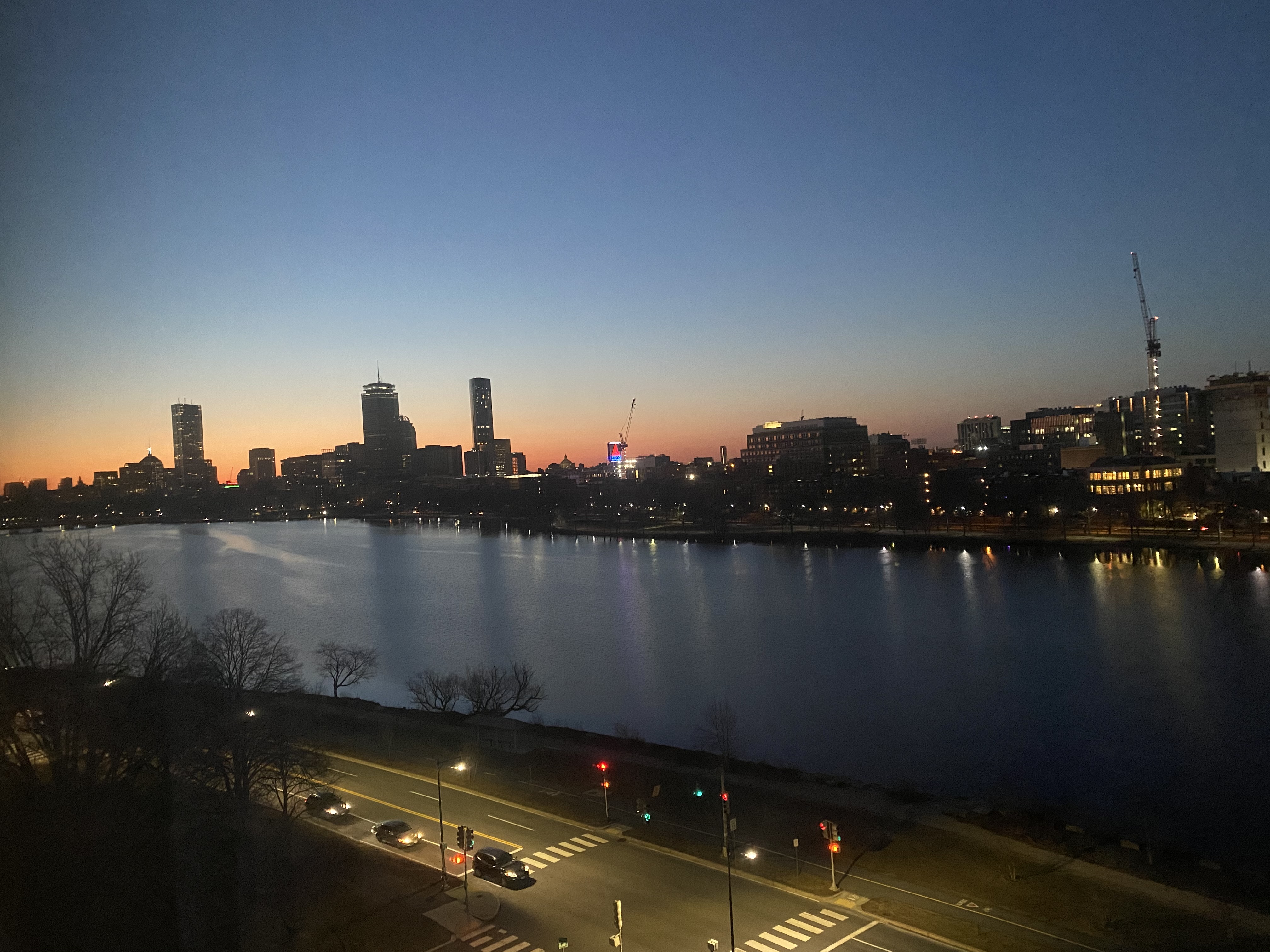
The hotel we decided to stay at is Grand Hyatt Cambridge. It offered dirt cheap rates, about $100 a night and had the bonus of being the first hotel I ever stayed it in Boston nearly 35 years ago. It also has a killah view of the Charles, The Fenway and downtown Boston. And for Rosie a wonderful walking path along the river. We were a little nervous about checking into such a large hotel but the place is almost empty and everyone follows protocols up to including individual elevator rides. That and the fact that everyone made a fuss over Rosie. As she would tell you herself, she is extremely petable.
I have to also add, that I have a huge place in my heart for this city. I have been coming here on business all of my career. I have lived here. I can get around without a map which in Boston is a feat onto itself. I feel at home here. Looking at the window fills me with nostalgia and activates memoires that I had forgotten to have. I share this with Rosie and she looks at me as if to say…Hence the Fenway Rose….to which I reply. “You’re a wicked smart dog.”
In June of 1967 my father, brother and I drove across country in our brand new blue Jeep Wagoneer that we had named Commanche. It would be the first of seven jeeps so named. I was thinking of this as our noble Metalkic Granite Jeep Grand Cherokee braved Noah like rains on our trip northward. I had never named this Jeep, only because the indigenous peoples I would have named it for, the Utes, seemed to big a pun. (I know, what is too big a pun) but considering the mileage I do a year it never seemed necessary. But now in the rain, with two sleeping passengers, I recalled that Steinbeck had named his truck Rocacinte after Don Quixote’s noble steed. What should we name our faithful (hopefully) transportation. Since both my co conspirators on this trip were off in the land of nod I was forced to make the decision by myself. I chose Winnetou after the indigenous leader of Karl May’s western sagas not only because he was smart and wise but because my father loved these books. I would like to think he would have approved of this trip.
The day did not start particularly well. On our way out of Dodge (sorry still in the Western mode, New Jersey) I stopped at the NJ DMV to get a new license with Real ID. I had completely studied the requirements of 6 pt of identification. I placed them deliberately in a manilla folder including a copy of my SS card that I have had at the back of wallets for a 50 years. It was with a sense of confidence that I presented myself to the examiner. Hubris. Stupidity. The lovely document examiner promptly told me that I had not presented to her a SS card. It was a receipt for their card. I questioned that. It was an official document after all. I was wrong she said and needed to come back when I could get an appointment. Maybe June.
The good news. It made me happy to leave NJ.
After suffering 2 hours of rainy superhighway I thought it would be great to enjoy something Super Duper. That is Super Duper Weenies just off 95 in Fairfield. It is a place I have visited many times before and they serve some of the best dogs in America and hands down have the best t-shirts. Besides, as I explained to Rosie, isn’t it funny that we were stopping at a hot dog stand on a Ramble with Rosie. She was not delighted with my humor. You can find their menu here https://superduperweenie.com/ Elaine went for a New Yorker (of course) and I chose a New Englander. She had a shake and I chose a Boylan Red Crème Birch Beer because why not. We split fries. Rosie abstained but watched with interest as we gobbled down the unbelievably good franks and near perfect fries.
You may be wondering why that Winnetou chose to point us in a northern direction. As I said, he was very wise. Going south would have meant running into Spring Breakers and Rosie is too young for bod shots and beer bongs. Going west would have been fun but Winnetou was from Oklahoma and it lacked real interest. However, Elaine had never been to the Cape and I have nothing but fond memories of the place so we decided are first stop would be Hyannis.
Even though the rain was near torrential and constant we managed to make it to Hyannis Port by 4 in the afternoon. I was pleased to see my uncanny sense of direction prevailed as I managed to make it off the mid cape and to the destination without a hiccup. It was much as I had last seen it a decade ago and I was glad for that. It is always nice when a place remains as it is in your memories. I decided that Rosie could use a walk so I we drove to the public beach by the Yacht Club and went for a little jaunt in the pouring rain. Rosie spent most of her time nose down in the sand. Too many new smells including old rope, decaying horse shoe crab, and seaweed but I kept my head up. It was a beach much favored by my dog Yankee and I half expected him to round the bend and come flying down the beach to me. At one point I thought it did happen but that turned out to be rain drops on my glasses.
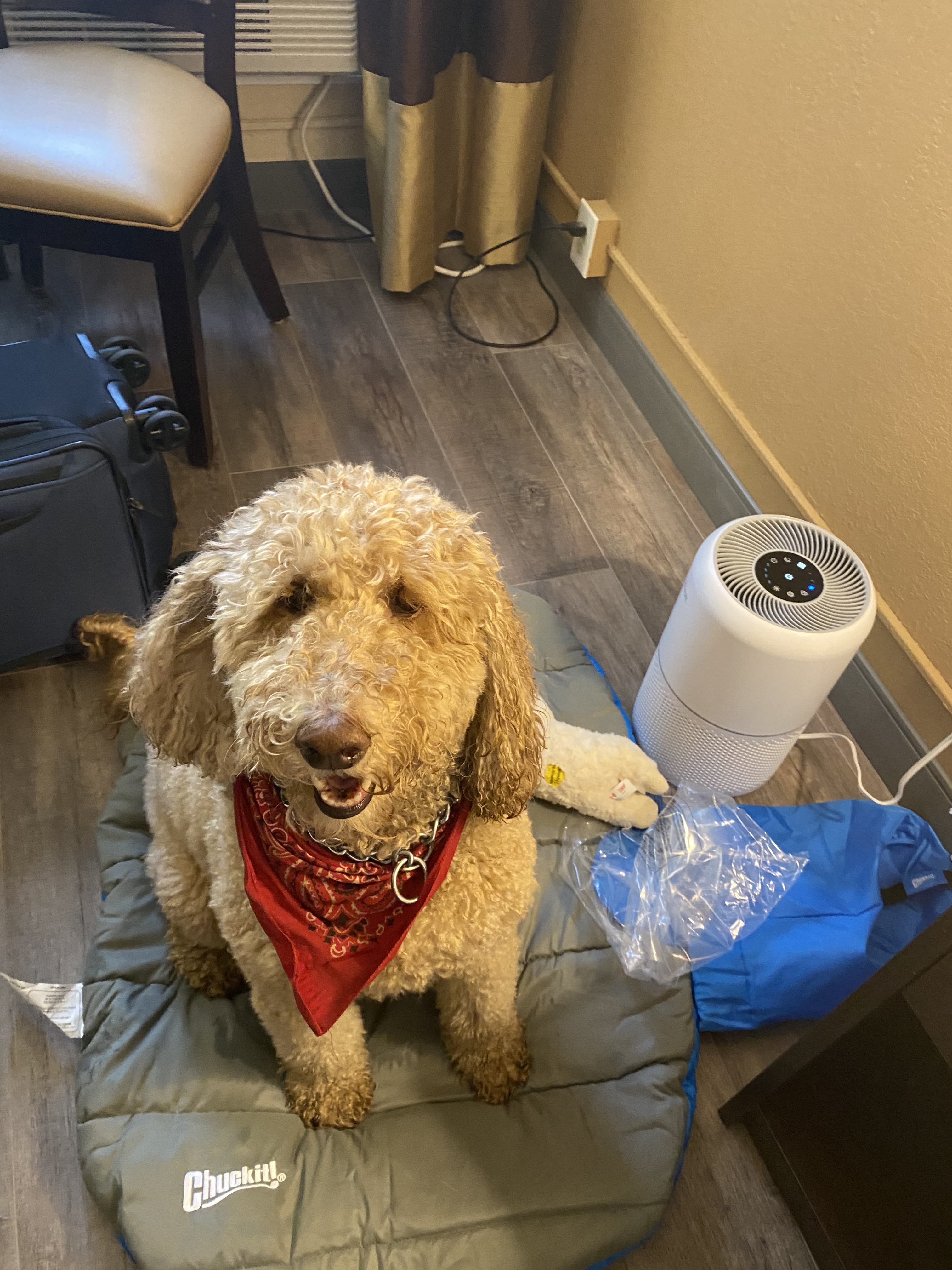
A group decision was made, due to the inclement weather we would cease walking about and head to the hotel. Best Westerns are not Mandarin Orientals but this one allowed puppies so it was just fine for us. It turns out their dog rooms are tiled not carpeted which makes hauling things in from the car with wet feet qualify for hazardous duty pay. And there was a lot to bring inside. In addition to Elaine’s and my rollaboard suitcases, Rosie had a bag full of treats and food. Additionally, she had a travel bed courtesy of my sister and a few other accoutrements to make sure she a mint on her pillow experience. This was after all her first hotel room. Additionally, also coutesey of my sister we had a Levolt portable air filtration system designed to keep us safe from ultra violet light pathogens that were likely lurking everywhere in our room.
When everything had been toted inside I decided that it was a good time to check out the quality and firmness of our King Size bed. I thought that after 7 hours on the road that I probably had earned a visit to napland. Rosie did not think so. Her anxiety was palpable. She kept pacing around the room sniffing and then looking at us like we were going to give her all the answers. Then she did something that she has been trained not to do. Not that. She put her feet on the bed and begged to come aboard. I was more than willing. She could sleep with us every night in Chatham as far as I am concerned but Elaine has deemed our Queen size bed too small for all three of us. Elaine, being suitably moved by her anxiety gave her permission for Rosie to be on the bed.
Which is where she stayed all night. Happily stealing the covers and hogging the bed. But what could I say. It is her ramble.
I don’t know when I first read Travels with Charley, John Steinbeck’s classic book about traveling the backroads of the United States. It was probably High School (thanks Leslie Meskin) but it made a huge impact on me. Some of that was Steinbeck’s prose. It is warm, self-deprecating, charming and funny But it was also teen age angst. I wanted to get out there see the world for myself and the idea of doing in a camper with a canine companion seemed just about perfect.
This summer, after being confined to our home for nearly six months, I was trolling my bookshelves looking for something to read and came across a dog eared (no pun intended) copy of Travels with Charley that had been hiding behind other paperbacks. It was as if I was running into an old friend whom I had not seen in a while. I needed to get reacquainted. Book in hand, I retired to my reading chair and did not get up until I had finished the book four hours later.
It was a thoroughly satisfying experience but what was surprising to me was how much I had not remembered about the book. (It was actually kind of terrifying. What else have I forgotten?) One of the things that had slipped my mind was the reason for the trip. He set out on his journey because he felt that he lost touch with our country. After being the voice of the common joe throughout his career he had spent much the last fifteen years of his life in New York and in the Hamptons. He felt he no longer had a connection to the country that had been his muse.
That resonated with me.
For most of my life I have been a traveling man. I have extremely blessed that business and pleasure have taken me to 48 out of 50 states, 35 countries, and every continent except Antarctica. I have loved almost every moment of those journeys. And it is what I have missed most during our Covid life. Going to the old familiar places where I do not need a map with my rental car and seeing friends who I have managed to collect along the way. Visiting new destinations and making new friends and getting a sense of our country and our world by being a part of it.
It sparked a fantasy.
When Elaine and I were both clear of the virus, we, along with Rosie, would rent an RV and hit the road for a while. Visit friends in far away places. See the sites we have missed along the way such as the statue of Paul Bunyan and his blue Ox babe or Yellowstone park. And perhaps along the way I would keep a blog and let my friends see what was out there now that the blast doors to our Covid shelters were creeping open.
Last Tuesday, I hit the two-week mark after my second dose of the Pfizer vaccine. Elaine cleared the hurdle on the previous Sunday. To celebrate our full immunity. We have decided to hit the road for a while. Probably a week. Maybe a little less. Maybe a little more. We will go where the car takes us, when it wants to take us there. Hopefully, along the way we will meet some people, have a little of fun and get an idea of what America looks like as it emerges from its Covid bubble.
For those of you who are concerned about our well being we appreciate your concern, but we will be following all safety protocols. We are well supplied with masks, wipes, alcohol gel and even an air filtration system to be used in hotels. We will not eat at indoor restaurants but will find alternative ways of sampling the local cuisine.
As always Rosie will be our ambassador to meeting people as she far more charming than me and gives Elaine a run for the money. And as on homage to John Steinbeck we have decided to call this jaunt “Rambles with Rosie.”
At Syracuse I once was a waiter at one of Chancellor Tolley’s receptions in the University Board room and it had been magnificent. Long and wide, with exposed beams and impressive stained-glass windows lining the wall its centerpiece was a 25-foot-long oak table that had been hewn from a single tree. The floors were made of slate tiles and covered with oriental rugs. Paintings from the Hudson Valley School added a sense of romance and mysticism.
This conference had none of that opulence. It was small. Only about 20 x 15. Its ceilings were low, only about 10 ft high. While the walls were made of beautiful, burnished wood paneling they lacked sheen, as if they had not been cared for recently with “shadows” where paintings had once hung. The Persian rugs on the floor were filthy and torn.
But it did have an element that the Chancellor’s conference at Syracuse did not have. A cast iron trunk trussed with bands of metal connected by pad locks and adorned with a metal bas relief of the Hungarian National Seal surrounded by angels. This conference room at the Seventh Army Interrogation center had been its home since Colonel Granville had brought them here along with Pajtas and his troops two months ago. With no keys to open it, the trunk had been under twenty for hour guard since then. such time as they could be opened.
That time had come. In the six days since Colonel’s Skoda murder Granville Cookie, Paul and myself had doggedly pursued the three keys required to open the trunks. It had taken us all over the British and American sectors of Austria, to a hotel in Luxembourg and finally back here to where the trunks were in “protective custody.” I would love to be able to say that it had been a team effort but that would be shading the truth. Granville, Cookie, and Paul all had specific skills that they had developed over time that helped us in our investigation. I on the other hand was a brevet Lieutenant on loan from OCS whose main contribution had been as a sounding board and giving advice on subjects of which I knew little. More than once during the last month I had wondered why they bothered to keep me around at all.
But we were all here now at the invitation of Major Kubala, the commander of SAIC and the man who had given us the mission to find the keys. He felt that because of our hard work we had earned the right to be there. Along with Kubala and our rag tag crew the only other person in the room was a tall Texan, Lt. Worth Andrews. According to Cookie he was Kubala’s right hand man who took care of the Major’s dirty work and had a well-earned reputation as a serious drinker. We were waiting on the arrival of General Alexander Patch, the commanding general of the 7th Army. Kubala had personally invited him to be there. In part to recover from the embarrassment of having told Eisenhower and consequently Truman that the Crown was in American hands only to discover he could not open the trunks. Cookie had also let it be known that Kubala was a real piece of work. The type of commanding officer who looks for every possible way at aggrandizement and to suck up to the brass. Cookie had described him as a “pissant.” I was not exactly sure of the exact definition of that word, but I had spent enough time in Oklahoma and Texas to know it was not a vote of confidence.
Patch, it appeared, was running late. Instead of dismissing us until the General arrived, the Major, in his wisdom, kept us in the small conference room. The silence was pretty deafening with no one making any attempt to break the awkward silence. I was dead on my feet. The last few weeks had been that of constant stress and movement and as much as I wanted to see the object of our quest, The Crown, I wanted to find a bed and sleep for 24 hours more. It was a classic case of the old infantryman’s creed: “When you do not have to run, walk. When you do not have to walk, sit. And when you do not have to sit, sleep.”
The trip to Camp to Marcus W. Orr from Pörtschach am Wörthersee was not far, only 120 miles or so but it was made more arduous but a couple of factors. First, with the end of the war troops and armies were redeploying based on the needs of an occupying army as opposed to a fighting force. We were continuously forced to pull over to allow convoys to pass we and to stop often to show our credentials when entering different areas of occupation. A trip that should have taken only three or four hours took almost 9 hours. But if felt longer. The events of the day before, both the assassination of Colonel Skoda and Dr. Pichler’s accident had made us all retreat into our own thoughts. Mine were particularly dark.
Pichler had gotten to me the day before. Not so much because of what he had done in creating such a despicable weapon or even the murder to which he had gleefully admitted. But, because of my government’s seeming embrace of this man and the weapons he represented. How could the country that had embraced me, given me a new home and supposedly stood for all that was good, right and decent also embrace such evil? While I understood the need logically, you do what you must to win a war, emotionally I could not accept it.
Uncle Anton’s murder also weighed heavily on me. Of course, there was my feeling of guilt for having led him to his destruction, but it was also the coldness of the murder. A man who had served his country well and honorably assassinated by his “brothers’ did not sit well with me. I grew up in the 13th district of Vienna as a Jew during the Nazi regime. I was not an innocent, but murdering a comrade seemed unspeakably cold.
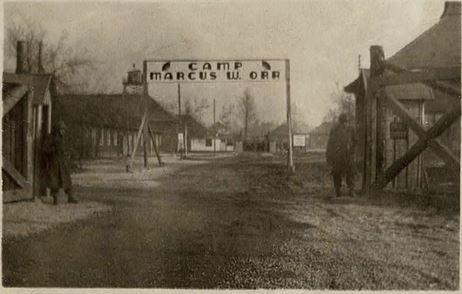
Camp Marcus W. Orr did not look like a place I would want to spend much time. A large compound consisting of a series of quickly constructed wooden barracks with metal roofs within a dirt compound surrounded by barbed wire fences. It had been constructed to house Nazi officials and sympathizers and others with whom the US Army had decided posed a threat but whose ultimate fate had not yet been determined. From the outside, which is far as I got, it looked like rough living. But Pichler looked happy enough to be there. He practically bounded out of the car to be processed. No doubt happy to be out of our command. However, his mood changed considerably when the Officer of the Watch, after consulting a clip board, informed him that he was being placed under arrest for possible crimes against humanity. When “Heinz” appealed first to the officer and then to Granville that he had been promised a job with the US Army he was met with stony glares. He was told that “the situation hadchanged.” Accusations had been placed against him by former inmates at the Gross Rosen Concentration Camp and until those complaints were settled, any arrangements he had with the Army had been suspended. Much to my schadenfreude, two MPs appeared and led him out of the administration hut.
On the walk back to the car, I could not help but express my joy to Granville saying “I hope that the son of a bitch get what he deserves.”
“He won’t.”
“What do you mean. He has been arrested and charged for Crimes against humanity. He as much as admitted his guilt to me. Why won’t he get his own?”
“Face facts. We need him too much. From everything I was told he has unique knowledge in how to make this gas and we need it. We are way behind in that area and the Russians are scooping up every scientist they can. We can’t let them get ahead. But we also could not just let him walk on what he did. There were too many accusations. So we will let him cool his heels here for a little while. Maybe we will put him on trials with other scientists. If he is found guilty, he will serve time in our prison and when he is released, we will put him under contract to help us to develop our nerve gas program. If he is not convicted or doesn’t go to trial, he will be given a contract sooner. No matter what he is likely to be living on easy street long before you and I.”
“But…”
“But it doesn’t seem fair? Well, it isn’t. Life isn’t. Sometimes the SOB wins and there is nothing we can do about it except press on and try to savor the victories we can.”
The next morning found us back at Camp Marcus W. Orr. We were here to have a chat with Enroe Gombas, the former Guard Captain and aide to the now deposed Fascist Prime Minister of Hungary Ferenc Szálasi. We would have seen him the day before when we had dropped off Pichler but the Colonel who was in charge of the Hungarian prisoners, Martin Himler, was not present and no one could interview his charges without his permission. Even though I imagined Himler as a bit of popinjay there was a reason behind his requirement. Orr is where Hungarian War criminals were kept and the allies were actively constructing “crimes against humanity” cases against them. Colonel Himler was inserting himself into any interviews to make sure those prosecutions went as planned.
There was a lot at stake. According to Granville the Allies now had verified reports that over 700,000 Hungarian Jews had been slaughtered in death camps under the Arrow Cross regime. The number of deaths had staggered me. Not because I had underestimated the anti-Semitism of the Hungarians. From what Mama, who was Hungarian by birth, it had always been there. But because of the sheer numbers. It was hard to comprehend a number that large. That was more people who lived in Pittsburgh. Hell, we had states that had less people living in it than that. But that number was also extremely personal. Mama had thirteen brothers and sisters many of whom were still living in Sopron when we had left for the United States. I was especially fond of my Uncle Ede, Mama’s baby brother, whose sons and I used to play together when we would visit with them. What had happened to them? Were they still alive? How would we find each other?
The revelations of the mass murders and the likely deaths of my relatives with the murder of Anton had me as tense as a virgin on her wedding night. Granville picked up on this. On the drive from our hotel in Salzburg to the camp he schooled me on interrogation techniques. How successful interrogation did not mean leaving your emotions at the door but to use them tactically to obtain your objective. He asked, “What is our objective this morning.”
“To find the keys for the trunk.”
“Not to solve Anton Skoda’s murder?”
“No. But if we can find out…”
Cutting me off he said “It is not our job. This guy won’t give a shit about Skoda. He is already facing a death sentence. Pushing him on it will just make him shut up and won’t get us any closer to finding the keys.”
I pressed him and said “Then who speaks for Anton. He signed his own death sentence when he spoke with us. Don’t we have an obligation to find out who murdered him?”
“Are you talking about the person who pulled the trigger? Or the person who ordered him shot? Two different things. We know who ordered him shot. Gombos or one his cohorts. As far as who pulled the trigger, we need to leave that to the Brits. Their town. Their responsibility. Their bailiwick not ours. We can only be responsible for what has been asked of us. Do you understand?”
I did. But I did not. It seemed so unfair to Anton but at the same time I knew Granville was right. We could not right all wrong. But it left me feeling empty. As if they act of moving on from Colonel Skoda’s murder had removed a small part of me. I said “Yes, sir.”
“Good. Because you are going to take the lead in this interrogation.”
“What?”
“I have a history with this guy. He lied to my face once and if I am on the one interrogating him, emotions are going to come into play on both sides. It would not prevent us from getting where we need to go with him, but it would slow us down some. I am hoping that if you take the lead on the questioning, he may open up a little bit more and perhaps even let his guard down and then I can sneak in a sucker punch. And besides” he added with a chuckle “You gotta get your cherry popped one day.” I am not sure what he meant by the last comment, but we spent the remainder of the trip with him briefing me about Colonel Himler.
Himler had immigrated to the United States as a teenager in the early part of the century. He worked as a miner in the coal fields of Pennsylvania and West Virginia until he decided life underground did not suit him and he began peddling in and around the mines. Eventually this led him to create a daily newspaper for the Hungarian miners who made up a large population of these towns. It was a huge success and allowed him to eventually buy his own coal mine and build a town he called Himlerville. When War broke out in Europe, he tried to enlist but was repeatedly turned down because of his age, he was in his 50’s, but eventually the OSS accepted him due to his extensive contacts in Hungary.
When I asked Granville how he knew so much about Himler he chuckled and replied “Anyone who has spent more than ten minutes with him knows that story. He is enormously proud of it and happy to let you know how successful and important he is.”
Colonel Himler met us in his office. Mustachioed and shorter than I expected he had the chin tilt that characterized those who wished they were taller. It was clear from the outset of our conversation that everything that Granville had told me about him was true. Before we had even sat down in our chairs he began telling me his biography. Thankfully, Granville cut him off saying “Cut it out Martin. I already filled in the kid on you.”
Himler seemed a little miffed at not being able to share his story with me but gave a little nod and asked “So what brings here today?”
Granville responded, “We need to have a conversation with Captain Gombos.”
“Why?”
“Do I need to give you a reason?”
“If you want to speak to him you do.”
“Even if I told you it was on a need-to-know basis.”
“Yes.”
That Granville and Himler were well acquainted with each other I knew from our conversation in the car. What I learned from this exchange was that had butted heads in the past and neither one of them much cared for the other. There were a few seconds of silence before Granville answered the question.
“Do you remember when you were in Augsburg a few weeks ago and I showed you the trunk that supposedly held the Crown of St. Stephen and that I had been assigned to find the keys to unlock the case and how I might need your assistance in tracking them down?”
Himler nodded.
“We think that Gombos might have knowledge of where those keys are and want to chat with him about it.”
“Okay.”
“Alone.”
Himler raised an eyebrow and asked with suspicion “Why?”
“Come on Martin. You and I both know that these Hungarian fascists hate your guts. You have arrested them. You have arrested their families. You are going to send them back to face Soviets courts. They just as soon kill you as to talk with you. I need to cajole this SOB and they won’t warm up to me and Floessel with you around.”
You could tell from the expression on Himmler’s face that he was both offended and complimented at the same time. Offended that Granville had the audacity to suggest he was not welcome at an interrogation of his own prisoner but complimented that he held sway over those in his charge. But it did not matter. Granville had played him perfectly because in short order we were sitting in an interrogation room speaking with Enroe Gombas.
You can tell that at once that while he still carried himself with dignity, he was a greatly diminished man. He had to force himself to sit erect in his chair and struggled to give the air of indifference. But defeat was written all over him. His eyes were sunken with heavy bags underneath and darted all about as if an attack could come at any moment. His shoulders were slumped and exuded the weariness of someone who has been knocked down one too many times.
We did not introduce ourselves. Instead, I began by saying “Is your name Enroe Gombos?”
“Yes.”
“Was your father Gyula Gombos, former Prime Minister of Hungary?”
“Yes. What is this about?”
“Just answer the questions please.”
“Were you an aide to the Arrow Cross Prime Minister of Hungary Szálasi?”
“I worked for the people of Hungary.”
“Answer the question yes or no.”
“Yes, but what is this all about.”
“Were you also a Captain of Crown Guard.”
Sighing he replied “Yes.”
I took a second to gain eye contact with him and asked “Did you know a man by the name of Anton Skoda, a former officer of the Crown Guard?”
Gombos answered automatically “I don’t recall knowing anyone by that name.”
I paused and pulled out a pack of Lucky Strikes from my blouse pocket and offered him one which he took with shaky hands. I took one myself and then lit both of our cigarettes. Exhaling a large plume of smoke, I said “I am going to ask you that question again and you are going to answer me honestly this time because I don’t have time to fuck around. Understood?” He nodded and I added “Because if you fuck around when I leave here, I will make sure that Colonel Himler spreads the word about how cooperative you have been and all the vital information you have provided. On the other hand, should you decide to be truthful with us, our conversation will only be between us. Do you understand?”
He nodded and I asked, “Do you know Anton Skoda.”
Fifteen minutes later we left Gombos in the interrogation room with a pack of Lucky’s and no doubt a few regrets. Colonel Himler intercepted us as we were leaving the building. He said “That went quickly. You must have used some very persuasive techniques.” clearly implying that Granville and I had used physical techniques in our conversation with Gombos and further that would not have bothered him if we had.
Granville answered him “No. Not at all” and pointed at me said “ Sam here cracked him like an egg.”
Himler, surprised, replied “Really?”
“Really! And he also gave up this” holding up an ornate iron skeleton key on a leather thong.
The sight of the key clearly annoyed Colonel Himler. No doubt Gombos had been searched any number of times and no key had ever been uncovered. The fact that Granville and I had managed to get in 15 minutes must have humiliated him because he said “I am going to have a serious conversation with the prisoner about keeping things from me.” With that the popinjay gave a sloppy salute and headed towards the interrogation room where we had left Gombos.
“Aren’t you going to stop him?” I asked.
“Why would I?”
“Because we promised Gombos that we would protect him from Himler. He knew that there would be hell to pay for keeping the secret from him.”
“Didn’t you tell me earlier that you wanted payback for the death of Skoda.”
“Yes.”
“So?”
As we made our way to the car, I realized that for the second time today I was being confronted by a moral dilemma. Since I was a little boy Papa had drummed into me that a man only had one thing of a real value and that was his reputation. That if a man gave his word, he needed to keep it. I had promised Gombos that I would protect him. Now I was walking away from him. Breaking my word because of another obligation: making sure Uncle Anton’s death was avenged. The difficulty I was having balancing these things must have shown on my face because as we were getting into the car Granville said “Son, don’t think about these things to much. We have a job to do. That is what you have to keep your eye on. Nothing else matters.”
“I am working on it. But tell me one thing. Why didn’t you mention anything to Himler about the other keys.?”
Granville chuckled. “He didn’t ask.”
That afternoon found the team on the road to Augsburg and SAIC. We were heading there because in addition to it being Granville’s commanding officer we believed there was good shot that the two keys that remained unaccounted for we were there. Gombos had told us that after he had left Colonel Skoda’s home with the keys, he had been ordered to take them to a Father Strasser in a small-town north of Salzburg called Zelhof. He almost made it was stopped by an Army patrol just outside Mattsee. When he could not present any legitimate travel papers, they had become suspicious and was arrested. He had been taken to SAIC for interrogation.
In ironic twist of fate one of the first inmates at the camp he had run into was Colonel Pajtas, the man who had ordered him to retrieve the keys. He told Gombos that it had been decided to do everything possible to keep the Americans from opening the trunk. It was hoped that if they could delay long enough a settlement could be reached whereby the Crown would go to the Vatican where it would be kept until such time as a legitimate government of Hungary (non-communist) could reclaim it. Pajtas then demanded that he turn two of the keys over to him for distribution and allowed him to keep one but to protect it with his life.
By the time we had reached Gombos and interrogated him he had bigger problems that protecting a key. He had been a part of a government that had killed 700,000 Jews and was now facing trial and a possible death sentence for war crimes. Moreover, his family name was on the line. His father had been a luminary, Prime Minister and we could destroy that legacy if he did not cooperate with us. Clearly the calculus of his decision making was that helping us would serve him far better than protecting a single iron key that by itself was worthless. The only part I could not figure out was why he gave up Pajtas. He did not have to. Perhaps it was an attempt to curry more favor from us. Or perhaps he was prosecuting an ancient grudge. In the long run, it did not matter. As Granville had pointed out to me that morning. We have a job to do. And that is what you had to keep your eye on.
The drive to Augsburg from Salzburg was not far. Just about one hundred and fifty miles. However, it was painfully slow going. We were passing from an area controlled by Patton’s Third Army to Patch’s Seventh. Patton was a real pain in the ass with regulations, hell his troops wore ties, so passing from one zone to another required minute inspection of documents, countless clip boards consulted and a few hushed conversations before we were allowed to proceed. Combine that with the roads being in poor conditions made for a long journey. The only saving grace was that it gave Paul, who along with me, was sitting in the back of our staff car while Cookie drove and Granville rode shot gun, time to speak. Something we had not been able to do for a variety of reasons since the murder of Anton Skoda.
I asked “How are you doing.”
He gave me a woeful look and replied “Nit mit sheltn un nit mit lakhn ken men di velt ibermakhn.,” an old Yiddish expression which roughly translates as “Neither crying or laughter will change the world.” While I was surprised that he was using quoting Yiddish wisdom I was not surprised at the sentiment. He had always been a bit of a stoic. It was he who had told me with great admiration the story of the Spartan child and the fox. A boy finds a fox on his way to school and hides it under its tunic. The fox, restless and angry, gnaws at the boy’s flesh just above the heart. The child studied his lessons without a word or cry, though he grew pale and weak until he collapses. When the teacher rushes to him the fox leaps from the boy’s toga and runs away but the boy was dead.
He was telling me that he was hurting over the loss of his Uncle. It was eating at his insides but what could he do but grin and bear it. Life went on. He was also saying that there was no need to talk about it because if I had a lick of brains in my head, I would understand the pain he was feeling and we need not talk of it as it would only embarrass us both. Friends do not need to share a lot of words to understand each other, and even though Paul and I had walked very separate paths over the last seven years the bond of understanding that had been forged between us all those years ago was still as strong as it ever had been.
I asked, “What do you think of all this?”
He knew what I meant. I was not talking about the car ride. I was asking what he thought of this game of intrigue that he and I had become wrapped up in. This adventure that had without question changed the trajectory of both our lives. He got a playful smile on his face and said “My dear Shatterhand, while you are still a greenhorn, I the great and wise Winnetou have been living this life for a long time.”
While I bristled at the idea of being called a “greenhorn”, it being one of the great insults we would hurl at each other as children, I also knew that it was true. While I had been in the United States learning how to become an American he had been here, learning to navigate the tricky waters of survival in a world at war. I replied, aping a quote from Karl May “Hey I know how to put on a knife, so it does not stab me in my thigh when I bend over.”
“Yes, but precious little else.”
“Maybe so but I won’t be a greenhorn for long.” Pointing to Granville I said, “He seems to think I have promise.”
My comment was off the cuff, but it seemed to catch Paul off guard. He scowled and said, “Are you sure that is what you really want?”
Confused I responded, “What do you mean?”
“I mean are you sure you want to get caught up in all this intrigue and spy nonsense?”
Defensive, I replied “You seem to be enjoying it just fine” instantly regretting what I had I stuttered “I mean…I didn’t mean.”
Paul held up his hand “I know what you meant. And, putting Anton’s death aside. I am enjoying myself. But it is what I have been doing for years. I am good at it and I get the pleasure at being good at something.”
Grateful for being let off the hook from my gaff “I said “You always were the cunning one, the master planner, when we were playing our games in Vienna.”
“You occasionally made a contribution.”
“Nah. You were the planner. I was the researcher. And despite how annoying you were I mostly followed your lead.”
He smiled and we sat in silence for a few moments, and I asked him a question that had been nagging at me since Maria Saal. “Paul, I am here because I have my orders. But as they say in Texas ‘You don’t have a dog in this fight.’ Why are you here?”
“Because Granville asked me to be here.” He said with his largest wise ass grin.
“That is not an answer.”
“Perhaps.”
“Seriously, why are you here. What is in this for you besides being in great company.”
“The company is so so. But the answer is still the same. Granville asked.”
“Okay. Why did Granville ask?”
Sighing Paul said, “He wants me to meet some people.”
“Now you are just being an asshole. Why does he want you to meet people? Who does he want you to meet?”
Leaning forward, he lowered his voice to a conspiratorial whisper and said “Don’t be so dense, Sam. I am being recruited.”
“Recruited for what?”
“That I am not sure of but no doubt it has to do with helping them gather intelligence.” I must have looked at him with a blank, confused expression my face because he added “Honestly, Sam it is just like when we were kids and had to explain to you all the obvious things you were missing. Don’t you get it?”
“Get what.”
“That while one war is over another is just beginning. Do you think the United States is going to sit by calmly while the Soviets, the communists, get a grip on Europe? They will not. They know, you should know that where east has always met west is Vienna. Our home city will be where the two powers clash and your boy Granville is recruiting people who can help the US when that clash comes.” Pausing he looked me in the eye and added “And that is why he is grooming you.”
Slapping me in the face would not have surprised me more. I stuttered “What do you mean?”
Paul laughed “You really are misshoganah you know. You asked me, why are you here. I could ask you the same question? Why are you here? Why do they need some greenhorn 2nd Lieutenant here? Do you think they need your expertise in interrogation? Do they need your well refined detective skills in tracking down the keys to open these verkakte trunks? They could easily do everything they need without you.” Always needing to get the last jab in added “Probably better.”
I was more than a little stunned. Paul was right. I had not even considered while I was being dragged along on this journey. It never occurred to me to do so. I just figured that as long as they had dragged my ass to Europe they might as well make good use of it. But really what benefit was I bringing them. Cookie and Granville spoke German as well as I did. So it wasn’t for my language skills. They had far more experience in the Army and intelligence work than I had. I had little to offer once we got Paul on board. So why was I here. Undoubtedly, Paul was right. I was being recruited. And oddly, I did not know how I felt about it. I had always loved spy novels and it was not hard to imagine yourself as the protagonist in a story where there was no consequence to being brave and noble. But in real life when you made a mistake you paid for it with your life like Uncle Anton had or your values got compromised like ours had been with Pichler.
As if he could read my mind Paul said “Can I give you a piece of advice?”
“Always.”
“Don’t do it”
“Don’t do what “
“Don’t get sucked into this world of spying and intrigue only for intrigue sakes. It is not as romantic as you think it is and it doesn’t suit you.”
Indignant, I have never liked being told I could not do something I replied “I think I would make a damn good spy.”
“I didn’t say you wouldn’t. I said I said I did not think you were suited for it. Sam, you think too much. It would wear on you like an engine without oil. Eventually you would just seize up. Besides, you have better options.”
Only a little appeased I asked, “What about you?”
“Sam, this is the life I have led for the past six years. There is no difference. This may not be what I was born to do but it is where I have developed a lot of skills. I could not have lasted as long as I did with Nazi’s without them. Plus, you saw what Vienna is like. It is a wasteland. No jobs. No opportunity. That is not going to change for a while. What else am I going to do?”
I could hear the frustration and sorrow in his voice. This is not the path we had discussed as kids and it was clear from his tone and words that this was not a path that he would have chosen for himself. It made me feel badly for him. No one likes to be trapped. My empathy for him made me ask “What would you do in my situation?”
“I would tell Granville thanks but no thanks. I would do my time in the Army and then I would go back to school. Live that dream we have had since we were in school together. You can still do it. Don’t give it up for this bullshit.”
We rode the rest of the way to Augsburg in silence, each of us lost in thoughts of lost dreams and new realities.
The Schloss Leonstain claims to have a history that begins in the 12th Century. It did not require a vivid imagination to believe that bit of local lore while sitting in its Taverne located directly adjacent to the lobby. It was a dimly lit place with only a single shuttered window located high up the wall directly above the outside entrance. The bar, which was ten feet long, and hand carved out of a dark wood had a patina that suggested centuries not years. The floors were made of wide planks of varnished wood that looked as if countless gallons of beer had spilled on it and was rubbed in by hard soled shoes. Hanging from the center beam of the ceiling was the coat of Arms of the Hotel, the supposed former royal castle of Carinthia: a lion that looked remarkably like the lion of St. George standing on its hind legs above three elliptical domes meant to represent mountains.
No doubt that the lion made it popular with the British troops who occupied the area. I am sure that it seen more than its fair share of pints raised for god and country in the past month or so. However, when I entered it early in the evening on the day Anton Skoda had been murdered, the place was empty. Not even a bartender. That suited me just fine. I needed time to sort through the events of the day and having to engage in conversation with anyone would only be a distraction. As there was no bartender and I was anxious to anesthetize myself I grabbed a bottle of Slivovitz and a glass from behind the bar. If anyone asked, I would tell them I thought it was self-service. I brought them to a table in the darkest corner of the bar and sat down with my back to the wall.
I am not a drinker even though I had spent endless hours stocking the shelves at Uncle Max’s store. Despite belonging to a fraternity when the foundation of Greek life where imbibing was considered sacred. I did not have a taste for it. Perhaps it would come later. But right now, I needed to drink. Which is why I chose Slivovitz. While my experience in Vienna with Paul had produced a massive hangover and I had sworn bitterly at the time never to touch the stuff again, I also remembered that it had tinted the world a lovely rose color and allowed me to forget, at least for the time, all of my worries and anxieties. I needed that now.
I had never seen a dead man before. Or at least I had not seen one that I knew. In Vienna before the war, it had been impossible to avoid death. There had been too many suicides too many displaced, too many beatings. But I had never seen a person I knew let alone a person with whom I just spoken dead.
After the shot, I had held Paul down for as long as I could. He was desperate to get to his Uncle and fought me. But I am bigger than he is and I managed to keep him down until it was obvious that no additional shots would be fired. When I let him go, he sprinted to his Uncle with me on his heels. It was a horrible site. Anton lay face down on the ground with half of his skull blown away exposing bone, blood and brain. Remarkably, at least to me, my friend did not wail or cry out. Instead, he collapsed downward, like a dynamited building ending up with his legs crossed Indian style his face in his hands. He made not a sound but the look of grief on his face was unmistakable and heartbreaking. Especially since I knew that in no small part, Colonel Skoda’s death was on me.
It was all I could think about at that moment. I may not have fired the shot but I certainly had caused his death. Had I not shared Anton’s secret with the draft board, had I not asked Paul to find his Uncle, had we not met with him, there is no doubt that he would be alive a this moment.
What made it worse, is seeing my best friend, my brother in all in blood in such pain. I had brought this agony on him. He would not have exposed Uncle Anton for anyone else. But he had for me. A person who albeit inadvertently was responsible for destroying his life. Now I had taken even more.
I poured myself a shot of the plum brandy and downed it a single mouthful. It was rough and burned all the way down. But I almost instantly felt release from the headache and shoulder tension I had been nursing for hours.
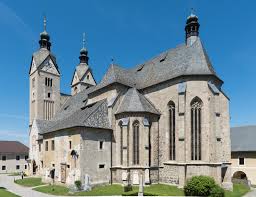
The first authorities to arrive on the scene were British Royal Military Police in their peaked caps white bandolier belts. They had been called by the nuns who maintained the church. The Lieutenant who was in charge of the squad, a man called Bates, was everything you might expect from an English officer: exceedingly polite, determined, and cynical. He of course wanted to know what Paul’s and I were doing in the British zone of occupation and specifically what had brought about our meeting with Colonel Skoda. He didn’t readily believe the store I wove for him which was that Paul, and I were childhood friends who had come here to meet with his Uncle for a reunion of sorts. While it had the merit of being true it did not explain why Anton was wearing a priest’s vestments or why someone had shot him in the head.
When he, politely but quite firmly had asked for more details. I, as equally politely and firmly declined to provide him any. A standoff ensued that resulted in Paul and I being be detained. Not exactly the low profile that Granville was hoping for but it did have the effect of bringing out Paul’s sense of humor. For as long as I had known him, he had found a way, even at the darkest of time to find a way to lighten the situation with a quip, a barb or witticism. He instinctively knew that a laugh would help defuse a situation, apply a little anesthetic to gaping wound or booboo. The murder of his Uncle was not an exception. Lt. Bates had detained us by placing us in the back of the deuce and half that had brought him and his troops to Maria Saal. We were sitting opposite each other on hard wood benches and my friend, looking with a solemn glare and said “Shatterhand, look at the trouble you have gotten me into again. Now we are going to have call in the cavalry or figure out a way to break out of the hoosegow.” This was all done in German, except hoosegow, which has no effective translation in German, but the use of the word at the end of a long German sentence combined with the use of the Karl May nicknames we had called each other during our boyhood adventures made us both laugh. So much so the British MP guarding us turned around and looked at us as if we were a little crazy.
It was at this point, that Cookie and Lt. Granville arrived. There arrival was not exactly a surprise. When one of the real priests of Maria Saal had arrived to investigate the shot that had killed Uncle Anton, I had the presence of mind to ask him if there was a phone, I might use to call my superior officer. He directed me to the rectory where I had the operator connect me the Colonel at Schloss Leonstain. He was brief. Stay with the cover story, say as little as possible and wait for his arrival. Luckily, I saw Cookie and the Colonel before Paul did and said pointing “Look the cavalry has arrived!” This minor witticism produced a serious case of the giggles which was completely inappropriate for the situation but entirely necessary for us to cope with what had happened.
When Granville reached us, we were still trying to recover our equilibrium. “I am glad you two have managed to find the humor in all this” he said shaking his head in mock disgust. “What is the situation.” Before I could answer Lt. Bates arrived on the scene and he whisked Granville off in the hopes of getting a better understanding about what had happened without the benefit of my input. Cookie, who had arrived with the Colonel, gave Paul and I a look that expressed with one shake of his head how pathetic he thought we were and then departed following the two officers.
The arrival of the “calvary” had cured us from our case of the giggles and I looked across at Paul. Elbows on knees, he was staring down at his shoes with a doleful expression on his face. We had not had the opportunity to speak since the murder of his Uncle and I looked at him and asked “How are you doing?”
Looking up with an ironic look on his face he said, “I have had better days.”
Trying to express the growing sense of guilt I had for Colonel Skoda’s death I said “I am sorry for all this.”
He shook his head “Don’t be.”
“But I am responsible for all this…”
“Hugi…Sam. It is not your fault. Uncle Anton knew what he was getting into when he agreed to meet with us. He knew the risks. He chose to accept them. That is on him. Not you.”
“But…”
“No buts about it. He was a soldier always. He chose the risks he wanted to take and took them. You heard him in there. He wanted to do the right thing. And talking to us was, in his mind, the right thing to do. He knew what the consequences could be but he did it anyway. Look at the arrangements he made to meet us. We thought the security was because he was concerned about being taken into custody, but it was not. It was because he feared others within this Crown cabal. That they would not be happy with him talking to the Americans. That whatever secrets they kept would be shared.”
“But…”
“Sam…this is in no way on you. Didn’t you see how he behaved in the church? He knew something was up. The lightening of the candles. The genuflecting. I can tell you that was not Uncle Anton’s normal behavior. He did it for a reason. He knew that what he had done had consequences. He did it anyway and prepared for it. He died with a clear conscience and in a state of grace. He absolved himself and us.” Pausing for a second he added almost wistfully.” And it was over before he knew it was happening. No fear.”
Paul would not tolerate my self-pity. For the second time in as many weeks he had absolved me of my sins. But I needed to say something. This was my friend, my brother in all but blood. I needed to let him know that he was not alone in his grief. I tapped him on his knee and when he looked up, I held his gaze and said “I am sorry then that he is gone. Sorry because I know he was like a father to you and you loved him like a son. I am sorry because he was a good man and treated me kindly when he didn’t not have to. Sorry because even though you say he was a soldier, and he knew what he was doing I am too and I know that his death here and now is my responsibility.” It was not until I said the last sentence that I realized how angry I was about Anton’s death. It was bestial and unnecessary and the people responsible for it were worse than criminals. They had acted out of zealotry and hatred and it is that what we were supposed to be fighting against.
“Paul, I can’t make this right. Not with you. Not with me. But I can promise we will do what the Colonel asked us to do. Will find the Crown. We will do our best to protect it.”
He gave me a halfhearted smile, the kind you give someone who has made a promise that you don’t quite believe that they can keep and said “okay.”
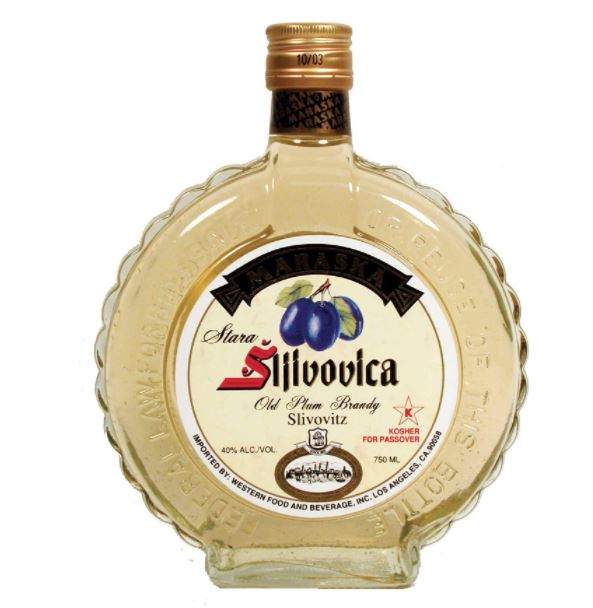
The bar was still empty which was just as well. I had no desire to make conversation with anyone. I had a lot to process. The events of the day had been traumatizing for sure. But it was not just that, but it was how I gotten here what was to come next. This was not the Army life I had imagined. I should be off firing howitzers on some tropical island in the Pacific or directing a barrage at some mountain town in Italy. Instead, I was caught up in intrigue where the battle lines and who the enemy was were not etched in solid black lines. I didn’t have any doubts that what I was doing was valuable but I was not sure whether this way of life was compatible with who I thought I was. My thoughts swirled and the circular bottle of Maraska Slivovitz beckoned me.
When Colonel Granville and Lieutenant Bates returned it was clear that they had come to some understanding. Paul and I were ordered released. Bates asked to speak with Paul about what he wanted to do with his Uncle’s remain. Granville grabbed me and walked back to “Clipper” staff car. Resting against the trunk of the car he offered me a cigarette and when he had lit both of our Lucky’s he said “This certainly went tits up. What the fuck happened. And give me the short version. Save the long version for your after-action report.”
“Colonel Skoda had the keys to the trunks but two weeks ago a Captain Gombos came to see him and demanded he turn over the keys. He did so with great reluctance and later regretted it. It is why he agreed to meet with us even though he knew it would put his life in danger. He thought Gombos and whomever he was involved with were going to use the keys as some type of bargaining tool. He thought that was unworthy of the Crown and he wanted us to protect it.”
Granville took a deep drag and let out a billow of smoke and said “Did he happen to mention Gombos’s first name.”
“I believe it was Enroe.”
“Son of bitch.”
“Sir?”
“We have the son of bitch in custody.”
“That is what Colonel Skoda claimed. He said that Gombos was being detained at Camp Orr.”
“He is. In fact, I interrogated him about the keys before I left. He claimed with the innocence of a choir boy that he had no idea what I was talking about that he was just an innocent soldier who happened to be in Szálasi entourage.”
You could tell that Granville was steaming. Everything about his demeanor screamed it from the tight-lipped expression on his face to the stiffness of his posture. He took another deep drag of his cigarette and then flicked into the grass and said “I am going to roast that bastard. Lets find Cookie and Paul and get out of here.”
Not surprisingly we found Cookie chatting up a few of the Royal Military Police. It had become clear to me that one of the roles he played for the Colonel was to gather the gossip from the troops and noncommissioned officers. His easy-going nature and slow talking southern accent made people feel comfortable around him instantly and they shared secrets with him they would not have shared with others. When he saw the Colonel signaling to him, he managed to disengage from the MP’s with them laughing and patting him on the back.
Paul was harder to find. He had disappeared from view but after a few missteps we managed to track him down in the vestry where he was making arrangements for his Uncle’s burial. As he explained later, this was not simple. Uncle Anton had told Paul years ago that he had wanted to be buried near his parents in Sopron. However, that was not possible now with the Soviets having control of that territory. Instead, he and the priest had agreed to find a suitable spot for his burial locally and then, when they were able to transport him, he would be moved to his final resting place. Then there were the normal considerations of casket and service. Paul wanted everything done immediately. Today. Not because of his adoption of the Jewish faith and its burial customs but because he wanted to come with us to Camp Orr. His uncle had given his life in the hopes that we could protect the Crown and he had a duty to help complete that mission.
I thought that Colonel Granville might object but surprisingly he did not. He told Paul that he thought he could be helpful especially in leveraging his Uncle’s name. I did not realize until much later that there may have been another reason as well.
The bartender appeared at my table looking miffed. I guess that he didn’t appreciate my liberated the Slivovitz. Not that he said anything. My uniform probably prevented that or it could have the US Dollars I handed him. They seemed to shut up peoples complaints fairly quickly. due to the liberated bottle of Slivovitz but my uniform kept him from saying anything. I asked him if they served food at this hour. I had not eaten since breakfast. He scowled and told me that at this hour of the afternoon he could probably put together a Brettljause, the Carinthian version of charcuterie. That sounded perfect and I asked him to bring me one. He agreed and then promptly remained standing in front of my table I got the hint. I slipped him a few more greenbacks and he disappeared as quickly as he appeared.
I was just about to pour myself another shot of Slivovitz when Cookie walked into the bar with Pichler in tow. I cursed under my breath. I really wanted time alone. As an only child, it was the company I kept most often and where I would retreat when having to wade through thorny issues. Today certainly qualified for the latter. That was not the main reason for my curse. One of the earliest lessons the Army had taught me was that no time was private time. The primary reason for my curse was Pichler. From the outset he had been unpleasant. But also had a unique talent for and seemed to revel in getting under my skin. He reminded me of Teodore Kreuz, a kid in Paul’s in my class at school who was unctuous with teachers and condescending with his classmates. If there had been a vote, he would have won hands down for the student most likely to be punched in the face by anyone who met him.
When they arrived at my table Cookie took one look at the bottle of Slivovitz on the table and said with his characteristic twang “Son, that stuff will make you see double and feel single.”
Laughing I said “Would you like to join me?”
“Don’t mind if I do.” He told Pichler to sit and went to the bar and, not finding the barkeep nearby pulled to glasses off an overhead rack. I poured him and the Nazi a shot of the amber liquid. Cookie, well aware of the day I had, silently tipped his glass to me and downed the brandy in a single gulp. Pichler too raised his glass and said “To what are we toasting today?”
Cookie gave him a cold dismissive stare and said “Shut up Ketchup” using the moniker that he had labeled the German Scientist with since nearly the beginning of his custody. It had started out as a bit of a joke. A way to harmlessly have a little fun at our prisoner’s expense. However, when we noticed how much it annoyed him it became a taunt we were more than happy to toss at him whenever we could.
“Son, I am sorry to say but “57” here is your responsibility for the next few hours. The Colonel needs to run some errands for him before we leave tomorrow, and I got no place else to park him.”
As much as I wanted to ask Cookie what these errands were, I knew better than to ask him. He probably would not have told me if we were alone. He certainly would not in front of the Nazi. Instead, I said “One for the road?”
“Don’t mind if I do.” I poured him one keeping my glass empty. Now that “Ketchup” was my responsibility there would be no more drinking. Downing his last shot he said, “Time to pour on the fire and call in the dogs.” I did not know exactly what that meant but I suspected it was a version of goodbye in Kentucky as he left after saying it.
Pichler reached for the bottle of Slivotvitz and said, “May I?”
Figuring an ossified prisoner would be easier to managed that a sober one I replied “Sure. Help yourself.” He poured himself a health shot. Downed it. And then another. At this pace he would soon reach a level of stupor where managing him would no more complicated that letting him hug the commode.
Perhaps the one characteristic that has plagued me my entire life is curiosity. As a child Mama’s constant refrain was “Hugi, kennen Sie denn nicht das Sprichwort: “Neugier ist der Katze Tod”” or “Hugi, have you not heard “Curiosity killed the cat.” In and of itself curiosity is not a bad thing. My inquisitiveness had made me a good student and that in turn had propelled me to college. And perhaps someday it would even lead me to a career as a physician, a scientist or even an academic. I hadn’t decided yet. But sometimes it is better not turn over rocks to see what is underneath. This was probably one of those times. But I was curious why “Ketchup”, as much as he annoyed me, was trying to drink his way into unconsciousness. After all, he had a sweet deal. He was, by the Colonel’s account a dedicated Nazi scientist who had used his skill and knowledge to create chemical weapons that would have condemned millions to an agonizing death had they been used. But instead of being treated as a prisoner of war or even being tried for war crimes he was being offered a contract with the US Government. In all likelihood, he would be in the US, living a good life, before I finished my hitch.
I should have said nothing. But that cat compelled me to do otherwise. I said “Ketchup, you might want to slow your roll a little bit. I don’t want to have to carry you upstairs. Besides, what do you have to drown your sorrows over. You are getting a new life courtesy of Uncle Sam.”
Pichler shot me a contemptuous look and replied “You think that you are giving me a new life. Hah. That is a rich one. The Allies destroyed my old life. Now they think they can replace it by forcing me to work for them. It is not the same. You don’t think I know about having my life destroyed? My wife and my daughter were my whole world. I did whatever I could to give them the life they deserved. Then one day, you Americans come along and drop a bomb on them and they are gone. Obliterated. Not even enough of a body to bury. Sneering, and revealing himself as a nasty drunk added “What do you know? You are nothing but an arrogant little boy playing dress up as officer.”
Perhaps it was the Slivovitz in my belly or perhaps it was seeing my friend’s Uncle murdered that day or the fact that when I lay in bed at night, I still saw images of my sweet grandmother being led away to camp Or maybe it was because his hit too close to the mark on how I felt about myself during moments of self-doubt that but he instantly got under my skin. I replied. “Fuck you Ketchup and the god damn horse you road in on. You declare war on the world because of some made up mythology and divine right and then complain when humanity fights back? I am sorry that your wife and daughter died. I really am. But you are more responsible for their deaths than the pilots who dropped the bomb. You and the rest of your crowd who thought that Germany’s destiny was to rule the world through ethnic purity and the Aryan ideal. Your hands are covered in the blood of your wife and child and millions of others.”
“And you are complaining that you are getting a free pass. A chance for a new life while my aunts, uncles and cousins are ashes. You get to breathe free air while the boys I grew up last memory was choking on Zyclon B.”
I paused for a second. My emotions were getting the better of me and I realized that was just what Pichler wanted. He liked playing with people and he was playing with me now. I took a deep breath and decided that I was not going to play anymore but I could not resist taking a last shot and said “Go ahead and drink up. But both of us know you are not drinking because of what the “terrible Americans” are doing to you. You are drinking to forget what you have done to yourself.”
Pichler picked up the bottle of Slivovitz and poured himself another shot of the amber liquor. Then, his eyes fixed on mine, tossed it down his throat. Then said “Do you know Lieutenant Little Boy what my work is that makes me so valuable to the Americans? Would you like to know what I did during the war that allows me to have a new life?”
I shook my head and said “I couldn’t care less. Our job is to transport you to Camp Marcus W. Orr. That is it. Everything else is above my pay grade.”
He poured himself another few fingers of the Slivovitz and blessed me with a very cold smile. “That is too bad. Because I am going to tell you anyway.”
We were in public and I could not stop him from talking. He began.
“Have you ever chemical gas called Tabun? No? I am not surprised not too many people know about this. In 1936, I had just completed my doctorate in Organic Chemistry and was hired by IG Farben to be an assistant to Dr. Gerhard Schrader. I could not have been more thrilled. Farben was one Germany’s industrial giants and Schrader had a world class reputation. The team I joined had been tasked with the creation. an insecticide that would kill weevils and leaf lice that were destroying crops all over Germany. I was very honored to get this job because Schrader was a word class scientist specializing in insecticides.. Schrader was determined to solve this problem. Not only for the glory of science but he knew that it would come was a large cash prize that he desperately wanted for his family. We work tirelessly for over a year, often incapacitating ourselves through exposure to toxic chemicals. Schrader even had an accident one night coming home from the lab that he said was due to over exposure to the gas. It laid him up for several weeks and the research came to a stop. But eventually we came up with a fumigant that killed all of the weevils and lice 100% of the time. We called it preparation 9/91and we proudly sent it off to an associate of his for independent testing.”
We did not hear back for months and we were beginning to worry that are efforts had all been in vain. Then one day an Army officer came to our laboratory. Apparently, Schrader’s associate had shared a sample with the military, and they had tested it on apes. It killed them in 16 minutes. 16 minutes! We were told that our “brainchild” was now the property of the state, considered top secret and that we should await further instructions. Schrader was horrified that his creation had been used on primates. He never intended to create something that could be used to kill people. I was less aghast. I was an ambitious young chemist and I figured hitching my star to something of great use to the Reich could only help me in the long run.
“A month later Shrader and I were invited to Farben’s headquarters in Berlin to present our research on product 9/91 to the board of directors. They were astonished at our breakthrough and they heaped praise on us. They thought it the most important development in chemical weapons since mustard gas. They were so delighted with it they gave it a new name. Tabun from the English word for taboo. We were told to create one kilogram of Tabun and hand it over to the Army for production.”
“And that was the end of it. Or so I thought. We went back to creating insecticides. The crops still needed to be protected from weevils and leaf lice. We heard nothing about it for years. In the interim I met a woman. We fell in love, got married and eventually had a child. Then one day, Dr. Otto Ambros came to our laboratory. He had been placed in charge of creating a full-scale production facility for Tabun. They needed a scientist to help supervise manufacturing and they wanted Schrader to go. He refused saying he had pressing work on insecticides but nominated me to take his place.”
“I guess I could have refused to go. But why should I? I had no problems helping the Reich in the war effort. What is the difference in the long run if it is an explosion, bullet or gas that kills an enemy as long as they are dead? Right Floessel? Besides I had a wife and a child and needed to secure my future. This was a chance for me to get ahead. I took the job. As I didn’t know how long I would be gone I sent my wife and child to Vienna to live with my mother. I thought they would be safer there.
“The production of Tabun was a huge industrial site in a small town in Lower Silesia called Dyhernfurth. I had been told that it was one of the Reich’s crowning achievement in manufacturing. Along with Farben, Blaupunkt, Siemens, Krupp and Damiler Benz all had operations there. Needless to say, I was full of anticipation to see these marvels of modern industrialization. I imagined sparkling modern facilities with a uniformed work forces working harmoniously for the good of the Reich. That is not what I found.”
“The facilities were brand new and state of the art in their way. They did have the latest machinery and manufacturing mechanisms. But the workforce I had imagined clad in color coded coverall’s that denoted area of expertise happily going off to work each morning for the glory of the Reich that did not exist. My work force wore the pajamas of prisoners. You see what I had not been told is that the manufacturing facility was located at the Gross Rosen Concentration Camp. We had heard rumors that the deported had been putting into camps and forced to work for the Reich but here it was confronting me along with the sign “Arbeit Mach Frei” over the doors of the camp. Instead of the colorful overalls of happy workers going off to work my work force of my fantasy my “employees” consisted of slave laborers wearing uniformed but wearing the tattered pajamas of inmates of Gross Rosen. Their shop supervisors wearing the uniform of the SS. I was surprised by this development only because I had not been told but the more I thought about it I realized how this represented the Nazi ideal of making the most of the resources available to us. We had millions of , Jews, gypsies and other perverts who had no place in society so why not use them to build a stronger Reich.”
“Do I have your attention yet Lieutenant Saugling?”
I said nothing and Pichler continued.
“As it turns out that have slave labor at facility making a deadly gas is quite useful. We could work them as hard as we needed to keep up with production. If a few died because of the work so be it. There were always more to replace them. In a normal manufacturing facility, you would have to build elaborate safety protocols to keep the workers from getting sick. At Gross Rosen, we didn’t bother with those things. It was too expensive to build and cut down on production. And if workers died because of the lack of protocols. Then so be it. There were always more workers.”
“And Floessel they begged to come to work for me. With me at least they could work where it was warm in the Winter and out of the sun in the summer. They would thank me every day. It was wonderful to feel so appreciated.”
“Keeping up with production was paramount. Nothing would stop us. For example, there were areas of our plant where you needed to wear safety suits with a respirator. But when we received a shipment of defective equipment for example if the respirators hoses were too short to connect properly that was fine. We sent the workers in anyway. They died horribly writhing and unable to breathe their bodies twisted in contortion but they survived long enough to do their jobs. We stayed on schedule and they were only Jews so what did it matter.
“One day, after I had been at the facility for about a year the Commandant of the camp, SS-Sturmbannführer Johannes Hassebroek, came to me and asked me to arrange a demonstration of Tabun for him and some of his fellow officers. He told me that they wanted to see with their own eyes what this new “wonder weapon” would do. Needless this required elaborate arrangements. We built a special facility. A large sealed room in which we installed a special ventilation system so that the gas could be introduced to the chamber. The room was equipped with a large viewing port that had on its other side a hermetically sealed room in which Hassebroek and his associates could view the room. But the construction was not our biggest problem. It was how do we get the prisoners inmates into the room with the least amount of agitation. It really wouldn’t do for our demonstration if there were upset.”
“We decided that we would tell the prisoners we were giving them a special meal because we had achieved our production goals for the year. They would be led to the special facility where they would be seated at long tables that had been laid out with loaves of bread, fruit, cheese and other food stuffs. The room would then be sealed and the demonstration would commence.”
“On the day of the demonstration everything went exactly as planned. When the officers had been seated, I gave a short presentation on what to expect. Then the Jewish inmates were led in. We only used Jews for these types of demonstrations as they made up the majority of the prisoners and of course it is what was expected. As expected, they were overwhelmed with the food on the tables and with laughter and joy began to enjoy their feast. It was a young woman who reacted to the Tabun first. She abruptly stood up, first becoming very stiff and then quickly lapsed into convulsions and foaming at the mouth. Other inmates went to help her and of course they too felt the effects of the gas and lapsed into paralysis and convulsions. When the remaining inmates realized what was going on they stormed the door but they could not escape the gas and they too fell victim to Tabun convulsing and gasping for breath.”
“When all the prisoners died do you know what the officers did? They applauded and told me what fine work I had done…”
“It turns out I am rather good at making people die. That is why your Government wants me so much. Because I can teach them how to make people die…”
“What do you think of my story Floessel? Isn’t it a real American success story? Isn’t it grand that you and I will both be in the same Army soon? “
A few hour later I heard a knock at the door to my room. It was Cookie come to take over guard duty on Pichler. I let him in and seeing Pichler, who was sitting in a small chair in the corner of the room said, “What the hell happened to him?”
I responded “Not really sure Cookie. One moment he was telling me a story about his experience in the war and the next moment he was falling up a flight of stairs.”
Cookie cocked an eyebrow and said without thinking “How do you get a black eye from falling on the stairs…Oh…it must have been quite a tumble.”
“Yeah. I don’t think he was expecting it. And the first fall must have really thrown off his sense of balance because every time he got up, he would fall right over.”
I was too stunned to respond. I had thought that once I explained the situation to Colonel Skoda, he would unquestionably give us the keys. I did not think he had an option. The Crown was in its possession and no doubt the greatest army ever assembled could find someone to break into them. It was only respect for the Crown and our strong desire to win the peace along with the war that kept us from doing that. But patience was wearing thin. Perhaps I didn’t explain it correctly. Perhaps if I explained to him what would happen to his precious Crown if he didn’t hand over the keys I could convince him to turn them over.
I was about to set foot down this path when Anton said “Honestly, I would give you the keys if I had them but I don’t.”
“But Pajtas told us you had the keys. He said he gave them to you per his orders.”
“He did not lie to you. He did give me the keys but I don’t have them any longer. They were passed down the line to someone else.”
“I don’t understand.”
“That is a bit of a story. Too long to tell in here. The priests have a room on the other side of the alter where they change into their vestments. Lets go there. We can have a smoke and I can tell you the rest of the story.”
We exited the confessional and walked down a short hallway to a door with a hand carved depiction relief of Christ giving the Sermon on the Mount. We entered and found a small room lit by a stain glass window with several closets full of various vestments and several stamped metal folding chairs that looked very out of place in this ancient church. We pulled three of them together so that Anton faced Paul and me. We sat and pulled out a pack of Lucky’s and offered a cigarette to Anton and Paul. The Colonel took a deep drag off the cigarette and began telling us his story.
“In late March of 1938, just a couple of weeks after the Anschluss, I received a telegram from from Baron Perenyi one of the two permanent Guardians of the crown inviting me to a special meeting on Good Friday, April 7th. Hugi, in case you do not know, The Guardians are given the right of determination of the Crown by the Hungarian constitution. Each is given one of three keys to the “trunks” in which the Crown and its retinue is kept and they swear a secret oath to protect the crown. I knew Perenyi from my time as Captain of the Crown Guard and knew him to be a good man, a real Magyar, and a patriot. He would not ask me to come to Budapest unless he had something serious to discuss and I decided I must go.”
“When I arrived at his home, I was shown into the Baron’s study. In addition to the Baron there were three other people in the room: Baron Radvansky, the other permanent Guardian; Pai Teleki The Prime Minister of Hungary who due to his position in Government a Guardian and Admiral Miklos Horthy, The Crown Regent. I was of course taken back by this. Why would four of the most powerful men in Hungary ask me, a former member of the Guard and now just a glorified clerk in a department store to such a meeting.”
Pereyni got right to the point. He said “Do you remember your oath you took as a member of the guard?” I told him that I did. He asked me to recite it which I did. He then said he asked me to recite it. When I finished, he reminded me that it was a lifetime oath and that the Crown needed my service once again. I told him that I would always live up to my oath to protect the Crown. This seemed to satisfy him and he said “Admiral Horthy has a request of you. I will let him explain.”
“Horthy gave a little speech about how important it was for Hungary always to be free and independent of outside powers. That the German annexation of Austria had threatened that independence. He had high hopes that he would be able to negotiate an alliance with Hitler that would keep Hungary independent. However, any prudent leader needed to make contingency plans. He wanted to make sure that no matter what happened to him or the Nation that the Crown needed to be protected at all costs. Hungary could not be ruled without the crown.”
“As a part of that emergency planning, the Guardians and he had decided to enlist the help of loyal former Captain of the Guard who would, when called upon, help shepherd the Crown to safety. Would I be willing to serve him and the Crown in such capacity?”
“Had we not been in a private setting I would have stood and saluted him but instead I told him I would happily serve in any way that is requested of me. For the next hour or so they outlined the contingency plans they had devised for a variety of different scenarios that could befall the country and the role I would play if such things should take place. Included in that planning were ways in which we could contact each other to activate the plan.”
Anton paused and said “Of course much of this you know already. It is what we discussed that day in the car. It is the reason you’re here Hugi.”
“Sam.”
“Sam?”
“Hugi is who I was before the war. Before I went to the United States. I changed my name when I got there. A new life deserves a new name don’t you think? But I didn’t mean to interrupt. Go on.”
“Returning to Vienna I felt tremendously honored by the trust placed in me by these august men. For months after, I awaited the call that my services were needed but that call never came. Horthy had managed to walk the tight rope and he was welcomed by Hitler in August 1938 and treated as a head of state. His loyalty to Germany was further solidified with the First Vienna Accords where Hungary was granted sovereignty over parts of Slovakia and Ruthania. It made me think that the plans we had made on that Good Friday were what we had hoped them to be: merely a precaution. By the time I talk to you two about in 1939 I was all but convinced that the contingency plans would never be executed. That is why I didn’t think it would do any harm sharing those tales with you.”
“For a long time, things went very well. No one could stand up to the Reich. Not the allies. Not Russia. And Hungary was safe. And despite the trouble young Paul managed to get himself into and the subsequent trouble that got me into, I was living a fairly good life. I had savings and a pension, so I had money. Years before I had bought an old farmhouse not far from here and I spent my time renovating it. There was a widow who lived nearby who would come and visit. I began writing a history of The Crown Guard.
He paused his story and got a faraway look in his eyes as if he were reviewing a mental picture of those times. Sighing he continued. “And then the tide turned. The American’s got into the war. Operation Barbarossa stalled outside of Moscow which led to the disaster at Stalingrad. And of course, D-Day. But none of it much bothered me. I lived in the country far away from the bombing and the war. The world may have been at war but I was at peace. That is until I got a visitor one warm August evening in l944. Just after dusk I was sitting on my porch smoking a cigar and drinking a glass of Tokai when a car came roaring up the driveway and pulls to stop right outside my door.”
“I was a little alarmed. I was not expecting any visitors and I had not forgotten the trouble I had been in with the Gestapo. I was relieved and surprised when Captain Pajtas, wearing mufti, stepped out of the car. He and I had met over the years and I knew he had recently been made the Captain of the Crown Guard so the minute I saw him I knew what had brought him here. As it was a warm night we stayed out on the porch. I brought him a glass of whisky, some pears I had picked that morning from a tree in my yard and some farmer’s cheese. After he had satisfied his hunger and his thirst, he told me what had brought him to me.”
“Hungary was caught between a rock and a hard place. The Red Army was on the move and that it was just a matter of weeks before they reached the Hungarian border. The Germans were exerting more and more pressure on the Horthy to be a more active member of the Reich. They had invaded the country earlier in the year and while Horthy remained nominally in charge the government was now being run by the Arrow Cross or Hungarian Nazi party. This was an anathema to Horthy and a violation of his oath as Regent. When Romania withdrew from the Axis Horthy took this as a signal to be more aggressive. He replaced the prime minister Sztojay and other Nazi favorable ministers with his own people. He also began secret peace talks with the Allies. He had concluded that a peaceful settlement with the Russians, despite be an adamant anticommunist, was a better fate for Hungary than an invasion and the consequent destruction.”
“Pajtas told me that Horthy was under no illusions. If his peace talks with the Soviets were successful and a separate peace achieved the Crown would need to be moved to keep it out of the hands of the communists. If the move failed and the Germans reasserted itself then the Crown would have to be moved to keep it out of their hands because he did not want it to become war booty or worse lost to vagaries of war. To protect the crown, he had initiated a bold plan. He had become friendly with Nicholas Roosevelt, a cousin of the President, when he had been Ambassador to Hungary in the early thirties and had reached out to him through our embassy in Switzerland. Using that back channel, it had been arranged, should the need arise for the Crown to be moved, it would be placed into the hands of the advancing American Army.”
“I was stunned. Placing the Crown in the protective custody of any foreign government at best could be called daring. At worst reckless. Couldn’t the crown be buried or hidden as had been so many times in the past when it had been threatened? I questioned Pajtas about this. He said that the plan had been discussed with the “Guardians” and that while the debate had been heated with some objecting strenuously it had been agreed that this was the course of action the largest chance of success.”
“He then went on to tell me what had brought him to my front porch. The Guardians and the Regent wanted to know if it should come that the Crown needed to be moved would I agree to be its escort?”
“I told him that I vowed to do so and would live up to my vow. He then proceeded to outline the plan. When the word came, I would meet the Crown when it passed into Austria using the Semmerling Pass. From there it would be my job to guide the Crown and the troops guarding it from there to a Monastery in Attersee. We discussed the best ways to do this for a little while and agreed on a plan including how the Crown Guard would get word to me when they were on the move. Then he left as quickly as he came.”
“You know what happened next. In October, the Germans, hearing of Horthy’s plot, kidnapped his son and forced him to appoint a new Fascist government. Recognizing that this was the beginning of the end of Hungary, the Guardians decided to put the plan in action. In early November The Crown in its protected iron trunks left Budapest with a contingent of Crown Guard under the command of now Colonel Pajtas. Over the next few months, The Crown and its entourage made their way west stopping at a variety of different way stations only moving on when it was safe to do so.
“I had spent the months since my visit from Pajtas reconnoitering the roads that led from Semmering to Salzburg. I had a suspicion that by the time the Crown made its way to Austria that the German forces would be in retreat. It meant that the major roads would be full of Wehrmacht troops and transports in a bad temper and with prying eyes. Things we needed to avoid if wanted to get the Crown to Attersee undetected. This was particularly time consuming because I could only cover a small portion of roads at a time to avoid suspicion. But eventually I was able to map a route and several alternatives that would allow us to make the journey quickly and with the least chance of being detected or stopped.”
“I was waiting for the Crown and its entourage on March 27th. I remember the day because it was two days after my sister’s birthday. As I had suspected the main road was jammed with ill-tempered and battered retreating German troops. Even though the weather was lousy we diverted off the main road per my plan. This slowed our progress considerably as these secondary roads were muddy and rutted. But I hadn’t planned to go far. Only to Murzsteg where I had found an abbey to give us shelter for the night.
So it went for the next week. We would travel the back roads of Austria during the day and stop in Abbeys, Convents at night. We went to Seeberg and turned north to Marizell. Once we cleared Linz we found that the main roads were cleared as the Germans were fearful of a Russian attack from the north so we made quick time of it arriving in Attersee on Easter Monday April 2nd. Our final move, to Matsee NNN was on April 7th, where the Crown Guard and its precious cargo had been told to wait for the advancing American troops.
That night there was a small celebration among the troops and officers of the Crown Guard. After nearly six months of being constantly on the move, constantly in danger, they had reached their destination. Somehow, they had managed to purchase or requisition a pig which they roasted whole and with the aid of some local beer and schnapps and proceeded to blow off some steam. Colonel Pajtas and I enjoyed the revelry as well but both of us refrained from drinking except for a few toasts made to the Crown. As the evening degenerated into the singing of Hungarian folk songs, Pajtas pulled me aside and asked to speak with me privately.
“He led me to the priest study and told me that the plans had changed. The Guardians and Horthy had agreed that while they were going to turn over the trunks with the Crown and its retinue over to the American Army that they would not turn over the keys. They believed that they could convince the Americans that breaking into the trunk was a violation of Hungarian Sovereignty. They hoped would not break into the trunks. Instead, they would search for the keys. The thought was that the delay would give the Catholic Church enough time to negotiate with the Americans for the custody of the Crown and in that way it would not become a lever of power or war bounty.”
“While I didn’t agree with the deception. I have always believed the best policy is say as you do, do as you say, I understood it. Which is why when he handed me the keys to the trunks, heavy and ancient, and asked if I would keep them safe, I agreed to do it. He then provided me with a code phrase. He said that if someone came to me and provided the code phrase that I was to do what was requested of me. Again, even though I thought this a little too much intrigue I agreed.”
“The next day I returned home. This took nearly a week as I was going against the grain of troops fleeing the Eastern Front and feared having my little Skoda seized by the retreating Army. When I finally reached my little farmhouse on April 13th I was exhausted from the nearly three weeks of constant threat and looking over one’s shoulder. But despite my exhaustion the first thing that I did was hide the keys. I had been thinking about where to do this for the three days and found what I considered a secure place. A location even a dedicated searcher would be reluctant to investigate. Underneath the seat in my outhouse. This required a little bit of carpentry and some malodorous work but when it was done, I felt as if a burden had been lifted from my shoulders.”
“That night, I build a fire and settled into my favorite chair with a glass of Peach Palinka and turned on the shortwave in the hopes of listening to some soothing Mozart Lizst or even Bartok. Instead, I got the BBC broadcasting news of President Roosevelt’s death and in honor to him that they played dirges. It reminded me too much of the death and destruction the war had caused. And for what. What really had been accomplished? Nothing! I found it far too depressing. I went to bed and slept for twelve hours.
“Over the course of the next few weeks I resumed my normal life. I built a new chicken coop so that I could have fresh eggs. I repaired my front porch where a number of the floorboards had rotted. I had the occasional dinner with the widow who lived down the road. And with my return to normalcy the trip with the Crown faded. Then one evening in early May I heard a car pull up to the house. Concerned by an uninvited desk so late at night I pulled my Walther P-38 from a drawer and went to the door. Cautiously, I pulled it open revealing unshaved man wearing a dark Homborg Hat and a suit that looked as if it had been slept in for a few days. He bade forgiveness for disturbing me so late, but he had been sent by Colonel Pajtas with a message and with that provided me with the code phrase.
Over the course of the next hour, and a meal of salami, cheese, and peasant bread he introduced himself as Captain Enroe Gombos. He was the son of the former Hungarian Prime Minister Gyula Gombos and now was an aide to the Ferenc Szálasi, the Arrow Cross Prime Minister of Hungary. Szálasi and his cabinet had fled in front of the advancing Soviet armies and like the Crown had hunkered down in Mattsee safely out of reach of the advancing Allies. Before surrendering to the American Army, they held a final cabinet meeting whose chief topic was the Crown. It was agreed that the keeping the keys with a single person would it make it too easy for the Crown to be compromised. He provided no explanation as to why this decision was made, although I got the impression they were to be used as a bargaining chip with the Allies. I have no doubt they realized that the Arrow Cross Government would be arrested in mass and they needed to dowl out information to exact leniency. It was Gombos’s assignment to take the keys and distribute to trusted allies of Szálasi and loyal Magyar.
“I felt as if I was caught between a rock in a hard place. On one hand, the demand for the keys was coming from the son of one of Hungary’s true patriots and from what had been the government of Hungary, it had not come from one of the Guardians or Horthy. But there were things I did not know and Gombos did have the code words that the current commander of the Crown Guard had given me. Did I have any right to refuse the order? In the end, I had I felt I had no alternative but to turn over the keys.
“The next morning, May 8th, I turned the keys over to Gombos. Before he drove away he thanked me for being a loyal servant of the Crown and reminded me of my oath and warning me that revealing any part of our conversation or what happened to the keys would result in undesirable consequences. Of course, later that day the Germans surrendered to the allies and I have worried ever since whether my decision to turn the keys over to Gombos was the right one.”
“Which is why I am talking to you Sam. I have come to regret my decision to give the keys to Gombos. While he had the code words that were given to me by Pajtas I have no idea how they were obtained but more importantly I concluded that the Crown is not a bargaining chip. It should not be used for one’s personal gain or to secure a person’s freedom it is bigger than that. It is Hungary. That my duty was to protect it and I have come to believe that the only entity able to do that right now are not desperate officers of defeated regimes. It is only something that the American Government can do.”
“After consulting with some old friends, former member of the guard and others I had reached the decision to approach the American Army and discuss what I had known. And I would have had you two not come along. Telling you allows me to relieve my conscience while not exposing me to the wrath of my fellow countrymen who will no doubt consider my act of conscience as an act of treason.”
There was a silence after Colonel Skoda finished his story. Part of my silence had to do with the fact that I had been flown halfway around the world to find this man and obtain the keys of the crown. The army had dedicated time and resources to find him. I had left OCS and engaged in espionage and deception to find him only to come up with nothing. What was I going to tell Granville?”
The other element that was causing paralysis of the tongue was trying to take in the scope of his story. It spanned from a length time that encompassed my entire journey to the United States and return to Vienna. Put another way, it covered a 1/3 of my life, the time it took a poor immigrant boy to become an officer in the Army. But it was also a remarkable story of devotion to an ideal that is bigger than oneself. I know that I felt the same dedication to my adopted country. I had sworn to “I will support and defend the Constitution of the United States against all enemies, foreign and domestic; that I will bear true faith and allegiance to the same.” But that had been for an ideal a concept. Skoda’s dedication was to an object in an addition to an ideal. And it had placed him in an impossible situation of having to interpret what was right for it, regardless of what he believed his orders to be.
I asked “How do you make a decision like that? How do you make decision between the orders your receive and what is the right thing to do?”
He shared a benevolent smile with me. One that might be exchanged between a senior officer and a junior officer that he was trying to instruct. “Sam, that is an unanswerable question. Sometimes to uphold your oath you have to break another. In the end, you can only try to do what you believe is right and hope that you have made the right decision.”
“Is that what you have done now? With this decision about the Crown?”
“Yes.”
“And how do you feel about telling us. Don’t you fear retribution in some way.”
Again, the benevolent smile. “No. I will let the future take care of itself. I made my decision to the best of my ability as I have made all the decisions in my life. I was chosen to protect the Crown based on my ability to make the correct judgment. Others can judge me any way they want. I cannot stop them but whatever the consequences I am comfortable that I made the right decision. “
I nodded in an understanding I did not truly have. He then added “But you have not asked an important question.”
“What’s that?”
“Where is Gombos.”
“I assumed that you didn’t know.”
He wagged a finger “Officers don’t assume.”
“Do you know where Gombos is? “
“I do. According to my sources shortly after he left my home an advance party of the American Third Army captured him. Why they detained him I don’t know but they eventually find out his identity and put him a detention center outside Salzburg called Camp Macus W. Orr.”
Paul and I exchanged a glance and then a small chortle. Col. Skoda looked confused not understanding why this would even be remotely funny to us. I explained “Uncle Anton, forgive our laughing but you see our next stop was going to Camp Orr. It is where the army is holding prisoners, they don’t know exactly what to do with and we have a person in our custody whom is going to be detained there.”
The Colonel’s face lit and he too let loose a small laugh. “Then I suppose it is destiny.”
“I suppose it is.”
Colonel Skoda rose and looking at his watch said “Boys, I am running late. I need to leave. Walk me outside. We walked out of the church the same way we came, Uncle Anton again genuflecting before he walked down the central aisle. Just before we left the church he excused himself and walked over to bank of votive candles that were nearby. There, after put a few coins in a wooden box, he used a taper to light a candle and then bowed his head in prayer.
Outside the sun was still very bright made more so by the dimness of the church. I put on my sunglasses and then offering my hand said “Thank you Sir. I appreciate you taking the time to meet with us. Perhaps the next time it will be under easier circumstances.”
“It was good to see you Hugi…Sam. You have come a very long way from the boy in short pants who brought his mother’s ties to Winters. Serve your Army well and with honor.”
“I will sir.”
He turned to Paul and wagging his finger “And you my favorite troublemaker, try to stay out of trouble.”
“I’ll do my best.”
“Be good to your mother and give her my love. Tell her that I hope to be able to come back to Vienna before too long. “
With that they hugged and we parted company. Paul and I headed back to the road which we had used to come the church and Colonel Skoda walking towards the Vestry. We had gone maybe a hundred meters when we heard the snap of a rife shot. Training took over and I yelled to Paul “Get down. Get down!” and tackled him.
When after thirty seconds we heard no other shots, we raised our heads. There only a few yards from the Vestry’s door lay the body of Colonel Skoda his biretta laying face up on the ground next to him.
The Cathedral of Maria Saal is located about 12 miles east of Portschach am Worthersee in a market town of the same name. According to the clerk at our hotel while not the seat of the bishop, it was the center of Christianity in Carinthia as a church has been on that location for the past 1200 years. For centuries it was the Cathedral that the local nobles went to obtain their ecclesiastical blessings. Perhaps it was that connection between faith and rulers that made Uncle Anton had choose it for our meetings. But there were strategic reasons as well.
First, the town of Maria Saal is a market town with many roads leading in and out of it. Anton did not trust us. That is he trusted Paul but not the US Army. That was made clear from the note that he had sent to Paul at our hotel. It said that he knew why we were here and that he would meet with us but we must come alone. If he saw we were not by ourselves or followed all bets were off and he would disappear. This did not please Granville. I was learning that he was the type that liked to command every step of an operation. He wanted to be at point and lead. Not having this control made him profoundly nervous. But in this matter, he had no choice and he agreed to let Paul and I go alone. However, in the lead up to our visit to the church he peppered us with instructions on what to do in certain situations, what to be on the lookout for and how to tell if we were being played for chumps.
It annoyed Paul. He had led an underground life for the past six years, living by his wits and surviving only because in most cases his instincts had been correct. He did not need to be lectured on the subject of stealth and intrigue by anyone let alone a US Army colonel who did not know the territory. And of course, Anton was his Uncle and had been the architect of his original salvation. A man who held a singular place in his and whom he revered. Granville was, by implication, suggesting that Anton was not to be trusted, and that insulted Paul. More than once in the two days leading up to this “operation” I had to talk him down from his anger with Granville by letting him know that while Granvilles instructions may be old hat for him it was helpful to me and reminding him that the Colonel did not known Anton and had no reason to trust him.
It was Granville that suggested the second reason why Anton had chosen to meet at the Cathedral. He explained, a little pedantically, that it was the law of sanctuary. That since ancient times, churches had served as a place for refuge for those being sought by the authorities. The word sanctuary original meaning of “sacred place” had over time developed another meaning: A place of safety. While there were no laws that prevented anyone from entering a church or any place of sanctuary and removing the person being sought it was only done in the most extreme circumstances due to blow back from religious authorities and local population. This would apply doubly the Cathedral of Maria Saal with its history and importance to the region. Anton would feel free to meet here without the fear of being taken into custody by us.
Trying to sound smart after this lecture from Granville I said, “Do you think that the fact the Crown of St. Stephan and its retinue are reliquary of the Catholic Church helped shape his decision.”
He turned to me and gave me a look that a teacher reserves for the dullest of its students and simply said “No.”
It was embarrassing and I decided that in the future I would keep my thoughts to myself. But Paul who had enough of Granville’s lecture at that point said “Well it could be. Especially if the “Holy Right” is locked up in one of those cases.”
“The “Holy Right?” I asked.
“Yes. The right mummified right hand of St. Stephen.” I must have given him a blank look so he continued “When Stephen was named a Saint by the Church his body was exhumed so it could be moved to a more exalted place. When they opened his coffin, it was discovered that his right hand, the Holy Dexter, was perfectly preserved. Supposedly, this discovery caused healing miracles all over Budapest and ever since then it has been considered a holy relic. It even has its own crystal casket and cult like following and is paraded around Budapest every St. Stephen’s day.”
I have never understood the Catholic churches obsessions with bones and body parts. We don’t do that in the Jewish faith. We put people in the ground as quickly as possible and most certainly avoid praying to anything other than the almighty himself. These reliquaries seem far too similar to idol worship for the Rabbi’s. Also, Paul used to delight in making up stories that would make me cringe. I said “You are making this up?”
“No. Absolutely true. For the better part of the last millennia Hungarians have held a severed right hand of an old king sacred.” And with a little too much glee he added “I hear its green and still has the pearl bracelet on it that Stephen was buried in . Right Colonel?”
Looking a little exasperated that the conversation had taken this turn he replied. “Yes. The Holy Dexter is one of the things we believe are in the iron trunks that were delivered to us. But we don’t know. And I certainly don’t know whether it is green or not. Lets get back to the subject at hand.”
“Good one Colonel.”
This earned me another glare and instead of commenting on his inadvertent bad joke he continued on with the third reason that he believed Anton had chosen the Cathedral. He explained that according to the British Army officer he had spoken to about the Cathedral, the place was a fortress. The designers of the church had intended it to be a house of god but they also meant it to be a “keep” where the townspeople could flee to in case of impending invasion. As such, a relatively small group of men could hold out against a much larger force for an indefinite period time. This suited Anton’s purpose because it meant that he and the men he was with would have a strategic advantage should we decided to break our word.
This advantage is also the reason Anton chose the time for the meeting: High noon. I joked with Paul that it felt like a scene out of a Karl May novel where Old Shatterhand and Winnatou were going to face danger. But in addition to appealing to my boyhood imagination the reason behind the time requested by him for the meeting helped ensure his safety. He, and whomever was coming with him, would find a way to slip into the Cathedral under the cover of darkness and have time to surveil all approaches for hours before the meeting took place.
What I did not understand was why he felt the need for the secrecy and security he had arranged. It was not something that I wanted to bring up with the Colonel. For him, and the type of work that he had been involved with during the war, this must have seemed perfectly natural. However, for me, who had been a college student less than a year ago it was a bit baffling. I resolved to talk to Paul about it. Not only did he have the practical experience stemming from the time he lived underground but no one knew Uncle Anton better than he did.
Unfortunately, my duties guarding Pichler and the constant presence of the Colonel or Cookie had made private conversations impossible. It was not until we were walking up the small hill from the town of Maria Saal to the Cathedral (another one of Uncle Anton’s security concerns) that I got a chance to question him about the need for so much security.
It was a beautiful late spring day for a walk. Deep blue skies that you only get in the mountains with only a few puffy clouds and temperatures with temperatures warm enough that I had taken off my jacket and carried draped over my arms. The winding road that led up to the Cathedral had once been paved but now was more pothole than road. It made for slow going as for every step up we had to take two to avoid stepping into one of the craters in the road. But t did give me time to ask my friend the questions I wanted to ask.
“Paul, I understand that your Uncle likes to be cautious, but don’t you think that he is taking his precautions too far. I mean it just seems so elaborate.”
“Not at all.”
“How come? I honestly do not get it. This is just a meeting to see if he knows anything about the keys to the Crown’s trunk.. It is not like there are any big secrets that are going to change the outcome of the war are going to be exchanged.”
“You don’t get it.”
“Get what?”
“What the Crown really means to Hungary and Hungarians. Or what it means to the future of Europe or why the American’s are even bothering looking for it.”
Feeling a little insulted, I said “I knew it was important enough that I thought it might get me a six-month deferment. I understand that it is important enough to us to drag me halfway across the world during war time to help us find it. The Crown represents Hungarians sovereignty, and we want it because we feel it will help us settle the peace.”
“All that is well and good, but that is all intellectual. The Crown is not about intellect. It can’t be. It is about emotion. What you said was the Crown represents Hungarians sovereignty. And that is right but it does not go far enough. The Crown is Hungary. It was given to St. Stephen by Pope Sylvester II because he had a dream in which God Almighty told him to give it to King Stephen. It is literally a gift from God to the Hungarian people. It is Hungarian’s Ark of the Covenant. Without it there is no Hungary.”
I smirked and said “When did you get so smart?”
“I always have been. You just have not noticed.”
“Okay I get how important it is to Hungary, but I still don’t understand why Anton has set up all of this security.”
“So you understand that the Crown is Hungary?”
“Sure. Okay.”
“Well, Uncle Anton was a commander of the Crown Guard. He swore an oath to protect and defend the crown. When I was a little kid, after my father disappeared, he was the only father figure I had. He would come and visit wearing his grand uniform and telling me tall tales of his life in the guard. I absolutely idolized him. I told him I wanted to be just like him. A member of the Guard. Remember I was about six or seven at the time and easily impressed. So when I would tell him this he would say well you can’t be a guard until you take the oath. We would say it together. I still remember it.
“I solemnly swear that I shall protect the Holy Crown incorporating the continuity of constitutional statehood of Hungary in all circumstances, against every danger, and I shall persevere in guarding it, and prevent it from getting into unauthorized hands, even at the cost of my life”, as the oath goes. “In order to meet the strict requirements of the special service, I shall strive to keep my best mental and physical condition and lead an irreproachable life. Guided by the spirit of camaraderie of the HDF Crown Guard, I shall live and die, fighting as a true warrior, in an exemplary way, at all times with honor, as worthy of a Hungarian soldier. So help me God!”
“In other words, he was just living up to his oath.”
“Yes.”
“But why is he protecting it from us. We already have it and we don’t really want as much as to protect it.”
“You are going to have ask Uncle Anton about that. But I am fairly sure there is something else at play as well.”
“What’s that.”
“Pichler.”
“I don’t get it. What does that son of a bitch have to do with it?”
“Remember what Granville said about Pichler. That you Americans were looking the other way about his past because you had another war to fight. He said it was about the Japanese and the Russians. But it is not really about the Japanese. Coming out of this war there are only two powers in the world the Soviets and the USA and they are going to try to dominate the world. And a part of the front line of that war is likely to be Hungary.”
“Okay.”
“Remember Admiral Horthy and his government allied with the Germans not only because they had little choice. They clearly did not want to get invaded by the Germans and lose control of the government. But they also had…have… a pathological fear of communism. I don’t know this for sure, but I am pretty confident the Crown was moved out of Budapest because it was clear that was only a matter of time before the city was going to fall to the Soviets. It was a risk to move it. No doubt the Germans were not pleased. And the Crown could have been lost to opportunists or worse. But anything would have been better than it is falling into the hands of the Reds. Anything.”
“All of this precaution is because of the Russians.”
“Maybe. I am fairly sure the reason they were paying so much attention to me in Vienna is because of Anton. They know who Anton is and they are looking for him. Your friend Major Kudarinsky was clear about it. And when I would provide him an answer, or better said could not and didn’t want to give him answer, he did what he could to make my miserable in the hopes that solutions to my troubles would lead back to Anton.”
“How come you didn’t mention it before?”
“You did not ask.”
I was going to argue with him about that but at that point we turned the last curve in the road and got our first full view of the Cathedral. It was a massive gothic structure with an onion dome clock tower and a matching bell tower on either side of the transept. Atop the narthex there was another dome but that end of the cathedral was defined by thin vertical stain glass windows that added to the soaring nature of the structure. All of this was laid out in a peaceful well manicured lawn that seem to defy the fact that a conflict that had laid waste to most of Europe had just concluded.
As we followed the cobblestone road up to the church Paul said “It is no Stephansdom” referring to the mother church of Vienna.
“True. But at least it still has a roof.” We laughed. More out of nerves than wit.
Our message from Colonel Skoda had told us to meet him outside the Cathedral by a frieze of a carriage being pulled by two horses. It was not evident from our approach, so we began to circle the structure. We found it on the far side of the church almost directly opposite of our approach. It did not appear to me that it was originally designed to be a part of its church. It looked as if it had been borrowed from an older structure and the architects had decided to add it to the edifice for a reason that were not immediately obvious to me. What was clear is that it was a powerful image that was not easily decipherable, and which made both Paul and I lean in to examine it closely. Which is why we were both startled when we heard behind us “It is called the Carriage to Kingdom Come. It depicts a soul being carried to the other world. It was done in Roman times and I think the designers thought it powerful enough to include in the outside of the church. What do you think?”
I turned to see an older priest, standing ramrod straight, wearing a black cassock and biretta with white silver hair underneath.. I was about to ask him a question when Paul exclaimed “Uncle Anton!” As I watched the two embrace each other, I could not help but think of the irony of the situation. Little old, insignificant me was dragged out of OCS and flown a 1/3 of the way around the world like a VIP, in a time of war brought to Europe on the off chance I could identify this man now standing before me. Looking at him now, I realized what folly that was as the Uncle Anton I recalled bore no resemblance to this man. And it was not the priest’s garb that threw me. It was other things. For example, his height. He was much shorter than I remembered. Obviously, some of this had to do with the fact that I had grown almost nearly a foot since I had left Austria. I remembered him as being a tall man and now he was just average.
Also, despite his military posture, he looked much older than I recalled. Where there had been a twinkle, a glint of joy, in his eye when I knew him in Vienna, it had been replaced by a wariness that bordered on weary. The countenance of man who had seen more than he wanted to see and pushed on despite all the forces that tried to bring him to a halt.
But what was the kicker was his lack of a moustache. My most vivid recollection of him was his magnificent imperial moustache. It had reminded me of the photographs my mother had shown me of her brother Rudolph. He had been a calvary officer in the first world war and had sported one a magnificent mustache as well Even though that style of facial hair had been out of style for decades, it had fit Colonel Skoda perfectly. It was if they had both sprung from a different time where nobility and honor meant a little more than they do now. Perhaps that was the reason he had shaved.
After Uncle Anton had finished embracing his nephew he turned to me and said to me with only a hint of irony “Hugi, I don’t think I would have recognized if I had stumbled on you along the street. You seem to have grown a little” and adding with a chuckle “And, you are no longer wearing short pants.”
“Well sir they fed me pretty well in the United States and I think only the British Military issues short pants to its soldiers.”
“Just so Hugi. Just so. It is good to see you have made a good life for yourself. An officer and everything. Perhaps now I need to salute you?”
“Never sir. I still in debt to you for the fifty deutschmarks you made Winter’s pay me. Without it, I don’t think my family and I would have been able to leave Austria. “
Paul added “And, Uncle he is no longer Hugi. He calls himself Sam now.”
“So you both have new names. I guess that is fair. But boys it is getting hot out here. Why don’t we go inside the cathedral where it is cooler and we can chat with a little more privacy. ”
It was not hot outside. At least not in the physical sense. But I understood his meaning. He wanted to minimize the number of people seeing us. He led us along the outside of the church until we reached the doors at the west end of the Cathedral. When Paul and his uncle entered, I hesitated. It is silly. I do not like entering churches. I am sure it stems back to my days in Vienna when the kids at my school used to call me delightful names like “Christ killer” and “baby Jesus eater” and chase me down the streets. Ever since then, I have imagined my entering a church would produce a thunderclap and the parishioners would take one look at my beautiful Jewish face and yell “Jew” where in they would attack me. Of course, that is just my mind playing games with me. It would never happen. I think. But it did make me hesitate a second before entering Maria Saal.
There was no thunderclap as I entered the cathedral. There were no cries of “catch the Jew” as the sanctuary was empty. When my eyes had cleared from going from the bright light of the outside to the relative dimness of inside I was blown away by the beauty of the Cathedral. There was a vaulted ceiling with frescos that I took to depict the life of Mary. The center aisle was flanked on both sides by graceful stone arches that drew the eyes attention to the golden two story alter that was framed by another stone arch and backlit by vertical stained glass windows. Adjacent to it was a raised pulpit that was bedecked with even more gold leaf. While not as grand as my recollections of St.Stephen’s before the war it was beautiful and even for a nice Jewish boy like me it made me feel as if we had walked into a place that touched heaven.
Paul and Colonel Skoda were walking down the green and white tile aisle. When Uncle Anton reached the first pew, he took a knee, genuflected and began walking towards the alter. I noticed that Paul, who had been raised a Catholic did not follow suit. Throughout our time together I had noticed that he had identified more with the Jewish faith of his father than of the Catholic faith of his mother, but I had never talked to him about what had produced this change. I made a mental note to ask him what would make him choose a faith that would get him instantly persecuted when choosing another could have made his life that much easier.
When we got to the front of the church, he made a sharp left turn and led us to a confessional made of dark hand carved wood. It had two doors and Uncle Anton indicated that we were to go into one and he the other. For a person who has a minor phobia of entering churches this felt a bit extreme, but we followed instructions and squeezed or way into the booth. When we had settled onto our knees a sliding panel in front of us opened and Skoda said in business like tones “Tell me why you are here? “
Paul looked at me and said “It is your show.”
I took a deep breath and launched into my story. I began by apologizing to him for breaking his trust that he had placed in Paul and myself regarding the Crown. I explained that I had told my draft board about it because I had wanted to stay in school a little while longer and that I justified it to myself by rationalizing that I was now living at a country at War with Hungary. That whether or not that justification was valid or not I had made a promise to him and I had broken it. For that I was profoundly sorry.
I paused there hoping to gain some absolution. We were in a confessional after all. There was only silence. It made me feel a little awkward, but I continued. I told him that I had been granted my deferment, went back to school and promptly forgot anything about the Crown. That is, until two men from Army counterintelligence had spent a few hours one cold winter’s afternoon in Syracuse interrogating me about it. They had seemed satisfied with my story and again I forgot completely about the Crown until two weeks ago when Army CIC had pulled me out Officer Candidate School because of the Crown.
“Apparently, sir the troops of Hungarian Crown Guard that were in charge of protecting the Crown were captured at Monastery neared Seaham, Austria. That while this appeared to be on the surface an ordinary surrender of enemy combatants it had been carefully arranged through back channels. The Crown Guard had possession of three large iron trunks in which the Holy Crown of St. Stephen and its retinue were contained. As agreed, upon, the Guard and the Crown were escorted to the 5th Army detention center in Augsburg.”
I paused to take a breath and said “Here is where things started to go off the rails. When the commander of the 5Th Army detention center found out that Guard and along with them the Crown had been captured, he sent word to General Eisenhower who in turn sent word onto President Truman. Needless to say, when they arrived in Ausburg the commander was very anxious to see the Crown and its retinue. He demanded the Guard open the cases. From what I have been told sir, the Guard’s commander, a Colonel named Pajtas at first refused to open the cases saying he was forbidden to do so. However, after many hours of interrogation he finally admitted that he could not open the cases because he no longer had the keys to them. He said that when he arrived in Austria with the Crown his orders had been to give the keys to the cases to you.”
“This of course, created quite an uproar. The President of the United States and Supreme Allied Command in Europe, the two most powerful men on the planet, had been told that we had the Holy Crown of Hungary in our possession and were anxious to see pictures of it but we could not provide it for them because we could not open the cases. A moment of glory for Major Kubala, the commander of the 5th Army detention center, had turned to one of major embarrassment. He had egg all over his face and splattered it on Eisenhower who had told the President. Orders were given. At all costs find the keys.”
“Army Intelligence HQ was contacted, and they were instructed to dig through their files for anything relevant. They found the reports on my conversation with them and the next thing I know I pulled from OCS and on an airplane to Europe. When I arrive that I have one mission. Find you and get the keys.”
I paused there. I was hoping that my silence would elicit a response from Colonel Skoda but after thirty seconds or so of quiet it was obvious that it would not. I in the most formal tone I could invoke said “Colonel Skoda, on behalf of the United States Army will you please turn over to me the keys to the cases that hold the Holy Crown of Hungary and its retinue.”
Again, there was a long silence the only sound being Paul fidgeting uncomfortably on the bench we were kneeling on. Finally, Anton after a deep sigh said “I am sorry Hugi. I cannot.”
I dreamt that I was back at Ft. Sill. We were doing a “close over” drill with 105mm howitzers and I was commanding a battery of three that kept firing in synchronized order. There would be the “boom” of the gun firing followed on its heels by the artillery piece next to it and so on. Interspersed between the rounds firing were the muffled “thumps” of the ordinance landing nearby. I remember thinking that this exercise was very loud and the next time I needed to remember to bring more cotton to stuff in my ears when I woke up.
There was someone banging on my door with a steady knock of the back of a fist. Thump. Thump. Thump. Just like an artillery barrage. I reached over and grabbed my watch from the table next to my bed. 3:30 AM. Who the fuck would be knocking on my door at this hour? I called out “Whose there?”
An urgent whisper responded. “It’s Granville. Open the fucking door.”
I hustled the door, unlocking it, open the door just a crack to make sure it was the Colonel. It was him. But he was not alone. Standing next to him, looking furtively up and down the hallway was a medium sized man, in a worn brown tweed suit, wearing rimless glasses and a dark Fedora he had pulled down over the forehead.
I opened the door wider and both men darted in. Shutting the door behind them I tried to come up with a smart retort in response to the Colonel busting into my room in the middle of the night but underlying fatigue in addition to being awakened in the middle of the night robbed me of any witticism I might have had and simply said “Good morning, Colonel.”
I guess by hotel room standards my room was not large. Just enough room for two twin beds nestled closely together, a small writing desk and a settee opposite the beds. The colonel made himself at home by laying claim to the small couch while my still unintroduced visitor deposited himself in the desk chair.
“Glad you don’t sleep in the nude, Flossel.” Referring to the Army boxers and t-shirts I had been sleeping in. “Put on some pants.”
I lifted the corner of the mattress on the bed in which I was not slept and pulled out my pants. Max, who dressed better than anyone I knew, had given me this tip before I had left for Syracuse. He had said “If you don’t know when you will be able to get you pants pressed, lay them between the mattress and box spring. It will keep you seems sharp.” Max had told me over the years a lot of nutty things but this tip actually worked and saved me money on pressing clothes when I had precious little of either.
Pants on I turned to Granville and he said “Lieutenant Floessel, let me introduce to you Dr. Heinz Pichler. You will be happy to know that he had decided to join our merry little band. However, he was a nervous to return to the places where he was sleeping as he felt the Russians were keeping tabs on him there. Considering his predicament, I volunteered your extra bed until we can arrange for his transportation. That isn’t a problem is it?”
What was I supposed to say? “No, Colonel of course not.” I nodded at Pichler and said “Herr Dr.”
He responded with a condescending expression, as if bunking with a Lieutenant was a step down in social order and replied in unaccented English “Lieutenant.”
His accent or lack thereof surprised me but I tried not to let it show but madea mentalnote to ask the colonel about it at some point. Granville continued. “Good. Great. Then I am going to get some shut eye. Let me have a quick word with you out in the hallway.”
Once we were in the hallway. The Colonel leaned in close to me and whispered “Don’t trust this sonofabitch for one second. He kept me waiting for over an hour for our meeting. When he finally did meet, he was condescending and rude making it perfectly clear that our offer was not his only option and that if we did not agree with his demands then he was perfectly willing to walk away. I was tempted to let him walk and would have except for orders.”
“If it is any consolation, I am pretty sure he was not lying to you. At least about having multiple options. During our travels today we found out that he had contacted some folks Paul knew to get forged papers. The guy we talked to said he would not do it because he thought Pichler was “too hot.” But Paul’s contact said there were many others who would have agreed to help him.”
Granville considered this for a second and said “Don’t trust him. We can’t let him out of our site until we figure out a way to get him to Salzburg. It means eyes on 24/7. Which means you are done with sleep tonight. Let him sleep but you need to stay up, so he does pull a dodge on us. Got it.”
“Yes, sir.”
“How was the rest of your day? Successful?”
“Yes….” I was about to tell him that we had located Uncle Anton he cut me off saying “Sorry. Can it. I got to hit the rack. I am . Give me a full report in the morning at Breakfast. 0800. I will send Cookie to relieve you.” And with that he walked off down the hall.
Returning to the room, I found Pichler sitting at the desk the telephone at his ear. I quickly crossed the room and depressing the switch hook said in German “I am sorry Dr. There are no phone calls allowed.”
He looked at me with a mild look of astonishment on his face and said, “You are Viennese?”
“I was born here.”
“Ah So.”
“May I ask how old you are?”
“No. And why don’t you move over to the settee. I think you would be more comfortable over there.” He, with a look of indignation, and distain, reluctantly got up and moved over to the small couch. As he did so, I unscrewed the mouthpiece to the telephone and removed the microphone from inside and placed it in my pocket. Pichler chuckled when he saw what I was doing. “I will not give you any trouble, Lieutenant Floessel. I am here because I want to work with you Americans.”
“I am sure you do Dr. But in that case us taking a few precautions so that you are not confronted with temptation should not be a problem for you. That way we can all relax. Yes?”
“Very good.” Then looking around the room he said “I see that you have taken the bed nearest the window. Would you mind letting me have that bed because I sleep better when I have a little fresh air.”
I knew Pichler was playing games with me. He was trying to intimidate, to be the alpha dog, as he no doubt was in his research lab. Perhaps he thought it would be easy considering my age and obvious inexperience. But I have never liked being pushed around or manipulated. Being a patsy got you beat up in the 16th district. I especially disliked being manipulated by a Nazi who according to Paul was likely involved in the murders of my grandmother, Aunts and Uncles. If not directly, indirectly. He knew. Trying to keep the anger out of my voice and to remember what I learned about command voice I said “Herr Dr perhaps you are under a misunderstanding that you are a guest of the American Army. You are not. You are here by the good graces of our Government. Or perhaps you think that your former position offers you some special privileges with me. It does not. In fact, just the opposite. You are a Nazi scumbag who’s playing the system while this city and most cities in Europe are shattered because of your arrogance and bullshit beliefs. Or maybe you think you can play with me because of my age. Let me disabuse of that notion. I am an officer in the American Army. You are in my custody. You will do what I say, when I say it or there will be measures taken so that you comply. Are we clear?”
“Lieutenant whatever you say. I was really just asking for a favor.”
“Dr., with all due respect. Bullshit. But let’s move on. You can take the bed on that has not been slept in. If you do not have any toiletry articles will try to get you supplied in the morning. In the meantime, you can use my toothpaste on your finger if you like and if you feel like taking a shower, I think there are some fresh towels under the sink. Any other questions.”
“No.”
“Good. I am glad that we understand each other.
I turned around and pulled out some writing paper from the desk drawer and began writing a note to my friend Eduard in England. I knew that I could never mail it. I was not supposed to be here. I was supposed to be Oklahoma learning how to fire cannons and had been told in no uncertain terms that is where people needed to believe I was. But I had four hours to kill before Cookie relieved me and I needed to do something to stay awake. I figured writing Eddie about all that I experienced was a good way of solidifying the details of the last few days in my memory. Who knows someday I may even be able to tell my children?
I heard Pichler get into bed and for a few moments the room was silent before I realized that I need not have worried about falling asleep. My guest snored. Not your run of the mill snore I had encountered at college or in the barracks. Not the put the pillow over your head and it is not so bad snores that Papa managed to generate especially after drinking with his friends. No. Pichler’s snores were stentorian. They were bass and full of power. The type of snores that they make fun of in Bugs Bunny cartoons. They were so loud there were times where I thought the window frames rattle.
Cookie showed up on time at 8:00am. By that point I had showered leaving the door open to keep an eye on Pichler whose snoring was uninterrupted by morning ministrations. Instead letting the Sgt into the room I stepped out into the hallway and handed Cookie the microphone from the telephone.
“What’s this?”
“It is the microphone from the telephone. When I was talking to Granville in the hall last night he tried to make a phone call so I figured I would take it for safe keeping.”
“What is he like?”
“More than a little full of himself. He tried to play some mind games with me last night. You know the type. He thinks he should be in some fancy suite and be waited on hand and foot. He was a little put out to be sharing a room with a lowly Lieutenant whose whole race he tried to kill.”
“And”
“I set him straight. I am sure he will complain to Granville when he gets a chance, but the Colonel will back my play.”
“Speaking of which he told me he wanted to meet you around the corner at Café Mozart. He wants to talk and thinks we are less likely to be overheard there.”
Café Mozart was only a short walk around the corner from the Hotel but it gave me time to wonder about how Pichler would react to Cookie. He felt slighted to be sharing a room with a mere Lieutenant, how was he going to feel about being guarded by a noncommissioned officer. I felt sure the Sgt had enough experience to bring our “guest” in line especially considering as he was relying on us to be his ticket out of Vienna and not becoming a permanent guest of the Soviets.
The Café Mozart reminded me of what I imagined an Imperial Hunting Lodge would have looked like during the time of Emperor Franz Josef. Twenty foot ceilings, illuminated by crystal chandeliers on long tethers, walls painted in warm yellows and accented with white, dark wood fixtures with mirrors and seating areas upholstered in rich maroon fabric with a green leaf pattern. The colonel was sitting at a small table with a starched white tablecloth in a far corner of the restaurant. There was a silver coffee pot at the table and a cigarette was burning in the ash tray. He had both elbows on the table and was leaning over his cup of coffee making me believe that he had even less sleep the night before than me.
“Good morning Colonel.”
He looked up. His eyes were blood shots and there were the beginning of dark circles underneath his eyes “Floessel, good morning. Have a seat. Pour yourself a cup of coffee. Tell me how it went last night.”
I did.
He shook his head. “I am afraid that has been the standard operating procedure with most of the German muckity mucks we have captured. They all act as if their former rank or position mean some to us. We don’t care if you had the Nazi’s Golden Badge or were a fucking Field Marshall. We kicked your ass. You our prisoner and you will take what will give you.”
Taking a gulp of his coffee “But there smart. It is like they all took a course on how to act when captured. They know we are not going to throw them in some gulag or torture them like the Russians. They know we have to follow the Geneva convention because if we don’t, we will not hold any moral authority over them. They can say “See you are just like us.”
“They also know that we need things from them. With some of the Generals I have taken into custody. They allude to the fact that have secret stashes of documents or war prizes or both and if we treat them well and they feel inspired that they might tell us where these things are.”
“Sadly, the scientist are the worst. You know about the V2 rockets?”
“Yeah, the ones the German starting tossing at London at the end of the War.”
“Right. Well, the person that ran that program was a guy by the name of Wernher Von Braun. Intelligence had a huge dossier on this guy. He was not only a major in the SS but personal friends with Himmler. When we started bombing his rocket factories he had them moved underground and used slave labor from the concentration camps to build them. We knew that thousands died because of rockets and even more died building them. Yet, he was on the top of our capture “blacklist.” We were to take him to custody and treat him right. We finally found hm near the end of the war and promptly installed him and a bunch of their scientists in there own villa. These guys who had murdered so many we were being sent to a hotel with servants. It was FUBAR. Right after he was captured I was ordered to due the initial interrogation with him. It did not go far. He objected to my rank. He thought he should be interviewed by a General. He had things he needed to negotiate and only a general would do. I wanted to tell to take a long walk off a short pier but command sent in a general. They need to know the secrets of the rockets and were willing to do whatever they needed to get it including kissing this guys ass.”
“Probably, the reason they sent me on the assignment. They know I know the score.”
“Did they tell you why this guy is so important.”
He gave me a jaundiced look that suggested that I should have known not to ask the question. He responded “There is not much I can tell you. What I can tell you is that he was doing work in biological warfare that the Army thinks is important. But even more important that we keep him out of the hands of the Russians.”
I knew what the Colonel was getting at but nonetheless tempted to ask him a question to make sure I really understood but learning from his previous look decided against it. Instead, I just nodded.
He said “Tell me about yesterday.”
I proceeded to give him a full report on our activity from the day before and ending with the news that we had found Anton Skoda in Portschach am Worthersee.
“Where the fuck is that.”
“It is in the south, Carinthia, in the British Zone. Before the war it was a resort town that visitors would stop at when traveling between Vienna and Venice. According to Tad it is quite picturesque.”
“Hmm. You say it is on the main railway line between here and Venice?
“Yes.”
“That might work out quite well for us.”
Two days later I found myself at the Sudbahnhoff. The same station in which I said goodbye to Vienna six and half years before I was once again saying my farewells, at least for now, to the city of my birth. The difference now is that instead of wondering what had happened to my friend Tad, he was with me, albeit in his new incarnation as Paul. Surprisingly, the station had not changed that much in the years since last I had been there. Allied bombs and Russian artillery had punched a few holes into her but by in large she remained intact. Whether this was by design on the part of the Allies or bad marksmanship I did not know but as a budding Artillery officer I wondered how you could miss such a large target. “
I mentioned this to Paul. He laughed “The Russians were notoriously bad shots. The only time they hit anything they were aiming at is was when they were shooting at point blank range. And you cannot really blame the American bomber pilots. Did you see the flak towers the Nazi’s built? They made bombing the center of the city an awfully expensive proposition.”
“Plus” he added needling me. “Everyone knows that Americans, except for Old Shaterhand, are lousy shots.” We both laughed as we made our way to our train’s platform.
The plan that Colonel Granville had come up with during our meeting at Café Mozart a couple of days before was simple misdirection. We hoped that the Russians were paying very close attention to Paul and myself. Or at least enough attention that they would divert enough effort into trying to figure out what we were up to so their surveillance of the Colonel, Cookie and Pichler would be less than robust. Paul, if could convince him, and I would embark on a tour of the city late at night visiting a number of night spots frequented by some of the cities more interesting cities. Our revelries would take us through the night and we depart directly from our evening frolic to the train station where we would buy tickets for Venice with the full intention of going no further that Portschach am Worthersee. While we were off on our jollies the Colonel and Cookie would load up his Packard “Clipper” staff car with our gear and Pichler concealed in an area between the back seat and the trunk. He felt that a combination of Paul’s and my activity, the early morning departure and the lack of any semblance of wrong doing on their part would allow them to pass over from Russian controlled Austria to British seamlessly. If things went well, we were all to meet up at Portschach at the Schloss Leonstan, a hotel that had been commandeered by the British near the center of town.
Convincing Paul to go along with our plan was not difficult. Apparently, the idea of getting out of Vienna appealed to him as he said “yes” even before I finished outlining our plan. Not only did he want to see his Uncle, but he thought after the trouble we had managed to stir up over the last few days getting out of town for awhile might be the most prudent course of action. He had only one question: How were we going to convince the Soviets to allow him to leave? You needed official papers to leave Soviet territory and those would be difficult to arrange. I had raised the same question with the Colonel and he thought that he would be able to swing with the Russians. In fact, he thought that it would be easy as the Russians would be happy to get rid of Paul. The more difficult part would be to get him back to Vienna.
When I raised this point with Paul he laughed and said “Getting out is the hard part. I have plenty of ways of getting back in.” This was a bit counter intuitive to me but I suspected his comfort in finding a way back to was an area of expertise he had developed during the war.
Our part of the plan went as well as we could have expected. Paul took me to a number of bars, nightclubs and speakeasies around the city. Most of these places were makeshift that had popped up after the cessation of hostilities to help people forget the trauma of the last few years and their tenuous existence now. Paul explained that most of the people he knew were live shadow existences compared to their life before the war. The city was shattered. Housing, at least decent places, were hard to come by. Food shortages were constant with old supply lines having been destroyed and the hungry men of the conquering armies being fed before the local populations. The economy no longer existed. Businesses that thrived before the war had been bombed and shelled out of existence. Those that had survived were on their knees suffering an economy that showed little mercy.
Everyone in Vienna had ghosts who haunted them. Those who had died either in the camps, in battle or in the siege and would never return. Their spirits brought to life every day with the familiar surrounding made foreign by war, or the need for their comfort made more acute by their absence. To silence them, people turned to other spirits. At least the ones they could find. There was not much scotch, rye, bourbon left in the city. Most of that had been destroyed or consumed during the war. But people always found a way to make liquor. It was one of the things our instructors at Fort Sill had warned us about. The chemical reaction that fired howitzers and other big guns also produced methyl alcohol that were drained from the guns after firing. We were told that invariably some wisenheimer in the battery would realized this and would try to get drunk from it. We needed to be on the watch for this as it would methyl alcohol he would be drinking not ethanol. And Methyl alcohol while produced a good buzz would also kill you pretty fast.
In Vienna they did not make their alcohol in cannons. They made it the old-fashioned way using stills and what ever yeast and carbohydrate they could find to make their spirits. As Paul explained sometimes this produced drinkable spirits and other times far less so. As a consequence, we mostly stuck to beer. It was often watery, had little flavor and no kick but as I was not much of a drinker I didn’t mind that much.
However, that changed at the last club we visited. It was a speakeasy/nightclub located on Austellungstrasse just a block away from the Prater. I don’t know if it had a name. If it had one I didn’t not see it but then again I was not really looking for it. At that point, it was just after three in the morning I was not at my most observant from a combination of fatigue and alcohol. Like most of the clubs we had visited it was a big rough. At one point it had been a large retail space that some entrepreneur had managed to salvage a few tables and couches and arranged them around a makeshift dance floor where a quartet of musicians played. The bar, if you could call it that, was an old desk that had been salvaged out of a bank or a law firm as it was hand carved and was massive. It was also full of Russian soldiers being entertained professionally by Austrian girls.
Paul and I found an empty couch far away from the dance floor and were immediately joined by a couple of girls who asked if we wanted to buy them a drink. We agreed, in part because of our cover and it would have looked odd had we not enjoyed the company of the dance hall girls and in part because we were nineteen. When the waiter, in an ill-fitting and grungy tux came to take our order the women, Karlotta and Barbara, ordered Champagne which was no doubt was a cheap wine that had seltzer added. Before I could answer Paul asked the waiter if they had any Slivovitz. They did and he order one for the both of us.
I said “What the hell is Slivovitz?”
Paul shared a big smile with me and said “It is something that I discovered during the war. It is a plum brandy. Guaranteed to take the edge off, never get you drunk, and never give you hangover.”
“Who fed you that line of bullshit.”
He gave me a perfectly sincere look and without hesitation replied “It is perfectly true. Have you ever tried it?
“No.”
“Then how do you know.”
I knew it was useless to argue the point with him. When he invented a story, and this one sounded truly invented, he rode it until it died. Instead, I turned my attention to Barbara. Like all the women in the club she wore too much make up and despite her young age, she was not much older than me, she had a hard look around her eyes. No doubt during the last couple of years she had seen and experience too much of the worst man had to offer. Still she tried to feign an innocence she no longer possessed. After her initial surprise that I spoke German with a Viennese accent and a surface curiosity about what I was doing here she told me her story. It was heartbreaking. Before the war she and her family had been very prosperous. Her father was a banker and they lived in a fine house in Dobling. They had a cook and a maid. She went to Catholic school where she was popular. Then the war came to Vienna. Two days after Christmas 1944 her home had been hit by an errant American bomb. She had been visiting friends and was unharmed but her mother, father and younger sister had been killed. Friends took her in and while the estate was being settled she had a small stipend. But then the Russians came and laid waste to the city. Her friend’s home was destroyed. She had no money and there were no jobs. So what was a girl to do? She needed to eat. And this was not so bad although the Russian soldiers were a little rough.
When the girls left to “powder their nose” Paul leaned over to me and said “You know not to believe anything these girls say? You know they are professionals at getting your sympathy. They want your money and with that uniform on, they probably are looking for you to set them up in an apartment as a “girlfriend.” These are not girlfriend material. Understand.”
For the next couple of hours, Paul and I talked, drank and danced with Karlotta and Barbara all the while drinking glass after glass of Slivovitz. My initial skepticism about it replaced by an appreciation of its unique ability to take the edge off and not make me feel drunk. If anything I felt like I saw the world more clearly and proceeded to share with our little group my worldly insights and philosophy of life. The young women seemed particularly interested in what I had to say and Paul just smiled as if amused by a private joke and nodded his head.
The place shut down at about 5:00 AM and we walked out into the early morning light of a new day. After the darkness of the club it hurt our eyes . Karlotta and Barbara wanted us to take them to breakfast at a place they knew not far from the club. I thought it was a great idea but Paul reminded me that we had a train to catch. We parted ways but not before Barbara gave me a wonderful kiss and a phone number she could be reached at when I returned to Vienna.
As we walked down Venediger Au we could see the green on the Prater in the early morning light. I put my arm around Paul’s shoulder and said “What a great evening. And you were right about that Slivovitz. I feel great. Not a bit drunk. Just happy. Like all my worries have disappeared.” Then pausing I added “Hey do you see that.” And I began running down the street. When I got to the edge of the park I stopped next to a one of those large hexagonal structures that mark the entrance of Vienna’s sewers and said excitedly to Paul “ Do you know what this is.”
Paul, who was now laughing, said “No. What is it.”
“Don’t you remember?”
“Remember what?”
“I can’t believe you don’t remember. This is where it happened?”
Paul laughing harder in exasperation said “What happened?”
“Don’t you remember the fire?”
“Oh that.”
In September of 1937, Paul and I had been leaving school when we had overheard one of the adults walking down the street that the Great Rotunda of the 1837 Worlds Fair had caught fire. The Rotunda was the largest in the world and a source of great pride for Vienna. Nothing touches a 12 year old boy’s heart more than the chance to see a big fire. It was exactly the type of adventure Tad and I loved. After all who doesn’t love the spectacle of an inferno of one’s Vienna crown jewels. People would be talking about this for the rest of their lives and seeing it would provide us with celebrity status on the playground. Without giving much thought to what our parents would think of us going halfway across the city to see a fire we jumped on a trolley and made our way to the Prater.
When we arrived, it was apparent that the fire was far bigger and as a consequence far more exciting than we had anticipated. It seemed that Vienna’s entire fire department had turned up to cope with the blaze. There were red fire trucks everywhere. Thin hoses spread like giant serpents hissed water from loose connections. Firefighters, wearing helmets that reminded me of soldier’s helmets during the great war except with a “sharks fin”on its crown with their blue tunics, broad belt, and white billowed pants and rubber boots hustled between their apparatus and the fire, a look of grim determination on their faces. It was all that we could have hoped but there was one exceptionally large problem. We were not the only ones to appreciate a good fire. A huge crowd had gathered to see the spectacle. At the fire lines they were ten people deep. Unfortunately, for us, we were significantly shorter than most of the crowd and could not see over them. We also lacked the strength to push our way to the front of the line and we could see nothing.
It appeared we were sunk. Having come all this way only to see people’s backsides and perhaps a weary firefighter or two resting between shifts at the fire line. It was very frustrating especially when an ooh or ahh would ripple through the crowd signaling an important development that we could not see.
I was on the verge of telling Tad that we should head home, staying and see nothing was not worth the beating I was sure to get from Papa for this adventure when he had one of his inspired ideas. I was sitting on a curb, feeling dejected arms around my knees, giving close inspection to my shoe laces when he grabbed my hand and said “follow me.” Before I could even object, we were standing in front of one of those hexagonal sewar entrances that are all over Vienna with Paul saying “Help me look.”
“Look for what?”
“The door of course.”
I was horrified “Come you are not thinking of going down there.?”
“Why not? We can use the sewers to travel under all those people and get a great view of the fire.”
“I can think of at least two reasons. No, three why nots. First, you have no idea how to navigate down there. We could get horribly lost and then what will we do.”
“We won’t get lost. You know I have an uncanny sense of direction. I can find my way anywhere. Remember that time in the Vienna wood and we got separated from our class. I found our way back.”
“Yeah, well you had the sun and things to guide you. Down there you have nothing.”
“Its simple but if it makes you feel better we can mark our way and if we feel like we are getting lost then we can find our way back.”
“You mean like Hansel and Gretel”
“What?”
“They thought they were laying a trail and the birds ate and they got lost.”
“Trust me we will not get lost. Next.”
“We are in our school clothes. Do you know what Papa will do to me if I come home in filthy clothes let alone wet and ruined shoes. They are new. Papa just bought them for me at the beginning of the school year. You know how he is about shoes”
“Not a problem. Take the shoes off. Tie them together and hang them around your neck.”
“You are not suggesting we walk barefoot through the sewers of Vienna?”
“Come on don’t be such a baby. It is mostly a storm drain. And even if we come across some of that nastier stuff, we can always wash our feet.”
“The smell will get into our clothes?”
“Don’t be stupid. Now you are only making excuses. We are only going to be down there a few minutes. Even if it smells horrible it won’t get onto our clothes.”
At this point Tad had found that latch to the door and pulled it open. He said, “Are you coming or not?” Refusal meant being called a chicken forever. Constant reminders of that day I did not have the courage to brave the sewer. I went.
We walked down the spiral staircase that led us into the architectural marvel that is the Vienna sewer system. When we reached the bottom, it is quite dark but you could see due to the light streaming in from the open grates on the surface. We sat on the bottom step and took off our shoes, stuffed our socks into them and tied the shoelaces together so they could hang around our neck. Luckily for us, the main tunnel of the sewer, like a small underground river, ran in the exact direction we wanted to go.
Tad asked “How far do you think the police lines for the fire are in front of us.”
I thought and then said “I don’t know a hundred meters maybe one hundred and twenty-five.”
“So if we go that far and then another one hundred and fifty meters farther we should behind the lines and be able to get a good view of the fire. What do you think?”
Still nervous I said “That should work.”
“Good. What we should do is count our steps. When we reach one hundred strides we each call out. Who ever calls it out last is our first line. Then we will do the same for one hundred and fifty strides. Then we look for a way up. Agreed?”
Luckily for us it had not rained for two weeks so the water level in the tunnel was low. But the slick stones ripe with algae and god knows what else felt creepy to walk on. To me it felt like you could catch a disease with every step and fall into the shit river next to you on every other. But I kept my comments to myself. I wanted to put up a brave front for the sake of our friendship. Tad who was a few inches shorter than I was called out one hundred first. I called out it out a few strides after that. The next one hundred and fifty yards proved far more challenging. First, the little light that we had before diminished as there were less open grates as we walked beneath the Prater. Also we began to hear sounds. Not just the steady drip drip of water from the ceiling and the rushing sound of the sluices flow but little squealy sounds that had to be rats. Of course, neither of us acknowledged the twin daggers of fear this placed in our hearts as we both wanted to prove our bravery to each other, but we each walked a little quicker. This time I reached our mark of one hundred and fifty first. Perhaps it was fear but I think it more likely that Tad lost count but he called a few steps after I did.
We began to look for a way out. Lucky for us, maybe twenty-five meters down the slimy tunnel we saw light popping through. When we got there we found another spiral stair case leading to the surface. I led our way up and found myself inside another hexagonally shaped structures. When Tad reached the small room, we opened the door to the outside just enough to peer around. Tad’s sense of direction and boldness had gotten us beyond the crowd and within only a few hundred meters from the fire. We put on our shoes but before I could venture outside Tad said “If we go outside we will surely be seen and they may shoo us a way. But if we sit on top of the kiosk no one will notice us. No one ever looks up. And, we will have an even better view.”
I thought it was a good idea and as a consequence when ventured outside I gave Tad a quick boost using my hands as stair and catapult. When he made it to the roof he lay on his stomach, extending his hands down while a took a running leap at the wall. And between his pulling and my feet clawing against the side of the building I managed to reach the top. There, we were the kings of the world, with a beautiful unobstructed view of the fire and of the fireman’s futile attempt to put out the fire. Or at least it seemed futile to me. The fire fighters kept attacking the fire with more hose lines, different angles of attack and brave forays into the inferno. But nothing seemed to work. The fire just seemed to grow more intense. I heard one of the firefighters yell to another “It’s the damn tin roof. It shields the water from the fire.”
When I heard a nearby church chime 6pm I said to Tad “We have to go soon. I need to get home for dinner. Papa hates when I am not there at dinner time. His says it is disrespectful to Mama.”
Even though Tad does not have a father to deal with he knew mine and understood. But as we were getting about to jump down from our little nest, the 150 meter dome of the Rotunda collapsed. It was spectacular. It sent flames and smoke 100 soaring into the sky and firefighters scrambling for their lives. It also meant we couldn’t leave just then. Who walks out a good movie on the 2nd reel? We stayed a little longer, even as clouds of smoke and ash covered our position. And then even a little longer after that when the firefighters pulled back their line when the rest of the building seems of the verge of imminent collapse. We had to see that. And we probably would have stayed even longer if some eagle-eyed policeman noticed us on our perch and ordered us off and behind police lines.
I did not make it home until almost 8pm. I spent the trolley ride home worried about what I was going to tell my parents when I got home. What could I say to stave off the beating that was sure to come not only because I was late and my parents did not know where I was but because of the strong odor of smoke that permeated everything I was wearing? Tad did not provide useful advice. He kept saying “How can they be mad at you? We were witness to one of the greatest fires in Vienna’s history. Not since the Ring Theatre fire has anyone seen such a fire. They have to understand.”
Everything Tad was true and maybe that would work with Mama but Papa was not the one to understand life’s frivolity. He believed that was life was hard. That you put your nose down and worked hard and you respected your parents by doing what they said. No excuses.” Tad knew this and he was giving me this advice. It made me mad. I said “You are useless. I am going to get a beating for sure.” And we spent the rest of the ride in silence. I didn’t even say good bye when I lept off the trolley at my stop.
I walked up the steps to our apartment like a condemned man on his way to the gallows. I paused for a second in front of our door and taking a deep breath pushed it open. Mama and Papa were sitting at the kitchen table, the remnants of dinner scattered across its top. Mama lept up from the table and wrapped me in her arms and with emotion in her voice Mama said “Yoy, Hugi I was so worried about you. My little boy where have you been.” Then sniffing she released me from her hug pushed me away gave me a once over and said “What have you been up to. You reek of smoke.”
I could see Papa glowering, coiled like a spring about to release, in his chair. I knew he was on a hair trigger and it would take very little to release the spring and for me to get a beating I would not soon forget. I had no choice. I didn’t have the imagination to create a story out of whole cloth. The only option I had was to tell them the whole story of how we come to see the Great Rotunde fire. From hearing about it on the steps of our school to our disappointment on not being able to see the fire and our adventures in Vienna’s sewers to the collapse of the dome. I tried to give them details that would make them feel as if they were there but more importantly to keep the story going. I felt for sure as long as I was talking Papa would not punish me. But finally, I had exhausted the story. There was nothing left to tell. I ended my tale by saying with as much sincerity as I could muster “Mama I am so sorry to have made you worry but you see, it was a once in a lifetime experience. I really could not miss it.”
I waited for the blows to fall as they had in the past when I had disappointed Papa. The anticipation making me hunch my shoulders and turn slightly away from him. I was shocked when instead of a slap I was hit with Papa’s chuckle. He laughed “What adventure! Just the type of adventure I went on when I was a boy. Mama make him a plate of food. Tell me Hugi could you feel the heat of the flames from where you were?”
I never told Tad I had not received a beating that night.
———-
“This is definitely the place.”
Paul gave me a knowing smile and said “No, I think that was on the other side of the Prater.”
“No. No. I am sure I am right. It was right here.” I said stomping my foot in adamance and nearly stumbling for my trouble.”
“You see right over there were the police lines. And over there is where we went into the sewer. It all adds up. How come you can’t see that.”
“Whatever you say Sam.”
“It was a great fire. Did I ever tell you what happened to me when I got home?”
“No. Never.”
“Well then I am not going to tell you now.
“Okay. Okay. I think we better get some coffee in you before we get on the train.”
The cool glass of the train compartments window felt marvelous on my face. It helped lessen the pounding in my temples and made feel less feverish. But the rocking motion of the train as it pulled out of Sudbahnoff negated all that. Not only did it bang my head against the window which worsened my growing headache but it reminded me that I had a queasy stomach on the verge of becoming volcanic. I may have groaned.
Paul laughed. Taking a bite out of disgusting smelling cheese and pickle sandwich he said “Not feeling so good?”
I lifted my head from the glass and facing him I said with as much vehemence as I could muster. You are an asshole.”
With a mouth full of food and smirk said “And what made you reach that conclusion?”
“Slivovitz.”
“What about it? You seemed to like it simply fine last night.”
I raised an eyebrow “No hangover?”
“I might have exaggerated a bit.”
I said, “Well fuck you for your exaggeration.”
Much to my annoyance my retort seemed to please him. Instead of engaging, I laid my head back on the window and let the cool of the glass soothe me a little. Despite my discomfort, I smiled into the glass so my friend could not see: Tad and Hugi were off to their next fire.
Granville acknowledged Paul’s concession with a slight nod and then proceeded to lay out the plan we had devised the night before. When our breakfast was over it would be convivial punctuated with handshakes and smiles. Then the colonel would walk us out the side entrance of the hotel where Cookie would be waiting for us with our Jeep. He would thank Paul loudly and let anyone in ear shot hear him say that we were forever in his debt. We would then drive away while Granville slipped back into the hotel.
Our mission was to visit a number of the cities open air markets that had sprung up around the city to meet the cities commerce needs now that the supply chain had broken down. Invariably, within these markets where citizens traded what few items they had left for what they needed, there were black marketers. Those who people who were resourceful enough to be able supply-controlled items in short supply such as medications, drugs, and clandestine items such as birth certificates, passes and ids. We would make a show of walking around the markets as if Paul were giving me a tour and then not so surreptitiously sneak off with some of the less reputable traders. Our hope was this would peak Soviet interest in a way that could not be ignored.
Granville had explained that ideally, this is the type of operation, would be a slow build. Over a series of days conduct these operations in a way that feigned stealth but was actually designed to tip our hand in a way that would intrigue our Russian observers. The end goal being that they would divert more and more of their assets to keep an eye on us. However, we did not have that kind of time. We needed them to pay attention to us now right now. The way we hoped to do that is in these markets talk to two types of “vendors” who the Soviets were already keeping their eyes on: Smugglers and forgers. We wanted them to believe that we were desperately looking for ways to help someone exit the city and have them pay attention to that.
Our first stop that morning was not far from our hotel, Karlsplatz. It was an open area, mostly cleared of rubble, where people had fashioned a makeshift open-air market. A few vendors had tables and improvised booths but most laid out their wares on the pavement. Even so early in the day it was crowded. It reminded me of those days when we were so desperate to get out of Vienna that any hint that an embassy would offering up Visas would spread at the speed of gossip. I suspect the same principal applied to these ersatz markets. News of fresh vegetables or fruit would or any other hard to get commodity would send people scrambling to get there before supplies ran out. None of that was really surprising however I was shocked by the number of Russian troops milling about, many of them drunk and some having in tow the women who entertained them the night below. When I expressed my astonishment to Paul, he laughed. “Who else would buy some of the shit these people were selling.” To make his point he walked me over to where a middle age woman who despite having spent time trying to make herself presentable looked as if she had been sleeping on the streets. It was clear at one point she had been quite prosperous because despite her unkempt appearance her clothes were well made and must have cost quite a bit of money when they had been purchased. They hung on her like a tent. Her once well-fed body had shrunk from deprivation. The items she had for sales were laid out a blanket was a pathetic collection of various household items including several well used pots and pans, a ceramic mantle clock with a floral design and a crack in the crystal, and a number of well used pipes.
Paul asked her how much she was selling the clock for and with a glance at me responded that she wanted one pack of “Lucky Strikes.” She launched into a well-rehearsed about why the clock was worth so much. It was a family heirloom bought in Switzerland during her Grandparents honeymoon. It was of the finest quality and still kept time perfectly despite the cracked crystal. It would make a wonderful present to someone special. That normally she would not even consider selling it as it meant so much to her family but what was she to do. Her husband had been killed on the Eastern front and now she needed to do what she had to stay alive. I have not had a lot of experience with antiques. The furniture we had in Vienna and Danbury may have been second hand, but it was not the type you passed from generation. No doubt when Mama and Papa got rid of their furniture it would go to the dust heap. Even so, I knew the clock was worth at least $100 back in the states. And, to see her a middle-aged woman, reduced to selling what little she had just for the privilege of eating touched me. It made me recall the days before the war when Mama had to sell many of her little treasures just so I would be able to eat.
I surprised her when I responded to her in German. “ Es ist eine schöne Uhr Mutter, aber es ist nichts für mich. Aber bitte nehmen Sie diese Zigarettenschachtel als mein Geschenk an Sie”. (It is a beautiful clcok mother but it is not for me. But please take this pack of cigarettes as my gift to you) and then handed her a pack of Camels I had in my pocket. She looked as she were about to cry and to save her embarrassment we walked away.
As we walked away, I could see Paul shaking his head “You do know that same woman would have spit on you and forced your mother to lick the bottom of her shoe six years ago.”
“I know.”
“Then why did you give her the cigarettes?”
“I don’t know. She reminded me of Mama. Selling anything she could to put a little money on the table. She is a victim.”
“You always were the compassionate one” he said with only a touch of irony in his voice. “And I don’t think living in the US helped cure you of it. Here, at least for the last six years ago we could not afford to be compassionate. It got you killed or worse…”
I really did not want to pursue this line of conversation with him as I feared it might bring up old grievances and hurts. Instead, I changed the subject. “There are a lot of Russian soldiers here. Is that normal?”
“There are always lots of Soviet troops here always looking to cause a little trouble. Steal when they can but there are more than usual today. Rumor has it that they just got paid yesterday and are painting the town “red.” Paul laughed. “No pun intended.”
Just then a Soviet corporal came up to Paul and I. He was wearing his envelope cap like a beanie on top of his head, his tunic was unbuttoned to his chest and his vodka-soaked breath could have been used as an offensive weapon. He had one arm around one of his less intoxicated comrades and another around a drunk Austrian girl of about 16 who wore too much make up. He stopped just inches from me and said in heavily accented English “Hey Joe. Let me buy your watch” and then holding up his bare left wrist adding “I need watch.”
I replied, “I have no watches for sale today, comrade” and attempted to walk by him and his friends. But with amazing agility for someone as clearly drunk as him he maneuvered himself in front of me and grabbing my wrist exposing the Wyler Incaflex that Max had given me.
“Sorry buddy that is not for sale.”
Freeing my wrist, I tried again to push past. But Ivan was not taking no for an answer and stepping in front of me again pulled out a wad of cash. “I got money. I can pay.” He grabbed for my wrist, as if to pull the watch off. Using one of the disabling moves they teach you in basic hand to hand where you grab your opponents thumb and use it to peel back the hand flip the wrist into the follow me hold, I pushed him away. But again, he did not move as if he had been drinking. He tried to counter the move and with surprising agility. That is when Cookie, who had been walking several yards behind Paul and me, got involved.
Stepping between me and the drunk Russian he said “Comrade what do you want with a shit American watch like that. I know where they have Bulova’s and Longines. I think I even saw a Rolex. “ And put his arm firmly around the drunk corporal’s arm led him and his companions away.
I turned to Paul and said “I don’t think that guy was drunk.”
My friend smiled back at me and said, “Smart boy.”
“At least we know they are paying attention. Might as well give them something to really think about. Where do your friends hide themselves here?”
“Follow me.” And he proceeded to lead me through the market towards Karlskirche. When we got to the steps of the church Paul asked me to hold tight and continued on to the steps of the church. There he approached a well dressed middle age man who sported a Van Dyke and a black beret that he wore more like a hat than cocked to one side military style. The man greeted Paul with a big bear hug and they proceeded to have an animated conversation almost as if they were having a disagreement. At one point, Paul held up a single finger and mouthed “hold on” whereupon both of them disappeared inside the church.
After about 15 minutes I got antsy and was just about to go charging into the church after them when they emerged. They were smiling and laughing like one of them had just told a very funny joke. Paul motioned to me to join them and from the church smiling and laughing. Paul motioned to me and I climbed the stairs and joined them. He said “This is my friend” indicating the man with whom he had entered the church “Augustine, he is someone who helps us out when we need a little printing done” he said with a wry grin. “Augustine, this is my boyhood friend Sam who, as you can see managed to miss all the fun, we have been having the last few years. But don’t hold that against him.”
We exchanged handshakes. And Paul continued “Since the Russians arrived in April, Tobias has become very well acquainted with our Russian friends. They seem to feel that his “printing” business includes generating paperwork that is not strictly legal and have detained him on multiple occasions. But they never arrest him not only because they have never found any proof of his guilt but because from time to time he lets them know when certain Nazi’s are looking for papers that would allow them to assume more desirable identities.”
“He tells me that the Russians keep him under surveillance most of the time. This doesn’t both him too much because of course he is not up to anything that would be of interest of them” I looked over at Tobias. His face was a picture of innocence or as much as one a man sporting a Van Dyke can be and winked at me. “He is fairly sure that the Russians will contact him after our meeting which is why we are making such a big show of standing here on the steps so they cannot help but notice our meeting. He will tell them that you and are old friends and that I was just introducing him to you as we had happened to be in the area.” Paul paused for dramatic effect. “After the Soviets question him, he will then pretend to make an effort to lose their surveillance and when they are sufficiently satisfied that Augustine believes that he has lost them he will make contact with one of his “friends.” An obvious exchange of money will occur along with a passing of a thick envelope. This man will then make his way to Hertha’s place in the Labau where we will be waiting.”
“What will be in the envelope?” I asked.
Paul laughed “Nothing. Just some blank sheets of paper. That way if he is detained his hands are completely clean. He can claim he was just doing a favor for a friend and has no idea what the meaning of the blank sheets of paper. And the Russian will have no reason to hold him.”
“Meanwhile they will be spending our time watching us and not watching other things.”
“Exactly.”
Realizing that no one does a favor of this size for nothing I said “Tobias I genuinely appreciate your help. How can we thank you for your assistance?”
“No thanks are necessary. A friend of Paul’s is a friend of mine. You might say that this just helps us balance the books a little.” Then catching the bulge in my top right jacket pocket said “But could you spare one of those American cigarettes? We have had nothing but ersatz cigarettes and Russian Belomorkanals. Both taste like shit and almost make you want to give up smoking.”
I wanted to give him the whole pack but while I had a carton back in my room this was the last pack, I had on me and I was painfully aware that this was not our last stop today. Instead, I took the pack out of my pocket and shook one loose for him and said “Take two.”
We left Augustine on the steps. Meanwhile Paul and I made our way through the market towards the Opera House. Paul said, “I didn’t want to talk about this back there but our friend Tobias’s printing business got a request from your friend Pichler.”
“He is not my friend.”
“You know what I mean. He was looking for new papers. Swiss and visas that would allow him to enter Argentina. But Augustine has an exceptionally low opinion of former Nazi’s, so he turned him down. But there are other places he can go those papers so my advice to Granville is to act quickly.”
I didn’t know how to respond to that. I would of course tell the Colonel about Pichler’s search for new papers. That was my duty. But I was profoundly disturbed by the idea of helping a former Nazi find a place in the United States. We had fled Vienna because of them. Our family had been murdered by them. They had killed untold millions and suddenly we are supposed to forget all that because they may help us with the Japanese and the Russians. All is forgiven because now you can help us. While I understood it intellectually it tore at my emotions and ripped at what I thought were my adopted American sense of values.
So, I said nothing. I just nodded my head and asked, “Where to next?”
Over the course of the next 6 hours Paul, Cookie and myself went to blackmarket sites in Leopoldstadt, Margaretten, Dobling Penzing and even our old stomping grounds Ottakring where the blackmarket had set up in a South East corner of Yppenpark not far from where Paul’s mother’s shop used to be. In each, place, Paul seemed to know someone on whom he could rely. Each of his friends agreed to a similar ploy as Tobias and on the same terms. They all seemed to be trying to balance the books with Paul. Which made me wonder what exactly my friend had been up to in the last few years where he had accumulated all of these favors and made a mental note to ask one day.
Someone knocked at the door of Aunt Hertha’s cabin. This was a bit of a surprise since we had positioned ourselves around the kitchen table so each of us could use the adjacent windows to monitor outside activities and we had seen nothing. Paul held a finger to his lips while Cookie and I both unholstered our pistols and plastered ourselves against the walls as not to be seen from the outside. Paul crept quietly to the door and putting his ear to it hoping that he could get a hint from what was going on outside the door. There was another knock door but this time it was accompanied by the squeaky voice of a young girl. “Herr Gross, it is Greta. Your mother sent me with a message.” Paul smiled and waving his hands he signaled us to put away our weapons. When we had he opened the door to a young girl of about eight or nine with two long blonde plaits running down her back wearing a wrinkled dark blue dress that was several sizes too big for her.
Paul gestured for Greta to enter and when he did, he poked his head outside and gave a quick looksee as to whether there was anyone watching the cabin. As he closed the door, he shook his head slightly indicating to Cookie and I that it appeared that she was alone. H greeted our guest “Bertha, did you come all this way by yourself? Aren’t you a brave girl.”
She blessed my friend with a look only a child who has grown up during war and occupation can give a condescending adult. A mixture of contempt over the perceived insult of age and incredulity that a child of conflict would be worried about walking a few miles. She did not respond to Paul’s question. Instead, she reached underneath her dress and pulled out a small envelope and said “Your mother said to bring this to you immediately.” And then pointing to me said “And she said you would give me a chocolate bar.” That froze me. I did have a stash of chocolate bars. I had snagged them at the PX before Cookie and I had set out for Vienna. But they were back in the room. Cookie saw the panicked look on my face and reached into inside breast pocket and pulled out a Hershey bar and handed it to Greta. She lit up. The hard child of war who had seen to much of war and destruction to be a child anymore and for a brief moment her innocence returned in the form of a smile that showed only joy. I knew the look too well because I had once worn it myself. Near the end of our time in Vienna, with all of the restrictions and food rationing for Jews, I had been that hungry child. Where even one square of a chocolate bar or a single piece of a Manner hazelnut Neopolitan wafer would make my day let alone my week. Seeing the innocence and the joy return to the little girl’s face made me want to find something else in my pockets. To help her return to a lost childhood. But I had nothing and knew even if I did the relief would only be temporary. She would never have the blessing of innocent childhood. Just like me.
Paul learning from his mistake said “Greta, be careful leaving here. There may be people who are watching the cabin and I don’t want you to get in any trouble with them.”
She replied with the matter-of-fact way of children. “You mean the Russians? I saw them on the way here. There are a couple of them down the road. They can’t really see the front door of your cabin from where they are. They can only see the path leading up to it. So I walked past your cabin and came around the back.”
“Smart girl. Now hurry home. If you see Momma tell her I will see her a little later.”
When Greta left, we returned to our positions at the table and Paul opened the envelope his mother had sent him. “Good news Sam. Momma has received word from her brother Anton. He is Carinthia. A place called Portschach am Worthersee. I remember before the war he used to go there in May for their annual Brahms festival. Perhaps that is why he is there now. Reading further from the note he added “Apparently, he is staying there with “friends” and has invited her to come and visit if she can get away.”
I turned to Cookie and asked, “Do you know what Zone that is in?”
“Carinthia is in the south, right?”
“Uh huh.”
“Well, if it is in the south.” Cookie said letting his Kentucky accent grow a little larger “Then more than likely it is in the British Zone. Which is fairly good news as they are a mite more friendly to us than are the Russians.”
Paul added, and apparently it is pretty easy to get to “According to Mama’s note the Train to Venice goes directly through there.”
“Well that adds some interesting options.” I said trying to think ahead to when we were going to have to sneak Dr. Pichler out of Vienna, but I kept those thoughts to myself. It is not that I did not trust Paul. If I couldn’t trust him whom could I trust., but it was not clear yet if he would be a part of that operation. I f nothing else had been driven into to me at OCS, it was the need to compartmentalize information. The “need to know doctrine” where only those with the need to know had informed shared with them was the foundation of military operations and it was likely what had allowed D-day to be successful.
I changed the subject. I said teasingly to Paul “When did you become such a Mama’s boy? Do you always tell your mother where you are?” He responded, not the least bit embarrassed. “Naturlich.”
I did not get back to the Hotel Sacher until quite late. Our plan had called for us not leaving the cabin until well after dark. This was part of our plan to have a feint within a feint. We really had nothing to hide from the Russians, but we wanted them to believe that we did. If we left after dark, it would only add to their suspicion. Why are they leaving during the dark unless they had something to hide? It meant we spent a few long hours with little to do but BS and smoke. Ironically, it was the least loquacious among us who did most of the talking: Cookie.
He had been in the war almost since the beginning enlisting in the Army on December 8, 1941. According to him, this was not out of any great patriotic fervor the Japanese attack on Pearl Harbor had awakened him but instead represented the opportunity for him to get out of Three Forks, Kentucky. A town, that was so small and so poor that the residents wanted to change the name of the town to one spoon because that was the only utensil most of them owned. The Army gave him a chance to get out but what he had not realized at the time, it would allow him to see himself very differently. The Army saw potential in him that he never saw in himself. After basic they assigned him to the 9th Infantry division and quickly promoted him to Sgt. As a part of Operation Torch, the invasion of North Africa, he had been in charge of a squad that had captured a German Colonel. He told a very improbable story about using a bottle of captured bottle of Cognac and a few cigarettes to coerce the Nazi officer to give up the battle plans. This had caught the eye of his unit’s counterintelligence officer, a then Captain Granville, and the two had been a team ever since.
After North Africa they had been in Sicily and then a part of the invasion of the Italian mainland before being sent back to England in preparation for D-Day. There they had been assigned to US Army and General Patton through his dash through France, the Battle of the Bulge until the end of the War found them at the Austrian border. Cookie was extremely tight lipped about his war activities only saying that he had Granville had some “interesting” times together and that they had a few “scrapes” where disaster had been averted by seconds. This was of course a disappointment to Paul and me. Despite the fact that I was an officer in the US Army and Paul a hardened member of the Underground, we were still both teenagers eager to hear the exploits of an experienced soldier who had seen significant action.
As tight lipped as he might have been about his military activities, he was more than happy to share with us his exploits off the battlefield. He had over the course of his 4 years of service become a connoisseur of whore houses across North Africa and Europe. He told us, that as much as the Army tried to keep the troops away from the ladies of “ill repute” they quickly realized that it was like ask asking water not to run downhill. Of course the army did not give up without a fight. There were films on venereal diseases, lectures by “experienced” soldiers on keeping “your gun clean.” They even put posters up where men were billeted that had WPA images of a sailor, soldier and Marine that said “Men who know, say no to prostitutes: The spreaders of syphilis and gonorrhea.” None of it worked. As Cookie put it “Men who can’t fuck, won’t fight. In the end the Army turned a blind eye and he became a connoisseur, of sorts, on the brothels of North Africa and Europe.
Cookie also said, with a totally straight face, that this was also part of his job description as a counterintelligence officer to visit brothels. After all, for millennia spies had used “compromised women” to gain enemy secrets and as a consequence he needed to avail himself of their services to assess the enemy threat. He looked indignant when Paul and I broke into laughter when he told us this.
He told us what had surprised him the most was the sheer number of brothels everywhere he went. Back home in Three Forks, you had to go all the way to Danville if you were looking to pay for love and then it was a “seasoned” woman who hung around the back doors of bars. In Tunisia, it was a regulated industry with the government licensing establishments. The Vichy government had even given them the title of “fonctionnaires” or civil servants. He said that ordinariness of the houses took some of the fun out of it but the Arab customs of making guests feel as if they were visiting royalty more than compensated for it.
Naples, he said, was one large whorehouse. And it was needed. Italy, especially after the Italian surrender and the Germans took over the fight had become a horror show and troops come to Naples for R&R took full advantage of what the city had to offer. Here, because of a quirky law prostitutes could only work out of private homes which made you feel like mother, father brother and sister were looking on as you completed the transaction. However, the Italian women were comely and passionate. If that had a fault it was that it seemed harbored the idea that the GI’s who were fucking them would come back and marry them at the end of the war. Cookie said he didn’t realize at the time, but it was just a trick to get more money out American GI’s whose puritanical upbringing made them feel badly about visiting prostitutes.
When, in the months leading up to D-Day, he had been stationed in England, he said he had been forced to go to brothels. I had asked “What he meant by being forced.” He explained that British women were just not “his cup of tea.” They were attractive enough but that their accent made them seem a little snooty for his taste and were just a little mechanical in their ministrations to him. If that was not bad enough, often his forays into these houses of ill repute were interrupted by the Luftwaffe and the baby blitz that was happening at the time. He said that nothing killed passion quite so completely as an air raid siren and the sounds of exploding ordinance.
He said that he was most disappointed by the French houses. Both Paul and I questioned him on this. We had grown up believing that the French were the epitome of sexual being. They were always portrayed in films and in novels as being sensual and passionate. Didn’t we call an open mouth kiss, a “French Kiss?” He said, that he had thought the same but by the time he had reached France in late June of 1944 many of the brothels had been turned out by the citizenry. Many of the prostitutes were accused of collaborating with the German’s dragged into the streets, stripped, had their head shaved and then daubed with tar and feathers. The working girls were still reeling from their mistreatment and it seemed to take the “steam” out of them. They put little or no effort in their work.
This was an education to me. I am embarrassed to admit how little experience I had with women or lovemaking. I had gone on dates in high school but they were pretty much chaste affairs Danbury being a relatively small town where a girls “reputation” could be easily tarnished. In college, despite being in a fraternity, TEP, I did not date very much. I did not have the time. If I wasn’t in class or studying, I was working trying to earn the money to pay for my tuition and expenses. There was one girl. A flaming red head named Gabrielle from Skaneateles, New York who had her hooks out for me. Just before I left Syracuse in August she had taken me on a picnic and there after a lot of fumbling and probably a little too much eagerness I had lost my virginity. It was not what I expected. Not that I did not enjoy it. I did. But I was so caught up in “I am losing my virginity” that the whole experience seemed as if it was happening to somebody else. It left me eager to have more experiences, but the Army had kept me too busy for the last 9 months for next times.
By the time Cookie had finished giving us his ”Baedecker Guide” to whore houses in Allied Territory it was sufficiently dark for us to leave. After agreeing to meet at Stephansdom the next morning we made our exits separately. Cookie leaving first, to make sure that the coast was clear, followed by me fifteen minutes later and then Paul. It was a little creeping through the woods at night, but I was aided by a clear sky and a mostly full moon. About a mile down the road from the cabin I found Cookie. He had retrieved the Jeep and together we headed back to the Hotel Sacher.
I discovered the word “ablutions” shortly after I had been placed in 2nd grade as a 14-year-old and decided that the quickest way to learn English was to read the dictionary. Perhaps it was because I was just learning the language, imagine standing at the base of Everest and looking up, but it seemed that their were so many words in English. Many of them meaning the same thing and the word had struck me as a wonderful way of describing the act of cleaning up before bed. Almost like a religious act. I had used it ever since.
I was thinking about the word ablutions was made for moments like this standing in the hot shower in my hotel room at the Sacher. I was washing the sins away from my day. Well not exactly sins but I never had imagined myself a spy trying to deceive my enemies into believing something that did not exist. It was far more like the crappy “penny dreadfuls” that Paul and I used to read as kids that life I had imagined for myself as an Army officer. Fort Sill seemed like it was months if not years ago. A whole other lifetime. Yet it had been less than a week since I had been calculating “base angles” and learning how to make “sticky bombs.” Since the day, those officers had told me that I was wanted to help with the search for the Crown of St. Stephan I had been on the bounce. I had traveled over 6,000 miles by plane and Jeep; been reintroduced the city of my childhood albeit horribly altered; mourned the death and destruction of most of my family; discovered my best friend whom I though dead for years was alive, well, and living a life underground; been arrested by the NKVD and engaged in counter terrorism operations.
There was more to wash off than the dirt of the day. If I was to sleep that night I would have to let the heat of the water soak into me enough that the events of the last few days to fade. I spent a long time in the shower but when I finally turned off the faucets and emerged from the shower the only thought I had was of the bed that was waiting for me.
My last thoughts that I had before falling asleep that night were of my grandmother and visits to her home in Farafeld. I would run the few hundred meters from the train platform to her home and in anticipation the hug that awaited me there. She smelled of strudel and cinnamon from the treat she had baked for me and her hugs were like getting a vacation from the world. Nothing could harm me in her arms. I thought about the handkerchiefs in which she would place my lunch when she would send me out to play during the day. How she always managed to find a piece of a peppermint candy for my dessert. I thought about the horsehair mattress that I slept on while I was there. Somehow it managed be hard and comfortable at the same time and how the roughness of the blanket that covered me was somehow reassuring. As were the lullabies she would sing to me as she stroked my hair until I fell asleep.
I thought of the last time I saw her. We were abandoning her for our new life in America but she was urging us to go. To make a good life. Our wellbeing, my wellbeing being more important than her own.
I thought about how horrible her last days must have been. Old and infirm. Unable to protect herself. Carried away to some faraway place in a cattle car only to find fear and death with no one to comfort her.
Despite all my army training. The hardness I had developed over the years. My journey had caught up with me and I wept. Then, in the midst of my tears, I heard my grandmother’s familiar voice singing me the lullaby she would sing to me all those years ago in Farafeld.
Paul, Cookie and I were sitting around the kitchen table of Aunt Hertha’s cabin in the Lobau. It had not changed much since I had seen last six years before. The windows were still covered with curtains that had a bright floral pattern albeit a little faded; the bedroom still had an ancient iron four poster bed that Hertha had no doubt inherited from one of her more well too do relatives, a fluffy faded yellow goose down duvet covering a sagging mattress; the table we were sitting at was covered with the identical lace tablecloth that had graced it the last time I was here.
The cabin also showed the tell-tale sign of neglect. It smelled musty. There was a thin layer of dust that blanketed everything. A rusted bucket sat in the corner of the kitchen in order to catch water dripping from the ceiling when it rained. One window was boarded shut, no doubt shattered when an artillery shell or bomb had missed its mark and landed on one of the neighboring cabins. The front door’s frame was cracked and askew. Whether it was from someone looking for shelter or food or the police I could not tell and did not ask.
There was a knock at the door. Paul said “Kommen Sie.” The door creaked open and a man wearing a black beret and a dirty grey suit that was two size too large for him entered. He looked at Cookie and me apprehensively and said to Paul “Was ist das?”
Paul replied “Ignoriere sie. Sie sind Freunde. Was hast Du für mich.” Pay no attention to them. They are friends. What do you have for me.”
The man, still nervous, replied. “I did what was asked of me. I went to the open-air market in Karlsplatz right by the Opera. I tried to make myself as conspicuous as I could I even spoke with a number of people we know are helping the Russians. Then I found Tobias Hoffer and after we talked a little bit he gave me this to give to you. “The man then pulled a single sheet of paper that was folded in three and looked as if it had spent the war in his pocket and handed it to Paul.
Paul asked “Did you read this.”
The man seemed slightly offended and said “No. Of course not.”
I took a packs of Lucky Strikes out of my pocket and slid them across to the man. He quickly picked them up and quickly hid them somewhere in the folds of his clothes. Paul said “Danke Schon” and the man quickly left the way he had come.
When he was gone Paul walked over to the fireplace and put a match to the paper the rumpled man had just given on him. He didn’t bother to look at it because we all knew what was on it. This was the fifth messenger we had received that afternoon. All the notes handed us had exactly the same thing on them. Nothing. They were blank sheets of paper. It was all part of the plan we had developed with Major Granville that morning.
I met Paul in the Lobby of the Hotel Sacher that morning. He was wearing a tweed suit that looked second hand as it was both a threadbare and too big for him. It gave him the appearance of a 2nd son wearing his older brothers discarded clothes. Normally, I would have teased him over it but the importance of his meeting with Colonel Granville that morning silenced me. He must have seen something in my eyes and said with a smile and a wink “A woman whose husband was killed on the eastern front gave it to me. It is a little big but it has nice memories”
“Very nice. I am sure that there is a bigger story to tell but we don’t have time for that this morning. I need to give you a heads up about our meeting this morning. The mission has changed.” Pausing I added “Did you find Uncle Anton?”
“Not exactly. I think we know where he is but I won’t be sure until later today or at worst tomorrow.”
“That is disappointing but We can talk about that later. Colonel Granville is going to ask you to help us out on something else. You need to be straight with him. If this is going to put you in a bad spot or break your ass in any way you need to be up front about it. Don’t do this because of our friendship. Only do it if you think you can help and your okay with it.”
Paul smiled “Don’t worry about it. Its cracked already.”
“What is cracked already.”
“My ass.”
“Always with the Witzelsucht. You need to be serious. This is important.”
“Okay, okay. Relax. What is going on.”
I would have loved to give him a full briefing on what the Colonel wanted us to do. However, I had been ordered not to. Granville wanted to check out Paul for himself. The job was too important to him to let alone a shave tail like me evaluate whether or not a person we would be trusting with a crucial element was worthy of that trust.”
“Granville will be here in a second. He wants to brief you in person but just do me a favor and go with the flow. Things may seem a little strange to you but trust me there is a plan of action we work on and it will all make sense later.”
Paul gave me the same look he used to give me when I had proposed some hair brained scheme when we were kids. A combination of “I think you are crazy” and “okay, if you are in so I am I.” And said “Okay.”
We walked through the lobby to the Café in the rear of the hotel. Colonel Granville had chosen a table in the center of the restaurant. When we arrived at the table he rose and boomed “Herr Gross, it is a real pleasure to meet you! Floessel here has told me a lot about you. We are really hoping you will be able to help us out.” Not the greeting one would expect when your meeting is on the edge of the clandestine. But that was part of the plan. We wanted the Russians and those who spied for them to pay attention.
They shook hands and as they sat down Granville said quietly to Paul “Did Sam fill you in?”
“Not exactly.” And then shooting me a glance “But I am sure he will fill me in later.”
Laughing the colonel replied “Good. That is grand.” Raising his hand like he was hailing a cab in New York he said “ Waiter would you please bring us some coffee. Have you eaten Paul? Would you like some breakfast? They don’t have eggs at the moment, but they have some delicious Krapfen and Mohnzelten. Waiter bring us a basket of pastries with the coffee. Danke.”
As the waiter walked away Granville leaned forward and said quietly “Have we resolved the issue with your Uncle?”
Paul replied, “Not exactly but I believe by this evening I should have resolved that issue to everyone’s satisfaction.”
“Good. Good.” He signaled that we should all lean in to hear him and said “For the rest of breakfast I want us to speak very quietly. I want those who are listening in to think we are trying to hide something from them. If anyone comes close to the table stop talking and lean back in your chair. Make it obvious that we are stopping because of them. Got it? Good now laugh.”
Paul, Granville and I all chuckled. Then Granville said “Sam, you should probably bring Paul here up to date on what happened to you after your meeting yesterday.” As I began to recount my adventure with Major Kudarinsky the waiter approached the table with a silver tray laden with coffee cups and a basket of pastries. Paul gave the high sign and we all stopped talking and were silent as the waiter fussed over us. When he left the table, I resumed quietly telling my story about how I had been picked up and interrogated by the Soviet NKVD and most importantly the warning Kudarinsky had given me about Paul.”
He laughed mirthlessly “Yes. No doubt they are not thrilled with me.” Pausing, to gather his thoughts he added “Us U-boaters learned a lot avoiding the Nazi’s and their collaborators. Those of us who learned our lessons well managed to survive for six years. Those who didn’t well..In any case we have managed to put together our own ways of getting things done. Food for people who could not shop for fear of being recognized. New papers for those who had none or needed new identities. Places for the disposed to sleep without fear. And when necessary ways for people to escape into the countryside and beyond. By the time the Soviets came, we had it down to a science. The NKVD knew all this. They had spies among us the whole time and when they go here they thought they could use us to help them find people they wanted to talk to like government officials and Nazi’s who they thought were in hiding.”
Paul paused to sip of coffee and claim a Krapfen for himself and then added “Of course, we saw the Russians for who they were. Nazi’s in other uniforms. But we decided that we would help them selectively. Where our interests coincided. If we knew where someone on their list was hiding and we agreed that he was someone who had earned the right to their hospitality, we helped the Russians find them. However, their were people on their list that had done nothing wrong. Fellow U-boaters who had done nothing wrong but had somehow managed to make their list of enemies. Those people we hid and told the Soviets we could not find whom they were looking for. They, of course, knew we were not being entirely honest with them.”
Paul took another large bite from his pastry and added with a smile “Of course, this has added a little tension to our relationship. They don’t know when to believe us and that makes them distrust us and I am sure they would lock us up but for the time being we are far too useful to them.”
I could see the wheels turning behind Col. Granville’s eyes. He was wondering whether or not we could trust Paul. Clearly, he was not fully cooperating with the Russians and that was good but it was clear from our conversation that he belonged to a group of some kind who while they could potentially make our tasks a little simpler could also jeopardize our mission with Pichler as well.
Granville gave Paul a look similar to the one Kudarinsky had given me the day before. The type that is designed to intimidate by implying that you knew what was going on inside the other persons head. If it effected Paul in any way I could not tell. He just smiled and reached for another pastry and refilled his coffee cup. When he realized that his intimidating look was not doing him any good the Colonel tried a different tact, being direct. He said, “I don’t know if I can trust you or not. Floessel here seems to think you are worthy of our trust, but I don’t know.”
Paul put down the Mohnzelten he had been enjoying and letting his face go blank said “Colonel, I am sure I cannot trust you. You are a military intelligence officer on a mission. No, Sam here did not tell me that. But looking for the Crown is an intelligence matter. Now, you want to get me wrapped up into something else. I know you will sacrifice anything for your mission because you have nothing to lose so why should I trust you.” Pausing long enough for Granville to digest what it is his message he added “But Sam here. I trust. He will not bullshit me because we know each other to well. He won’t sell me down the river for a bigger cause because we have been brothers since we are five years old and brothers don’t do that to each other.”
Turning his gaze on me he continued. “Sam, why don’t you tell me what this is all about.” I glanced at Granville who gave me a small nod. I told Paul that our original mission as he knew was to find the keys to the cases that held the Crown. However, we had received additional orders when our Counterintelligence group had uncovered that one of the Nazi scientists they had been looking for, Dr. Heinz Pichler, a virologist, was in Vienna. Apparently, he had some vital information that could help us win the war with the Japanese. The type of knowledge that the Russians wanted desperately as well because they saw a war coming against the west. But now, since my fun adventure our hosts were spending too much looking at our team making it difficult to recruit Pichler with the Soviets finding out. If we were going to be successful we needed to distract them. That we had a plan. If we could get the Soviets to pay attention to Paul and I doing something benign, Granville could sneak off and meet with Pichler below the radar. At the end, I said “Would you mind helping us distract the Russians for a while?”
Paul looked at me with the gaze of older, wiser brother who has been down this path before and feels the need to let his sibling know what lies ahead.. He said “Of course, I will help. We have done this type of dodge many times with the Soviets. They are like a dog with the ball. You can pretend to throw one way and they will go chasing after it while the ball has never left your hand.”
“I sense a but…”
“But do you know who this Pichler is? Why your people want to get ahold of him so badly?”
I looked at Granville. He gave a nearly imperceptible shake of his head.”
“I have no idea.”
“I will help you, but I don’t think you have any idea of what you are getting yourself into… There are people trickling into Vienna from all the camps these days. And the stories they are telling of the atrocities at the Concentration Camps are beyond imagination.”
We had been hearing stories for months now. But while I knew the cruelty of Nazi’s first hand some of the stories we had heard seemed so nightmarish that it strained your ability to believe them. Then I saw the photos. While I was waiting for my flight at Homestead Air Base someone had left an issue of Life Magazine laying around. On its cover, was a picture of prisoners from Buchenwald. The article was called “Atrocities: Capture of the German Concentration Camps Piles Up Evidence of Barbarism That Reaches The Low Point of Human Degradation.” There had been pictures of the survivors who resemble more skeleton than human. Corpses half burned in crematoria. Bodies of dead inmates lined up like cordwood. And perhaps the most horrifying picture, a photo of little German Boy in shorts and a sweater blithely walking by a line of dead inmates outside of Belsen concentration camp.
I said simply “I have seen the pictures.” Knowing that Paul would appreciate the understatement behind the words.
Paul nodded “Good. So you know. But what you may not know is what we have heard from some who escaped from Auschwitz and Dachau. The Germans were not content in just murdering us. They were using us as human guinea pigs in experiments that were to help glorify the Reich. They are telling us stories of having to carry away bodies with their bodies twisted into pretzels where the German scientist were wearing protective gear and they were not and how sick some of them got afterward with many dying. A group from Dachau talk about removing bodies that looked if they had been exploded from the inside. Every day as more manage to find their way back to Vienna we hear more and more about what these Nazi scientists were up to and what they did to us. Are you really sure you want to be a part of this?”
I did not know what to say. Why would I want to be a part of any program that helped those who tortured and experimented and brutally murdered people who could have been my family or friends. But what could I do? A superior officer was giving me an order. How could I possibly turn him down but justifying something by saying “I just followed orders” did not sit well with me. Luckily, Granville interjected before I could say anything.
“What you don’t know about me is that I was on the original counterintelligence team to enter Dachau. It was the day after they liberated the camps. The first thing you noticed was the smell. You noticed it miles away from the camp it was so putrid, so full of death it was hard to breathe. There were piles of bodies, maybe five of six feet tall, stacked like wood. The mind is funny. At first I didn’t even realize that they were bodies, I had been in fights from North Africa to Germany, I had seen more than my share of dead bodies and I just couldn’t wrap my head around the fact that they used to be human. It was not until I got closer and I could make out faces and hands that I realized what it was that I was seeing. As I walked through the camp you would see these barracks where the prisoners were kept crowded with men most of whom were so pale and emaciated that they more resembled the corpses that I had just seen than people. I felt like I was walking through the worst nightmare that I had ever had and I must just started to walk around aimlessly when a prisoner grabbed me by the sleeve and told me to follow him. He led me to the edge of the camp. There the Nazi’s had bult huge crematoria There were still bodies burning in them and their smell is something that I think will haunt me for the rest of the life.”
I opened my mouth to say something, but Granville continued with a look in his eye that made me believe he was reliving those moments all over again. “I spent most of the rest of that day and the morning of the next looking for some of the Nazi’s who were on our grab list. We knew who that some of these sons of bitches would try to hide pretending to be prisoners. But the inmates knew who they were and kept turning them in. We built a detention center for them right in the midst of the corpses. We wanted to make sure they knew we knew what they were.”
“On the afternoon of the 2nd day a convoy pulls into the camp. It is led with a deuce and a half’s and a squad of MP’s followed by a couple of jeeps with heavily armed MP’s and a staff car with a 5-star flag on it. Out walks Ike but he is not alone. He has brought along Patton and Omar Bradley. A colonel comes out to greet them and offers to give them a tour. Patton, fucking George S Patton, the fucking meanest sonofbitch in the army will not go in. He says it will make him sick. But Ike and Bradley go in. When they finish with their tour, they are both pale and look sick to their stomachs. Ike orders the colonel to go the nearest town and round up all of their citizens and force them to the come the camp. It turns out Ike had stopped in the village on his way in and the people went out of their way to tell him they knew nothing that was going on the camp. Now he knows they are lying, and he wants to rub their nose in it.
Granville paused long enough to pull a pack of Lucky Strike out of his jacket pack and offering one to Paul and I, he lit up and sends a plume of smoke over the table. Looking at Paul he says “Don’t for a fucking second think that I don’t know who and what these bastards are because I do. I have seen with my own eyes and the odor of those camps is something that I will never be able to wash away.” Taking another long drag he adds, a little more calmly, “But I have also seen a lot of our boys dead. 18- and 19-year-old boys like you. Brave kids who leaped into the lurch because we told them to and got their faces shot off for their trouble. or who died staring at their own guts pouring out of their bodies. Kids who died screaming for the Mamas because they were hurt and dying. Young men who will never see their families again let alone have families of their own. I can’t forget them either. But I can help those boys we are sending to the Pacific. I can make sure that we have done everything we can to make sure they come home from a fight that will be much uglier fight than we had here. The Japs thinking dying is honor and surrender is a disgrace. They are going to fight to the last man. And if I can do something to help keep a few more of our boys alive even if means making a deal with the devil then goddammit I will.”
Crushing the cigarette as if it had done him personal harm, he gave Paul an awfully hard stare “I am not asking you to deal with SOB. I know what they did. But you owe us. We lost a lot of men liberating your asses and perhaps by helping me you can pay us back by helping save a few lives down the road.”
Granville’s outburst was not a part of our original plan. Paul had hit a nerve. But it still served our purpose. While the colonel’s voice had never risen above a loud whisper his emotional response had generated looks from the wait staff and other diners. Which in the end what we were hoping to do. We wanted the Soviets to notice that we were engaging with a known member of the black market and get them curious enough about it to invest some of their energy in following us.
Paul leaned across the table and said “I understand Colonel. You are doing what you must to protect your country. And I must do what I must to protect mine. Far too many of my fellow Austrians decided to make a deal with a devil in the hopes that it would provide our country with a better, safer, future. But the problem in dealing with the devil is that he exacts a very heavy price in the long run. Our deal with him has left this city a pile of rubble and a country occupied by forces who hope to exert their will over ours.”
Paul went silent. His gaze firmly affixed on Granville and then unexpectedly burst into a laughter. Then looking at me he said “But, sometimes it is better to deal with the devil you know that the devil you don’t know. What do you have in mind?”