
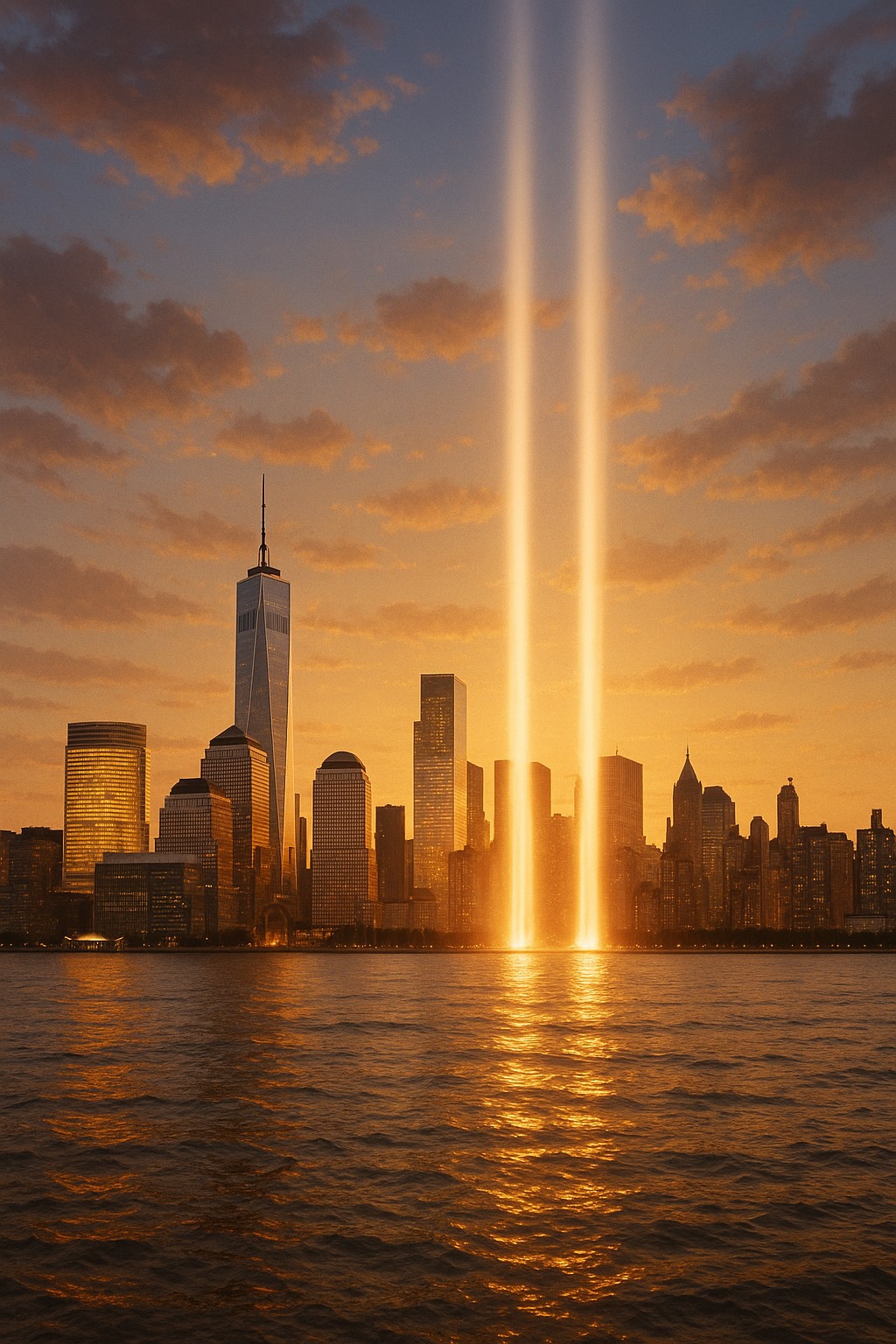
That morning, twenty-four years ago, began like so many others for me. I rose early, completed my morning ablutions, walked the dog, and was in a cab heading to my office at The Sporting News before 7 a.m.
You could not help but notice it was an extraordinarily beautiful day. The heat and humidity of summer had given way to clear blue skies and crisp, fall-like weather. The kind of day my mother used to describe as “positively Swiss.” It was so beautiful that I hesitated before entering my building, wanting to savor it before putting my nose to the grindstone.
At 8:15, I was convinced the most exceptional thing that would happen that day was that my assistant had actually arrived on time and kindly brought me my second cup of coffee. I thought it was going to be a good day—even when I heard an airplane flying low and fast over our heads. I casually remarked to her that the FAA didn’t take kindly to aircraft flying so low over the city.
That plane turned out to be the first, lined up with the neighboring Empire State Building, flying down Fifth Avenue at five hundred miles per hour. We learned the truth when someone came running into my office shouting that the Towers were on fire. We ran to the southern windows of our 27th-floor office. From there, we watched in horror the moments that changed us forever.
We saw the second plane hit, erupting in a burst of orange flame. We watched the first tower crumble and fall. And then the second. We had no way of knowing, or comprehending, what had just happened:
- 246 people who had boarded their flights minutes before had cruelly died when their planes were turned into missiles.
- 2,606 people innocently working at their desks lost their lives in clouds of flame and dust.
- 343 firefighters ran into the Towers and never emerged.
- 60 police officers disappeared into the buildings, never to be seen again.
- 8 paramedics went to save lives and lost theirs instead.
I had no way of knowing that my childhood friend and neighbor, Todd Rancke—the first boy I met when I moved to Summit—was among the victims.
After making sure my staff had a plan to get home, and my address in case they couldn’t, I began my walk back. I remember seeing dust-covered people, heads down, no doubt in shock, mechanically moving uptown.
On Madison Avenue, cars were lined up bumper to bumper, yet there were no horns, no impatience—just the tramp of feet as pedestrians made their way home.
Crossing the park, I saw groups of people huddled around boom boxes listening to grim news broadcasts. Overhead, unbelievably, fighter jets patrolled the skies. Warplanes. Over my city. At the Imagine mosaic, someone had already laid flowers. I thought of Lennon’s lyrics:
Imagine there’s no countries
It isn’t hard to do
Nothing to kill or die for
And no religion too
Imagine all the people
Living life in peace…
Never had those words felt so far away.
I withdrew money from an ATM, knowing cash could come in handy in a disaster. I shopped at an empty Fairway, worried food supplies might run out. Then I went home, turned on CNN, and waited for the displaced and the dispossessed to arrive. They came. They went. Together, we watched endless loops of the Towers crumbling.
I remember the frustration of trying to reach my parents. The collapse of the towers had destroyed a major AT&T switching station, and cell lines were jammed. Only my BlackBerry worked. Hours later, when I finally got through, I will never forget the relief of being able to tell them I loved them.
The next morning, I rose early and went for a long run as I was training for the Chicago Marathon, just weeks away. Running south along the West Side Greenway, I could see smoke rising from the pile and the nearly mile-long line of ambulances waiting to help those who would never need help again. I felt I had to do something.
After finishing my run, I went to the American Red Cross HQ near my home and waited sixteen hours to give blood we hoped would be needed. When I emerged, the wind had shifted. The smell from Ground Zero now engulfed the city. It was unlike anything I had ever encountered—the smell of death, fire, and concrete dust. I wondered if this was the smell of hell.
That night, I didn’t lie awake thinking about lessons. I was simply grateful that most of those I loved were safe. But in the twenty-four years since, I have thought a lot about that day and what it taught me.
Some lessons were immediate:
- Be grateful for everything. Every day is precious. Savor it.
- Open your heart wider. Love more. Accept others for their gifts.
- Prepare for the worst, hope for the best. And if the worst comes, still look for the best in people—even if they haven’t earned that trust.
- My family—my wife, sister, brother, brother-in-law, nieces, and nephews—are my most precious gifts. I do what I can every day to make sure they know they are cherished.
But the most important lessons of that day seem to have faded. This is especially true in these MAGA days.
I think about how together we felt as a country in the days that followed 9/11, and how good it felt when everyone had each other’s back. Donald Trump did not bring us together; he divided us. He and his political allies chose to fracture rather than include. And to be blunt, I have grown intolerant of their nonsense.
To them I say: September 11 should have taught you that we are all in this together.
That you need to look out for your family, friends, and neighbors. And that means being woke when woke simply means treating people as they wish to be treated. Pronouns, sexual orientation, religion—these are personal and private choices that do not affect you, and no one should feel “less than” for being who they are.
When someone is homeless or mentally ill—or both—they should not be arrested or vilified. We have an obligation to help them up. Capitalism is as broken as communism if it creates a permanent underclass that cannot afford housing or food because wages have not kept up with costs.
Facts are facts. Cut the crap. Vaccines save lives. Get vaccinated. If you choose not to be vaccinated, you are choosing to separate yourself from the group—the society—that depends on one another to protect the vulnerable: the elderly, the immunocompromised. Being part of society comes with obligations as well as benefits. If you refuse the obligations, you are not entitled to the benefits.
If that day taught us anything, it is this: we do not get to choose the moments that define us, but we do get to choose how we show up for each other. Honor the dead by choosing well.


 Blame it on Rio