
PRESS RELEASE
FOR IMMEDIATE DISTRIBUTION
The Starbucks Revolution: Coffee Cargo Dumped in Santos Harbor in Protest of Global Tariffs and Corporate Overreach
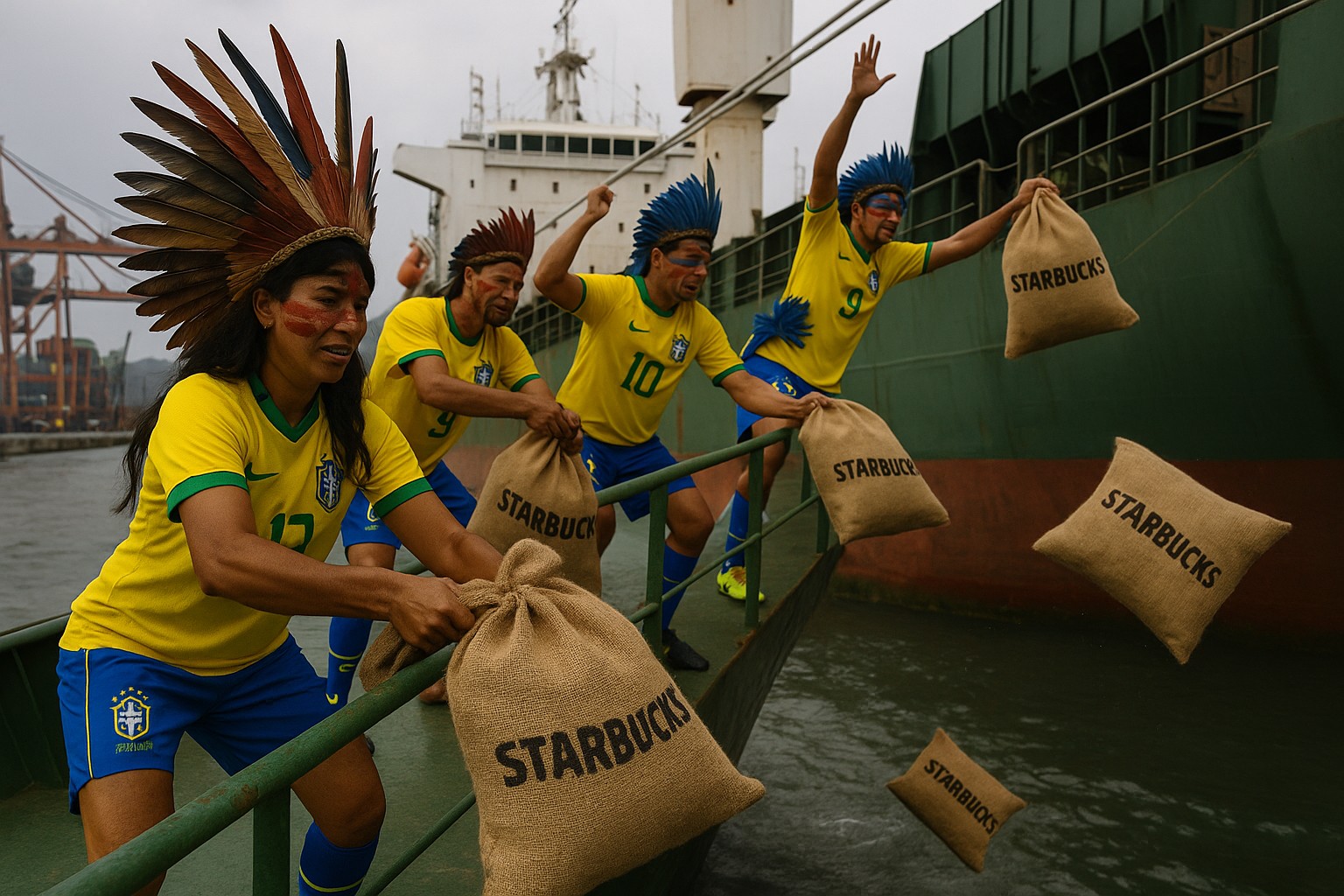
SANTOS, BRAZIL – [Today’s Date] – In a stunt equal parts historic homage and caffeinated mischief, a group of Brazilian citizens staged what they are calling the “Starbucks Revolution” by sneaking onto a cargo vessel docked in Santos harbor late last night. The activists, dressed in costumes meant to resemble Indigenous Brazilians, tossed dozens of sacks of premium Arabica coffee beans—destined for Starbucks stores across the United States—directly into the waters of the Atlantic.
The group’s action, which they described as “performance protest with a splash of saltwater,” was deliberately modeled after the infamous Boston Tea Party of 1773, where American colonists protested high tea tariffs by dumping East India Company cargo into Boston Harbor.
“This is our Boston moment—only stronger, hotter, and with better crema,” said one masked participant, his face partially obscured by feathers and faded carnival paint. “If the American patriots could stand up to King George over tea, Brazilians can certainly stand up to exploitative coffee tariffs and Starbucks’ empire-building.”
History Repeats Itself (With a Dark Roast)
The activists, numbering roughly two dozen, claimed that their protest is aimed at drawing attention to tariff structures, trade inequalities, and the stranglehold multinational corporations hold over Brazilian coffee growers. The protestors issued a collective statement that read:
“For centuries, Brazil’s farmers have supplied the world with coffee, yet global profits funnel to boardrooms in Seattle, not the fields of Minas Gerais or Espírito Santo. We throw these beans into the sea not out of disrespect to our labor, but to honor it. Let the U.S. taste a harbor brew for once.”
Observers on the docks reported the scene as “half carnival, half chaos.” One dockworker noted that the costumes resembled “a mix between school pageant, Carnival rejects, and something from a bad tourism poster,” but conceded that the group’s energy was undeniable.
Starbucks Responds (Sort of)
While Starbucks headquarters in Seattle has not yet issued a formal comment, an anonymous regional executive suggested off the record: “Frankly, we’ve dealt with oat milk shortages, pumpkin spice hysteria, and frappuccino blenders on strike. A little maritime cosplay protest isn’t going to derail our Q3.”
Still, analysts noted that the cost of lost cargo could amount to hundreds of thousands of dollars, given that the vessel was reportedly carrying premium-grade coffee earmarked for U.S. holiday promotions. “That’s a lot of Gingerbread Lattes floating around the Atlantic right now,” one industry insider quipped.
Echoes of Lula and Trump
The group also tied their protest to broader political themes, quoting Brazilian President Luiz Inácio Lula da Silva, who earlier this year criticized former U.S. President Donald Trump for attempting to meddle in Brazilian legal affairs.
“President Lula reminded the world that Trump once tried to stick his orange fingers into Brazil’s judiciary and political system,” said another protester, adjusting a papier-mâché jaguar mask. “If Americans once dumped tea to resist an English king, Brazilians can dump coffee to resist political interference and economic domination from across the equator.”
Their statement drew laughs from onlookers but also sparked serious commentary among local journalists, who pointed out the irony of invoking American revolutionary imagery against American corporations.
A Brewing Movement?
Whether this “Starbucks Revolution” is a one-off prank or the start of a broader movement remains unclear. The group hinted at future actions, suggesting they may stage “latte blockades” in front of shopping malls or “macchiato marches” through São Paulo’s Avenida Paulista.
Local police, meanwhile, expressed mild exasperation. “It’s technically theft and destruction of cargo,” said one officer. “But on the other hand, it’s the most educational reenactment of U.S. history we’ve seen in Santos.” Authorities confirmed that while a few activists were detained, no serious charges have yet been filed.
The Snark Factor
Critics of the protest were quick to point out the contradictions. “Dressing up as Indigenous Brazilians to make a point about coffee tariffs? That’s cultural cosplay at best, appropriation at worst,” said a São Paulo academic. “But then again, Americans in Boston dressed as Mohawk Indians while protesting British tea. If anything, the Brazilians are just following the script.”
Meanwhile, Twitter (or X, depending on one’s loyalty to Elon Musk) lit up with hashtags like #StarbucksRevolution, #BostonBrew2.0, and #HarborLatte. One user posted: “Finally, a protest I can support AND make into an Instagram Reel. Dunk the beans!”
Closing Thoughts
Though it remains to be seen whether the Starbucks Revolution will alter trade policies, rattle Starbucks’ balance sheets, or simply amuse bored grad students writing theses on protest symbolism, the event has already carved its place in the annals of quirky political theater.
As one protester shouted while tossing the final burlap sack into the ocean:
“In 1773, they had tea. In 2025, we have coffee. The revolution will be roasted, not televised.”
“Don’t believe everything you read, and only half of what you see.”
Contact:
The Starbucks Revolution Collective (unofficial, unverified, and currently offline due to poor Wi-Fi in harbor warehouses)
Email: 8647@protonmail.com; forobolsonaro@protonmail.com
Instagram: @StarbucksRevolution


 Blame it on Rio