
For the better part of the last twenty years, on the anniversary of Kristallnacht, I have published my father’s “A Minor Memorandum to My Children on the Fiftieth Anniversary of Kristallnacht: November 9 and 10, 1938.”
He wrote it for his children so that we would never forget the horror of that night — and the genocide that followed. His hope was simple: we remember what happens when a society loses its humanity. What happens we begin to treat a group of people as less than human. When we call people names instead of trying to understand who they are. When we forget what we share in common. When a nation decides that the only way it can feel good about itself is to demonize and denigrate others.
He never wanted another living soul to endure the hell he and his family faced that night. I publish his story each year to honor his memory and his wish that we never forget.
But we have failed him — and the six million who died in the camps, the fifteen million Allied soldiers who perished fighting for us, and the fifty million civilians who were slaughtered.
How do I explain to my father that in today’s America, if you call yourself an anti-fascist, you can be labeled a terrorist? That, as I write this, masked men are breaking into people’s homes, arresting them, and sending them to other states or countries without due process or habeas corpus?
How do I tell him that the President and his supporters reject the welcoming spirit engraved on the Statue of Liberty:
Give me your tired, your poor,
Your huddled masses yearning to breathe free,
The wretched refuse of your teeming shore.
Send these, the homeless, tempest-tost to me,
I lift my lamp beside the golden door!
How do I explain that they have slammed that golden door shut and now seek to welcome only 7,500 white South Africans and that Christian nationalism has become a core tenet of the Republican Party?
Can I make him understand that a country which once offered refuge to those fleeing totalitarianism and violence now separates parents from children, hides them in secret prisons, and sends them back to places where despair, brutality, and death await?
What words could justify the sight of the same Army he served in now roaming American streets against the will of the people? Or that the Justice Department, once the envy of the world, is being wielded as a weapon against the President’s critics?
How can I tell him that this administration has criminalized homelessness and mental illness rather than confronting their causes — that instead of building affordable housing or funding treatment, we arrest the suffering? The mentally ill and the homeless were among those rounded up on Kristallnacht, and a quarter-million were murdered in the camps.
How do I explain that his generation’s greatest achievement — transforming the ashes of war into a vision of decency and shared humanity — is now on life support? That the determination to build a fairer world, one rejecting the tribal hatreds that nearly destroyed civilization, is dismissed as naïve?
That the hard-won advances for civil rights, women’s equality, and justice — achievements built by his generation — are now derided as “woke”?
Those legacies should have stood as monuments to him and his peers. Yet today, that progress, paid for in blood, is being squandered by prosperity preachers who worship wealth instead of wisdom, and by frat-boy politicians who mistake cruelty for strength and insults for insight.
When Nick Fuentes and his anti-gay, Christian and white nationalist, Hitler white washing and
Holocaust denying message is being accepted as mainstream and promoted by the Heritage foundation there is only conclusion you can draw.
We have forgotten. And in forgetting, we have failed my father — and all those who reminded us to Never Forget.
We are no longer on the road to fascism. Our country is in the hands of fascists. Denying that fact — or sugarcoating it in any way — is worse than forgetting. It is malignant neglect of our duty as human beings who swore we would remember.
My father’s story follows.
A MINOR MEMORANDUM TO MY CHILDREN
ON THE FIFTIETH ANNIVERSARY OF KRYSTALLNACHT,
NOVEMBER 9 AND 10, 1938
I don’t intend to make this a big deal literary effort or a weepy emotional debauch. I simply want to tell you what I remember about Krystallnacht. So you should remember as well. And if there are to be others like us, so you can tell them. Nothing big! Just a small and portable lesson about the planet we live on and the hazards of being a little different.
Kristallnacht did not start for me until November 10, 1938. I knew that von Rath had been shot by Gruenspan but I knew nothing about what was happening all over Germany during the night of the ninth. I was 12 years (12 10/12 ths )old and I was asleep.
I was still lying in my bed, at about seven on the morning of November 10, when there was loud knocking on our door. I heard my father and mother (your grandparents ) talking to some people. Several stormtroopers (SA) had come to arrest Jewish men. The entrance to our apartment was through the kitchen and all this was taking place in the kitchen. After a few minutes I heard one of the Brownshirts ask whether there were any other male Jews in the apartment. Grandma said only my little boy. I dont think they believed her because they came into our mainroom, where my bed was. I closed my eyes and pretended I was asleep. They came to my bed and they looked at me and they must have decided either that I was too young, or that I looked too fierce to mess around with since there were only six of them. So they took just grandpa with them and they left.
As we later found out, they took grandpa to the local police station. From there they marched him and others to the Rossauer Kaserne, a military barracks. He was lucky because he had a roof over his head. Many other Jewish men were taken to a large soccer stadium and did not have a roof over their head.
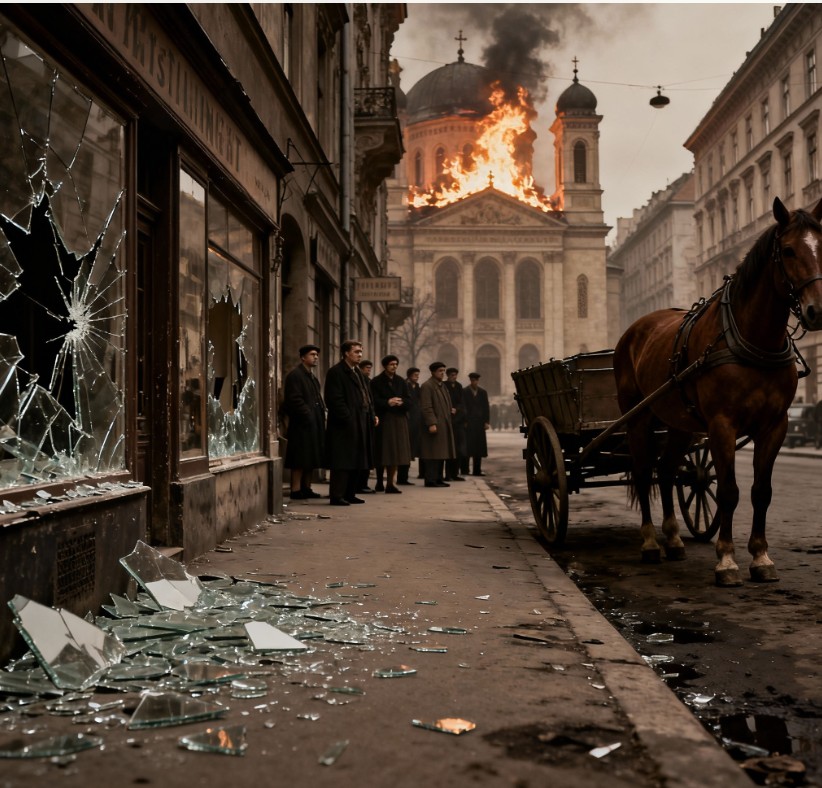
Grandpa had been fired from his regular job as a bristle processor a couple months before. He was earning some money by helping a carter hauling the furniture of Jews that had been kicked out of their apartments. The cart was pulled by one brown horse. Grandpa had a job scheduled for that morning.
Grandma sent me to help the carter in grandpa’s place. May- be grandma was a tough Hungarian cookie who did not want the Rothkopf’s reputation as men of their word sullied, or maybe we needed the money, or perhaps she wanted me out of her hair so that she and Aunt Mitzi ( who lived in the next apartment and whose son Walter and friend Albert were already on the way to Dachau) could weep in peace.
I don’t remember exactly where I met the carter but it was at his client’s apartment near the Jewish section of Vienna. We loaded the wagon with furniture. I sat next to the driver on the high bench behind the horse. Then the brown horse slowly pulled us through the streets towards the place where we had to make our delivery.
Groups of people were standing in front of the broken windows of Jewish stores, gawking while Brownshirts were putting their owners through their paces — handing over business papers, washing the sidewalk with lye, licking Aryan employees shoes clean. Anything that would keep the cultured Viennese crowds amused. We passed a narrow street that led to one of Vienna’s larger synagogue. The alley was jammed with jeering onlookers. Stormtroopers were throwing furniture and Torah scrolls through the big main door into the street. One side of the roof (I couldnt see the other and you know what a sceptic I am ) was afire. I remember very vividly the twists of whitish-yellow smoke that were curling up the slope of blue tiles.
Farther on we passed another synagogue that was fully ablaze. The police had made people stand back from it. I suppose they feared for their safety. A fire truck was parked down the street. The firemen were leaning against their equipment, talking and smoking cigarettes. Everywhere there were clusters of people, in a holiday mood, gathering around smashed Jewish stores. Little groups of Jews, both men and women, were being led along the sidewalk flanked by squads of SA men. The Jews were made to do all sorts of menial chores. Someone told me later, that one elderly Jew asked to go to the toilet. They made him go in a bucket and then forced him to eat his feces.
By now I was beginning to figure out what was going on. I sat high on my horsey throne (just like the Duke of Edinburgh when he drives his high-stepping pair, except that I didn’t wear an apron ). Whenever we passed a sidewalk event or other happening, I pulled down the wings of my nostrils (I thought I looked more Christian that way), staring straight ahead, but watching the Nazi street theatre out of the corners of my eyes. The driver, who was also Jewish, was a hard old soul. I dont remember him saying a single word to me, all day, about what was going on. Maybe he thought I was too young to hear about such things.
I dont remember much more detail. I got paid. The trolley I went home on was crowded. I kept staring out the window so that people wouldn’t notice the handsome Jewishness of my face. Beyond the rattling trolley panes, the peculiar happenings of November 10, 1938 were still in progress here and there, even as the day’s light was fading.
When I got home, grandma and Mitzi were still weeping. They had just come back from the police station but grandpa and the other Jews were no longer there.
Grandpa came home ten days later. He had spent that time in a room with 500 other people and one water faucet. They did a lot of military drill ( was this the beginning of the Hagganah ?) and exercises — push-ups, deep kneebends, and the like. Some who didn’t do so well got beaten up. He never told me whether they did anything to him. But then I wouldn’t tell you either. Grandpa was lucky. A lot of the Jewish men who were arrested on the 9th and 10th of November were sent to the concentration camp at Dachau.
Not one single synagogue was left intact in all of Vienna. That really screwed me up because I was nearly thirteen. You need to have a Torah to become a Bar Mitzwah and you need to have a table on which to lay the scroll while you read. And how was I to get a fountain pen now?
The dead, of course, are dead. They are mourned by those who remember. Tears dry. Bruises heal. Razed synagogues become parking lots. Injured dignity heals although slowly. What hurts most to this day is impotent compassion for those who were swept away.
In order to have faith in our quality as human beings, we need to remember! And thats why I am writing you this note.


 Blame it on Rio