
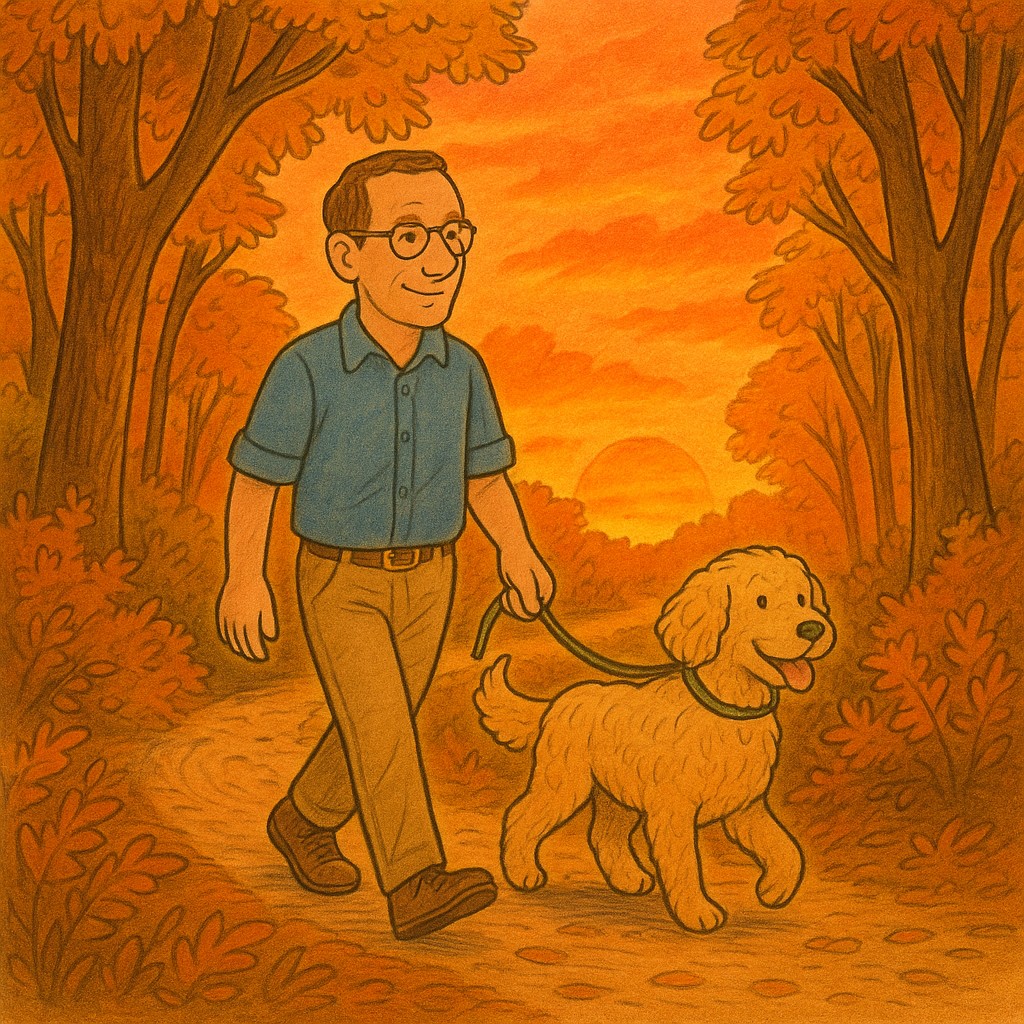
I love walking my dog, Rosie.
The first walk usually happens around 8:30 in the morning. By then, I’ve already braved the long commute from my bedroom to the kitchen for coffee—my daily fuel—to my desk so I can put in a few hours of work before the day’s demands drag me down any number of unexpected rabbit holes. Our morning walks give me a chance to clear my head and prepare for whatever the day has in store.
Our evening walks, on the other hand, often take place just before sunset. By that point, most of my neurons have been fried beyond recognition. The constant multitasking and digital demands of the day have usually reduced me to something close to drooling. That twilight walk offers more than just the chance to stretch my legs; it’s a separation ritual—a way to step away from the screen and into the fading light. Sometimes the sky even puts on a technicolor show, a quiet reminder that beauty still exists beyond the browser window.
I should mention that I live in a fairly idyllic place for dog walking. Our townhome community sits tucked in the woods beside a river and a county park. For us humans, it’s wonderfully quiet, except for the occasional birdsong or the honking of Canadian geese. For Rosie and her canine friends, there are plenty of in-scent-ives—a rich network of smells demanding frequent stops and careful deposits.
In the end, we both get what we need from our walks. I get the peace and quiet to sort through the day’s twists and turns, and Rosie gets to check in on her friends who’ve left her messages along the way.
This past Thursday, though, had been particularly challenging. I hadn’t slept well—which isn’t unusual, but it’s always draining. A work project was moving as fast as it could, though not as fast as I wanted it to. And for reasons known only to Verizon and God, my internet connection had decided to operate at a glacial pace.
Still, those are the usual daily nuisances—irritations that dissolve after a few minutes in the cool evening air, walking beneath the setting sun. What truly bothered me that night was reading that the Republican Party had decided to use SNAP benefits as a bargaining chip in budget negotiations—negotiations that would raise healthcare costs by over 100% for 44 million Americans. It made no sense. Starve 42 million people so you can make healthcare unaffordable to 17% of U.S. citizens.
Rosie, meanwhile, had discovered a scent so exquisite to her canine senses that she was rolling in it with complete abandon. Behind her, the sun—deep yellow, fringed with orange—hung low above the trees.
Her ecstasy reminded me of something I had read after adopting my first dog, Yankee. I wanted to be a good pet owner, to make sure I was doing right by him. A Google search led me to an article on what it meant to be a good Jewish pet owner. I’m not religious, but I was curious. The article said feeding your pet before yourself was not only moral—it was a duty. Animals depend on us; they can’t tell us when they’re hungry. Letting them suffer while we indulge ourselves is wrong.
Aren’t the people who rely on SNAP benefits also dependent on us? Why should they suffer because a man who’s never known hunger wants to give billionaires and millionaires, most of whom have never known hunger, a tax break?
By now Rosie had moved on, nose to the ground, searching for one of the many rabbits that populate our little corner of suburbia. As she pulled me along, I tried to remember what other obligations my faith of origin asked of us. In preparation for my bar mitzvah, I had learned that visiting the sick was a mitzvah—a good deed. But Rabbi Bial reminded us that God’s compassion wasn’t to be admired from afar; it was to be emulated. Feeding the hungry wasn’t optional. It was a duty.
I’d fallen down one of the metaphorical rabbit holes I try to avoid on our evening walks. So I sat down on a bench at the crest of a small hill. The sunset had turned neon orange, the clouds lit up for their nightly curtain call. I pulled out my phone and wondered what other faiths said about caring for the sick and the hungry.
Here’s what I found in those few minutes on the bench:
- Islam: The Prophet Muhammad said, “Feed the hungry, visit the sick, and free the captive.” Feeding the hungry is among the highest forms of charity.
- Catholicism: Feeding the hungry is the first corporeal act of mercy; caring for the sick is another—both acts of God’s love made tangible.
- Evangelical Christianity: Feeding the hungry and healing the sick are living expressions of faith, following Christ’s example of compassion.
By then the sun had slipped below the horizon, leaving the world brushed in burnt orange and mauve—the days reminder of what had been.
Rosie and I resumed our walk as the streetlights flickered on. Rosie was no longer interested in rabbits. Some other scent, perhaps a fox, a deer or her boyfriend Duke, a very large Rottweiler, had caught her interest. But I was still trapped in my rabbit hole.
My memory and sentiments were shaped by the members of the greatest generation and their parents. They had searing memories of the great depression and the world that was left behind after World War 2. Hunger and the hungry were a part of their life experience. The words of Franklin Roosevelt “True individual freedom cannot exist without economic security and independence. People who are hungry and out of a job are the stuff of which dictatorships are made.”
Their stories, their guidance formed an indelible belief that to preserve the freedoms and liberty we have it is essential that we feed the hungry, we take care of the sick and we give a hand to those whom need to be lifted up. This not woke. It is being kind in the way that religions ask us to be. It is also smart. The chain that holds are democracy is only as strong as its weakest link and right now Donald Trump, Speaker Johnson and MAGA Republicans are doing there best to destroy those bonds.
By the time Rosie and I made it home to our home it was fully dark. A crescent moon shown brightly in southeastern sky.
Normally when I return from these walks, the stress and pressure that has built doing my day have been released. Not today. I had made the mistake of going down that rabbit hole and it had made my mood almost as dark as the evening sky because I can’t see an end to the MAGA madness.
But my father came home from the Second World War with an expression: “Illegitimus non carborundum.” It’s soldier Latin for “Don’t let the bastards get you down.” I’ve always taken it as a call to action — a reminder not to let others grind down your resolve or your sense of purpose. That choice is always yours.
So the first thing I did, after reminding Rosie what a good dog she is, was go to my computer and make a $50 donation to the Community FoodBank of New Jersey. And on Tuesday, I’m going to vote my conscience — and click every lever on the Democratic side.
I hope you do the same.


 Blame it on Rio