
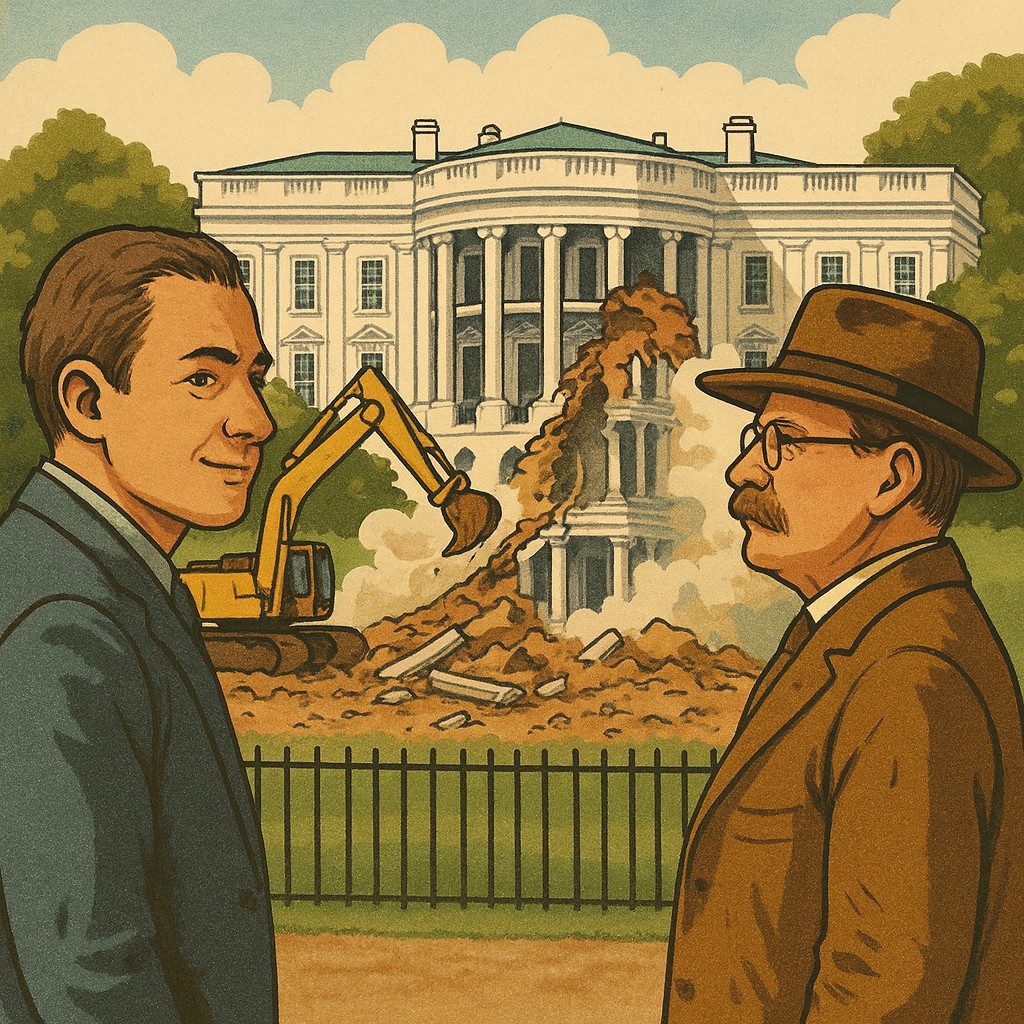
I like walking in Washington, D.C.
Not the modern kind of walking, where people are glued to their phones, but the old-fashioned, head-on-a-swivel kind. D.C. is full of history, and if you don’t pay attention, you’ll miss something important — something you’ll probably regret later.
I was standing on Pennsylvania Avenue near 16th Street NW, just outside the White House, when I saw a crowd pressed against the iron fence that keeps the uninvited from dropping in on the President. Everyone knew what they were watching. You’d have to be living on another planet — one with bad cell coverage — not to know that *The Great Destructor* had turned his attention to the East Wing. He’d once claimed he only wanted to build a grand ballroom worthy of the United States, promising construction nearby that wouldn’t touch the structure itself. Now it was clear: that had been just another lie. The East Wing was coming down.
I decided I needed to see it. I wanted to witness the metaphoric embodiment of the current administration’s policies. The fence was lined with people, but I spotted an opening and stepped forward.
It was a horrible sight. The destruction of historic buildings often is. The heavy excavators, with claw-like attachments tearing at the structure, reminded me of vultures feeding on the newly dead — one of those scenes you want to look away from but can’t, out of respect for what’s being sacrificed.
“You know, they used to call it the People’s House,” a man standing beside me offered.
Still transfixed by the destruction before me, I replied without looking, “Yes, and just look at it now.”
He continued, “Do you know when they started calling it that? John Adams was the first resident, and Jefferson carried on the tradition. They wanted the country to understand that while they lived there, it was a rental — that the landlord was ‘We the People.’”
His words resonated with me. It was the symbolism of the White House I’d grown up believing in — the history geek in me felt that deeply. I turned and saw a well-dressed man of average height with a solid, athletic build — barrel-chested, a thick, well-groomed mustache, and round wire-rim glasses that couldn’t hide alert blue-gray eyes. He radiated energy.
I extended my hand. “My name’s Paul.”
He grinned. “You can call me Ted.” (As if I didn’t know.)
“Well, Ted,” I said, “what else do you know?”
He replied, “Did you know that both the East and West Wings were built during the first Roosevelt administration? He wanted the residence to be a true home for his children, so he built the West Wing to house the presidential staff and his office, and the East Wing to welcome visitors to the White House.”
“So this guy is literally tearing down the part of the White House designed to be open to the people — to build a ballroom he wants to name after himself.”
Ted sighed. “That’s right. Just to build a ballroom for state dinners that happen about three times a year.”
I shook my head. “What gets me is that he was supposed to get approval from Congress, the National Park Service, and other agencies before making changes to the White House — and he didn’t. He lied, said it wouldn’t touch the original structure. And now look. He just did it, knowing there’d be no blowback from Congress.”
A woman to our right, overhearing, chimed in. “Well, at least we’re not paying for it. He says the funds for the new East Wing are all coming from private donors.”
Annoyed, I blurted out, “Aren’t we, though? Have you seen the list of donors for this monument to bad taste and kitschy architecture? Amazon, Google, Meta, Lockheed, Palantir, Altria, Blackstone, and the Adelson Family Trust — all have a vested interest in keeping the President on their side. And those are just the ones we know about. There’s no public list, no transparency. It’s better than bribery — same return, zero risk of prison.”
The woman retorted, “Well, didn’t Teddy Roosevelt do the same thing when he built the East Wing? Didn’t he do it without approval from Congress or anyone else?”
I resisted the urge to tell her that Fox News shouldn’t count as a primary source and said instead, “Not even close. Roosevelt used money from an existing budget to renovate the White House, and he did it to preserve the idea of the People’s House — so citizens could visit the Executive Mansion without interfering with the work of government. This isn’t preservation. It’s a vainglorious waste of money, time, and resources.”
Glancing back at Ted, then returning my gaze to the woman, I added, “If anything, Trump seems determined to destroy as much of TR’s legacy as possible. Teddy was a conservationist. Trump wants to drill in wildlife preserves and calls climate change a hoax, despite overwhelming evidence it’s an existential threat. TR created the precursors to the FTC and the FDA — he made sure our food was safe and our medicines didn’t kill us. He believed corporations could pursue profit but not at the public’s expense. Trump doesn’t care about any of that. He believes businesses should operate without regulation — to make as much money as possible, regardless of who gets hurt.
“Teddy championed, funded, and built the Panama Canal — arguably one of the most important pieces of infrastructure in history. This guy can’t even finish a wall.”
I took a breath, then continued, “And while we’re at it — Teddy Roosevelt was everything this guy isn’t. He reportedly read one to three books a day, while the current occupant hasn’t read one since *Dick and Jane.* TR authored 38 books and published over 150 articles. The current occupant can barely string together a coherent sentence. Roosevelt earned the Nobel Peace Prize for mediating the Russo-Japanese War and creating the framework for the Treaty of Portsmouth. Trump thinks he deserves one because he claims he can end wars with a tweet.
“Roosevelt received the Medal of Honor for his heroism at San Juan Hill. He felt an obligation to fight for his country, while this guy paid a doctor to say he had heel spurs.”
I paused, looked the woman on the right in the eye, and added, “When Teddy Roosevelt left office, he was celebrated as a hero in nearly every country he visited. When this guy leaves office, the world will just breathe a sigh of relief.”
A hand landed on my shoulder. I turned to see Teddy smiling.
“Bully,” he said.
I smiled back and unable to resist, add. “Yes. He is that too.”
“No,” he said, laughing. “I meant it the other way — first-rate job.”
I grinned. “I know.”


 Blame it on Rio