
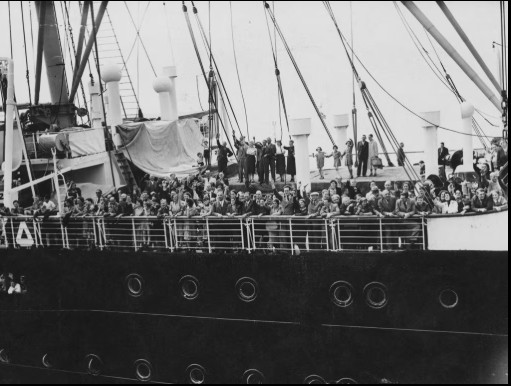
In May 1939, as Nazi persecution escalated in Germany, a German ocean liner named the MS St. Louis quietly left the Port of Hamburg. Aboard were 937 passengers, most of them Jewish refugees desperate to escape the tightening grip of Hitler’s regime. The ship’s destination was Havana, Cuba, and for many, it seemed like the first step toward a new life—safe, far away, and full of hope.
The man in charge, Captain Gustav Schröder, wasn’t your typical officer. He was German, yes—but he was also fiercely human. Knowing full well the trauma his passengers had already endured, he did everything he could to restore a sense of dignity and calm aboard his ship. Meals on board included items no longer available to many Germans due to rationing. There were dances, concerts, religious services, even swimming lessons for the kids. Lothar Molton, a young boy on the ship, later recalled thinking it felt like a “vacation cruise to freedom.”
That feeling was short-lived.
The ship arrived in Havana’s harbor early on May 2. They were not welcomed. Instead of being they were blocked from docking. The Cuban government, under President Federico Laredo Brú, had just changed its immigration rules—quietly and drastically. A new decree required a $500 bond for each refugee and explicit authorization from government officials. The passengers had no way of knowing when they left that their once-valid entry permits were now worthless.
Only 28 people were allowed off the ship. That left more than 900 refugees stranded on the ship, just outside the coast of a country that didn’t want them.
Desperate for help, U.S. Jewish organizations and senior U.S. officials, including Secretary of State Cordell Hull and Treasury Secretary Henry Morgenthau, tried to convince Cuba to reconsider. That failed. Captain Schröder decided to turn the ship toward the United States, hoping that surely America—the land of immigrants and freedom—would offer refuge.
He steered the ship near Miami, just off the Florida coast, and waited. Pleas were made to allow the passengers to disembark. But the Roosevelt administration, caught between internal politics and rising anti-immigrant sentiment, did not act. The U.S. Coast Guard followed the ship closely, making it clear no unauthorized landings would be tolerated. At one point, Schröder even considered running the ship aground so the passengers could escape, but he was boxed in.
Next, a small group of clergy and professors in Canada tried their hand. They appealed to Prime Minister William Lyon Mackenzie King to grant sanctuary. The ship could have reached Halifax, Nova Scotia in two days. But Canada’s top immigration official, Frederick Blair, was openly hostile to Jewish immigration. Canada rebuffed the immigrants
It left Captain Schröder with only one choice sailing back across the Atlantic, with over 900 lives in limbo. Conditions on the ship worsened. Fuel and food were running low. And still, Schröder refused to take the passengers back to Germany. He negotiated tirelessly with European governments, trying to find any country willing to accept the refugees. He even considered scuttling the ship near the British coast to force a response.
Eventually, he succeeded—partially. The United Kingdom agreed to take 288 passengers. The rest were divided among France (224), Belgium (214), and the Netherlands (181). With every passenger offloaded, the St. Louis returned to Hamburg—empty.
At the time, it seemed like a partial victory. But less than a year later, Germany invaded France, Belgium, and the Netherlands. Many of the passengers who thought they had found safety were once again under Nazi control.
Of the 620 passengers who returned to continental Europe, 87 managed to emigrate before the Nazi invasion. The rest were trapped. It’s estimated that 254 were murdered in the Holocaust—most in Auschwitz and Sobibór. 365 survived, often through extraordinary efforts, hiding, or luck.
Today, the voyage of the MS St. Louis is known as the “Voyage of the Damned.” It’s one of the most tragic illustrations of what happens when the world looks the other way in a humanitarian crisis.
However the legacy of Captain Schröder endures. After the war, he was awarded the Order of Merit by West Germany. In 1993, he was posthumously named Righteous Among the Nations by Yad Vashem, Israel’s Holocaust memorial—an honor reserved for non-Jews who risked their lives to save Jews during the Holocaust.
The ship’s story is now featured at the U.S. Holocaust Memorial Museum in Washington, D.C. In Halifax, where the ship never docked, the Maritime Museum of the Atlantic hosted an exhibit called Ship of Fate. Canada also created a striking monument in 2011: The Wheel of Conscience. Designed by architect Daniel Libeskind, it features four interlocking gears etched with the words “antisemitism,” “xenophobia,” “racism,” and “hatred.” The back bears the names of the passengers denied entry.
Governments eventually acknowledged their mistakes—too late, but with humility. In 2012, the U.S. Department of State formally apologized, and in 2018, Canadian Prime Minister Justin Trudeau issued a heartfelt apology in Parliament, calling it a failure of leadership and compassion.
The story of the St. Louis isn’t about a single ship or a failed voyage. It’s a cautionary tale of what happens when bureaucracy trumps humanity, when doors are closed, and when the world says “not our problem.” It should be an abject lesson. But sadly, it is one that the Trump Administration has failed to learn from.
Note: Much of this piece was culled from Wikipedia’s account of the St.Louis


 Blame it on Rio