
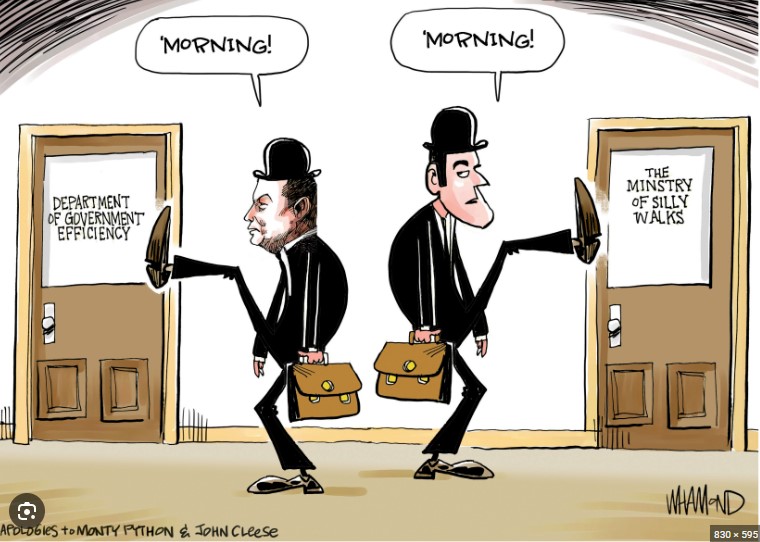
When I was in high school, there was a joke that asked, “What are the three great lies of man?” The joke was both racist and sexist, so I’m only going to share one of the “lies”: “I love you.” More on that later.
I bring it up because I think there’s another great lie being told today—that business leaders make great government officials. This belief holds that because someone has successfully managed a business and made money, they automatically have the skills to make the government run more efficiently.
That’s complete cow excrement.
The mission statement of the U.S. government is stated in the preamble of the Constitution:
“We the People of the United States, in order to form a more perfect union, establish justice, insure domestic tranquility, provide for the common defense, promote the general welfare, and secure the blessings of liberty to ourselves and our posterity, do ordain and establish this Constitution…”
Boiled down, the purpose of our union is to create a society that is safe, healthy, and decent for all its citizens.
Business mission plans are fundamentally different. While they may include lofty goals—like Tesla’s “To accelerate the world’s transition to sustainable energy”—they all share one core requirement: revenue generation and profitability. Without those, leaders are replaced, or companies go out of business. Many businesses incentivize short-term financial performance through bonuses and perks tied to quarterly targets which means long term consequences have far less weight in decision making that do short term profiteering.
It’s Tom Cruise and Cuba Gooding Jr jumping up and down screaming “Show me the money!”
Successfully achieving a government’s mission requires different skill sets and vastly different perspectives than those of business leaders.
In 1906, President Theodore Roosevelt laid the foundation for what would become the Food and Drug Administration. He did so after journalists like Upton Sinclair and reformers such as Harvey Wiley exposed the widespread use of dangerous chemicals (formaldehyde, borax, arsenic), fillers (chalk, plaster, brick dust), and drugs (cocaine, heroin, morphine) in the U.S. food supply.
Roosevelt said at the time:
“The adulteration of food and drugs deprives the purchaser of money, but may entail injury to health and even death.”
By creating the FDA, Roosevelt affirmed the government’s role in protecting the public’s general welfare. He also tacitly acknowledged that no industry can truly self-regulate. Business leaders, focused on profitability, often overlook—or accept—the human cost of their decisions.
Look no further than Massey Energy, which calculated that paying out settlements after fatal mining accidents was cheaper than improving safety protocols. Or Facebook, which prioritized engagement—driven by inflammatory and false content—over social cohesion. Or Tesla, which pushed forward with self-driving technology and battery systems despite reports that battery fires could trap passengers inside locked vehicles.
All the companies share the same playbook with DOGE.
As of this morning, the DOGE website proudly exclaims:
“$150 Billion Saved, $931.68 per taxpayer.”
It also featured a “Top 10” list of departments with the biggest savings:
- Health and Human Services: 10,000 layoffs
- Department of Education: 2,000 layoffs
- General Services Administration: 3,500 layoffs
- Housing and Urban Development (HUD): 4,000 layoffs
- Environmental Protection Agency (EPA): 2,000 layoffs
- USDA: 15,000 layoffs
(Note: These figures are derived from public sources, as DOGE.gov does not list totals directly because transparency is not in their playbook.)
What the site doesn’t mention is how these cuts impact the government’s mission.
How will laying off 10,000 people help ensure the safety of new and existing drugs, prevent disease outbreaks, or protect public health?
How will eliminating 2,000 jobs in education improve STEM scores or address the fact that we rank 14th in literacy among industrialized nations and 23rd in math skills?
How does cutting 4,000 HUD employees reduce homelessness or support community revitalization?
Will 2,000 fewer EPA workers result in cleaner air, safer watersheds, or more sustainable energy?
Can the USDA support farmers, safeguard our food supply, or conserve resources with 15,000 fewer employees?
These questions go unasked because Trump and Musk are focused on one thing: cutting spending. That’s a business goal—not a governance goal. They’re chasing short-term wins and flashy statistics, knowing they won’t be around to deal with the long-term consequences. CEOs can get away with this kind of thinking because their scorecard is simple: profit.
But that playbook fails when there’s no FEMA response after a tornado or when people die because the food they ate was contaminated or when we lose jobs to other nations because our workers can’t read, write or do simple math.
Let me reframe the question: If you could donate $1,000 to charity, and that money would…
- Ensure the air and water are safe.
- Protect the food supply.
- Provide citizens with the skills they need to succeed in a global economy.
- Provide homes for those in need.
Would you? Sounds like a bargain to me.
Our government may be inefficient. It probably has wasteful spending but how do you know if you don’t ask the right questions and only measure success by how much money you are saving or jobs you are cutting? Efficiency in government needs to be measured by how effectively and efficiently it is executing it’s mission. How much money you saved may be a great scorecard for a business, but it’s the wrong one for a government. Government should be measured by how well it helps us form a more perfect union—not by how many people it fires.
In other words, like so much of what this administration chooses to invest in DOGE is a dodge—a feel-good metric that lets Trump and Musk claim success while failing on the mission of our constitution.
One last thing. Remember that great lie I told you I would bring up again. If the Trump’s administration’s goal with DOGE’s goal was really about saving the taxpayer money, then why are they imposing tariffs that will cost the average family four times more than what DOGE is purported to save? Sadly, this is not a punch line, and I am not laughing.


 Blame it on Rio