
My wife met my father for the first and only time in the last month of his life.
Three months earlier, I had met this gorgeous, smart, funny woman on an eighteen-day cruise up the coast of Brazil, with a transatlantic passage to Africa and Europe, ending in Savona, Italy. We bonded over many things, not the least of which was that we had both been caretakers to our fathers, in the final stages of their lives.
I went back to Brazil a month after we met, to do a gut check on whether this was just a shipboard romance or the honest-to-God, certifiable real thing. Sadly, her father had already passed, and I never got a chance to meet him, but Elaine put her mourning aside and, over the course of the next ten days, gave me a full tour of Rio. We took the cable car to the top of Sugarloaf. We toured the Tijuca Forest. We visited Christ the Redeemer. I saw the sand and decorative elements of Copacabana, Ipanema, and Leblon. I savored feijoada, farofa, pastels de camarão, and Picanha. I drank the coldest (and most delicious) beer I had ever had. It was wonderful and ticked off all the boxes a tourist might have on his checklist for “Cidade Maravilhosa.”
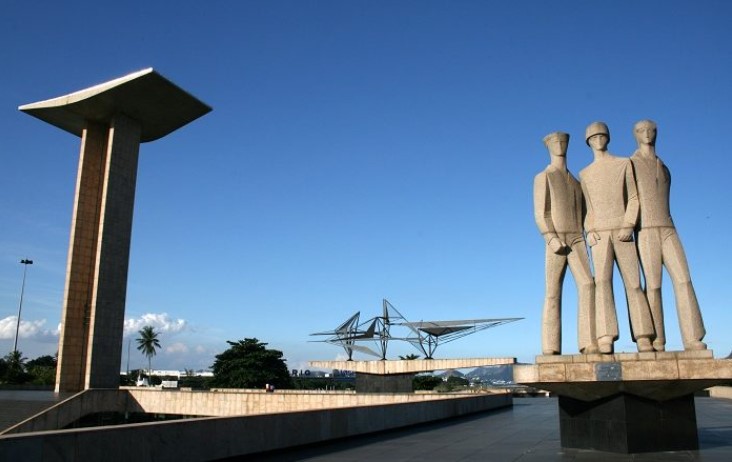
One place that my eventual wife took me, which is not on the normal tourist agenda, was the Monumento Nacional aos Mortos da Segunda Guerra Mundial, Brazil’s memorial to their troops who perished fighting during the Second World War. You may think this an unusual place for a new love to bring another, but Elaine knew me well enough to understand that this was exactly the way to show she understood me.
Elaine knew from our many conversations about our fathers that I was obsessed with my Pops origin story. Born in Vienna in 1925, my dad saw his synagogue burned down two weeks before his bar mitzvah on Kristallnacht. His family managed to escape Austria, arriving in New York Harbor three months after the war began, with no money and no English. By the time he was drafted into the Army five years later, he had completed two years of college. After receiving his commission as a second lieutenant in the artillery, he was sent to Italy as a member of the 88th Infantry Division, where he and his comrades in the Fifth Army fought their way up the boot of Italy until VE Day on May 8, 1945.
He was then, and will always be, my hero.
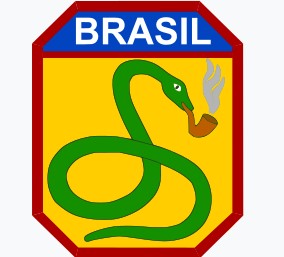
What I did not know until that day was that among his comrades in the Fifth Army was the FEB (Força Expedicionária Brasileira). They were 25,000 men of mixed race and limited training who wore a shoulder patch depicting a snake smoking a pipe. They adopted this symbol and the motto “A cobra vai fumar” (“The snake will smoke”) because before Brazil joined the Allied forces, there was widespread doubt, both domestically and internationally, about whether the country would actually send troops to fight. A popular saying at the time was, “It’s more likely for a snake to smoke a pipe than for Brazil to go to war.” Despite being poorly equipped and minimally trained, they showed immense bravery and determination during the Gothic Line offensive and the battles of Collecchio, Bologna, and Montese. Four hundred sixty-seven of these soldiers lost their lives fighting totalitarianism and fascism.
The Smoking Snakes were heroes back home. They became known as the “pracinhas” and were given special privileges, including never having to pay taxes. In 1960, forty years before the U.S. began building its World War II memorial, Brazil completed its monument. Located on Guanabara Bay in the Flamengo Park neighborhood, it is a modern structure featuring a below-grade mausoleum that holds the remains of 467 servicemen who were brought home from Italy. They are commemorated by long, low stone peninsulas of simple marble tablets. An adjacent large space has permanent exhibits, films, and documentaries relating to Brazil’s participation in the European Theater including images of personnel and equipment of the era. The memorial is topped by a granite statue by Alfredo Ceschiatti honoring the personnel of all branches of service, and a metal abstract sculpture by Júlio Catelli Filho honoring the Air Force.
A little more than a month later, when Elaine met my father, we told him about our trip to the Brazilian World War II monument. He cocked an eyebrow and, with a wink, said, “Yes, I remember them well. They were very noisy.”
Last Friday, shortly after Trump ambushed Zelensky in the Oval Office, we were driving by the memorial, and I could not help but think about how the current president has ignored history. How appeasement in Europe—in the Sudetenland and in Poland—cost the lives of 70 million people. (That is more people than live in 95% of the countries in the world.) He seems to have never learned that the only way to deal with a bully like Putin is to punch him in the nose, and if he gets back up, you hit him in the nose again until he decides that bloody noses are not in his best interest.
That was the lesson the Greatest Generation taught us. It was the reason they created NATO: to ensure that aggression toward any of its members would be met with force, quickly and aggressively. And it kept the peace in Europe for eighty years: the longest period of peace on the continent since the time of Christ.
But what bothers me the most is that the sacrifices the Greatest Generation made for us, whether in the U.S. or in Brazil, are being washed away by a man who cares little for what they gave up to create a better world and is only concerned with the amount of money and personal power he can claim while being President of the United States.
I mourn for the Republican Party which used to understand the cost of freedom is vigilance against totalitarianism and authoritarianism. Today, they have devolved into the party of sycophants, conspiracy theorists, opportunists and profiteers.
I grieve for my dad and the Greatest Generation. I only find solace in the fact that most of them are dead, so they cannot see how badly we have fucked things up.


 Blame it on Rio