
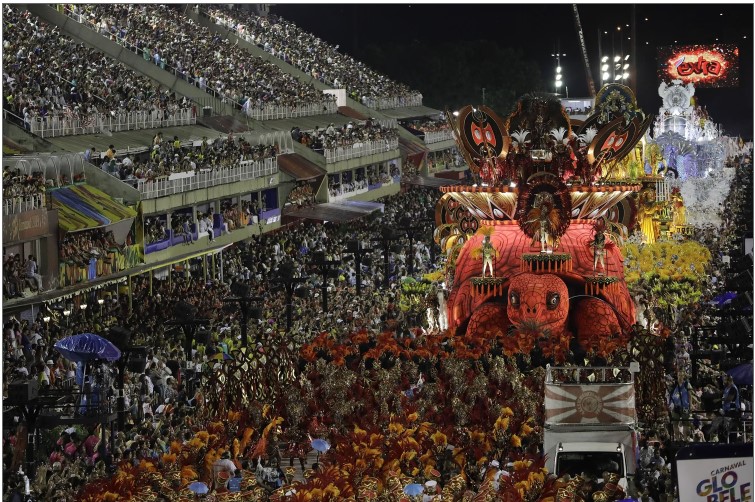
We live in a quiet neighborhood of Rio de Janeiro, nestled in the shadow of Pedra da Gávea—the world’s tallest coastal monolith (2,769 feet)—and a cone-shaped granite dome (whose name I don’t know and, apparently, neither does anyone around here. I have asked.). The neighborhood, Jardim Itanhangá, translates roughly to “Garden of the Stone,” and its streets and homes are graced with stunning foliage, from golden acacias to orchids of every variety, from Emperor’s Scepters to Bismarck Palms. I could go on, but imagine a tropical forest, and you’ll get the idea.
Its fauna is just as diverse. Instead of squirrels, we have tamarin monkeys (an improvement), big-eared opossums (definitely uglier), hummingbirds, parakeets, egrets, bem-te-vis, and even the occasional capybara.
Needless to say, my usual 2.5-mile trek through the neighborhood is always scenic, interesting, and filled with the constant sense that I’ll discover something new around every bend.
This was never truer than yesterday.
Around mile two of my walk, directly adjacent to a trail leading up to Pedra da Gávea and near a playground for neighborhood children, sits the Wiz Mart. It’s a tiny, overly air-conditioned, self-serve market (a lifesaver for those moments when you realize you’re out of something but can’t summon the energy to trek to a store miles away). It carries everything from cleaning supplies to snacks, frozen dinners to ice cream, beer to Powerade. I stop there almost every day for a sports drink—and, if it’s particularly hot, an ice cream bar.
Yesterday, as I approached this little oasis, I was surprised to see two women emerging in full Carnival attire. One was dressed as an indigenous figure, wearing a thong, headress and a bikini-style top. The other was a samba dancer, complete with dazzling plumage and glittering—if not exactly modest—clothing.
While not entirely unexpected (a Carnival party was happening down the street), it was a noticeable departure from the usual neighborhood wildlife. And it made me realize something: despite having visited Brazil for thirteen years, being married to a Brazilian beauty for twelve, and having watched countless films depicting Carnival, I had no real understanding of what it was—beyond a massive party leading up to Lent. (And, if I’m being totally honest, due to my Hebraic heritage, my grasp of Lent is pretty rudimentary.)
So, I decided to educate myself.
According to my most reliable source, my wife, the predecessor to Carnival was a festival called Entrudo, which may have roots in the Roman festival Lupercalia, a mid-February fertility celebration involving masks, rituals, and street festivities. In Portugal, Entrudo was marked by rowdy street parties where people gleefully hurled water, flour, mud, and citrus fruits at each other. When the Portuguese colonized Brazil, they brought the festival with them, and it became particularly popular in Rio, Recife and Salvador. There, it evolved. The wealthy organized masked balls, while the lower classes continued the tradition of messy street battles. Over time, Entrudo blended with African and Indigenous cultural elements, incorporating new rhythms, dances, and instruments—eventually becoming what we now know as Carnival.
I also learned that Carnival’s meaning is derived from the phrase “without meat,” a reference to the fasting associated with Lent. The excesses of the celebration not only highlight the fleeting nature of worldly pleasures but also serve as a release of inhibitions before entering a more introspective and devout Lenten period. The masks, disguises, and costumes allow people to shed their social identities and embrace the personas they feel truly represent them.
Finally, Carnival is a time when rich and poor, young and old, Black, brown, or white, all come together. It aspires to create a sense of unity before the personal journey of Lent. It encourages forgiveness and reconciliation before entering a period of self-reflection.
All this learning made me think: Perhaps the time has come to bring Carnival to Washington, D.C.
It might serve as a reminder to those in our nation’s capital that the world is progressive in nature. Nothing stands still. What began as a Roman fertility festival, then transformed into a mud-rowing party, has evolved into a grand celebration that ultimately reflects Christianity’s most profound meaning.
It might remind those who have forgotten the fundamental promise of our country: E Pluribus Unum—Out of many, one. Just as Carnival arose from European, African, and Indigenous traditions, the United States is strongest when it embraces all of its citizens. Carnival would not be the vibrant, joyous event it is without the contributions of different cultures. Similarly, the United States would not be the nation it is without the diverse communities that have made it their home.
Carnival is not about the rich or the poor. It is about connection. It unites people across socioeconomic lines. Our nation was founded as a democracy, not an oligarchy, where the poor and middle class are just as vital to our success as the wealthy, the powerful and elite.
Finally, it would serve as a constant reminder to the current occupant of the White House that forgiveness, reconciliation, and reflection are far more important than personal grudges, vendettas, or the pursuit of power
There is one downside to all of this. By tradition in Rio, the keys of the city are turned over to “King Momo” on Friday morning and serves as the King of Carnival until its conclusion on Tuesday night. By tradition, King Momo is tall and fat. Need I say more. We already have a tall, fat man who thinks he is King.


 Blame it on Rio