
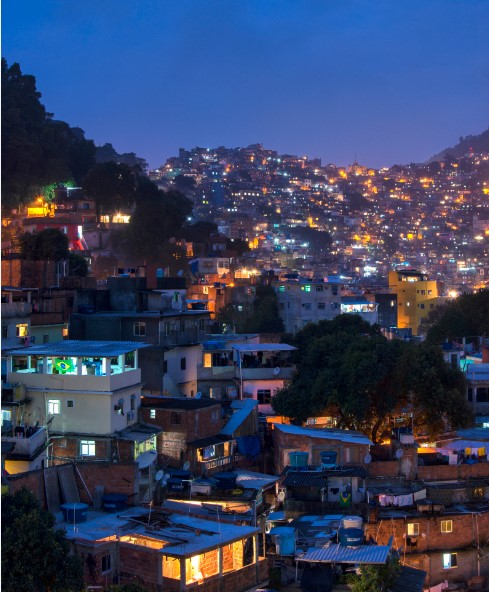
Not far from where we live is the neighborhood of Rocinha.
We pass by it—really, through it—every time we travel from our home in Barra da Tijuca to Leblon, Ipanema, or Copacabana. Perched on a sheer mountainside, it commands breathtaking views of the beach and the ocean beyond. At night, it is literally a shining light on the hill.
If this were any other city in the world, the homes here would be among the most expensive.
But this is Rio Instead of luxury living, Rocinha is the city’s largest favela, home to upwards of 200,000 people crammed into just 0.86 square kilometers (0.33 square miles)—a population density nearly five times that of Mumbai.
Favelas are institutionalized slums that emerged when Black, Brown, and Indigenous people left their slavery adjacent jobs in rural areas in search of a better life in urban centers like São Paulo and Rio de Janeiro. Unable to find affordable housing on their less than subsistence wages, they “squatted” on unoccupied land. In Rocinha’s case, that land was a former coffee plantation worked by sharecroppers. They built their own homes—first shanties, which over time evolved into brick structures, often stacked on top of one another, some reaching three stories high. They developed their own infrastructure, frequently tapping into electricity, water, sanitation, and cable services illegally.
You might think the city would have objected to this land occupation. After all, the land was owned. But the authorities either turned a blind eye or didn’t object too loudly. It solved a problem for them. If the poor had somewhere to live, the government didn’t have to invest in housing. A policy of benign neglect took root.
To those who champion unrestrained capitalism and minimal government intervention, this may seem like a perfect solution. The government spent nothing—no reals, no taxpayer funds—while simultaneously creating a permanent underclass to serve the more fortunate.
As anyone who has seen Cidade de Deus (City of God) knows, such neglect has dire consequences. Nature abhors a vacuum. Where there are no rules, people create their own—or, more accurately, the powerful impose their own rules on the powerless.
In the favelas, drug traffickers and militias filled the void. They established their own communities governed by rules outside Brazil’s legal system. Those living in favelas must pledge absolute loyalty to the criminal and paramilitary organizations that control them. In return for their obedience, residents receive protection and occasional rewards. This system, known as narco-populism, sees traffickers providing food, medicine, and cash to struggling families. In many cases, they were more effective than the Bolsonaro government in distributing aid, enforcing quarantines, and providing medicine during the pandemic. They fund community events and enforce a strict code of conduct, punishing petty crimes like theft and assault with severe punishments for the violators.
Police rarely enter the favelas—it’s simply too dangerous. At the first sign of an approaching patrol, lookouts launch fireworks, alerting the entire neighborhood. Armed enforcers prepare for battle, often leading to bloody shootouts that leave scores of residents and police dead.
No wonder many police officers find it heathier and if we are being honest, far more lucrative to stay out.
The result of this cycle is captured in the phrase “Nascer no morro, morrer no morro.” Born on the hill, die on the hill. In other words, those born in the favelas rarely escape the institutional poverty that traps them. They are condemned to a life of servitude, working for the middle and upper classes as maids, laborers, street vendors, or drug mules.
In the United States, we are taught that if you work hard, play by the rules, and use your intelligence, you can achieve anything. The American Dream promises that anyone can rise from poverty to wealth in a single generation.
But that dream crumbles in the face of institutional poverty. And the surest way to create a permanent underclass is by dismantling programs that protect the financially marginalized programs the Trump administration is determined to destroy.
Eliminating the Department of Education and diverting public school funds to private vouchers leaves marginalized communities without the resources necessary to educate their children. Cutting welfare pushes desperate families toward survival strategies that criminal organizations can exploit. Slashing Medicaid would not only lead to higher rates of disease and death but also create yet another opportunity for drug cartels and other predators to take advantage of those least able to defend themselves by providing health services the government declines to provide and generate a market for social media cures that generate even greater problems. .
I could go on, but you get the point. Gutting social welfare programs may save a few dollars in the short term, but the long-term consequences will be catastrophic. If you want proof, just look at Rocinha. Then ask yourself: What do we want to be? The shining light on the hill that is Rocinha or the vision John Winthrop and John Kennedy had for America.


 Blame it on Rio