Chapter 7: Day 2: 9:05 AM
Chapter 7:
Day 2: 9:05 AM
The original people of these islands believed that rainbows represented the connection between heaven and earth. Rainbows were how the gods descended to earth and the pathway for the souls of the dead to travel to the world beyond. The goddess of rainbows, Anuenue, acts as the messenger for the gods’ delivering messages to us who still reside within the mortal realm.
I am contemplating this sheltered under a palm tree on a crescent shaped white sandy beach that has waves that would look more at home on a lake in Maine than on a beach on Earths’ largest ocean. It is bracketed on either side by two rocky outcroppings, the remnant of ancient lava flows. This is the destination of my long hike and when I arrived twenty minutes ago, hot, sweaty and tired all I could think of was diving into the water and cooling off. But the gods had other plans for me. Just as I am pulling off my Asics running shoes an errant cloud, one I had not seen before, let loose with a torrential downpour. The palm tree was my only choice for shelter and for what seemed like an eternity I watched as intense sheets of rain poured down. The tree was not very sheltering and by the time the squall ends I am as wet as if I had been for a swim.
The rain stopped as abruptly as it began, replaced by a towering transcendent rainbow that runs the entire length of the cove.
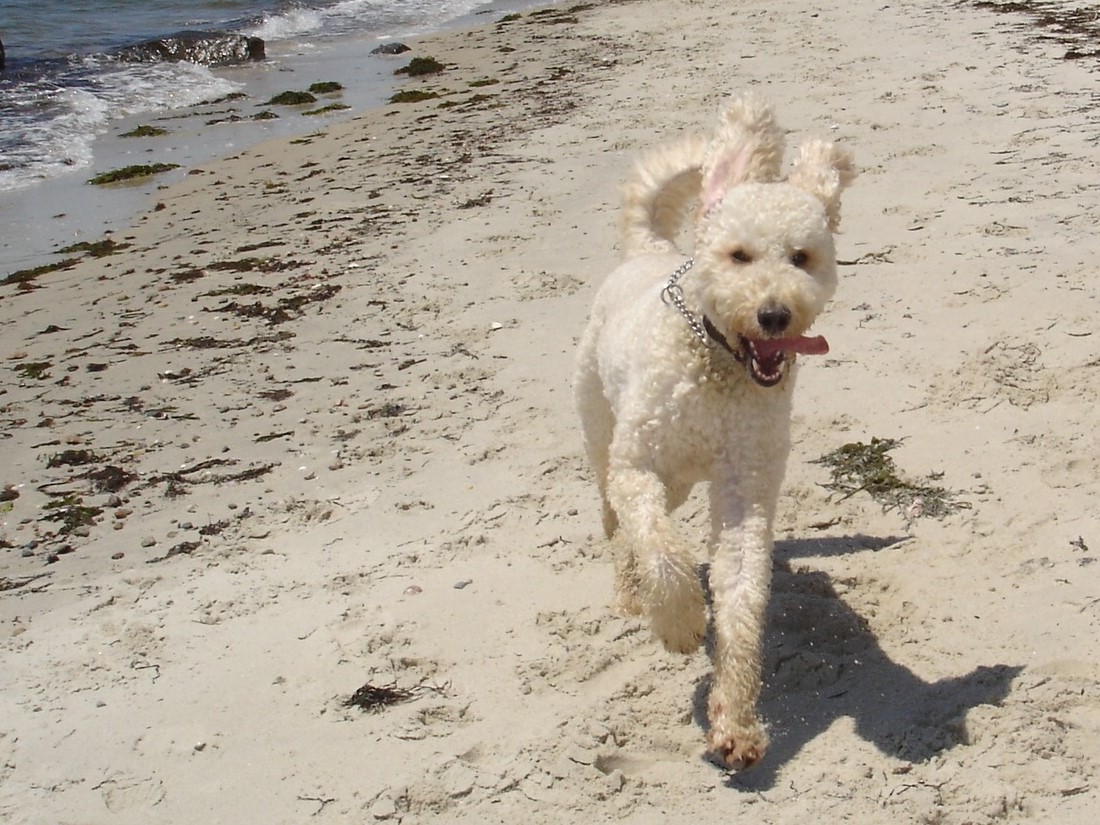
As I step out from under the palm, I am joined on the beach by a cream-colored dog, with tight curly hair and floppy ears that are streaming behind him as he runs towards me, a raspberry-colored tongue leaking out of the side of his mouth. It reminds me of a time, years ago, when Mac and I would go for runs on the beach. He loved it there. He would run full speed down the beach and just as I would think he was getting too far away for my comfort he would come to a skidding stop and then run back to me full speed, often stopping along the way to pick up some object on the shore to bring to me so we could play fetch until my shoulder fell off.
In the seventeen months of my Covid solitude I had often wished for the companionship of Mac. Not that Fenway was not a comfort to me. She was. But, as much as I love Fennie, she could never replace Mac.
Shortly after the Twin Towers fell, while many married people were making contributions to a mini baby boom, I decided I wanted a dog. This was not a sudden whimsical thought. I had wanted a puppy since I moved back to the city six years ago. But, I always found an excuse for not getting one. I travel too much. They were expensive. Do I really want to make a fifteen-year commitment right now? Like almost all who had lived through that 9-11, and witnessed its horrors firsthand, we understood the importance of now. We discovered, over the course of one hour, that tomorrow is a wish that you may not be granted. Only today counted.
The challenge for me was what type of dog did I want. I did not need or want a fearsome dog such as a Doberman, Rottweiler, or German Shepherd Dog to make me feel safe and powerful. I wanted a dog that was a good companion to me and a good neighbor. Not a barker. Not a shedder. A friendly dog that everyone wanted to pet on the elevator. I listened to my friends who suggested, with fervency and reasonably, that I should go to a shelter and get a rescue dog. That was not for me. I wanted a puppy. A dog I could raise from its earliest days and more importantly a companion whose breeding I understood. I had known far too many who had adopted a dog only to discover that its inner Beagle compelled it to howl in the middle of the night and to dig in its potted plants. To aid in my decision making I purchased an encyclopedia of dogs and would spend evenings diligently placing tape flags on breeds that might be the dog of my dreams.
Everyone knew of my search. I would get texts and emails from friends and families about dogs they had encountered in their journeys suggesting that this was the ideal dog for me. I thanked them but none of those leads panned out. Then, one afternoon, my sister, who hates the telephone, left me a voicemail. “I have found the perfect dog for you. I just met one on the elevator. SOOO cute. He is a golden doodle. SOOO friendly. And his owner says he is super smart and get this, they don’t shed. Look them up. You’ll see.”
I did my research. Labradoodles were originally bred in Australia because two friends felt compassion for their blind friend and could not get a seeing eye dog as he was allergic. They applied to the Australian government for a grant to breed a dog that was non allergenic and smart and sweet enough to be a seeing eye dog. After years of research, and likely a few more Fosters, they came up with the Labradoodle, a true breeding cross between a Labrador and a Poodle. The breed clicked every one of my boxes. I was sold.
The challenge was finding someone to sell me a puppy. At the time the breed was quite rare in the United States, and apparently, I was not the first person to hear about Doodles because all of the domestic breeders had years long waiting lists. I had a bad case of puppy fever. I could not wait that long. In desperation, I contacted one of the original Australian breeders, Tegan Park, and asked if they had any recommendations on where I could find a puppy in the US. The owner, Mel Rice’s response surprised me. “How about one from us? We ship worldwide.” After a little research into how they shipped their dog, better than first class, and with a little trepidation I sent them a deposit for a puppy that would be born sometime that summer. I heard nothing from them for months. To mitigate my excitement, I busied myself learning about dog training. I watched Cesar Milan until I could predict his next sentences. I read a dozen or more books on training including classics like “The Art of Raising a Puppy” by the Monks of New Skeet.
On the evening of July 4, 2002, I was on my way for a vacation at Whistler in British Columbia. Disembarking the plane in Vancouver my Blackberry buzzed. It was an email from Mel at Tegan Park sharing a picture with me of my new puppy. Over the moon, I wrote back immediately thanking her for the photo and note but also enquiring if my puppy had been born on July 4. Her response came back quickly. Yes! I realized the puppy’s name had been decided for me. A “doodle” born on the 4th of July should be named Yankee but as a die-hard Red Sox fan I could not do that to myself. I named him Macaroni, after the feather in Yankee Doodle’s cap.
When Mac arrived in the USA twelve weeks later it was literally love at first sight. From the moment I saw his black shiny nose sticking out of his travel crate he was my puppy. My best boy. This was not a one-sided love affair. When released from the confines of his crate he lept into my arms and began furiously licking my face with the reckless abandon only puppies possess, knocking my glasses off my face and filling my nostrils full of puppy smell and tongue. He was so overjoyed he lost control of his bladder. I didn’t mind it one bit.That first night I slept on the floor next to his crate, my fingers sticking through the grate so he would not be fearful of being in a new place.
Mac was the best wingman I ever had. At first it was because I carried him around in a puppy Bjorn. Yes, a puppy, Bjorn. I had been advised by our veterinarian that his feet could not hit the ground in NYC until he was fully vaccinated. And one of the dozen or so books I had read about raising puppies suggested that the best way to get my new best friend acclimatized to the city was to make sure he got used to the sights and the sounds of the city. Each day Mac and I would venture out, he swaddled in puppy Bjorn and walked the streets of the Upper West Side. He was a magnet for young women who begged to meet him, coo at him, and ask questions about him. I benefited from propinquity.
Mac was exceptionally smart and engaging. He would do anything to please, the perfect meshing of his poodle and Labrador stock. Top in his class at puppy kindergarten and excelled in each of the three other behavioral classes we took. Looking back on it, that may have been a bit excessive, but I was determined to have a well-behaved dog. Mac was going to be a good boy. It connected us more powerfully than super glue, duct tape or electromagnets.
Mac also knew English. They say that an average dog can learn one hundred sixty-five words. An exceptionally intelligent dog has the capacity to know two hundred and fifty. My guess is that Mac could understand about double that amount. Or about the number of words of an average toddler. After a while I no longer had to give him commands in the single or double syllable we originally learned. I could say “Lets go for a walk” and he would run and get his lead so we could go out. Or if he sensed someone in the hall outside our apartment and begin to bark, I would simply say “Don’t worry about it” and he would come and sit or lay by my feet.
His intelligence, his kindness, his willingness to please and engage made him an extremely popular dog. When we left the apartment building for our daily walks Mac would insist that we stop and have a moment with the doormen so they could dole out their daily ration of petting to him. When he would see a friend of mine on the street, he would invariably guide me towards them. The service I used to walk him while I was at work or stay with him while I was traveling, Pampered Pets, told me that he was their favorite client. At first, I thought they were just trying to charm me to keep the business until one day I received a call from the woman who ran their business, Stocker Carroll. She had a favor to ask of me. They were launching a dog training part of the business and were wondering if they could “borrow” Mac as their demonstration dog in return for free day care. Of course, I agreed.
The old saw is that dog is man’s best friend. Mac proved that to be true. During our time together we discussed everything from my latest dating disaster to why my beloved Red Sox could not win a playoff game with the Yankees. And in 2004 he barked in delight, and I screamed in joy when the Red Sox broke that eight-six-year-old curse.
Mac was also an exceedingly empathetic dog. He sensed when people needed love and kindness. When my father became ill, and confined to a wheelchair, the first thing Mac would do when we entered my parents’ home was bound up the stairs and look for Dad. When he found him, he would sit or lay next to him often placing his head in the old man’s lap for a little scritch and giving my father unconditional love. And when Dad died, and I was inconsolable, Mac would curl up next to me on the couch or the bed and make sure that I knew he was with me often nudging me with his head to remind me of his solidarity.
Some of the best times Mac and I shared were the days we spent in Cape Cod at Katherine’s mother’s home. It was a wonderful old home in Hyannis Port that had direct access to the beach. As the property was large, and the neighbor’s dozen or so dogs friendly, Mac was never on lead. He would scoot around the property in endless loops always keeping me in sight. We would spend endless hours on the beach throwing balls and frisbees until he could run no more, and my arm was sore. We would swim together and if I went out too far, he would bark to have me come closer to shore. I keep a picture of him running up the beach to me floppy ears flapping, tongue in full deployment on my desk to remind me of what joy looks like.
One morning when Mac was about thirteen, we were out for a walk together and I noticed that his gait was not as fluid as it once was. I realized in that moment that my buddy’s, my best boy’s, days were growing shorter and that one day in the foreseeable future I would no longer have the comfort of his companionship. I tried to imagine what it would be like walking in the apartment without his joyful greeting that demonstrated there was no more important human in the world to him than me. The thought depressed and scared me. I made the decision to get another dog from Mac’s breeder. It was a selfish act for sure but there was some logic too. I figured that a young pup might give Mac a boost of energy and because he was such a good boy perhaps, he could help me train the yet unnamed dog.
Fenway came to live with us nine months later. To no one’s surprise, except mine, she was a different dog than my best boy. Mac was crème colored Fenway was brick red. While Mac was happy just to be near you, Fenway needed to be your center of attention. If I would give a little love to Mac, she would, tiny as she was, push him aside insisting I give her attention. Mac was good with her. Of course, he was. But it was more out of love for me than affection for Fennie.
Eventually we became a pack. I would work at my desk Mac would sleep in the well by my feet. Fennie would do her imitation of a bagel on the couch next to Nadine. Walks became adventures. Each of the dogs tried to outdew (pun intended) each other on how many places they could leave their mark. Sniffing out rabbits, chipmunks and barking at pesky squirrels were games they played with each other. It was almost as wonderful as I had hoped.
About a year after we had formed our pack, Fenway jumped up on the couch to snuggle with Mac who had already laid claim to one of the cushions. She misjudged and landed on Mac who howled in pain. There was no consoling him. He was whining and clearly in deep pain. He could not or would not walk. I picked up his fifty-four-pound body and rushed him to the vet. They brought us to the exam room immediately where the vet, seeing how much pain Mac was in gave him an injection to help relieve his extreme discomfort. They took an X-Ray thinking that Fenway may have broken Mac’s leg. When the Vet, Dr. Matos, returned she looked grim. Putting the Xray on the lightbox she showed me the leg was not broken. She was concerned about a “shadow” around his tibia. She could not be sure, but it could be bone cancer. There was no way to be sure unless they biopsied it and she did not want to do that until we got his pain under control. I asked, “What if we can’t control the pain?” She shared a compassionate look with me and replied, “Then we will know that it is bone cancer.” She sent me home with pain pills and told me that if Mac was still in pain tomorrow to bring him back in.
At home, I wanted my friend to be as comfortable as possible. I built a nest of blankets and towels for him on the floor of our living room. I sat next to him and gave him what comfort I could. But he would not raise his head or even try to stand. He would just make eye contact with his big brown eyes and occasionally lick my hand. I tried to get him to eat by spoon feeding him canned dog food, but he was not interested. The only way he would drink water was out of Nadine’s hand. I had to carry him outside so he could “do his business.” Then he just stood in the grass and looked at me with a sorrowful expression. That night I slept on the floor next to his nest. I wanted him to know I was there and not to be scared.
The next morning, despite the pills, despite all the love to which we had showered him, his pain was worse. I was conflicted. I wanted to believe that over time Mac would recover. We could keep him around for a little while longer. I could not imagine my day without my buddy. Nadine consoled me but she also told me that I should not make the decision on what to do with our boy based on my emotions. I had to do the kind thing for him. What was nice for me, had no place in our decision.
We took Mac back to Dr. Matos. She listened with a grim face as we told her that Macs pain was unabated. He was not eating, drinking or evacuating bladder or bowel. We told her that we wanted to do the best we could for Mac and was there anything else we could do that would ease the pain and maybe allow us a few more months together. She told us our only option was amputating his leg. While that might relieve him of pain it would also be exceptionally difficult for a fifteen-year-old dog to adjust to walking on three legs. Even if he learned to walk again, he would spend months getting chemo which would undoubtedly make him sick. She then had the grace to leave us alone for a few minutes to make our decision. Nadine, held my hand and asked with her gentle Brazilian accent “What do you want to do my darling?”
I got down on the floor and took my boy’s head into my lap and stroked it. I whispered in his ear “Mac, what should we do buddy?”
He just looked at me with his deep dark puddles of brown eyes and whimpered. Then he licked my nose just like he had when we first met. After fifteen years and countless wordless conversations I knew what he was trying to say to me. He did not want to go. He was sad to say goodbye to me. But it was his time. He hurt. If I loved him, I needed to let him go.
When Dr. Matos returned, I told her, through choked tears, that we had decided to let Mac go. She assured us we had made the right decision and then asked if we wanted to be present for his final journey. Nadine, through tears, said she could not go through that. I said, I understood but that I must stay. I did not want Mac to be alone in his last moments. He had always been there for me. Now I must be there for him. Nadine nodded and courageously said she would stay too. As we held Mac, and stroked his head with as much love as our hands could convey Dr. Matos gave him the shot that sent him over the rainbow bridge. My last words to my boy were “Go find Pops. You will not be alone. Pop will take good care of you.” I like to think that I saw his tail wag one last time.
Mac brought me a bright yellow tennis ball. Where he found it on this deserted beach I do not know. But he was sitting at my feet in his best clever dog pose, sitting, straight back, and his eyes fixed on mine, waiting for me to throw it to him. I smile at him and say “Who is a good boy. Here you go” then threw the ball deep into the surf. He flew after the ball and was soon in the water up to his chest. eagerly doggy paddling to where the ball floated gently. But my best boy was not alone in the water. Fifty yards further yards further out was a swimmer doing an elegant crawl stroke. He looked as if he were swimming laps. I smile. I knew he would show up eventually.


 Blame it on Rio