
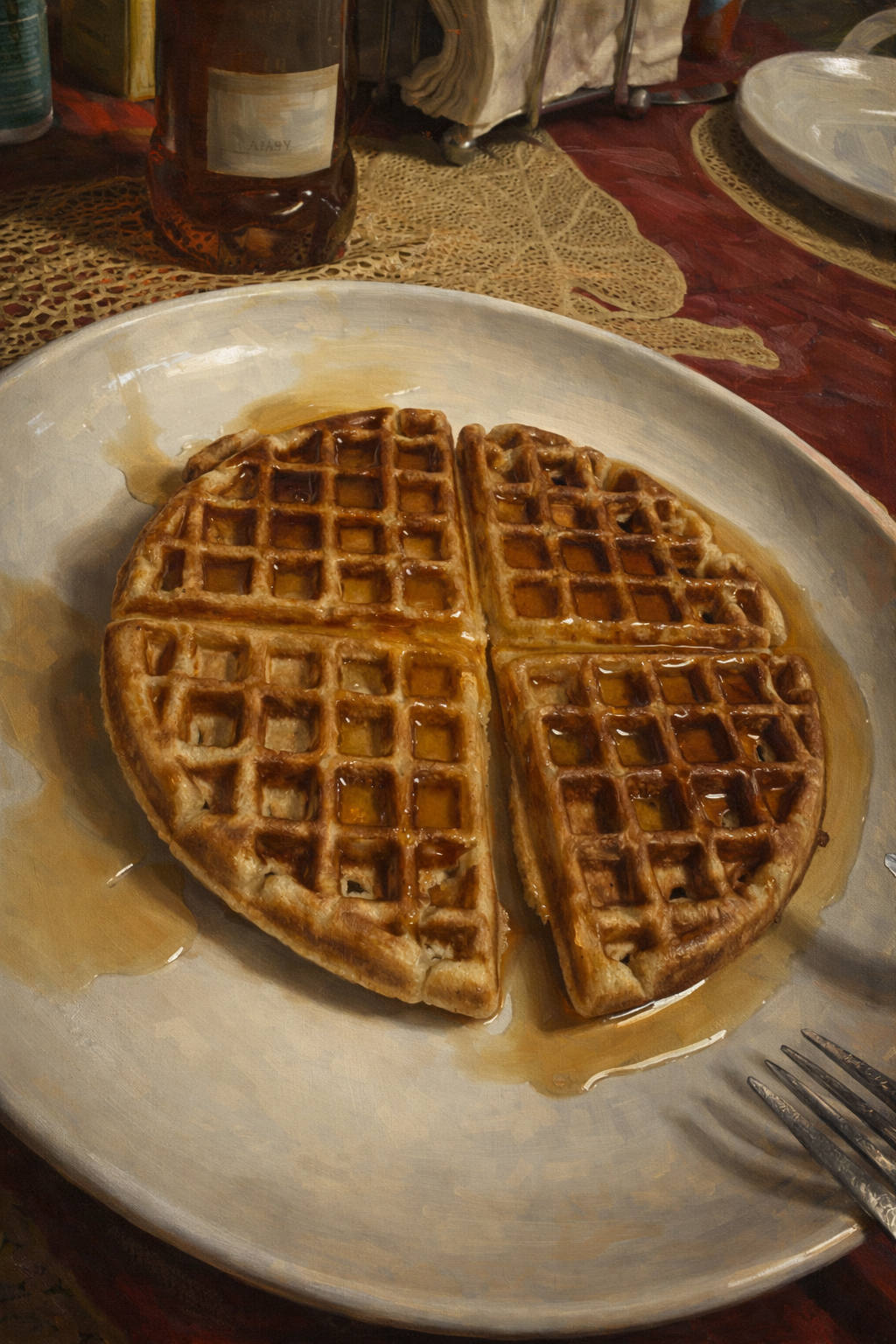
WAFFLES!
That’s the proclamation I make to my wife, sister, and friends when the fluffy white stuff is falling from the sky.
This isn’t due to a brain injury or a neurodiverse condition. I know it’s snowing. I could easily say “snow.” But I don’t, because those who know me understand that long ago, in some breakfast corner of my deep, dark past, I decided I like waffles far too much. Given the opportunity, I would eat them every day, in every way. (The possibilities are endless: with chicken, fruit, stuffed, savory, Belgian-style, as sandwiches… you get the idea.)
I needed to curb my obsession with waffles; otherwise, I’d have to double my time at the gym—or my wardrobe allowance—as my waistline kept expanding.
So I made a deal with myself: I would only have waffles on days that it snowed.
Hence the happy, happy, joy-joy proclamation.
As you can imagine, I’ve been thinking a lot about waffles this past week. Not only did we get six inches of snow on Monday, but all week long the weather prognosticators have been issuing increasingly alarming statements about the storm predicted for Sunday and Monday.
Or, as I prefer to hear it: two days of waffles. Oh yeah.
But winter storms weren’t the only reason waffles were on my mind. Like any right-minded person, I drown my waffles in warm pools of wonderful Canadian maple syrup. This past weekend I noticed I was out, so in my weekly Instacart order I added a jug of Kirkland’s finest. It was $14.99.
That seemed high.
So I looked it up. Last year at this time it was $12.99 — a 15% increase despite a bumper crop year. In other words, our demented leader, in his haste to prove his masculinity by imposing tariffs on countries that wouldn’t bend the knee, had made maple syrup a little less sweet for me.
But me being me, I had to take it a step further.
So I did a little research and came up with this grid.
The most positive thing I can say about this data is that consumers in the U.S. only had to pay about 10% more for their waffle breakfast in 2025 compared to 2024. And the only reason that’s positive is because it means retailers are absorbing some of the tariff costs.
The bad news starts with this: our waffles cost more than they did last year because of the non compos mentis whims of Trump, while our neighbors to the north saw virtually no inflation in the cost of their waffles.
It ends with an economic certainty. Even if tariffs come down tomorrow, we’ll still pay more for our waffles. Prices are sticky downward. Once retailers see what you’re willing to pay, reductions take a long time. COVID reminded us of that economic fact, and now retailers use AI-enhanced pricing tools that turn ordinary inelasticity into something closer to arthritis.
This didn’t ruin my love for waffles. I wouldn’t let Donald Trump do that to me.
Besides, waking up every morning without a news alert saying he didn’t survive the night already feels suboptimal.
But waffles gave me something else: hope.
Well, not exactly my waffles. The hope came from the Prime Minister of Canada, whose blessed maple syrup makes them sweet. His speech in Davos, delivered before global economic leaders, was a concise takedown of Trump’s economic agenda in a little more than ten minutes.
It was a call for realism, courage, and collective action among mid-sized democracies. He argued that the old world order is gone, that compliance is dangerous, and that only coordinated strategic autonomy can protect national values and interests.
He essentially told the emperor he had no clothes. As he put it, “the power of the less powerful begins with honesty.” The post-WWII order, he argued, has become a convenient myth. Middle-sized countries no longer need the United States to protect them, guarantee their currencies, or safeguard their geopolitical interests. The myth was worth sustaining as long as America acted in everyone’s best interest. But when it prioritizes only itself, that myth stops serving anyone.
He warned that “while there is a strong tendency for countries to go along to get along… to hope that compliance will buy safety… it won’t.”
And he declared, “Other countries, especially intermediate powers like Canada, are not powerless. They have the capacity to build a new order that encompasses our values.”
It was a calm, well-reasoned dismantling of the myths Trump has sold to MAGA and the U.S. — the idea that American exceptionalism means other countries must kowtow simply because we have a bigger economy and military. Carney reminded us that American exceptionalism was supposed to be about values. Other countries cooperated as long as those values aligned with their interests. Now that they don’t, the myth is losing its power.
Which brings me back to waffles.
The unspoken truth about eating waffles on snowy days is that they give me joy on a day when it would be easy to surrender to confinement, cold feet, and fogged glasses. And as delicious as my waffles were on Monday—and will be tomorrow—Mark Carney’s speech at Davos was an emotional waffle I needed in this long ICEy winter.


 Blame it on Rio